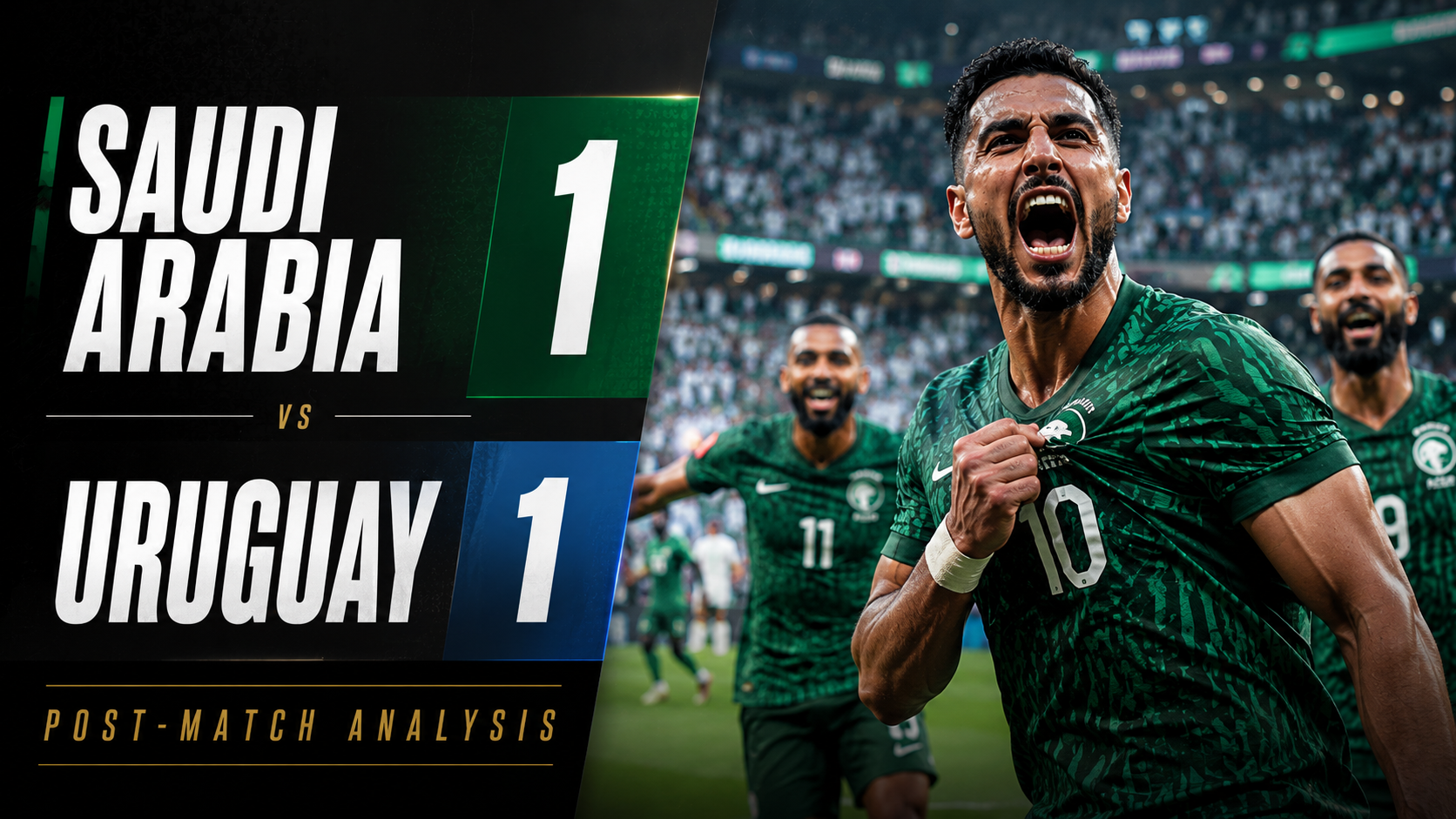
Saudi Arabia 1-1 Uruguay: Green Falcons Hold La Celeste in Dramatic FIFA World Cup 2026 Group Stage Draw
Saudi Arabia produced a resilient defensive display to hold Uruguay to a 1-1 draw at Miami Stadium, denying La Celeste a deserved victory despite being outshot and outpossessed across 90 rain-soaked minutes in Miami Gardens.
What happened
Under a shroud of moderate rain in Miami Gardens, Saudi Arabia and Uruguay played out one of the World Cup 2026 group stage’s most tactically intriguing draws. The Green Falcons, buoyed by an Abdulelah Al Amri effort just before half-time, held firm through relentless Uruguayan pressure only to be pegged back in the second half by Maximiliano Araújo. Uruguay’s statistical dominance — 612 passes to Saudi Arabia’s 322, 18 shots to four — told the story of a match they should have won. But football, especially at a World Cup, is never just about numbers. Saudi Arabia’s defensive resilience, the brilliance of individual moments, and Uruguay’s clinical wastefulness all combined for a gripping Group Stage opener that leaves both sides with questions to answer.
How it was won and lost
Saudi Arabia’s Deep Block Frustrates La Celeste
Saudi Arabia set up in a disciplined low-to-mid defensive block, ceding possession almost entirely to Uruguay. With just 33–27% possession across phases of play and only 322 total passes compared to Uruguay’s 612, the Green Falcons were under no illusions about their gameplan: sit compact, absorb pressure, and hit on the counter. Their defensive structure held remarkably well for long stretches, limiting Uruguay’s more penetrative combinations through the middle third. The Saudi back line, anchored by Hassan Al Tambakti and featuring Al Amri’s aggressive presence, maintained shape despite the volume of Uruguayan crosses and combinations. Saudi Arabia registered 11 clearances and 9 blocked shots defensively, underlining how determined this block was. It was not pretty — but it was effective.
Uruguay’s Possession Dominance Lacked Final-Third Precision
Uruguay dominated every territorial metric. They generated 18 shots, 27 shots on target attempts, and an xG of 2.07 — more than double Saudi Arabia’s 0.71 — yet only found the net once. The issue was not a lack of creation but a failure to convert high-quality moments. Darwin Núñez, a constant physical threat, was introduced via substitution in the first half and added dynamism; however, Uruguay’s intricate combination play in tight spaces was frequently disrupted by Saudi Arabia’s committed pressing triggers. Federico Valverde’s deep-lying runs and Manuel Ugarte’s distribution from midfield were the engine room of Uruguay’s build-up, but the final pass too often broke down around the Saudi penalty area. Uruguay’s 47 offensive duels and 16 crosses reflect ambition, but also profligacy.
Momentum Shift and Second-Half Tactical Adjustments
Uruguay made two significant first-half substitutions — Agustín Canobbio and Juan Manuel Sanabria replaced Darwin Núñez and Matías Viña at half-time, signalling an intent to inject fresh energy and directness. The tactical shift worked: Uruguay pressed higher after the break and were rewarded when Araújo’s composed left-footed finish levelled matters in the 80th minute. Saudi Arabia countered by withdrawing Nasser Al Dawsari and Musab Aljuwayr mid-second half, introducing Nawaf Boushal and others to tighten the defensive line. The late flurry of substitutions from both sides — including Diego De La Cruz for Ugarte and a trio of Saudi changes in stoppage time — reflected the frantic nature of the closing stages as Uruguay pushed for a winner that never arrived.
Set Pieces and Transition: Saudi Arabia’s Dangerous Moments
While Saudi Arabia were largely pinned back, they demonstrated menace on the transition. Al Amri’s shot in the 41st minute — the precursor to what appears to be the opening goal — came from a moment of quality in a match dominated by defensive attrition. Saudi Arabia registered 10 counter-attacks and showed directness when they won the ball back, exploiting Uruguay’s high defensive line with quick vertical passes. Saudi Arabia also forced 3 offensive corners and generated set-piece opportunities that kept Uruguay’s defenders honest. Their xG of 0.80 relative to the volume of pressure they absorbed suggests they were efficient in the moments they did create.
Who decided it
Abdulelah Al Amri
Saudi ArabiaThe Saudi defender had a defining first half, providing the decisive attacking contribution with a shot in the 41st minute that appears to have produced the opening goal. He was also booked for a foul in the 44th minute, walking a disciplinary tightrope that added drama to Saudi Arabia’s half-time lead.
Al Amri’s combination of defensive tenacity and willingness to surge forward on set-piece situations gave Saudi Arabia their crucial foothold in the match. His physical presence in duels anchored the Saudi defensive structure throughout.
Maximiliano Araújo
UruguayThe Uruguayan winger was the spark plug off the bench, and his composed left-footed finish in the 80th minute drew La Celeste level and rescued a point. He was immediately substituted off after his goal, having delivered exactly the impact his manager required.
Araújo’s ability to arrive late into shooting positions and finish calmly under pressure highlighted Uruguay’s attacking depth from the bench. His goal came from Uruguay’s patient build-up finally finding a moment of precision after 79 minutes of frustrated dominance.
Federico Valverde
UruguayValverde was Uruguay’s most complete performer — a box-to-box dynamo who combined defensive responsibility with attacking intent throughout 90 minutes. His pass volume and pressing energy set the tone for Uruguay’s attempt to unlock the Saudi low block.
Operating at the heart of Uruguay’s midfield, Valverde’s vertical passes and late runs created the spatial problems that Saudi Arabia’s defence found most difficult to manage. His influence waned only slightly when De La Cruz was introduced late to provide fresh legs.
Nawaf Alaqidi
Saudi ArabiaThe Saudi goalkeeper was tested repeatedly and delivered a commanding performance. With Uruguay generating an xG of 2.07 from their 18 attempts, Alaqidi’s shot-stopping and aerial dominance were central to Saudi Arabia claiming a share of the spoils.
Alaqidi’s ability to organize his defensive line and make crucial saves at critical moments typified Saudi Arabia’s collective resilience. Without his contributions, Uruguay’s possession dominance would almost certainly have been converted into a winning scoreline.
Where it sits in history
Saudi Arabia’s World Cup history is punctuated by moments of stunning upset — most memorably their 2-1 victory over Argentina at Qatar 2022. That result signalled that the Green Falcons could no longer be dismissed as lightweight World Cup participants. A draw against a traditional South American powerhouse like Uruguay continues that narrative of competitive respectability on the global stage. Uruguay, meanwhile, are one of world football’s most decorated nations, boasting two World Cup titles (1930 and 1950) and a consistent presence in the tournament’s latter stages. La Celeste arrived in the United States as one of South America’s primary challengers. Dropping points against Saudi Arabia — a side ranked considerably lower in global football’s hierarchy — represents a significant early setback for Marcelo Bielsa’s side as they look to navigate the expanded 48-team tournament format at FIFA World Cup 2026.
Inside the ground
Miami Stadium, capable of hosting 65,326 spectators, provided a vivid backdrop for this Group Stage encounter. The rain-soaked conditions in Miami Gardens added a raw, atmospheric edge to proceedings, with the partisan noise levels rising sharply around the Araújo equaliser in the 80th minute. Uruguay’s passionate following — a significant South American diaspora present in South Florida — made their voices heard across all 90 minutes. Saudi Arabia’s supporters, equally fervent, channelled the spirit of Qatar 2022’s memorable nights as they cheered their team’s stubborn resistance. The combination of wet weather, World Cup stakes, and the cultural electricity of Miami created an atmosphere worthy of the tournament’s expanded American stage.
Looking ahead
Both Saudi Arabia and Uruguay will now take stock before their next Group Stage fixtures, knowing that a draw leaves them with work to do. For Uruguay, the priority is converting their statistical dominance into goals — Marcel Bielsa will be acutely aware that an xG of 2.07 should not produce just one goal against a defensively compact side. Saudi Arabia, meanwhile, will draw confidence from their disciplined display but will need to add more attacking ambition if they are to progress from the group. In the expanded FIFA World Cup 2026 format, with eight groups of six teams and four automatic qualification spots per group, today’s point carries genuine value — but neither side can afford further dropped points if they want to advance with comfort.
The bottom line
-
Saudi Arabia held Uruguay to a 1-1 draw in the FIFA World Cup 2026 Group Stage at Miami Stadium
-
Abdulelah Al Amri gave Saudi Arabia a first-half lead with a shot in the 41st minute
-
Maximiliano Araújo equalised with a composed left-footed finish in the 80th minute to rescue Uruguay’s point
-
Uruguay dominated possession and created significantly more chances — 18 shots, xG of 2.07 — but were frustrated by Saudi Arabia’s defensive resilience
-
Saudi Arabia’s goalkeeper Nawaf Alaqidi was outstanding, preventing what would have been a comfortable Uruguayan victory
-
Both teams deployed aggressive second-half substitution strategies to influence the outcome
-
The result leaves both teams with a single point apiece and vital decisions ahead in the group
-
The match was played in moderate rain at Miami Stadium, adding drama to an already tense encounter
