Son Heung-min’s Last Dance
South Korea 2026 World Cup guide: Hong Myung-bo’s squad, captain Son Heung-min, Lee Kang-in, Kim Min-jae, Group A predictions and the Taeguk Warriors’ knockout hopes.
South Korea
Taeguk Warriors · AFC · Group A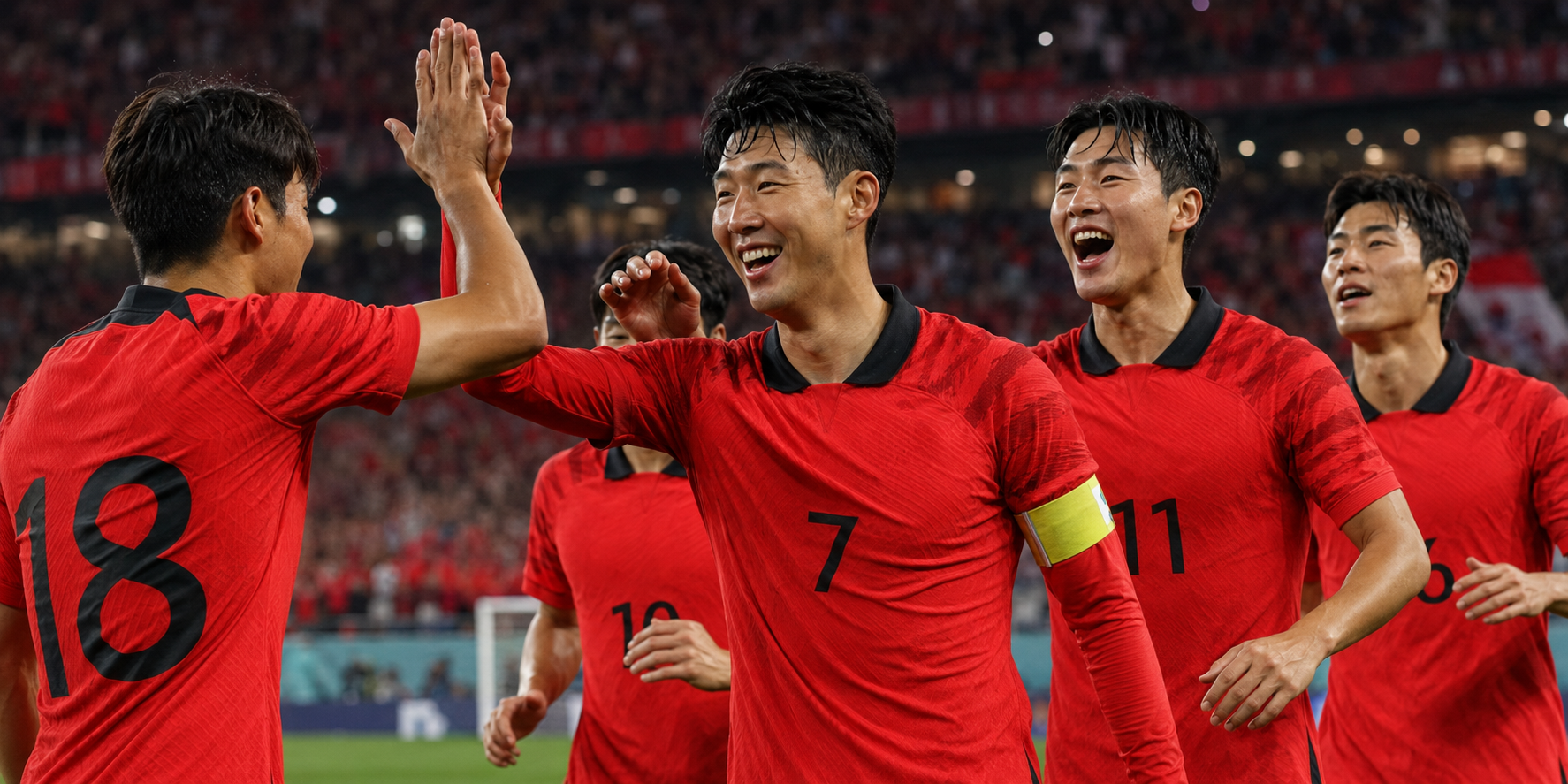
Everything at a glance
- Nickname
- Taeguk Warriors Taegeuk Jeonsa
- Confederation
- AFC
- FIFA Ranking
- 25th FIFA Men's World Ranking, April 2026
- Head Coach
- Hong Myung-bo
- Captain
- Son Heung-min LAFC
- World Cup Appearances
- 12th 11th consecutive since 1986
- Best Finish
- Fourth place / Semi-finals 2002, as co-hosts
- Group
- Group A Mexico, South Africa, Czech Republic
Asia’s most consistent World Cup presence, with a legend’s farewell on the horizon.
South Korea are Asia’s most consistent World Cup presence, qualifying for every tournament since 1986. The Taeguk Warriors are led by head coach Hong Myung-bo, a national icon who captained the legendary South Korea side that stunned the world by reaching the semi-finals on home soil in 2002. Now in the dugout, Hong has the task of guiding a golden-tinged generation through what is expected to be the final World Cup of talisman captain Son Heung-min.
Son, now 34 and playing for LAFC in Major League Soccer after a decade at Tottenham Hotspur, headlines a squad packed with European talent, including Paris Saint-Germain’s Lee Kang-in and Bayern Munich’s Kim Min-jae. This is the fourth World Cup for Son, who has hinted it may be his last.
This is the fourth World Cup for Son, who has hinted it may be his last.
A compelling mix of star power, history and sentiment.
South Korea blend genuine European pedigree with the emotional weight of a farewell tour. Son Heung-min, one of Asia’s greatest-ever players, has openly suggested this could be his final World Cup, adding a “last dance” narrative to every match. Behind him, Lee Kang-in was part of PSG’s Champions League final run, while Kim Min-jae helped Bayern Munich reach the semi-finals., giving Korea two players operating at the very top of European football.Then there is the symbolism of Hong Myung-bo, hero of 2002, attempting to recapture some of that magic from the touchline. Few teams arrive with such a compelling mix of star power, history and sentiment.
Son Heung-min, one of Asia’s greatest-ever players, has openly suggested this could be his final World Cup.
The bar, and the dream
South Korea are arguably the second-strongest team in Group A behind hosts Mexico, and reaching the knockout rounds is the clear primary goal. Statistical projections have given them roughly a coin-flip-to-better chance of advancing from the group. With the expanded format and a squad boasting elite European talent, qualification for the Round of 32 is the expectation, with the Round of 16 a realistic ambition. Anything beyond that would echo the spirit of 2002.
The realistic route
With the expanded format, qualification for the Round of 32 is the expectation. The Round of 16 is a realistic ambition — and anything beyond that would echo the spirit of 2002.
Hong Myung-bo’s 26
Based on Hong Myung-bo’s confirmed 26-man squad; likely starters marked with an asterisk.
Goalkeepers
3- Song Bumkeun Jeonbuk
- Jo Hyeonwoo Ulsan
- Kim Seung-gyu FC Tokyo
Defenders
10- Jens Castrop Borussia Monchengladbach
- Lee Hanbeom Midtjylland
- Park Jinseob Zhejiang FC
- Lee Kihyuk Gangwon
- Kim Minjae Bayern Munich
- Kim Moonhwan Daejeon
- Kim Taehyeon Kashima Antlers
- Lee Taeseok Austria Wien
- Seol Youngwoo Crvena Zvezda
- Cho Wije Jeonbuk
Midfielders
10- Lee Donggyeong Ulsan
- Hwang Heechan Wolves
- Yang Hyunjun Celtic
- Hwang Inbeom Feyenoord
- Lee Jaesung FSV Mainz
- Kim Jingyu Jeonbuk
- Eom Jisung Swansea
- Bae Junho Stoke
- Lee Kangin PSG
- Paik Seungho Birmingham
Forwards
3- Cho Guesung Midtjylland
- Son Heungmin LAFC
- Oh Hyeongyu Besiktas
★ Likely starters. Based on Hong Myung-bo’s confirmed 26-man squad.
The names that decide it
One of Asia’s greatest-ever footballers, a lethal two-footed finisher with electric pace and a ferocious shot. His leadership and clutch quality define the team. Fact: Likely playing in his fourth and final World Cup.
A silky, left-footed creator who provides the guile and unpredictability in Korea’s attack. Fact: Won a Champions League run with PSG, reaching a final.
The defensive cornerstone: powerful, quick and commanding, nicknamed “The Monster.” Fact: A Bundesliga and Serie A title-winning defender, among the best Asian centre-backs in history.
A direct, high-energy attacker whose running stretches defences and complements Son. Fact: A former Premier League goalscorer known for his pace and pressing.
The metronome who controls tempo and links defence to attack with intelligent passing. Fact: A key orchestrator in Hong Myung-bo’s build-up play.
Breakout Player
Bae Jun-ho — One of the younger attacking talents in the squad, the World Cup offers a global platform for him to make an impact off the bench or in rotation. If given minutes, his fearless dribbling could be a surprise weapon.
Hedged: breakout role projected, pending tournament minutes.
Most Underrated Player
Hwang In-beom — While Son, Lee and Kim grab the headlines, Korea’s rhythm depends on Hwang In-beom’s quiet, intelligent control of midfield. He rarely makes highlight reels but is fundamental to how the team functions.
At their best playing on the front foot with intensity and pace.
Hong Myung-bo’s South Korea typically deploy a flexible 4-2-3-1 or 4-3-3, built on high energy, aggressive pressing and quick transitions. The system is designed to get the ball to Son and Lee Kang-in in dangerous areas, with Hwang Hee-chan stretching play. Defensively, Kim Min-jae anchors a back line that can sit deeper against stronger opposition. Korea are at their best playing on the front foot with intensity and pace.
By the numbers
Attack: Son, Lee Kang-in and Hwang Hee-chan form one of the better attacking units in the group.
Midfield: Technically sound and balanced, controlled by Hwang In-beom.
Defense: Kim Min-jae is world-class; the supporting cast is solid if less proven.
Goalkeeping: Reliable in Jo Hyeon-woo, without an elite headline name.
Depth: Good European-based core, thinner in true squad-rotation quality.
Experience: Tournament regulars led by World Cup veterans.
Asia’s most consistent qualifier, defined by the magic of 2002.
South Korea debuted at the 1954 World Cup and have qualified for every edition since 1986, making 2026 their 11th consecutive appearance. Their defining moment came at the 2002 World Cup, co-hosted with Japan: under Guus Hiddink, the Taeguk Warriors stunned the world by beating Italy in the Round of 16 and Spain in the quarter-finals before falling to Germany in the semis, finishing fourth, the best-ever result by an Asian nation. They also reached the Round of 16 in 2010 and 2022. The 2002 run remains the gold standard, and the presence of 2002 hero Hong Myung-bo in the dugout makes the connection especially poignant.
-
1954
World Cup debut
South Korea’s first appearance at the World Cup, beginning a storied relationship with the tournament.
-
2002
Fourth place as co-hosts — the defining moment
Under Guus Hiddink, beat Italy and Spain to reach the semi-finals before losing to Germany — finishing fourth, the best-ever result by an Asian nation.
-
2010
Round of 16
Continued their record of advancing from the group stage, reaching the knockout rounds in South Africa.
-
2022
Round of 16
Advanced from the group stage again in Qatar, maintaining South Korea’s record as Asia’s most reliable World Cup performers.
-
2026
11th consecutive appearance
Back at the World Cup for the 12th time overall, with 2002 hero Hong Myung-bo now in the dugout.
Son’s last dance, The Monster, and Asia’s greatest World Cup result
Asia’s greatest-ever World Cup finish
South Korea’s fourth-place finish in 2002 is the best-ever World Cup result by an Asian team.
From captain to coach
Head coach Hong Myung-bo captained that legendary 2002 side.
Son’s decade at Spurs — then MLS
Son Heung-min left Tottenham after 10 years to join LAFC in MLS in 2025.
Son’s fourth and final World Cup
2026 is expected to be Son Heung-min’s fourth and final World Cup.
The Monster of the back line
Kim Min-jae is nicknamed “The Monster” for his physical dominance.
Club rivals on the World Cup stage
Lee Kang-in and Kim Min-jae faced each other in a Champions League knockout tie in 2026.
Eleven consecutive World Cups
South Korea have qualified for 11 consecutive World Cups since 1986.
The meaning behind the name
The nickname “Taeguk Warriors” references the Taegeuk symbol on the South Korean flag.
A chance to watch a legend one last time.
- Son Heung-min’s potential World Cup farewell, a chance to watch a legend one last time.
- Two genuine European stars in Lee Kang-in and Kim Min-jae.
- The 2002 nostalgia, with Hong Myung-bo seeking to recreate the magic.
- High-tempo, attacking football full of pace and pressing.
- A passionate, unmistakable Red Devils fan culture.
Round of 16 — with upside to the quarter-finals.
South Korea are well-placed to finish second in Group A behind Mexico and reach the knockout stage. With elite individual quality and the motivation of Son’s farewell, a Round of 16 appearance is the realistic target, with an outside chance of going further if the draw is kind.
