BMO Field: Toronto’s Lakeside Stage
BMO Field hosts FIFA 2026 in Toronto. Inside guide to seats, transit, Canadian football culture and matchday tips for the World Cup in Canada.
Full Match Schedule
6 matches at BMO Field
| Match | Stage | Group | Result / Kickoff | Host City |
|---|---|---|---|---|
| Group Stage | B |
1 – 1
Full Time
|
Toronto Canada | |
| Group Stage | L |
1 – 0
Full Time
|
Toronto Canada | |
| Group Stage | E |
2 – 1
Full Time
|
Toronto Canada | |
| Group Stage | L |
0 – 1
Full Time
|
Toronto Canada | |
| Group Stage | I |
5 – 0
Full Time
|
Toronto Canada | |
|
Portugal
vs
Croatia
|
Round of 32 | — |
2 – 1
Full Time
|
Toronto Canada |
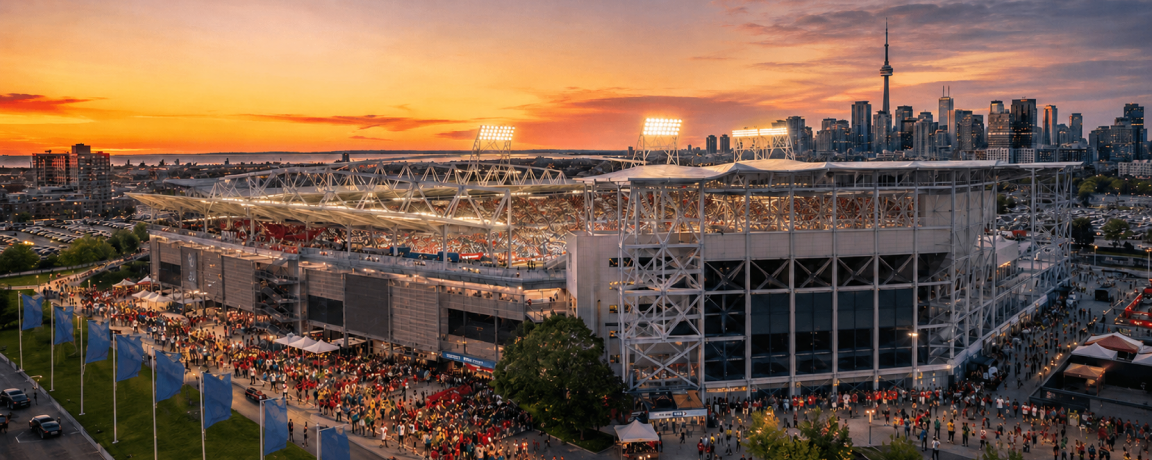
There’s a particular feeling that comes with walking into BMO Field on a midsummer evening.
The streetcar lets you off at Exhibition Place. The CN Tower rises behind you. Lake Ontario shimmers to the south. The path through the grounds passes art installations, food trucks and the relics of a Canadian National Exhibition that has been running on this same property for nearly 150 years. By the time you reach the stadium entrance, the sun is setting over the harbor, the Toronto FC supporter sections are already loud, and the bowl is filling with red.
This summer, in June 2026, BMO Field will host something unprecedented. The Canadian men’s national team will play a World Cup match on home soil for the first time in history. Six matches in total will route through Toronto during FIFA 2026. The city that birthed one of MLS’s most influential supporter cultures will finally take its place on the global football map.
Here’s the full guide.
The city that birthed one of MLS’s most influential supporter cultures will finally take its place on the global football map.
Everything at a glance
- Stadium
- BMO Field Exhibition Place, Toronto
- City / Region
- Toronto, Ontario Canada
- Capacity
- ~45,000+ with temporary seating expansions
- Opened
- 2007 expanded through the 2010s
- Primary tenants
- Toronto FC MLS · CFL Argonauts · Canada national teams
- FIFA 2026
- 6 matches Including Canada's opening match
- Surface
- Natural/hybrid grass
- Location
- Exhibition Place Lake Ontario waterfront, west of downtown
- Roof
- Open-air with canopy-covered seating areas in parts of the venue.
- Climate
- Warm summer Lake-effect breezes; thunderstorms possible
- Transit
- TTC streetcar GO Transit Exhibition station adjacent
TTC streetcar service to Exhibition Place. GO Transit Exhibition station is adjacent to the venue.
What happened next reshaped Canadian football
BMO Field opened in 2007 as a purpose-built soccer-specific stadium — at the time, one of the first dedicated football stadiums in Canada at a top-tier level. The original design provided around 20,000 seats, with the intention of supporting the Toronto FC MLS expansion franchise. The build was fast, the architecture was modest, and the supporter culture began organizing before the first ball was kicked.
What happened next reshaped Canadian football. Toronto FC immediately drew capacity crowds. The supporter sections — Red Patch Boys, U-Sector, Inebriatti and others — built one of the loudest, most theatrical fan environments in MLS. The “Voyageurs” identity for the Canadian men’s national team, which had existed in fragmented form for years, found a more visible home base.
Multiple expansions through the 2010s added seating tiers, a sheltered upper deck, premium clubs, and improved fan amenities. The stadium became the home of the CFL’s Toronto Argonauts in 2016. The Canadian men’s and women’s national teams continued to play key fixtures here, particularly through the World Cup qualification cycles.
Six matches will be played at the venue — including the Canadian men’s national team’s opener, which will be the first World Cup match ever played on Canadian soil.
Things to do in Toronto
Booked through our partners — we may earn a commission at no extra cost to you.






Purpose-built for football
BMO Field is purpose-built for football. That’s its single most defining quality, and it shapes the entire matchday experience.
The seating bowl wraps tight to the touchlines and the goal lines. There’s no NFL geometry to dilute the football sightlines. The supporter sections at both ends are deliberately steep and close to the field. The atmosphere from those sections has, on multiple occasions, drawn comparisons to South American and European fan environments.
- Lake Ontario is visible from upper seating tiers, with the Toronto skyline and the CN Tower providing a famous backdrop.
- Exhibition Place’s surrounding grounds — including art installations, historical pavilions and waterfront access — make the matchday environment unusually integrated with the city.
- The supporter section at the south end has produced some of the most photographed tifos in MLS history.
- The relatively compact capacity creates an intimate, intense crowd dynamic when sold out.
For FIFA 2026, temporary seating expansions will bring the venue’s capacity up significantly. But the fundamental character — a purpose-built football stadium on the Toronto waterfront — will remain.
Three reasons
Canada is co-hosting
Canada is co-hosting the 2026 World Cup. Toronto is the largest city in Canada and the country’s most internationally connected media market.
The venue
BMO Field is one of the most authentic, established football-specific stadiums in Canada. The supporter culture is mature. The operational track record for major fixtures is strong.
The cultural fit
Toronto is one of the most multicultural cities in the world. The city’s diaspora football culture — including substantial Italian, Portuguese, Brazilian, Caribbean, West African, South Asian, East European, Mexican and South American populations — makes it natural ground for hosting a global tournament. Almost every national team in the World Cup will have a built-in supporter base in Toronto before the tournament begins.
The six-match assignment, anchored by Canada’s first World Cup match on home soil, will give Toronto one of the most emotionally significant fixtures of the entire tournament.
At the top of the all-time list
In Canadian football specifically:
- Toronto FC’s 2017 MLS Cup championship season included home knockout matches that produced some of the most-attended professional soccer matches in Canadian history.
- Canadian men’s national team World Cup qualifying matches, particularly during the 2022 qualification cycle that ended Canada’s 36-year men’s World Cup absence.
- Canadian women’s national team fixtures, including pre-Olympic and World Cup preparation matches.
- High-profile Concacaf and international friendlies featuring Mexico, the U.S. and major European clubs.
The 2026 World Cup matches — and Canada’s first World Cup match on home soil — will sit at the top of the venue’s all-time list.
In CFL terms
Multiple Argonauts seasons since 2016, including Grey Cup runs.
One of the most layered football identities in North America
The diaspora community
The city’s Italian-Canadian population is enormous, particularly in neighborhoods like Little Italy on College Street, Corso Italia on St. Clair, and Woodbridge in the suburbs. The Portuguese-Canadian community is concentrated in Little Portugal and Mississauga. The Brazilian, Argentine, Colombian, Salvadoran, Honduran and Mexican populations have all built football cultures. The Caribbean — particularly Trinidadian and Jamaican — community is substantial across the metro. The West African community, with strong Ghanaian, Nigerian and Senegalese populations, brings their own football audiences. South Asian (especially Indian and Bangladeshi), Eastern European and East African communities are all visible in the city’s football fan culture.
Toronto FC
Since its founding in 2007, Toronto FC has been one of the most consistently sold-out franchises in MLS. The supporter culture — anchored by groups like Red Patch Boys, U-Sector and Inebriatti — has built theatrical traditions including coordinated tifos, drum sections, capos and sustained vocal participation.
What to expect
-
Morning in downtown Toronto
Coffee on Queen Street, breakfast in Kensington Market or the St. Lawrence Market.
-
Travel to Exhibition Place
TTC streetcar (the 509 Harbourfront line runs to Exhibition Place) or GO Transit to Exhibition station. Travel time around 10–20 minutes from downtown.
-
Pre-match in Exhibition Place
Wander the grounds, visit the food trucks, check out the art installations, walk along the waterfront.
-
Tailgate culture
Less dominant than in American stadiums but growing. Expect organized supporter group meetups.
-
Entry
Clear-bag policy. Security is efficient.
-
Inside the bowl
Look around. The waterfront, the skyline and the CN Tower are all visible.
-
Concessions
Toronto food trucks regularly operate within the grounds.
-
Post-match
TTC back to downtown or walk along the waterfront on a nice evening.
Where to sit
South end of the bowl
The most coordinated supporter sections traditionally cluster here.
Mid-tier sideline
The clearest read on shape and movement across the pitch.
Upper-deck corners
Lake Ontario, the harbor and the CN Tower are all visible from here.
Mid-bowl, off the noise
Mid-bowl seats away from the most vocal sections.
Upper-deck end zone
The most affordable entry point in the building.
Field-level clubs
Field-level clubs and indoor lounges.
A BMO-specific tip
The upper deck at the north end gives you the best skyline view, with the CN Tower rising directly behind the open end of the stadium.
Getting here
- From Toronto Pearson International Airport (YYZ)
- UP Express train direct to Union Station in downtown Toronto, then TTC streetcar or GO Transit to Exhibition Place. About 45 minutes door-to-door.
- From Billy Bishop Toronto City Airport (YTZ)
- Roughly 10 minutes by car or short walk and ferry combination.
- From Downtown Toronto
- TTC streetcar (509 Harbourfront line) or GO Transit. About 10–15 minutes.
- From Buffalo, New York or Niagara region
- Easier than international fans expect. Direct GO Transit connections and rail routes.
- Driving
- Multiple lots in Exhibition Place. Pre-paid parking is recommended.
- Rideshare
- Designated zones at the stadium. Surge pricing post-match.
- Walking
- From downtown Toronto, walking along the waterfront is practical for some fans.
- Cycling
- Toronto has bike share stations near Exhibition Place. The Martin Goodman Trail runs along the waterfront.
- Accessibility
- ADA/CSA-compliant routes and seating. Coordinate accessibility services with FIFA in advance.
Neighborhoods
Downtown Toronto (Financial District)
Closest to UP Express airport rail and to the streetcar lines serving the stadium.
King West
Walkable, with a strong restaurant and bar scene.
Queen West
Trendy district with bars, music venues and boutique hotels.
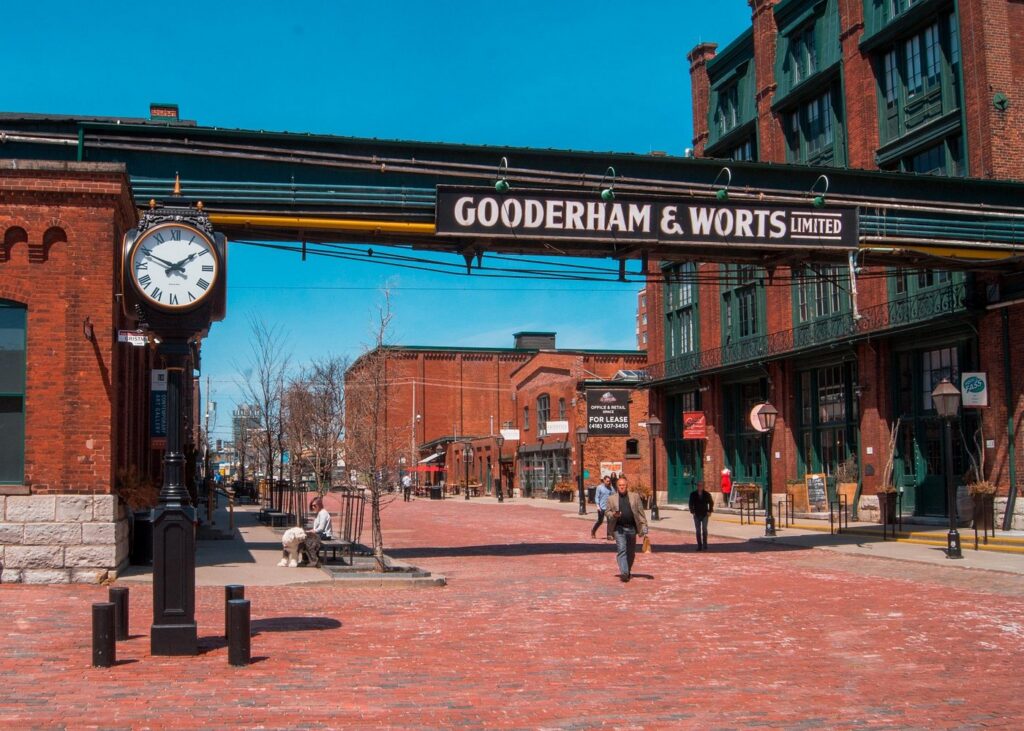
The Distillery District
Historic, walkable, with restaurants and bars.
Kensington Market and Little Italy
Eclectic, walkable, food-centric.
Liberty Village
Immediately east of Exhibition Place. The closest residential neighborhood to the stadium.
Mississauga or other suburbs
Cheaper alternatives with GO Transit access.
If you’re staying for multiple matches, downtown Toronto strikes the best balance.
One of the great food cities in North America
Toronto is one of the great food cities in North America.
- Italian-Canadian food — multi-generational restaurants in Little Italy on College Street, Corso Italia, and Woodbridge.
- Portuguese food — Little Portugal and surrounding neighborhoods.
- Caribbean food — roti, jerk chicken, doubles. Strong scene across the city, especially in Scarborough.
- Chinese food — multiple Chinatowns and dense East Asian dining options.
- Korean food — Bloor-Yonge Korean district.
- South Asian food — some of the best Indian, Bangladeshi, Sri Lankan and Pakistani dining in North America. Gerrard Street’s Little India is iconic.
- Vietnamese, Thai and Filipino food — distributed across the city.
- Ethiopian and West African food — strong scene across multiple neighborhoods.
- Brazilian and Latin American food — strong scene growing rapidly.
- Canadian classics — poutine, butter tarts, peameal bacon sandwiches at the St. Lawrence Market.
- Coffee — strong third-wave scene across the city.
Bars & viewing parties
Bars in Little Italy, Little Portugal, King West, Queen West and Kensington Market run early-morning international matches every weekend.
Mild by North American standards
24–29°C. Heat waves above 90°F (32°C) happen but are uncommon.
Occasional afternoon thunderstorms.
Lake-effect breezes off Lake Ontario are common.
Moderate sun exposure in the bowl during day matches.
Practical kit
- Reusable water bottle
- Light, breathable clothing
- Light jacket for evening matches near the lake
- High-SPF sunscreen
- Compact rain poncho
- Comfortable walking shoes
Bragging rights
One of Canada’s first purpose-built football stadiums
BMO Field was one of the first purpose-built soccer-specific stadiums at the top professional level in Canada.
Nearly 150 years of Exhibition Place
The stadium is located within Exhibition Place, which has been hosting the Canadian National Exhibition continuously for nearly 150 years.
Toronto FC’s historic 2017 season
Toronto FC won the MLS Cup in 2017, achieving one of the most decorated single seasons in MLS history.
The end of a 36-year absence
The Canadian men’s national team’s qualification for the 2022 FIFA World Cup ended a 36-year men’s World Cup absence and was secured at BMO Field.
The CN Tower backdrop
The CN Tower, visible from the stadium, is one of the most-photographed structures in North America.
The Voyageurs predate the modern era
The Voyageurs supporter group for the Canadian national teams predates the modern professional Canadian football era by over a decade.
Canada has produced more world-class footballers per capita over the past two decades than most international observers realize.
Alphonso Davies, Jonathan David, Jonathan Osorio, Stephanie Labbé, Christine Sinclair, Ashley Lawrence — the list of Canadians playing at the highest levels of European football has been growing steadily. Many of those players passed through the Canadian Soccer Association’s developmental pipelines that route through BMO Field. The 2026 World Cup matches in Toronto are, in a real sense, the moment Canadian football finally gets the global stage to match the talent it has been quietly producing.
One of the most theatrical supporter cultures in MLS
Toronto FC’s supporter culture is one of the most theatrical in MLS, with organized tifos, drum sections and sustained vocal participation that has set a standard across the league. International fixtures at BMO Field have historically produced even louder, more multilingual crowds.
For 2026, expect the bowl to feel like a true international football environment. The Canadian men’s national team opener will be one of the most emotionally significant moments in Canadian football history — anticipate a sold-out, full-throated, deeply patriotic atmosphere.
The Canadian men’s national team opener will be one of the most emotionally significant moments in Canadian football history.
Public transit is part of the sustainability story
BMO Field has implemented sustainability upgrades through its various expansion phases, including LED lighting, water-efficient field maintenance and recycling programs. The integrated public-transit access reduces matchday emissions.
Technology: high-density Wi-Fi, mobile-app ticketing, modernized broadcast infrastructure.
Transformational for Canadian football
The 2026 World Cup matches will be transformational for Canadian football. The Canadian men’s national team will gain global visibility. Toronto FC’s audience will deepen. Investment in youth football, women’s facilities and broader soccer-specific infrastructure across Canada will accelerate. Canada’s place in the global football conversation will become permanent.
Quietly powerful
A Toronto World Cup is going to be one of the most quietly powerful experiences of FIFA 2026. The first World Cup matches on Canadian soil. A multicultural city that already speaks every football language. A purpose-built football stadium on a beautiful waterfront. A supporter culture that has been preparing for this moment for almost two decades.
If you’re going, take the UP Express from Pearson. Stay downtown. Eat in Little Italy. Walk the waterfront. Sit in the south end. Stand for the entire ninety minutes if you can.
Six matches at BMO Field. Including the one match that finally puts Canadian men’s football on the World Cup map at home.
