Mercedes-Benz Stadium: Atlanta’s Pinwheel Cathedral of Football
Mercedes-Benz Stadium hosts FIFA 2026 in Atlanta. Inside guide to the pinwheel roof, seats, transit, Southern food and matchday tips for the World Cup.
Full Match Schedule
8 matches at Mercedes-Benz Stadium
| Match | Stage | Group | Result / Kickoff | Host City |
|---|---|---|---|---|
| Group Stage | H |
0 – 0
Full Time
|
Atlanta United States | |
| Group Stage | A |
1 – 1
Full Time
|
Atlanta United States | |
| Group Stage | H |
4 – 0
Full Time
|
Atlanta United States | |
| Group Stage | C |
4 – 2
Full Time
|
Atlanta United States | |
| Group Stage | K |
3 – 1
Full Time
|
Atlanta United States | |
|
England
vs
DR Congo
|
Round of 32 | — |
2 – 1
Full Time
|
Atlanta United States |
|
Argentina
vs
Egypt
|
Round of 16 | — |
3 – 2
Full Time
|
Atlanta United States |
|
England
vs
Argentina
|
Semifinal | — |
1 – 2
Full Time
|
Atlanta United States |
When you walk out of the MARTA train at the Vine City or GWCC station and look up, the first thing you see isn’t a stadium.
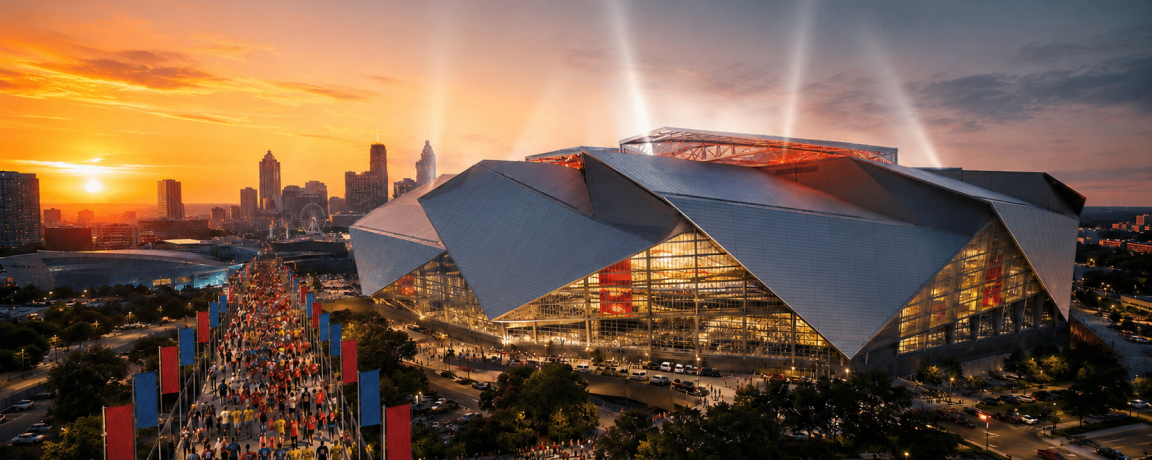
Mercedes-Benz Stadium sits on the western edge of downtown Atlanta like a piece of architectural origami, eight triangular roof panels folding open and closed like the aperture of a camera lens. Inside, a circular video screen runs the entire halo of the bowl, wrapping the seating tiers in 360-degree LED light. The whole building is engineered to feel less like a stadium and more like a moving piece of public art that happens to seat 71,000 people for a football match.
In the summer of 2026, that piece of art is going to host one of the most important football moments in Atlanta’s history. A FIFA World Cup Semifinal. Eight matches across the group stage and knockout rounds. A city that has spent the last decade rebuilding its football identity around a club that broke American attendance records, finally getting to put its showpiece bowl on the world’s biggest stage.
The whole building is engineered to feel less like a stadium and more like a moving piece of public art that happens to seat 71,000 people for a football match.
Everything at a glance
- Stadium
- Mercedes-Benz Stadium
- City / Region
- Atlanta, Georgia
- Country
- United States
- Capacity
- ~71,000 Expandable for major events
- Opened
- 2017
- Primary tenants
- Atlanta Falcons + Atlanta United FC NFL · MLS
- FIFA 2026
- 8 matches Group-stage + multiple knockouts + Semifinal
- Location
- Downtown Atlanta Adjacent to Centennial Olympic Park and the city's largest convention center
- Surface
- Natural grass Installed for the tournament
- Roof
- Retractable Eight triangular petals open and close in a pinwheel motion
- Climate
- Hot, humid Southern summer Afternoon thunderstorms common
- Transit
- MARTA rapid transit Vine City and GWCC/CNN Center stations within walking distance
MARTA rapid transit is the simplest path — Vine City and GWCC stations both put you within easy walking distance of the stadium.
One of the most ambitious stadium designs in American history
The Falcons used to play at the Georgia Dome — a famously beige, famously functional concrete building that hosted Super Bowls, Olympic basketball during the 1996 Games, and a steady stream of major events. When the franchise decided to replace it, they could have built something equally functional and called it modern. They chose, instead, to commission one of the most ambitious stadium designs in American history.
The pinwheel roof was the central idea. The eight panels, each weighing hundreds of tons, slide open and closed in a synchronized motion that takes roughly ten minutes start to finish. The halo video board — a circular ribbon of LED screens looping the interior — was built to a scale that no other stadium had attempted. The exterior facade uses ETFE panels capable of lighting in dynamic colors. The reported cost was over a billion and a half dollars.
The building opened in 2017, became LEED Platinum certified (the highest level of sustainability rating for major facilities), and immediately set new standards for fan-friendly concessions pricing. Atlanta United, the MLS expansion team, made the stadium its home and proceeded to break the league’s single-match attendance records repeatedly. The MLS Cup of 2018 was played here in front of more than 73,000 fans. International friendlies, Concacaf Champions Cup matches, and the 2024 Copa America semifinals have all routed through.
For FIFA 2026, Atlanta Stadium hosts eight matches: five group-stage games, one Round of 32 match, one Round of 16 match, and one semifinal.
Things to do in Atlanta
Booked through our partners — we may earn a commission at no extra cost to you.




The most visually distinctive matchday environment in North America
The roof is the headline. Eight aluminum-and-ETFE panels open and close in a synchronized choreography that takes about ten minutes from sealed to fully open. From inside, the effect is dramatic — a slow reveal of the Atlanta sky as the panels unfold above the field. From outside, the building changes shape depending on the time of day and the weather.
The halo board is the next show-stealer. Imagine a circular video ribbon that loops the entire upper bowl, hanging from the roof in a single continuous LED display. It’s visible from every seat. It’s used for replays, fan animations, sponsor visuals and tournament storytelling. Atlanta United regularly uses it for choreographed pre-match displays that feel halfway between a sports event and a music video.
- The “Window to the City” — a massive glass façade behind one of the end zones that frames the Atlanta skyline from inside the bowl. Standing on the lower concourse and looking out is one of the great stadium views in American sports.
- Fan-friendly concessions pricing — the venue has built a national reputation for selling food and drinks at prices well below the American stadium norm.
- A sloped seating geometry that feels intimate despite the venue’s enormous capacity.
- LEED Platinum sustainability features, including extensive rainwater capture, solar integration on adjacent buildings, and a public-transit-first design philosophy.
- The Falcon Statue outside the stadium — a 41-foot-tall bronze sculpture that has become a landmark photo spot.
The combination of architecture, lighting and crowd noise gives Atlanta one of the most visually distinctive matchday environments in North America. For the World Cup, it will look spectacular on television and even better in person.
Three reasons
The venue
Mercedes-Benz Stadium is among the most modern, technologically advanced stadiums in the world. It was purpose-designed to host both NFL and MLS football, which means the geometry for an international football pitch is already comfortable.
The city
Atlanta is the busiest air-travel hub in the world by passenger volume. Hartsfield-Jackson International Airport connects directly to over 150 cities globally, which makes it an extraordinarily efficient gathering point for international fans.
The football culture
Atlanta United has, in less than a decade, built one of the loudest, most consistently sold-out crowds in North American club football. The base is real and growing. The Latino and Caribbean diaspora football culture in metro Atlanta is enormous. The city’s youth football scene, particularly in DeKalb and Gwinnett counties, has been producing professional and national team players for years.
The Semifinal assignment, combined with eight total matches, signals FIFA’s confidence that Atlanta will deliver both atmosphere and operations. Expect the venue to host one of the two most-watched football nights in American history when the Semifinal arrives.
Super Bowls, MLS Cups and Copa America semifinals
Mercedes-Benz Stadium has hosted Super Bowl LIII, the College Football Playoff National Championship, the SEC Football Championship, NCAA men’s Final Four basketball, and a long calendar of major concerts and entertainment events.
- MLS Cup 2018 — Atlanta United winning the league title in front of more than 73,000 fans, setting the tone for the venue’s football identity.
- Multiple matches in the Concacaf Champions Cup era, including knockout fixtures involving Atlanta United and visiting Liga MX powers.
- Copa America 2024 semifinal involving Argentina, drawing one of the largest international football crowds in Atlanta’s history.
- USMNT and Mexico friendlies that have repeatedly drawn capacity crowds.
The 2026 Semifinal will sit at the top of the venue’s all-time list.
This is the most surprising football city in the United States.
Atlanta United and The Vortex
Two decades ago, professional football in Atlanta was almost invisible. The collapse of the Atlanta Chiefs in the 1980s left a vacuum. Then, in the 2010s, Atlanta United arrived — and changed the conversation faster than any expansion club in MLS history. Average attendances of over 50,000 became routine. The supporter group culture, organized in a section called The Vortex, modeled itself on European and South American supporter traditions: tifos, drums, capos, full ninety-minute vocal participation.
The Latino diaspora
Mexico, Guatemala, Honduras, El Salvador, Colombia and Brazil are heavily represented across metro Atlanta. Liga MX and South American leagues have huge weekly audiences here.
The African and Caribbean diaspora
Nigerian, Ghanaian, Ethiopian, Trinidadian and Jamaican populations have grown rapidly. Watch parties for African Cup of Nations and Caribbean qualifiers are everywhere.
The Southern football pipeline
Georgia, Tennessee, Alabama, North and South Carolina youth football has matured dramatically in the past two decades.
What to expect
-
Pre-game in downtown Atlanta
Centennial Olympic Park, the National Center for Civil and Human Rights, the World of Coca-Cola, the Georgia Aquarium and CNN Center are all within walking distance of the stadium.
-
MARTA to the stadium
The Vine City and GWCC/CNN Center stations are both within easy walking distance. MARTA is the path of least resistance.
-
The Home Depot Backyard
A large grass park adjacent to the stadium where pre-match fan zones gather. Live music, food trucks, supporter group meetups.
-
Entry
Expect FIFA tournament security screening. Gates open 3 hours before each match. Check official FIFA and Atlanta Stadium matchday rules before attending.
-
Inside the bowl
Look up at the roof. If it’s open, you can watch the panels finish their motion as you find your seat.
-
Concessions
Cheap by American stadium standards. Eat well.
-
Post-match
MARTA back to your hotel. Avoid trying to rideshare directly out of the immediate stadium perimeter — walk a few blocks first.
Where to sit
Lower bowl behind the goals
Supporter sections, including the home Atlanta United Vortex, traditionally gather in the south end. Visiting national-team supporters will likely consolidate in similar patterns during the World Cup.
Mid-tier sideline seats
The bowl’s geometry gives you an unusually clean perspective across the entire pitch.
Upper-deck corners
Especially on a night with the roof open, you can catch the halo board, the field and the Atlanta skyline through the Window to the City in a single frame.
Mid-bowl seats
Well removed from the supporter sections. Concessions and exits are convenient throughout the building.
Upper-deck end-zone seats
Watch resale platforms for late-release inventory.
Field-level clubs and lounges
Among the best premium hospitality offerings of any U.S. stadium.
A Mercedes-Benz-specific tip
Anywhere with a clear view of the Window to the City is visually special. Look for sections opposite that end of the building.
Getting here
- From Hartsfield-Jackson International (ATL)
- MARTA direct from the airport to downtown takes roughly 20 minutes. The stadium is a short walk from the relevant MARTA stations.
- From Buckhead and Midtown
- MARTA runs north-south through the city’s main commercial districts. Travel time from Midtown to the stadium is roughly 10 minutes by train.
- From Decatur and the eastern suburbs
- MARTA’s east-west line connects to downtown stations within walking distance of the stadium.
- Driving
- Multiple downtown parking decks are available, generally with pre-paid options. Walk-up parking on matchday is risky.
- Rideshare
- Designated pickup zones are organized. Surge pricing post-match is high. Walking out of the immediate perimeter before requesting a ride generally helps.
- Walking
- Downtown Atlanta is walkable from most central hotels. Walking from Midtown is feasible if you don’t mind a 30-minute stroll.
- Accessibility
- ADA-compliant routes and seating throughout the venue. Coordinate accessibility services with FIFA in advance.
The simple rule for Atlanta
Take MARTA. It is the cleanest, fastest path on matchday, and the rail-to-stadium walk is one of the more enjoyable urban approaches in the league.
Neighborhoods
Downtown Atlanta
Walkable to most attractions and major fan zones. Inventory ranges from luxury to budget.
Midtown
Atlanta’s cultural district, with the Fox Theatre, Piedmont Park and a strong restaurant scene. Easy MARTA access. About a 10-minute train ride to the stadium.
Buckhead
Upscale district, more residential. Excellent dining and shopping.
Castleberry Hill
Walking distance to the stadium and one of the most underrated neighborhoods in the city. Arts-focused, with a quieter post-match vibe.
Old Fourth Ward and Inman Park
Beltline-adjacent, walkable, packed with bars and restaurants. Easy MARTA or rideshare access.
Decatur
A short MARTA ride east. Quieter, with its own walkable downtown.
If you’re staying for multiple matches, downtown or Midtown are the most practical choices for transit convenience.
One of the most consequential food cultures in the South
Atlanta’s food culture is one of the most consequential in the South.
- Southern cuisine — Fried chicken, biscuits, collards, mac and cheese, cornbread, banana pudding. Multi-generational restaurants in West End, Sweet Auburn and the Beltline corridor.
- Soul food and Black culinary tradition — Atlanta is one of the most important cities in the country for Black culinary excellence.
- Hot chicken and barbecue — A growing scene with regional crossover influence from Tennessee, the Carolinas and Texas.
- Latin American cuisine — Buford Highway is one of the great international food corridors in the United States. Mexican, Salvadoran, Honduran, Colombian and Peruvian restaurants alongside Korean, Vietnamese and Ethiopian neighbors.
- West African cuisine — Strong in metro Atlanta. Nigerian, Ghanaian and Senegalese restaurants distributed across DeKalb and Gwinnett counties.
- Ethiopian cuisine — Atlanta has one of the largest Ethiopian populations in the country, and the dining scene reflects it.
- Coffee and bakeries — A growing third-wave scene in Inman Park, the Old Fourth Ward, Cabbagetown and Decatur.
Bars and viewing parties
Soccer-specific pubs in Midtown, Inman Park and Decatur run early-morning Champions League and Premier League matches every weekend. Expect every one of them to be packed during the World Cup.
Hot, humid Southern summer — afternoon thunderstorms possible
Daily highs commonly 29–35°C.
The air feels heavier than the air temperature suggests.
Afternoon thunderstorms are common in the summer. Storms typically pass quickly but can be intense.
The retractable roof closes for storms or extreme heat. With the roof closed, the bowl is comfortable year-round.
Practical kit
- One factory-sealed disposable soft plastic water bottle, up to 20 oz / 590 ml, if allowed under current FIFA venue rules.
- Light, breathable clothing
- Compact rain poncho
- High-SPF sunscreen
- Light layer for inside the air-conditioned bowl
Bragging rights
The pinwheel roof took multiple iterations to operate reliably
The pinwheel roof was one of the most complex engineering challenges in modern stadium design. The mechanism took multiple iterations to operate reliably.
The halo video board uses miles of LED strip
The halo video board uses miles of LED strip and wraps the entire upper bowl in a single continuous display.
The “fan-friendly pricing” model has influenced American venues nationwide
The stadium’s “fan-friendly pricing” model has been credited with influencing concession pricing strategies at other American venues.
Atlanta United’s MLS attendance records outpace some European top-flight teams
Atlanta United’s MLS attendance records here have outpaced even some European top-flight teams.
The Window to the City was designed to make the Atlanta skyline part of the stadium’s interior
The Window to the City — the giant glass façade — was specifically designed to make the Atlanta skyline a piece of the stadium’s interior identity.
The Falcon Statue weighs over 70,000 pounds
The Falcon Statue outside the building weighs over 70,000 pounds and is the largest free-standing bird sculpture of its kind in the world.
LEED Platinum — one of the most sustainable major sports venues in North America
LEED Platinum certification makes Mercedes-Benz Stadium one of the most sustainable major sports venues in North America.
Atlanta wasn’t built into a football city. It was already one — quietly, patiently — waiting for somebody to notice.
Atlanta nearly lost professional football for a generation. Before Atlanta United arrived in 2017, the city had been without top-tier club soccer for decades — and most market analysts assumed Atlanta wasn’t a “soccer town.” The first home match at Bobby Dodd Stadium (the team’s temporary home before Mercedes-Benz opened) drew over 55,000 fans. The numbers shocked even the league. The 2026 World Cup matches at Mercedes-Benz are, in a sense, a continuation of an audience that was always there.
A Southern reimagining of Latin American supporter traditions
Atlanta’s fan culture has been described, with some accuracy, as a Southern reimagining of Latin American supporter traditions. The chants are organized. The drums are real. The tifos for Atlanta United matches have included some of the most ambitious displays ever produced in MLS history. National-team-affiliated supporter groups will adapt easily to this venue during the World Cup.
The sound behavior is unusual. The halo video board, combined with the pinwheel roof’s reflective surfaces, focuses noise back down toward the field. When the bowl is fully open at the roof, sound disperses into the Atlanta sky and the crowd feels expansive. When closed, the noise concentrates into a more intense pattern. Both can be loud. Both feel different.
For traveling supporters: the city is welcoming. The Beltline is full of pre-match social options. MARTA is friendly. The food is excellent. By the time you’re heading home from your match, you’ll understand why Atlanta has become one of the most beloved World Cup host cities in the United States before a single match has even kicked off.
LEED Platinum, rainwater capture and one of the most complex display systems in any stadium in the world
LEED Platinum sets the baseline. From there, Mercedes-Benz Stadium operates one of the most ambitious water-management systems of any American sports venue — rainwater capture, on-site filtration and reuse, and a partnership with local urban-water projects. Energy efficiency is built into the lighting, HVAC and concessions systems. On-site recycling and composting are aggressive by U.S. stadium standards.
On technology: high-density Wi-Fi, app-based ordering and ticketing, augmented-reality experiences in select sections, and a fully integrated network for broadcast and fan engagement. The halo board itself is one of the most complex display systems in any stadium in the world.
One of the most consequential football cities in North America
The 2026 World Cup will accelerate Atlanta’s transformation into one of the most consequential football cities in North America. Atlanta United’s audience will deepen further. Youth investment, women’s soccer, and the city’s broader football media ecosystem will all expand. The downtown corridor around the stadium will continue to evolve as a sports and tourism district.
For metro Atlanta culturally, the 2026 tournament will be a global confirmation of what residents already know: this is a deeply international city, and its football culture has been catching up with that reality for years.
A World Cup Semifinal night under the pinwheel roof
A World Cup Semifinal night under the pinwheel roof, in a city that re-invented itself as a football town in less than a decade, is going to be one of the great stadium experiences of 2026.
If you’re going, take MARTA. Stay downtown or in Midtown. Eat on Buford Highway. Walk the Beltline. Drink your post-match beer in a Beltline tap room with strangers from twelve different countries. Then come back the next morning and do it again, because Atlanta is not a one-day city and Mercedes-Benz Stadium is not a one-match destination.
Look up when you walk in. The roof will open. The halo will glow. The match will start.
