Estadio Azteca: The Cathedral That Opens the World Cup Again
Estadio Azteca hosts the FIFA 2026 opening match. Inside guide to the legendary Mexico City stadium — history, seats, altitude, transit and fan culture.
Full Match Schedule
5 matches at Estadio Azteca
| Match | Stage | Group | Result / Kickoff | Host City |
|---|---|---|---|---|
| Group Stage | A |
2 – 0
Full Time
|
Mexico City Mexico | |
| Group Stage | K |
1 – 3
Full Time
|
Mexico City Mexico | |
| Group Stage | A |
0 – 3
Full Time
|
Mexico City Mexico | |
|
Mexico
vs
Ecuador
|
Round of 32 | — |
2 – 0
Full Time
|
Mexico City Mexico |
|
Mexico
vs
England
|
Round of 16 | — |
2 – 3
Full Time
|
Mexico City Mexico |
There are a small number of buildings that football fans speak about with religious cadence.
Wembley. Maracanã. Old Trafford. The Bernabéu. La Bombonera. San Siro.
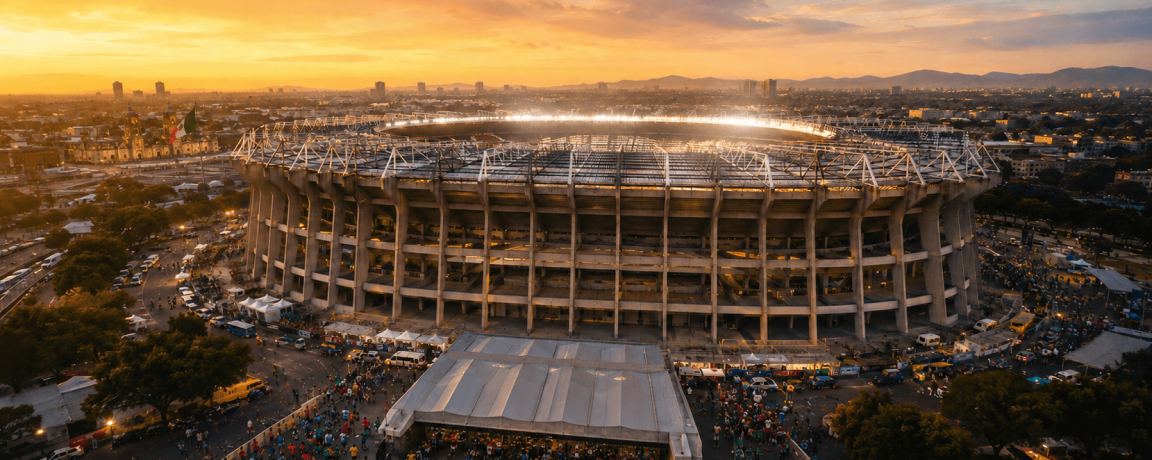
Estadio Azteca belongs on that list — and arguably above many of them. No other stadium in the world has hosted two FIFA World Cup Finals. No other stadium in the world has hosted Pelé lifting a World Cup trophy and Diego Maradona scoring what is widely considered the greatest goal in the sport’s history. On June 11, 2026, when the opening match of the 48-team FIFA World Cup kicks off in this same bowl at 2,240 meters above sea level, Estadio Azteca will become the only stadium in history to have hosted matches in three different FIFA World Cups.
Here is the full fan guide for the most legendary venue in the 2026 tournament.
That’s not hyperbole. That’s the building’s literal record.
Everything at a glance
- Stadium
- Estadio Azteca also Estadio Banorte · Mexico City
- City / Region
- Mexico City Southern Tlalpan/Coyoacán borough zone
- Capacity
- 83264 Historically over 100,000
- Opened
- 1966 Built for the 1970 FIFA World Cup
- Primary tenants
- Club América + El Tri Liga MX + Mexican national team
- FIFA 2026
- 5 matches Including the opening match — June 11, 2026
- Surface
- Natural grass
- Location
- Southern Mexico City Tlalpan/Coyoacán area
- Roof
- Partial canopy Large concrete cantilevered structure; field open to sky
- Climate
- Mild, high-altitude Daily highs 75–80°F in June
- Altitude
- 2,240 m 7,350 ft above sea level
- Transit
- Metro + Tren Ligero Multiple bus and rideshare options available
Metro Line 2 to Tasqueña, then Tren Ligero light rail directly to the Estadio Azteca station. About 60 minutes from central Mexico City.
Mexico City built Estadio Azteca to host the 1970 FIFA World Cup
The construction project began in 1962, financed largely through a combination of private investment from media mogul Emilio Azcárraga Milmo and other backers, with design by the architect Pedro Ramírez Vázquez. The stadium opened in 1966 — at the time, one of the most ambitious stadium construction projects in the Western Hemisphere.
The original capacity was over 100,000. The bowl was carved partially into the southern Mexico City landscape, with much of the seating arranged in two enormous tiers separated by a cantilevered concrete roof. The exterior architecture was minimalist by Mexican Modernist standards — clean lines, functional concrete, an iconic ramp system leading fans up to the upper bowl from ground level.
The 1970 FIFA World Cup made Estadio Azteca an international icon. Pelé’s Brazil won the trophy here — the third Brazilian World Cup, the team often remembered as the greatest international side ever assembled. Sixteen years later, in 1986, Estadio Azteca hosted its second World Cup Final, this time as Mexico stepped in to replace Colombia as host nation on short notice. Argentina won. Diego Maradona produced the “Hand of God” goal and the “Goal of the Century” in the same quarterfinal match against England. Both goals were scored in this building.
Since then, the venue has hosted Mexican national team matches that defined a generation, Liga MX finals, NFL international series games, concerts by some of the biggest names in global music, religious gatherings, and a long calendar of major events. A multi-year renovation program in the 2020s modernized the seating, concourses, technology infrastructure and surrounding precinct in preparation for FIFA 2026.
On June 11, 2026, Estadio Azteca becomes the first and only stadium in history to host matches in three different FIFA World Cups — 1970, 1986 and now 2026 — including all three with significant ceremonial roles.
Things to do in Mexico City
Booked through our partners — we may earn a commission at no extra cost to you.







Football’s most decorated single venue
This is football’s most decorated single venue.
No stadium in the world has hosted two World Cup Finals. Estadio Azteca has. Both Pelé’s coronation and Maradona’s mythmaking happened on this exact pitch. The grass has been recut, the bowl has been reshaped multiple times, the surrounding city has grown beyond recognition — but the building itself remains a continuous physical record of football history.
- The two-tiered seating bowl with cantilevered roof is one of the most recognizable architectural silhouettes in world football.
- The bowl is partly carved into the ground, so the exterior of the building doesn’t fully convey its enormous interior capacity.
- The original “Tribuna” (lower bowl) and “Cabecera” (upper bowl) sections each carry their own social and cultural codes within Mexican football fandom.
- Murals, plaques and commemorative spaces throughout the stadium reference its football history.
The altitude is also a defining feature. At over 2,200 meters above sea level, the stadium sits well above the elevation at which aerobic performance for non-acclimatized athletes drops noticeably. Visiting players have routinely described the altitude effect as a serious competitive factor. Mexico’s historic home-stadium advantage at Estadio Azteca is partly a tactical phenomenon — opponents fatigue earlier in matches played here than in lowland venues.
Three reasons, each enormous
History
No venue in the world embodies global football tradition as completely as Estadio Azteca. Putting the opening match here is, in part, FIFA’s tribute to the stadium’s unmatched record.
Mexico
Mexico is one of the three host nations of the 2026 tournament. The country deserves a marquee fixture, and Mexico City — the political, cultural and football capital — is the natural venue for that match.
Broadcasting and global storytelling
The opening match of a World Cup is one of the most-watched single sports events on the planet. Setting it in Estadio Azteca guarantees a globally meaningful visual and emotional anchor for the tournament’s first week.
Mexico City will host five total matches at Estadio Azteca. The opening match on June 11, 2026, will draw a planetary audience.
The list is long
A short selection:
- 1970 FIFA World Cup Final. Brazil 4, Italy 1. Pelé won his third World Cup. The team is often called the greatest international side ever.
- 1970 Semifinal: Italy vs. West Germany. Known as “The Game of the Century.” A 4–3 Italian win in extra time that has lived in football folklore for over half a century.
- 1986 FIFA World Cup Final. Argentina 3, West Germany 2.
- 1986 Quarterfinal: Argentina vs. England. Maradona’s “Hand of God” goal and “Goal of the Century” in the same match. Possibly the most-referenced single match in football history.
- Mexican national team World Cup qualifying matches across multiple cycles, including some of the most-attended qualifiers ever played in the country.
- Club América Liga MX finals, including some of the most historic moments in Mexican club football.
- NFL international series games, including high-profile fixtures involving major NFL franchises.
- Iconic concert performances from some of the largest global music acts.
The 2026 World Cup opening match will join — and add a new chapter to — this list.
Mexico City is one of the most fervent football cities in the world.
Club América
The Mexican capital is home to four major Liga MX clubs — Club América, Cruz Azul, Pumas UNAM and (historically) Atlante. Each club has its own neighborhoods, traditions and supporter cultures. Club América, based at Estadio Azteca, is the most successful club in Mexican football by trophies and one of the most polarizing in the country. Their supporter group culture — including the “Monumental” tifos and sustained vocal participation — is among the most theatrical in CONCACAF.
El Tri
The Mexican men’s national team — El Tri — is the country’s most beloved sporting institution. Mexico has qualified for every men’s FIFA World Cup since 1994, one of the longest active streaks in international football with additional historical appearances). El Tri’s matches at Estadio Azteca are some of the most-watched single sporting events in the country.
Amateur football
Beyond the professional clubs, Mexico City’s amateur football culture is everywhere. Parks throughout the city host weekend matches with surprising tactical sophistication. Street football, futsal and seven-a-side leagues operate in every borough. Football is woven into Mexican civic life at a level few other countries match.
What to expect
-
Morning in central Mexico City
Breakfast tacos, café de olla, a walk through the Zócalo or Chapultepec Park.
-
Travel south to Tlalpan
Mexico City Metro Line 2 to Tasqueña station, then Tren Ligero light rail to the Estadio Azteca station. Travel time from central Mexico City around 60 minutes.
-
Pre-match in the streets surrounding the stadium
Food stalls, taco stands, supporter group meetups, jersey vendors, organized chants from the area’s bars.
-
Entry
Security is firm. Allow extra time for high-profile matches.
-
Inside the bowl
Find your seat early. The opening match ceremony will be one of the most globally watched moments of 2026.
-
Concessions
Mexican food traditions are reflected in stadium concessions — tacos, tortas, esquites, chelas (cold beer with lime and salt).
-
Post-match
Plan your departure carefully. The streets around Estadio Azteca crowd quickly. Tren Ligero and Metro back to central Mexico City is the standard path.
Where to sit
Lower bowl (“Tribuna”) behind the goals
The most intense supporter sections traditionally cluster here.
Mid-tier sideline
The clearest read on shape and movement across the pitch.
Upper-bowl (“Cabecera”) corners
The bowl’s enormous scale and historical resonance produce some of the most iconic football photography in the world.
Mid-bowl, off the noise
Mid-bowl seats away from the most vocal supporter sections.
Upper bowl
Watch official FIFA ticketing and resale platforms in the months leading up to the tournament.
Box-level & club zones
The “Pista Atlética” club zones and VIP boxes that have been used for distinguished guests at major historical matches.
A specific tip
The bowl is enormous. Even some upper-bowl seats feel surprisingly distant from the field. The architectural geometry makes mid-bowl sideline seats one of the better value tiers.
Getting here
- From Mexico City International Airport (MEX or AICM)
- Roughly 60 minutes by car, depending on traffic. Metro connections via Line 5 to Pantitlán and transferring is technically possible but inconvenient on matchday.
- From Felipe Ángeles International Airport (NLU)
- Roughly 90+ minutes by car. AIFA is significantly further from Estadio Azteca than the primary airport.
- From Central Mexico City
- Metro Line 2 to Tasqueña station, then Tren Ligero light rail to Estadio Azteca station. About 60 minutes door-to-door.
- From the Coyoacán historic district
- About 20–30 minutes by car on a matchday.
- Driving
- Limited parking near the stadium. Matchday traffic can be severe. Rideshare or public transit is usually faster.
- Rideshare
- Uber and DiDi operate in Mexico City. Surge pricing post-match.
- Public transit
- Tren Ligero light rail directly serves the stadium. Mexico City’s Metro system is extensive and inexpensive.
- Walking
- Not realistic from outside the immediate area.
- Accessibility
- Accessible routes and seating are available. Coordinate accessibility services with FIFA in advance.
Neighborhoods
Roma Norte and Condesa
Trendy, walkable neighborhoods with strong dining and bars. Many international fans base themselves here.
Polanco
Upscale neighborhood with luxury hotels and Chapultepec Park access.
Centro Histórico
Historic core with the Zócalo, the Templo Mayor and major museums. Walkable.
Coyoacán
Beautiful colonial neighborhood with Frida Kahlo’s Blue House. Closest historic district to Estadio Azteca.
Del Valle and Tlalpan
Residential areas closer to the stadium.
Santa Fe
Modern business district to the west, with hotel inventory but a longer commute.
If you’re staying for multiple matches and want to be near central Mexico City attractions, Roma Norte, Condesa or Polanco strike the best balance.
One of the world’s great food cities
Mexico City is one of the world’s great food cities.
- Tacos — Mexico City’s regional taco traditions are extraordinary. Al pastor, suadero, lengua, tripa, cochinita pibil, barbacoa.
- Tortas, tlacoyos, gorditas, sopes, tlayudas — the street-food vocabulary is endless.
- Pozole, mole, chiles en nogada — festival cuisine and traditional Mexican specialties.
- Markets — Mercado de Coyoacán, Mercado de la Merced, Mercado de San Juan. Pilgrimage destinations.
- Mezcal and tequila — Mexico City has one of the deepest mezcal scenes in the country.
- International cuisine — strong Asian, European and South American restaurant scenes in Polanco, Roma and Condesa.
- Coffee — strong third-wave scene across the city, particularly in Roma Norte and Condesa.
Bars & viewing parties
Cantinas in Centro Histórico, bars in Roma Norte and Condesa, and pulquerías throughout the city all serve as football viewing destinations.
Mild year-round — with altitude to respect
24–27°C. Significantly cooler than coastal Mexico.
Daily afternoon thunderstorms are common during June and July. Storms can be intense but usually pass quickly.
Visitors arriving from sea level may experience mild altitude effects — fatigue, shortness of breath on stairs, slight headaches. Acclimatization typically takes 2–3 days.
Strong UV at altitude even with moderate air temperatures.
Practical kit & altitude tips
- Check final FIFA and Mexico City Stadium rules for permitted hydration items before matchday.
- Light, breathable clothing
- Layer for cool evenings
- High-SPF sunscreen
- Hat and sunglasses
- Compact rain poncho or umbrella
- Arrive at least 2 days before your match if possible
- Stay hydrated
- Limit alcohol consumption on arrival days
- Pace your walking — central Mexico City is hilly in places
Bragging rights
Three FIFA World Cups — one stadium
Estadio Azteca is the first and only stadium in the world to host matches in three FIFA World Cups: 1970, 1986 and 2026.
Two FIFA World Cup Finals
It is the only stadium to host two FIFA World Cup Finals.
Pelé’s third World Cup trophy
Pelé won his third FIFA World Cup here in 1970.
Maradona’s two most famous goals — same match
Diego Maradona’s “Hand of God” goal and “Goal of the Century” were both scored in the same match at Estadio Azteca in 1986.
More than 50 national teams
The stadium has hosted matches involving more than 50 different national teams throughout its history.
A papal mass in 1979
Pope John Paul II visited Estadio Azteca during his 1979 papal visit to Mexico, conducting a mass attended by tens of thousands.
NFL international series host
The stadium has hosted multiple NFL international series games.
Carved into the landscape
The original construction was carved into the southern Mexico City landscape using techniques unusual for major stadium construction of the 1960s.
A documented competitive advantage
The bowl’s altitude — over 2,200 meters above sea level — gives it a documented competitive advantage for acclimatized teams.
Estadio Azteca was effectively the only Western Hemisphere stadium with the operational maturity and capacity to anchor a global tournament at that scale.
When Mexico stepped in on short notice to host the 1986 World Cup, replacing Colombia as 1986 host after Colombia withdrew because it could not meet FIFA’s financial and logistical requirements. the 1986 hosting decision is sometimes told as a matter of football politics — but it was also a matter of pure infrastructure. Estadio Azteca was the only place ready to do it. When it does it again in 2026, that historical fact is part of what’s being celebrated.
One of the most theatrical crowd environments in world football
A packed Estadio Azteca is one of the most theatrical, sustained, fully-committed crowd environments in world football. Mexican supporters chant continuously. The “Cielito Lindo” tradition — the entire bowl singing — is one of the most recognizable matchday moments in the global game. National team matches feel like genuine civic events. Liga MX finals between Club América and rival clubs (Chivas in particular) are among the most contested social occasions in Mexican sport.
For 2026, the opening match will be a moment unlike any other in tournament football. Expect the bowl to be sold out hours before kickoff, the surrounding neighborhoods to be packed from morning, and the global broadcast audience to peak in the hundreds of millions.
The “Cielito Lindo” tradition — the entire bowl singing — is one of the most recognizable matchday moments in the global game.
2020s renovation brings modern infrastructure to an iconic building
Estadio Azteca’s renovation program in the 2020s has integrated modern sustainability features including LED lighting, water-efficient field maintenance and updated waste management systems. The high-altitude climate naturally reduces cooling demands compared to lowland stadiums.
Technology: extensive video board upgrades, modernized broadcast infrastructure, expanded Wi-Fi and mobile-app integration for ticketing and concessions.
The most historic football venue in the Western Hemisphere
The 2026 World Cup matches will further consolidate Estadio Azteca’s status as the most historic football venue in the Western Hemisphere — and arguably the world. Mexico’s role as a host nation will reinvigorate Liga MX, youth football development, women’s football and broader sporting tourism. The bowl that hosted Pelé and Maradona will gain a third generation of World Cup memories.
This might be the one
If you can be in only one stadium during the 2026 FIFA World Cup, this might be the one.
Estadio Azteca hosts the opening match. The first 90 minutes of the largest World Cup ever. Possibly the most-watched single sporting moment of 2026. In the same bowl that watched Pelé lift the trophy. In the same bowl that watched Maradona produce two of the most-referenced goals in football history. In the same city that has been producing world-class football culture for over a century.
If you’re going, arrive in Mexico City a couple of days early. Acclimatize to the altitude. Eat tacos. Visit Coyoacán. Walk the Zócalo. Take the Tren Ligero south on matchday. Find your seat early. Stand for the national anthems. Stay for everything.
Five matches at Estadio Azteca during FIFA 2026. One of them is the opening of the most-watched football tournament in human history. You will not forget the experience.
