Modric’s Last Dance
Croatia 2026 World Cup guide: Dalic’s squad, captain Luka Modric, Gvardiol, Kovacic, tactics, Group L fixtures and predictions for the Vatreni.
Croatia
Vatreni · UEFA · Group L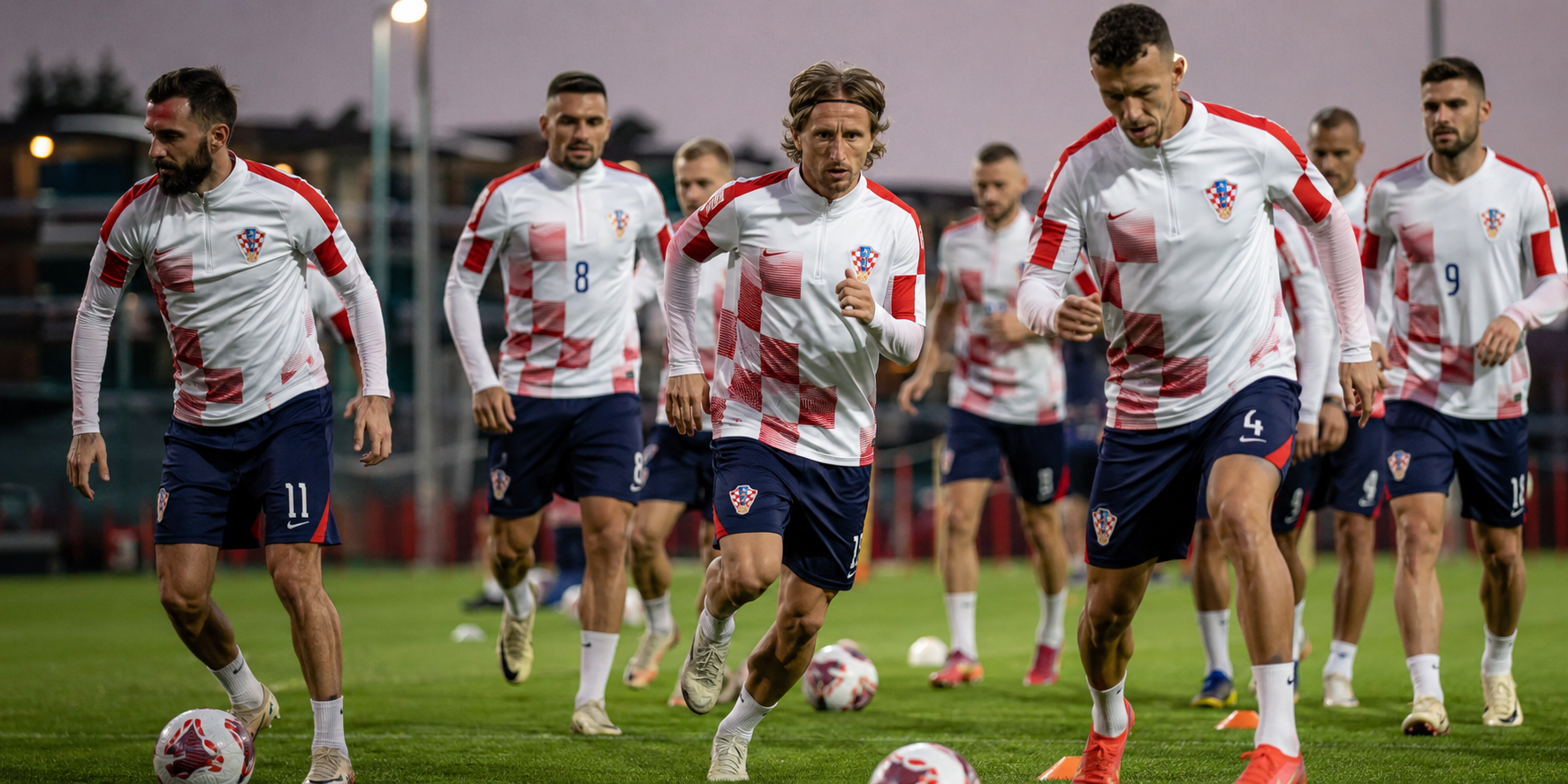
Everything at a glance
- Nickname
- Vatreni "The Blazers / Fiery Ones"
- Confederation
- UEFA Europe
- FIFA Ranking
- 12th spring 2026 — rankings shift before kickoff
- Head Coach
- Zlatko Dalic Led Croatia to 2018 final and 2022 third place
- Captain
- Luka Modric Ballon d'Or winner · record cap-holder · 5th World Cup
- WC Appearances
- 7th 1998, 2002, 2006, 2014, 2018, 2022, 2026
- Best Finish
- Runners-up 2018 · also third in 1998 and 2022
- Group
- Group L ENG · GHA · PAN · CRO
Few small nations have punched above their weight like Croatia.
Few small nations have punched above their weight like Croatia. With a population of under four million, the Vatreni have produced two of the most remarkable World Cup runs in modern history — finishing runners-up in 2018 and reaching the semi-finals (third place) in 2022. At the heart of it all is Luka Modric, the Ballon d’Or-winning midfield maestro who, even at 40, remains the captain and conductor.
Croatia are managed by Zlatko Dalic, the steady hand who has guided them to consecutive deep runs and topped a qualifying group ahead of Czechia, Montenegro, the Faroe Islands and Gibraltar, winning seven of eight matches. The 2026 tournament has the unmistakable feel of a farewell tour for the golden generation — and a passing of the torch to younger players like Luka Sucic.
The unmistakable feel of a farewell tour — and a passing of the torch to younger players like Luka Sucic.
The ultimate tournament team — masters of grinding out results
Croatia are the ultimate tournament team — masters of grinding out results, winning shootouts and outlasting more talented sides in extra time. The central storyline of 2026 is Luka Modric, set to feature at his fifth World Cup as a 40-year-old captain, an extraordinary act of longevity. Whether this is genuinely his final international tournament adds emotional weight to every Croatia match.
Beyond the romance, Croatia remain tactically sophisticated and mentally ruthless. They specialise in the kind of patient, controlled football that frustrates favourites — exactly the profile that makes them dangerous opponents for England in the Group L opener.
The bar, and the dream
Croatia are expected to compete for top spot in Group L and should comfortably target the knockout rounds. Their opener against England is likely to decide first place, with Ghana and Panama representing winnable fixtures. Given their pedigree, a place in the last 16 is the baseline expectation, and a deeper run is well within their range if the veterans stay fit.
The honest concern
The midfield engine relies on players in their thirties (and Modric at 40), and key contributors like Mateo Kovacic have battled injury. If Dalic can manage minutes across the expanded format, Croatia could once again go further than their ranking suggests.
Dalic’s likely 26
Based on Dalic’s announced 26-man squad and reporting; likely starters marked. Club listings reflect available reporting and may include recent moves.
Goalkeepers
3- Dominik Livakovic
- Dominik Kotarski
- Ivor Pandur
Defenders
7- Josko Gvardiol
- Duje Caleta-Car
- Josip Sutalo
- Josip Stanisic
- Marin Pongracic
- Martin Erlic
- Luka Vuskovic
Midfielders
10- Luka Modric
- Mateo Kovacic
- Mario Pasalic
- Nikola Vlasic
- Luka Sucic
- Martin Baturina
- Kristijan Jakic
- Petar Sucic
- Nikola Moro
- Toni Fruk
Forwards
6- Ivan Perisic
- Andrej Kramaric
- Ante Budimir
- Marco Pasalic
- Petar Musa
- Igor Matanovic
Standby list
7- Lovro Majer
- Franjo Ivanovic
- Dion Drena Beljo
- Ivan Smolcic
- Karlo Letica
- Adrian Segecic
- Luka Stojkovic
★ Likely starters. Some individual clubs and the precise starting XI could not be fully verified for every player; exact roles remain Dalic’s decision. Treat squad specifics as provisional.
The names that decide it
The talisman, record cap-holder and conductor of everything Croatia do. His vision, set-piece delivery and game management remain world-class even at 40 — the heartbeat of the team. He holds Croatia’s all-time appearance record and is set for a fifth World Cup.
A ball-playing centre-back often deployed at full-back, combining pace, aggression and progressive passing — Croatia’s defensive cornerstone. He recovered from a serious leg injury that threatened his World Cup participation.
A press-resistant carrier who glides through midfield and links defence to attack — vital if Modric’s minutes are managed. He missed a large chunk of the season with Achilles trouble.
The face of the next generation: technically gifted and composed beyond his years, tasked with eventually inheriting Modric’s role. Seen as a potential breakout star of the tournament.
A clever, two-footed finisher and one of Croatia’s most reliable goal sources at international level, providing experience up front.
Breakout Player
Luka Sucic (Real Sociedad) — with the golden generation ageing, Sucic is the player Croatian fans are watching most closely. Technically refined and comfortable under pressure, a strong tournament could announce him as the long-term successor to Modric in the engine room of the Vatreni.
Most Underrated Player
Josip Stanisic (Bayern Munich) — a versatile, dependable defender who can cover both full-back roles and centre-back, Stanisic does the unglamorous work that lets Croatia’s midfield artists flourish. In a team built on balance and tournament savvy, his flexibility is quietly invaluable.
Patient, possession-oriented and midfield-dominant
Croatia play a patient, possession-oriented, midfield-dominant game. Dalic typically builds around a three-man central midfield that controls tempo, recycles possession and slowly suffocates opponents. They are comfortable in low-scoring, tight contests and excel at game management — protecting leads, drawing fouls and thriving in extra time and shootouts.
The trade-offs are pace and physicality: against quick, direct teams, an ageing midfield can be exposed in transition. Their identity is intelligence over athleticism.
By the numbers
Attack: Reliable rather than explosive; goals are shared and often midfield-created. Midfield: Still elite in quality and game intelligence, even with age concerns. Defense: Organised and led by Gvardiol, though vulnerable to pace.
Goalkeeping: Experienced and shootout-tested. Depth: Strong in midfield, thinner in attacking firepower. Experience: Among the most tournament-hardened squads in the world. A proven knockout-round side whose ceiling depends on the legs of its veterans.
A reputation built on extra time, shootouts and World Cup folklore.
Croatia announced themselves in spectacular fashion at their 1998 debut, finishing third with Davor Suker winning the Golden Boot. After a quieter period, the golden generation delivered the nation’s finest hours: a stunning run to the 2018 final in Russia, where they fell to France, and a third-place finish in 2022 in Qatar after edging Brazil on penalties in the quarter-finals.
Their reputation as serial extra-time and shootout survivors is now part of World Cup folklore. The 2026 edition is their seventh appearance overall.
-
1998
Third place — a stunning debut
Croatia announced themselves on the world stage with a third-place finish, as Davor Suker won the Golden Boot.
-
2018
Runners-up — the nation’s finest hour
A stunning run to the final in Russia, defeating England and Argentina along the way, before falling to France.
-
2022
Third place again — edged Brazil on penalties
Another remarkable run in Qatar, culminating in a quarter-final penalty shootout win over favourites Brazil, before a semi-final defeat.
The grass remembers everything
Third place in their debut
Croatia finished third on their World Cup debut in 1998.
2018’s extra-time marathon
They reached the 2018 final despite playing three consecutive knockout games that went to extra time.
Modric at 40 — a fifth World Cup
Luka Modric is set to appear at his fifth World Cup at the age of 40.
Eliminated Brazil on penalties
Croatia eliminated favourites Brazil on penalties at the 2022 World Cup.
One of the smallest nations in a final
With under four million people, Croatia is one of the smallest nations ever to reach a World Cup final.
Suker’s 1998 Golden Boot
Davor Suker’s 1998 Golden Boot remains a benchmark for Croatian forwards.
Seven wins from eight in qualifying
Croatia topped their 2026 qualifying group, winning seven of eight matches.
The iconic checkerboard kit
The Vatreni are famed for their red-and-white checkerboard kit, drawn from the national coat of arms.
Four reasons to tune in
- Modric’s farewell — a chance to watch one of football’s greatest midfielders on the biggest stage, likely for the last time.
- Giant-killers — Croatia routinely outperform their ranking and topple favourites.
- Drama specialists — if a match is heading to extra time or penalties, Croatia are usually involved.
- A revealing opener — Croatia vs England is a heavyweight tactical chess match.
Knockout-round qualification — with quarter-final potential if the veterans stay fit.
Croatia should reach the knockout stages comfortably, likely finishing first or second in Group L behind or alongside England. Their tournament nous makes them dangerous in any single knockout tie, and a run to the quarter-finals would be no surprise. The limiting factor is whether the ageing core can sustain its level across an expanded tournament. Projected: knockout qualification, with quarter-final potential.
