Squad, Davies, Marsch & Group B
Canada at World Cup 2026: co-hosts in Group B under Jesse Marsch, led by Alphonso Davies and Jonathan David. Full squad, key players and predictions.
Canada
Les Rouges · CONCACAF · Group B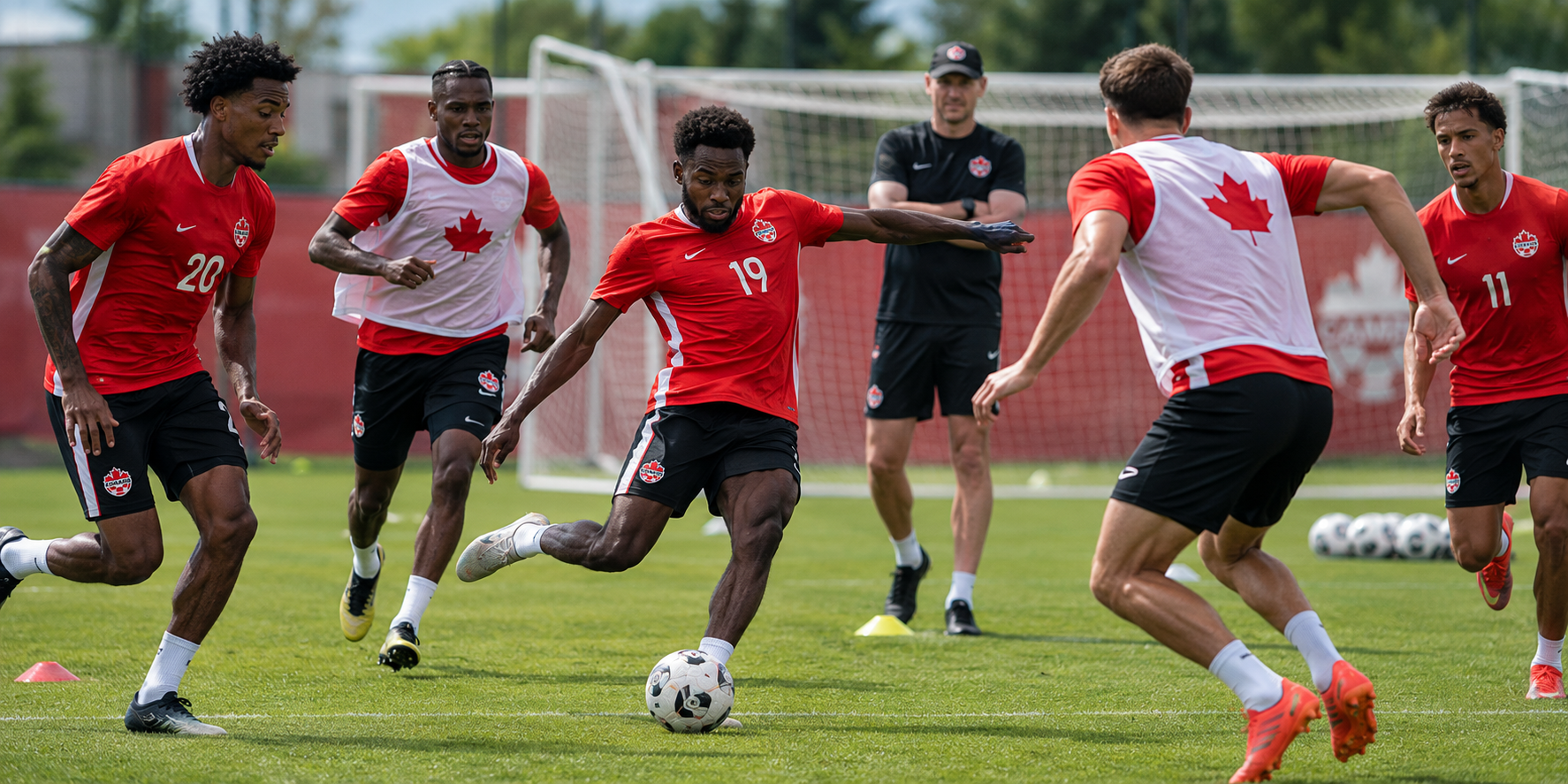
Everything at a glance
- Nickname
- Les Rouges / The Reds Canucks
- Confederation
- CONCACAF
- FIFA Ranking
- Around 30th 30 (March 2026), peaked at 28 in July 2025
- Head Coach
- Jesse Marsch USA
- Captain
- Alphonso Davies
- World Cup Appearances
- 3 1986, 2022 and 2026
- Best Finish
- Group stage Never advanced past the group stage
- Group
- Group B Switzerland, Bosnia and Herzegovina, Qatar · Seeded B1 as co-hosts
One of the most intriguing co-hosts in tournament history.
Canada arrive at their home World Cup as one of the most intriguing co-hosts in tournament history. For decades, Canadian men’s soccer lived in the shadow of hockey and of their southern neighbours, with a single, pointless World Cup appearance in 1986 to show for generations of effort. That changed dramatically in the 2022 cycle, when a young, athletic and increasingly Europe-based generation stormed through CONCACAF qualifying to top the region and reach Qatar 2022.
In 2026, Canada qualify automatically as one of three host nations alongside the United States and Mexico. The squad is built around a core of players competing at elite clubs across Europe, blended with MLS and domestic talent. Under American head coach Jesse Marsch — appointed in 2024 and since signed to a long-term extension reportedly running toward 2030 — Canada have grown more tactically disciplined while keeping the verticality and athleticism that define their best football.
A young, athletic and increasingly Europe-based generation stormed through CONCACAF qualifying to top the region.
The rare host nation arriving with genuine momentum.
Canada represent the rare host nation arriving with genuine momentum rather than just home-soil hope. Their fan culture is young, multicultural and loud, mirroring a national team drawn from across the country’s diverse communities. The narrative is irresistible: a program that had never won a World Cup point or scored a World Cup goal until 2022 (when they scored but lost all three) now gets to chase its first-ever knockout berth in front of home crowds. Add a globally recognised superstar in Alphonso Davies and a proven goalscorer in Jonathan David, and Canada become one of the tournament’s best feel-good stories.
A program that had never won a World Cup point or scored a World Cup goal until 2022 now gets to chase its first-ever knockout berth in front of home crowds.
The bar, and the dream
The realistic target is the first knockout-stage appearance in Canadian men’s history. The expanded 48-team format, which sends the top two from each group plus the best third-placed sides through, gives Canada a strong mathematical chance. Drawn into Group B with Switzerland, Bosnia and Herzegovina and Qatar, Canada will fancy themselves to finish in the top two. Much hinges on the fitness of Alphonso Davies, who has battled serious injury problems; head coach Jesse Marsch has publicly acknowledged his participation is not guaranteed. If Davies is fit and David finds form, a quarter-final run is not fantasy. If key players are absent, simply advancing would be a success.
The realistic route
Canada will fancy themselves to finish in the top two of Group B. If Davies is fit and David finds form, a quarter-final run is not fantasy. If key players are absent, simply advancing would be a success.
Marsch’s 26
Projection based on recent call-ups and pre-tournament camp reporting; final selections may differ.
Goalkeepers
3- Maxime Crepeau
- Owen Goodman
- Dayne St. Clair
Defenders
9- Moise Bombito
- Derek Cornelius
- Alphonso Davies
- Luc de Fougerolles (if fit · left-back)
- Alistair Johnston
- Alfie Jones
- Richie Laryea
- Niko Sigur
- Joel Waterman
Midfielders
9- Ali Ahmed
- Tajon Buchanan
- Mathieu Choiniere
- Stephen Eustaquio
- Ismael Kone
- Liam Millar
- Jonathan Osorio
- Nathan-Dylan Saliba
- Jacob Shaffelburg
Forwards
4- Jonathan David
- Promise David
- Cyle Larin
- Tani Oluwaseyi
★ Likely starters. Alphonso Davies fitness is in doubt; Marsch has publicly acknowledged his participation is not guaranteed.
The names that decide it
Explosive, end-to-end pace; one of the fastest players in world football, equally dangerous defending and overlapping. Captain, talisman and the face of Canadian soccer. Fact: His participation is in doubt due to a difficult run with injuries; Marsch has cautioned that he may not be fully available.
Intelligent movement, two-footed finishing, links play well. Canada’s primary goalscorer and a player with elite European pedigree after a prolific spell in Ligue 1. Fact: He moved to Juventus and has been Canada’s go-to forward through qualifying-era friendlies and Nations League play.
Deep-lying playmaker and metronome who dictates Canada’s tempo. The team’s midfield heartbeat and set-piece option. Fact: Born in Canada, raised partly in Portugal, he chose to represent Les Rouges.
Combative, athletic, reliable defensively with strong delivery. A dependable starter and vocal leader on the right flank. Fact: A regular Champions League performer with Celtic.
Box-to-box energy, progressive carrying. Provides legs and drive alongside Eustáquio. Fact: Emerged from the Montreal system before moving to Europe.
Breakout Player
Moïse Bombito (Defender) — A powerful, fast modern centre-back who has risen rapidly through MLS into European football. On home soil, with a back line that may need to cover for an attack-minded Davies, Bombito’s pace and aggression could make him one of the tournament’s revelation defenders.
Most Underrated Player
Stephen Eustáquio — In a squad headlined by Davies and David, Eustáquio’s quiet control of midfield is the engine that makes Canada function. Without his composure in possession, Canada’s transitions become chaotic. He rarely makes headlines, but coaches and analysts consistently rate him as indispensable.
Energetic, pressing-oriented — built for vertical speed.
Under Marsch, Canada lean toward an energetic, pressing-oriented approach, often in a 4-3-3 or 3-4-2-1, designed to win the ball high and attack in transition. Their greatest weapon is vertical speed: get the ball wide to Davies or Buchanan, or in behind for David, and let athleticism do the rest. Marsch’s German-school influence shows in coordinated pressing triggers. The risk is that against organised, possession-based sides, Canada can be stretched and over-reliant on individual brilliance.
By the numbers
Attack: David and Larin give real cutting edge; depth behind them is thinner.
Midfield: Eustáquio is excellent; overall creativity is moderate.
Defense: Athletic and improving, but prone to lapses against elite movement.
Goalkeeping: St. Clair is steady; not a standout strength.
Depth: Strong first XI, but injuries (notably Davies) expose limited high-end backups.
Experience: Many starters have one World Cup; still a relatively young program.
A story brief in chapters, but building toward history.
Canada’s World Cup story is brief. They debuted at Mexico 1986, losing all three group games (to France, Hungary and the Soviet Union) without scoring a goal. A 36-year absence followed until they topped CONCACAF qualifying to reach Qatar 2022. There, they lost all three group matches again — to Belgium, Croatia and Morocco — but did register their first-ever World Cup goal, scored by Alphonso Davies against Croatia. The 2026 tournament is their third appearance and first as hosts, and they have never reached the knockout rounds.
-
1986
World Cup debut — Mexico 1986
Lost all three group games (to France, Hungary and the Soviet Union) without scoring a goal. A 36-year absence would follow.
-
2022
Return after 36 years — Qatar 2022
Lost all three group matches again — to Belgium, Croatia and Morocco — but registered their first-ever World Cup goal, scored by Alphonso Davies against Croatia.
-
2026
Third appearance, first as hosts
Automatic qualification as co-hosts. The first opportunity in Canadian men’s history to reach the knockout rounds.
36 years, one first goal, and a journey from a refugee camp to Bayern Munich
Canada’s first-ever World Cup goal
Alphonso Davies scored Canada’s first-ever men’s World Cup goal, against Croatia in 2022.
Davies’s remarkable origin story
Davies was born in a refugee camp in Ghana to Liberian parents before his family settled in Edmonton.
36 years between appearances
Canada went 36 years between World Cup appearances (1986 to 2022).
An American coaching Canada at a North American World Cup
Head coach Jesse Marsch is American, making for a notable cross-border storyline at a North American World Cup.
Zero points until the 2022 generation
Canada had never scored or earned a point at a World Cup until the 2022–2026 generation arrived.
Canada’s host cities for 2026
Toronto and Vancouver are Canada’s host cities for the 2026 tournament.
2000 CONCACAF Gold Cup champions
Canada won the 2000 CONCACAF Gold Cup, long their biggest senior trophy.
Jonathan David’s Ligue 1 century
Jonathan David racked up more than 100 Ligue 1 goals before his move to Italy.
Watching Alphonso Davies in full flight is one of football’s pure thrills.
- Watching Alphonso Davies in full flight is one of football’s pure thrills — assuming he’s fit.
- A host nation chasing its first-ever World Cup knockout berth makes for compelling stakes.
- Canada play fast, vertical, high-energy football that rarely produces dull games.
- The feel-good underdog-on-home-soil narrative is among the best in the tournament.
Knockout-stage qualification — Round of 32 (with upside).
Canada have the talent and the home advantage to escape Group B, most likely finishing second behind Switzerland or fighting for a best-third-place berth. If Davies is fully fit, expect them to reach the Round of 32 and possibly spring a knockout upset to make history. If injuries bite, a narrow group exit is the downside scenario.
