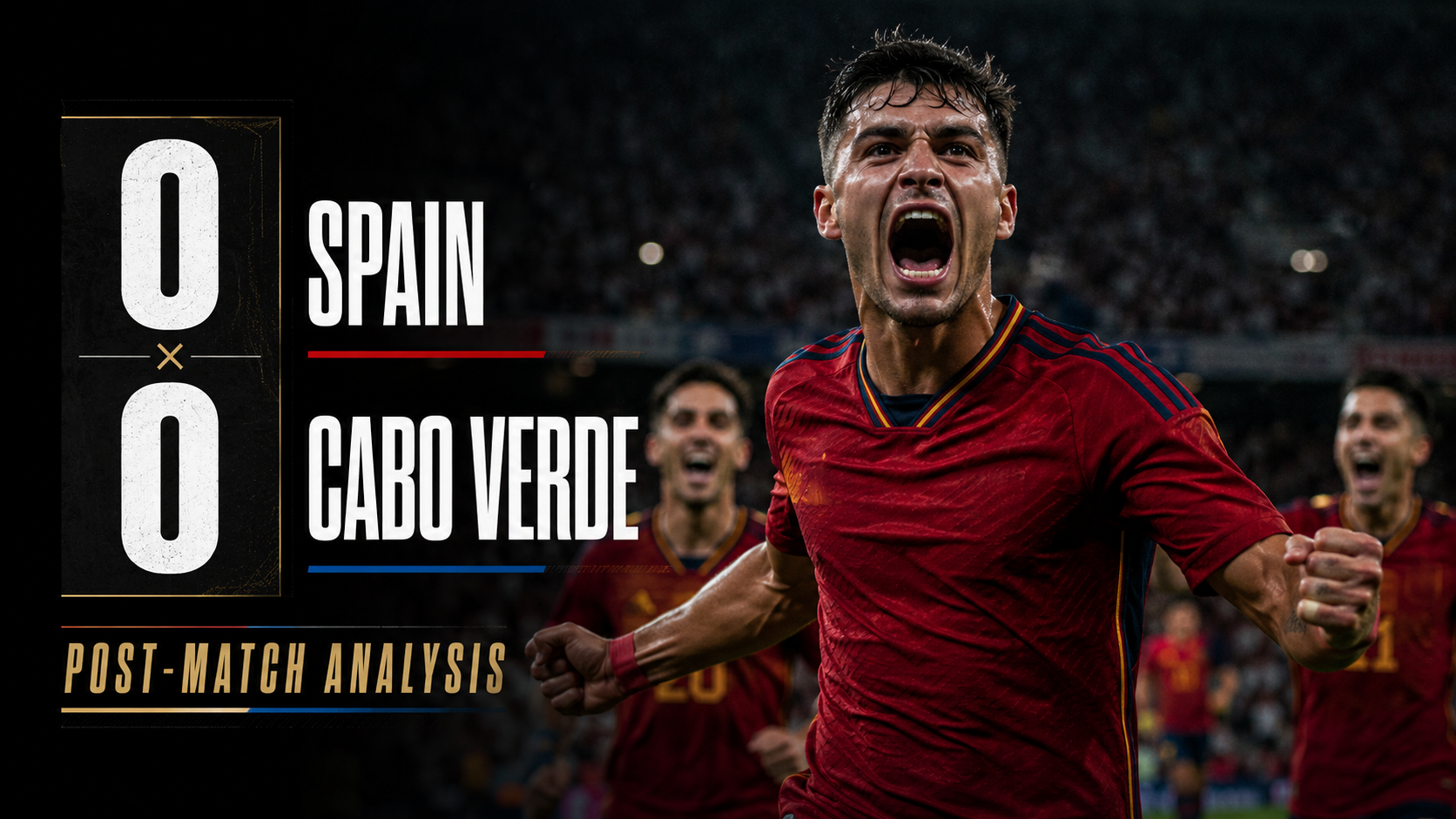
Spain vs Cabo Verde Islands: 0-0 Draw — FIFA World Cup 2026 Group Stage Tactical Analysis
Spain dominated possession and created the lion’s share of chances but were frustrated by a resolute Cabo Verde Islands side in a surprise 0-0 Group Stage stalemate at Atlanta Stadium. With an xG of 2.61 versus 0.27, Luis de la Fuente’s men will rue a wasteful afternoon in Georgia.
What happened
There were no shortage of expectations when Spain walked out at Atlanta Stadium for their FIFA World Cup 2026 Group Stage opener against Cabo Verde Islands. The reigning European champions — a side built on relentless pressing, intricate combinations, and one of the deepest squads at the tournament — were heavy favourites against a Cabo Verdean outfit making their mark on football’s grandest stage. What unfolded over 90-plus minutes was a testament to the unpredictability of the World Cup: Spain dominated in nearly every measurable category, piling up 796 passes with a 92% completion rate and generating an xG of 2.61, yet goalkeeper Josimar Évora Dias and a disciplined Cabo Verde defensive block held firm to claim a famous point. The scoreboard read 0-0 at full time — a result that sent shockwaves through Group Stage calculations and gave the Blue Sharks one of the most celebrated results in their short international history.
How it was won and lost
Spain’s Possession Dominance — All the Territory, Not the Trophy
Spain controlled this match in every spatial and statistical sense. Their 796 passes — compared to Cabo Verde’s 278 — reflected a side that dictated tempo from the first whistle. Operating in what appeared to be a fluid 4-3-3 that morphed into a 3-2-5 in possession phases, Spain overloaded wide areas, with Ferrán Torres and Yeremi Pino stretching the Cabo Verde defensive line. Fabián Ruiz and Pedri orchestrated from deep, recycling possession with precision and looking to unlock a packed defensive shape. Despite creating 20 shots (11 on target), Spain could not find the decisive moment, with the final ball repeatedly breaking down at the edge of Cabo Verde’s compact low block.
Cabo Verde’s Defensive Masterclass — The Low Block That Held
Head coach Pedro Brito deployed a disciplined 5-4-1 defensive structure that denied Spain any meaningful pockets of space centrally. Cabo Verde’s 84% of defensive actions in their own half tells its own story: this was a team that came to contain, frustrate, and counter. Garry Mendes Rodrigues and Jovane Cabral were tasked with tracking back diligently, ensuring Spain’s full-backs — Grimaldo and Pubill — could not create dangerous overlaps unopposed. With 14 defensive clearances and aggressive pressure when Spain played into the final third, Cabo Verde executed their gameplan with near-perfect discipline.
Spain’s Transition Struggles — Width Without Penetration
While Spain had 74% of possession and dominated territory, their transitions into the final third lacked incisiveness against Cabo Verde’s organised shape. Despite 34 dribble attempts and 17 crosses, the quality of delivery into the box was frequently poor. Pablo Martín Páez Gavi, operating centrally, found limited space between the Cabo Verde midfield and defensive lines, limiting Spain’s ability to play through the press and into dangerous areas. The wide forwards, though active, struggled to find the half-space combinations that typically unlock deep defensive blocks for La Roja.
Substitutions Change Shape But Not the Score
Spain’s coaching staff made bold moves from the 71st minute, introducing Mikel Merino for Fabián Ruiz and withdrawing Gavi for the electric Lamine Yamal, aiming to stretch Cabo Verde with pace and directness. Daniel Olmo replaced Ferrán Torres in the 81st minute, and Nicholas Williams came on for Rodrigo Hernández in the 87th, adding fresh legs and unpredictability in the closing stages. Cabo Verde had already made wholesale changes from the 61st minute, freshening their midfield and wide positions to maintain their defensive press and disrupt Spain’s rhythm — a substitution strategy that proved decisive in protecting the clean sheet.
Who decided it
Josimar Évora Dias
Cabo Verde IslandsThe Cabo Verde goalkeeper was the standout performer of the match, making a series of crucial saves to deny Spain on a day when they generated an xG of 2.61. Évora Dias was commanding in the air, decisive in one-on-one situations, and composed under sustained pressure from a Spanish attack that included some of Europe’s finest forwards.
His ability to keep a clean sheet against a side that attempted 20 shots — 11 on target — was the defining tactical contribution of the match. Without his interventions, Spain would almost certainly have converted their dominant xG into goals and claimed a comfortable victory.
Fabián Ruiz Peña
SpainThe Paris Saint-Germain midfielder was Spain’s metronome in the first half, completing passes with precision from deep midfield positions and driving forward to test the Cabo Verde defensive structure. His withdrawal in the 71st minute for Mikel Merino suggested the coaching staff sought more physicality in midfield as Spain chased the game.
Ruiz’s press-resistance and ability to carry the ball through lines gave Spain their clearest moments of forward momentum. His absence in the second half coincided with Spain’s inability to find the cutting edge they needed to break the deadlock.
Garry Mendes Rodrigues
Cabo Verde IslandsThe veteran Cabo Verde winger worked tirelessly across the pitch, contributing defensively and providing moments of attacking threat on the counter-attack. His tracking back to deny Grimaldo space in wide areas was a key tactical element of Cabo Verde’s defensive plan.
Rodrigues exemplified Cabo Verde’s collective defensive discipline and provided the rare counter-attacking threat that kept Spain’s back line honest throughout the second half.
Logan Costa
Cabo Verde IslandsThe centre-back was commanding throughout, organising Cabo Verde’s defensive shape with authority and winning aerial duels against Spain’s physical forwards. His composure under pressure was critical in preserving the clean sheet.
Costa’s leadership at the back and his ability to read Spain’s attacking patterns — particularly through central areas — was central to Cabo Verde’s disciplined defensive performance.
Where it sits in history
Cabo Verde Islands qualified for the FIFA World Cup for the first time in their history in 2026, making this Group Stage encounter a landmark moment for African football. Spain, by contrast, arrived in the United States as one of the tournament’s heaviest favourites — reigning European champions following their UEFA Euro 2024 triumph, with a golden generation headlined by Lamine Yamal, Pedri, and Gavi. A goalless draw against a debutant World Cup nation will rank among the more surprising results of Spain’s recent international history, echoing the kind of opening-game frustration that has occasionally preceded deeper tournament runs for La Roja. Spain’s last World Cup triumph came in South Africa in 2010, and the class of 2026 carries the weight of that legacy into every match.
Inside the ground
Atlanta Stadium — with a capacity of 71,000 — provided a vibrant backdrop for this unexpected Group Stage contest. The city of Atlanta, one of the USA’s most culturally diverse, brought energy from both sets of supporters. Spain’s fanbase, bolstered by a significant diaspora across North America, generated noise throughout, particularly when La Roja threatened on goal. But the real emotional scenes came from the Cabo Verde supporters, a passionate community whose pride in their nation’s first-ever World Cup appearance was palpable. When the final whistle blew, the Cabo Verdean end of Atlanta Stadium erupted — for them, this was a result worth celebrating like a victory.
Looking ahead
Spain will regroup quickly as they look to bounce back in their second Group Stage fixture and reassert their tournament credentials. A draw against Cabo Verde Islands is far from catastrophic — points are still on the board — but Luis de la Fuente will demand greater clinical efficiency from a squad that should be converting dominant xG performances into wins. For Cabo Verde Islands, this is a historic result that opens up genuine possibilities in Group Stage progression. Their defensive organisation and squad spirit will be tested further, but the belief generated by holding Spain will fuel their remaining fixtures with renewed confidence. All eyes now turn to the next round of Group Stage matches to see whether this result reshapes the group dynamics entirely.
The bottom line
-
Spain dominated possession with 796 passes and a 92% completion rate but failed to convert an xG of 2.61 into goals
-
Cabo Verde Islands earned a historic point in their FIFA World Cup debut, holding Spain to a 0-0 draw
-
Josimar Évora Dias was outstanding in goal for Cabo Verde, producing multiple crucial saves
-
Spain created 20 shots (11 on target) without finding the net — wasteful finishing the primary concern
-
Cabo Verde’s disciplined 5-4-1 defensive block frustrated Spain’s combination play throughout
-
Spain’s substitutions — including Lamine Yamal and Daniel Olmo — failed to unlock the Cabo Verde defence
-
Cabo Verde’s triple substitution at the 61st minute was a tactically astute move that refreshed their defensive structure
-
The result leaves Spain’s Group Stage campaign open and Cabo Verde with a platform to pursue further surprises
-
Logan Costa and Garry Mendes Rodrigues were defensive standouts for the Blue Sharks
-
Spain will need to improve clinical finishing significantly if they are to challenge for the FIFA World Cup 2026 title
