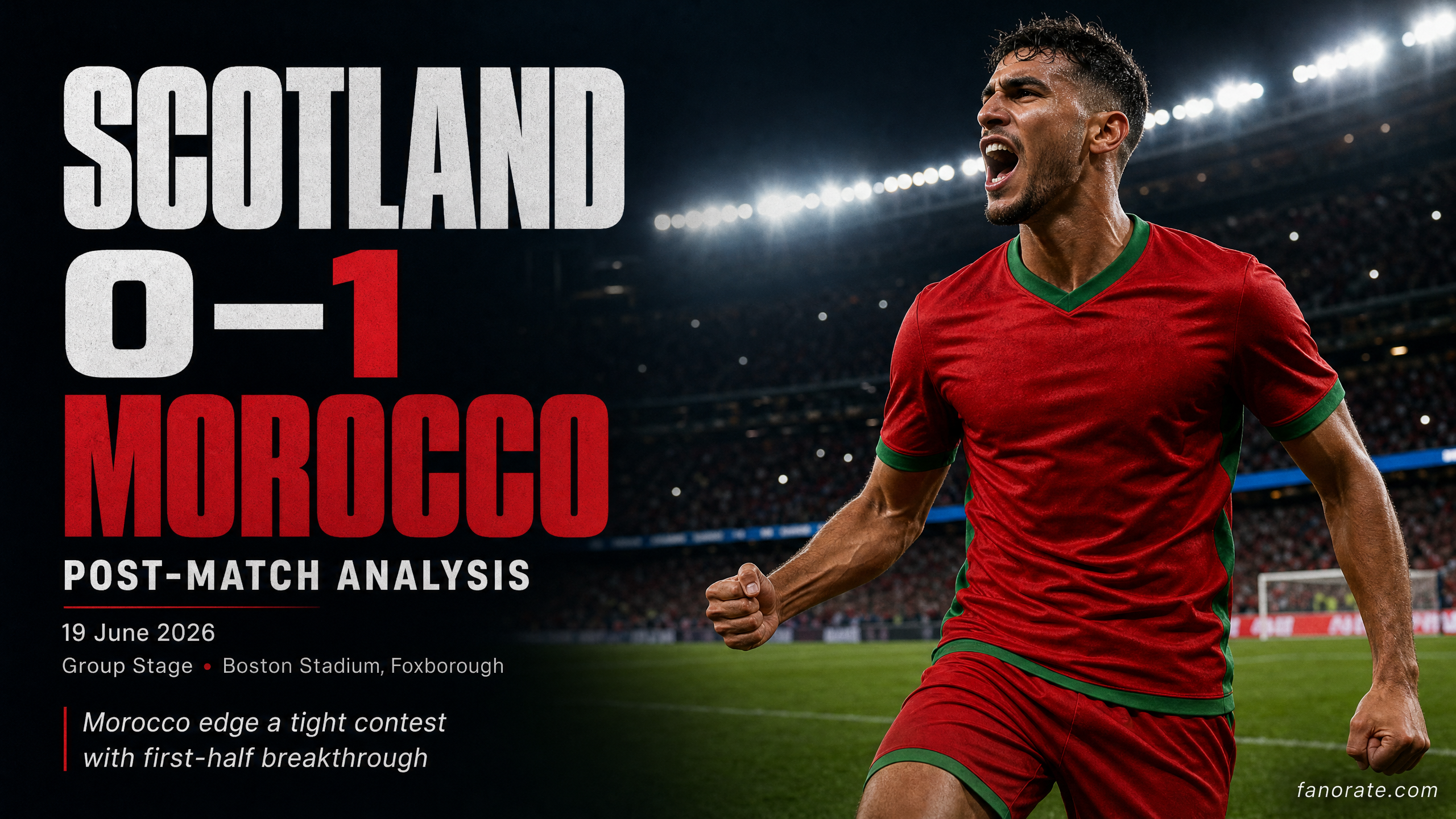
Scotland 0-1 Morocco: Atlas Lions Strike Early to Sink Brave Scots at FIFA World Cup 2026
Ismael Saibari needed just two minutes to break Scottish hearts at Gillette Stadium, as Morocco’s clinical early strike proved enough to secure a composed 1-0 victory over Scotland in the FIFA World Cup 2026 Group Stage. The Atlas Lions controlled possession, managed the contest intelligently, and left Foxborough with three vital points.
What happened
Morocco wasted absolutely no time announcing their intentions at Gillette Stadium. Within 120 seconds of the FIFA World Cup 2026 Group Stage opener, Ismael Saibari latched onto a precise delivery from Brahim Diaz and rifled a right-footed shot past Angus Gunn to send the Atlas Lions surging into the lead. From that moment, Scotland were chasing shadows. Morocco, who stunned the world at Qatar 2022 by reaching the semi-finals, showed exactly why they remain one of the most tactically sophisticated sides in international football. They absorbed Scotland’s sporadic pressure with disciplined structure, controlled large spells of possession, and ultimately ran out deserved 1-0 winners under the broken clouds over Foxborough. For Scotland, it is a damaging opening defeat that leaves them with serious work to do in the group.
How it was won and lost
Morocco’s Blistering Start: Saibari Strikes in 120 Seconds
The goal that decided this match arrived before most supporters had settled into their seats. Brahim Diaz — operating as Morocco’s creative fulcrum in the No.10 role — played a sharp combination that released Ismael Saibari down the right channel. The winger showed composure far beyond the pressure of the moment, taking a single touch to set his feet and drilling a clinical right-footed finish past Gunn. It was a perfectly executed opening-minute press, exploit, and finish that exposed Scotland’s failure to establish early defensive shape.
Morocco’s Possession Control and Structural Discipline
Morocco dominated the ball throughout, completing 601 passes to Scotland’s 388 and recording an 85–90% passing accuracy differential. Their positional structure was meticulous — Sofyan Amrabat anchored the midfield as a deep-lying disruptor, allowing Brahim Diaz and Azzedine Ounahi to roam with creative freedom ahead of him. Morocco’s 59% possession share allowed them to dictate tempo, slow the game when needed, and deny Scotland any sustained rhythm. It was the kind of assured, mature performance that reflected years of collective tactical development under their coaching staff.
Scotland’s Inability to Create: Shots on Target Tell the Story
Scotland mustered only 6 shots in total compared to Morocco’s 10, and the difference in quality was stark. The Scots recorded just 0.62 xG across the entire match against Morocco’s 1.15 xG — a gap that accurately reflects how few genuine chances Scotland carved out. Scotland’s attacking play was disjointed, with Che Adams and Lyndon Dykes (introduced as a second-half substitute) struggling to receive meaningful service. Morocco’s back line, organized by the ever-reliable Noussair Mazraoui and Issa Diop, maintained their shape and restricted Scotland’s forward runners throughout.
Scotland’s Pressing Ambitions Fall Flat
Scotland did attempt to press Morocco high in the first half, but Morocco’s technical quality on the ball — particularly from Amrabat and Brahim Diaz under pressure — allowed them to navigate through Scotland’s press repeatedly. With 97% passing accuracy in certain phases and a significant advantage in short combination play, Morocco consistently broke Scotland’s press lines and progressed into advanced areas. Scotland’s high press became increasingly ineffective and energetically costly, contributing to their struggles in the second half.
Half-Time Adjustments and Scotland’s Late Push
Scotland’s manager introduced Ben Doak for Kieran Tierney at the 60-minute mark — a bold attacking move that signalled a shift toward width and direct running. Lyndon Dykes and Kenny McLean followed at the 71st minute, giving Scotland a physical presence up front and additional midfield energy. However, Morocco responded intelligently. Their own substitutions at the 84th and 90th minute — including fresh legs via Soufiane Rahimi and Chemsdine Talbi — helped the Atlas Lions see out the game without ever looking threatened. Scotland’s late territorial pressure came to nothing, with Morocco defending their lead with calm authority.
Set-Piece Threat: Morocco’s Dead-Ball Danger
Morocco registered 4 corner kicks and 4 free kicks in attacking areas throughout the match. While none of these directly led to goals, Morocco’s aerial presence — particularly through Issa Diop — created moments of concern for Scotland’s defense. Scotland, meanwhile, recorded 6 corners and 3 free kicks but lacked the delivery and movement to convert dead-ball situations into genuine danger. Morocco’s set-piece defensive organization was also strong, clearing their lines efficiently under any aerial threat.
Who decided it
Ismael Saibari Ben El Basra
MoroccoThe match-winner and arguably the player of the match. Saibari’s second-minute right-footed strike — set up by a brilliant Brahim Diaz assist — was the defining moment of the entire contest. He was bright, direct, and created constant problems down Morocco’s right flank throughout.
Saibari’s early goal forced Scotland into an immediate reactive posture and shaped the entire tactical narrative of the match. His ability to exploit space behind Scotland’s full-back line was a consistent threat and a key element in Morocco’s attacking blueprint.
Brahim Abdelkader Diaz
MoroccoBrahim Diaz was Morocco’s creative heartbeat. Operating in the No.10 space, he linked play with intelligence, drew fouls, and provided the decisive assist for Saibari’s opener with a perfectly weighted delivery. His technical quality in tight spaces repeatedly unlocked Scotland’s midfield block.
Diaz functioned as Morocco’s primary press-breaker and creative architect. His ability to receive in tight spaces and play quickly through the lines gave Morocco a consistent avenue to bypass Scotland’s midfield structure and build dangerous attacking sequences.
Sofyan Amrabat
MoroccoThe midfield engine. Amrabat was everywhere defensively — winning second balls, breaking up Scotland’s rare attacks, and distributing efficiently to launch Morocco’s possession cycles. His presence allowed Morocco’s attacking midfielders to operate with freedom.
Amrabat’s role as a deep-lying shield was critical to Morocco’s structure. He prevented Scotland from ever establishing midfield dominance and served as the pivot around which Morocco’s entire game plan was built.
Scott McTominay
ScotlandIn a difficult day for Scotland, McTominay was one of the few bright spots — working tirelessly in midfield, attempting to drive Scotland forward and bridge the gap between defence and attack. However, he was unable to single-handedly fix the structural issues that plagued Scotland throughout.
McTominay’s work rate and pressing energy kept Scotland competitive in the midfield battle for spells, but without adequate support from the wide areas, his individual efforts could not compensate for the team’s collective tactical shortcomings.
Yassine Bounou
MoroccoThe Morocco goalkeeper was rarely truly tested, reflecting his side’s defensive dominance. When called upon, Bounou was assured and commanded his area well. His composure on the ball contributed to Morocco’s build-up play from the back.
Bounou’s sweeper-keeping ability and distribution quality allowed Morocco to maintain their possession structure even from deep. Scotland’s lone shot on target presented minimal danger, underscoring the clean sheet’s relative comfort for the Atlas Lions stopper.
Where it sits in history
Morocco’s victory continues one of international football’s most remarkable recent ascents. After their stunning run to the semi-finals of the 2022 FIFA World Cup in Qatar — becoming the first African nation in history to reach the last four of the tournament — the Atlas Lions arrive at FIFA World Cup 2026 with genuine pedigree and continental pride driving their campaign. For Scotland, the World Cup 2026 represents the nation’s first appearance at a major tournament finals since France 1998 — a 28-year wait that made qualification an achievement in itself. But history cannot paper over the cracks of this performance. Scotland have now lost their opening group game at every World Cup they have participated in, and this defeat to Morocco maintains that painful tradition. The match at Gillette Stadium was a collision between a nation re-emerging onto the world stage and one that has become a modern standard-bearer for African football excellence.
Inside the ground
Gillette Stadium in Foxborough provided a vibrant and colourful backdrop for this World Cup 2026 Group Stage clash. Morocco’s supporters — well-represented across North America’s large Moroccan diaspora — generated an extraordinary wall of sound, with drums, chants, and national flags transforming sections of the 66,829-capacity venue into a replica of the atmosphere their fans are famous for creating. Scotland’s Tartan Army, never shy on the world stage, turned out in force as well — a sea of kilts, saltires, and unmistakable good humour, even as the result turned against them. The broken clouds overhead did little to dampen spirits, and both sets of fans contributed to the kind of tournament atmosphere that reminds the world why the FIFA World Cup is football’s greatest stage.
Looking ahead
Morocco will take their three points and move into the next phase of Group Stage action with significant momentum. A strong first result makes the Atlas Lions genuine contenders to top their group and advance deep into the knockout rounds — a prospect that will excite a generation of North African football supporters watching across the globe. For Scotland, the situation is urgent. A defeat in their second group match would leave them on the brink of elimination, and manager Steve Clarke will need to address the structural issues exposed by Morocco — particularly the lack of a coherent pressing structure, limited attacking creativity, and vulnerability to early-game pressure. The Tartan Army will rally behind their side, as they always do, but Scotland must respond with both tactical discipline and collective spirit if their FIFA World Cup 2026 dream is to stay alive.
The bottom line
-
Morocco struck inside 2 minutes through Ismael Saibari, assisted by Brahim Diaz, setting the tone for a controlled and disciplined performance
-
The Atlas Lions dominated possession — completing 601 passes to Scotland’s 388 — and controlled the match’s tempo from start to finish
-
Scotland’s xG of just 0.62 compared to Morocco’s 1.15 reflects how thoroughly the Atlas Lions outplayed their opponents across all phases
-
Brahim Diaz and Sofyan Amrabat were exceptional, providing both creative quality and midfield control to neutralize Scotland’s pressing ambitions
-
Scotland’s substitutions — Doak, Dykes, and McLean — failed to change the game’s dynamic as Morocco managed the closing stages with composure
-
Morocco continue their rise as a modern international football powerhouse, building on their historic 2022 semi-final run
-
Scotland face an uphill battle in the group after losing their World Cup 2026 opener — their first match at a major tournament since France 1998
