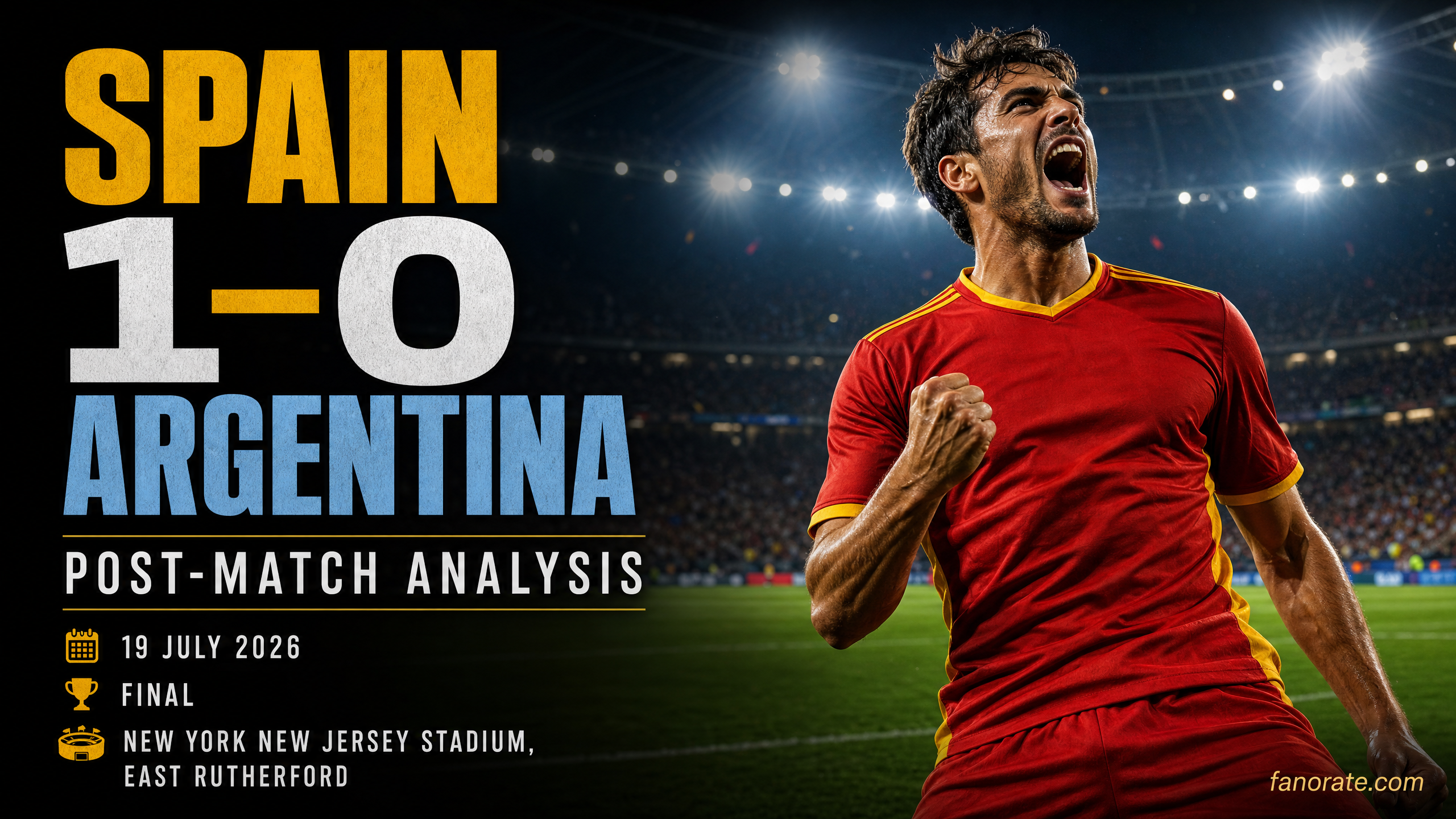
Spain 1-0 Argentina (AET): Ferrán Torres Wins the World Cup Final for La Roja | FIFA World Cup 2026
Ferrán Torres struck in the second period of extra time to hand Spain the FIFA World Cup 2026 trophy, ending a tense and fiercely contested final against Argentina at New York New Jersey Stadium. La Roja’s suffocating possession game ultimately wore down the reigning champions, who finished with ten men and zero shots on target.
Spain win after extra time
What happened
Under clear New Jersey skies, history was written at a heaving New York New Jersey Stadium. Spain claimed the FIFA World Cup 2026 trophy with a 1-0 victory over Argentina after extra time, Ferrán Torres converting a Nicholas Williams assist in the 106th minute to settle one of the most suffocating and tactically loaded World Cup Finals in recent memory. La Roja controlled the match with an iron grip — 65% possession, 852 passes, 20 shots — but were made to sweat by an Argentina side that defended with ferocious discipline, physical intensity and the increasingly desperate belief that Lionel Messi could conjure one last miracle. In the end, it was Spain’s relentless structure and quality from the bench that proved decisive, ending Argentina’s reign as world champions.
How it was won and lost
Spain’s Positional Dominance Suffocates Argentina
Spain operated with their trademark positional football throughout, completing 762 of 852 passes at an 89% accuracy rate. With Rodri anchoring deep and Fabián Ruiz providing the progressive link between lines, La Roja consistently circulated the ball wide to exploit Argentina’s narrow defensive shape. The 27 total crosses — five accurate — reflected Spain’s systematic effort to stretch Argentina’s low block and create openings in central areas, generating 88 dangerous attacks to Argentina’s 20. While the final ball often lacked the precision to truly break Argentina down in regulation, the cumulative pressure proved unsustainable over 120 minutes.
Argentina’s Defensive Fortress and Its Cracks
Scaloni set up Argentina in a compact, disciplined low block designed to neutralize Spain’s passing superiority and funnel them wide. The plan largely held through 90 minutes — Argentina recorded 11 saves, blocked 3 shots, and made 16 interceptions — but the defensive effort came at enormous physical cost. The loss of Lisandro Martínez to a yellow card and subsequent early substitution before half-time disrupted the backline’s organization. Cristian Romero and the rearguard held firm heroically, but the double yellow and red card for Enzo Fernández in the final minutes of normal time left Argentina facing extra time with ten men, fundamentally undermining their ability to sustain the defensive structure.
The Discipline Collapse That Changed Everything
Argentina’s discipline issues proved pivotal. Lisandro Martínez was booked at 41 minutes, forcing an emergency substitution as Otamendi entered before the half-time whistle — a tactically disruptive early change that depleted Argentina’s bench flexibility. Paredes followed with a booking at 52 minutes after coming on as a substitute himself, further thinning Argentina’s midfield options. The decisive moment came late in normal time when Enzo Fernández, already booked at 83 minutes, received a second yellow in the 90th minute to be reduced to ten men. Argentina were exhausted, stretched, and now numerically inferior heading into extra time — Spain’s clinical pressure in the second half of extra time made the outcome feel inevitable.
Spain’s Bench Wins the World Cup
Luis de la Fuente’s substitution strategy was masterful. The introduction of Ferrán Torres and Nicholas Williams at 62 minutes injected directness and width that Spain had lacked in the final third. Williams — sharp, powerful, and direct — caused repeated problems with his driving runs before delivering the crucial assist in the 106th minute. Mikel Merino added physicality in midfield at 75 minutes to help Spain manage the extra-time demands. The goal itself was a product of Spain’s consistent width overload: Williams exploited the tired, depleted Argentina left flank and timed his cut-back perfectly for Torres to finish. Six substitutions deployed with precision, the final three in extra time reshaping the game’s dynamics entirely.
David Raya’s Commanding Goalkeeping Performance
While Argentina recorded zero shots on target across the entire 120 minutes — a remarkable statistic that underlines Spain’s defensive dominance — David Raya was called upon for 11 saves according to the match data, figures that reflect routine collections and command of his area in a high-pressure final environment. Spain’s clean sheet was built as much on their collective pressing and high defensive line as individual heroics, but Raya’s positioning and composure underpinned La Roja’s defensive security throughout.
Who decided it
Ferrán Torres García
SpainCame off the bench at 62 minutes and delivered the moment that won Spain the World Cup, finishing clinically from Nicholas Williams’ cut-back in the 106th minute. Torres brought energy, directness and goal threat from the moment he entered, stretching an increasingly exhausted Argentina defence.
His movement across the frontline created space for Spain’s wide overloads and his positional intelligence — arriving late into the box for the decisive goal — reflected the clinical edge Spain’s front three had developed throughout the tournament.
Nicholas Williams Arthuer
SpainAnother second-half substitute who changed the game, Williams was direct, physically dominant and a persistent danger down Argentina’s weakened left flank in extra time. His assist for Torres’ winner — a perfectly timed cut-back into the penalty area — was the defining action of the World Cup Final.
Williams’ ability to beat his man and deliver from wide positions gave Spain a different attacking dimension to the controlled possession patterns that had dominated the first 90 minutes, offering a direct route to goal that Argentina’s ten men simply could not handle.
Rodrigo Hernández Cascante (Rodri)
SpainThe engine of Spain’s entire game plan, Rodri controlled the tempo from deep with authority, completing passes at a high rate and positioning himself expertly to recycle possession and protect the backline across 99 minutes before being replaced by Zubimendi.
His presence at the base of midfield gave Spain’s creative players the license to advance with confidence, knowing the defensive structure was secure. Rodri’s role in sustaining 65% possession through a brutal final was a masterclass in positional intelligence.
Daniel Olmo Carvajal
SpainOne of Spain’s most threatening players in the number ten role, generating key passes and linking play between midfield and attack with his characteristic combination of pressing intensity and technical creativity before being replaced at 75 minutes by Merino.
Olmo’s movement into half-spaces stretched Argentina’s defensive lines and created the most dangerous moments in normal time, contributing to Spain’s tally of 15 key passes and 4 big chances created.
Lionel Andrés Messi Cuccittini
ArgentinaIn what may prove to be his final World Cup match, Messi battled tirelessly against a relentless Spanish press but was effectively marshalled across 120 minutes. Despite carrying the weight of a nation’s hopes, he was unable to create the decisive moment that might have extended the match to penalties.
Messi’s influence was necessarily limited by Argentina’s conservative defensive structure and the midfield discipline Spain imposed. His presence nonetheless drew attention and forced defensive respect, but the surrounding support was systematically dismantled by Spain’s numerical and tactical superiority.
Where it sits in history
Spain’s victory marks their third FIFA World Cup title, following their triumphs in 2010 and their continued dominance as one of world football’s great tournament powers. This victory is particularly significant as it ends Argentina’s reign as reigning champions, having won the 2022 Qatar World Cup in one of the most celebrated tournaments in the competition’s modern era. A Spain vs Argentina World Cup Final is the summit of international football — two global football superpowers with combined footballing philosophies, generational talent and continental pride colliding on the grandest stage. That it was decided in extra time, by a substitute’s goal, adds to the dramatic tapestry of a final that will be discussed for decades. For Lionel Messi, the defeat marks a poignant chapter — the greatest player of his generation, unable to retain the only major honour that had previously eluded him for so long.
Inside the ground
New York New Jersey Stadium was a cauldron of noise and colour for football’s biggest occasion. With a capacity of 82,500 and a crowd drawn from across the Americas, Europe and beyond, the atmosphere blended the roaring blue-and-white of Argentina’s passionate travelling army with the vibrant red fury of Spain’s supporters. The tension was palpable through every minute of the goalless 90, the stadium rising and falling with each shot, tackle and near-miss. When Torres struck in the 106th minute, the Spanish end erupted in scenes of euphoric disbelief, while Argentina’s faithful fell silent in the kind of stunned heartbreak that only a World Cup Final can deliver. East Rutherford had never witnessed anything like it.
Looking ahead
Spain are crowned FIFA World Cup 2026 champions and will lift the trophy at New York New Jersey Stadium, completing a tournament campaign built on tactical brilliance, squad depth and the kind of collective belief that defines great teams. Argentina exit the tournament as beaten finalists, their reign as world champions ending at the hands of a Spain side that proved tactically superior across 120 gruelling minutes. The post-tournament debate will centre on the legacy of this Spanish golden generation, the future of Lionel Messi at international level, and the broader implications for Argentina’s rebuild heading toward the next World Cup cycle.
The bottom line
-
Spain win FIFA World Cup 2026, defeating Argentina 1-0 after extra time in East Rutherford
-
Ferrán Torres scored the only goal in the 106th minute, assisted by substitute Nicholas Williams
-
Argentina were reduced to ten men in the 90th minute after Enzo Fernández received a second yellow card
-
Spain dominated possession with 65% of the ball and completed 852 passes at 89% accuracy
-
Argentina recorded zero shots on target across 120 minutes despite making 11 saves and 16 interceptions
-
Spain created 4 big chances and registered 12 shots on target in a comprehensive tactical display
-
Luis de la Fuente’s substitution strategy was decisive — Torres and Williams both came off the bench to create the winning goal
-
Lionel Messi is unable to retain the World Cup as Argentina’s reign as world champions ends
