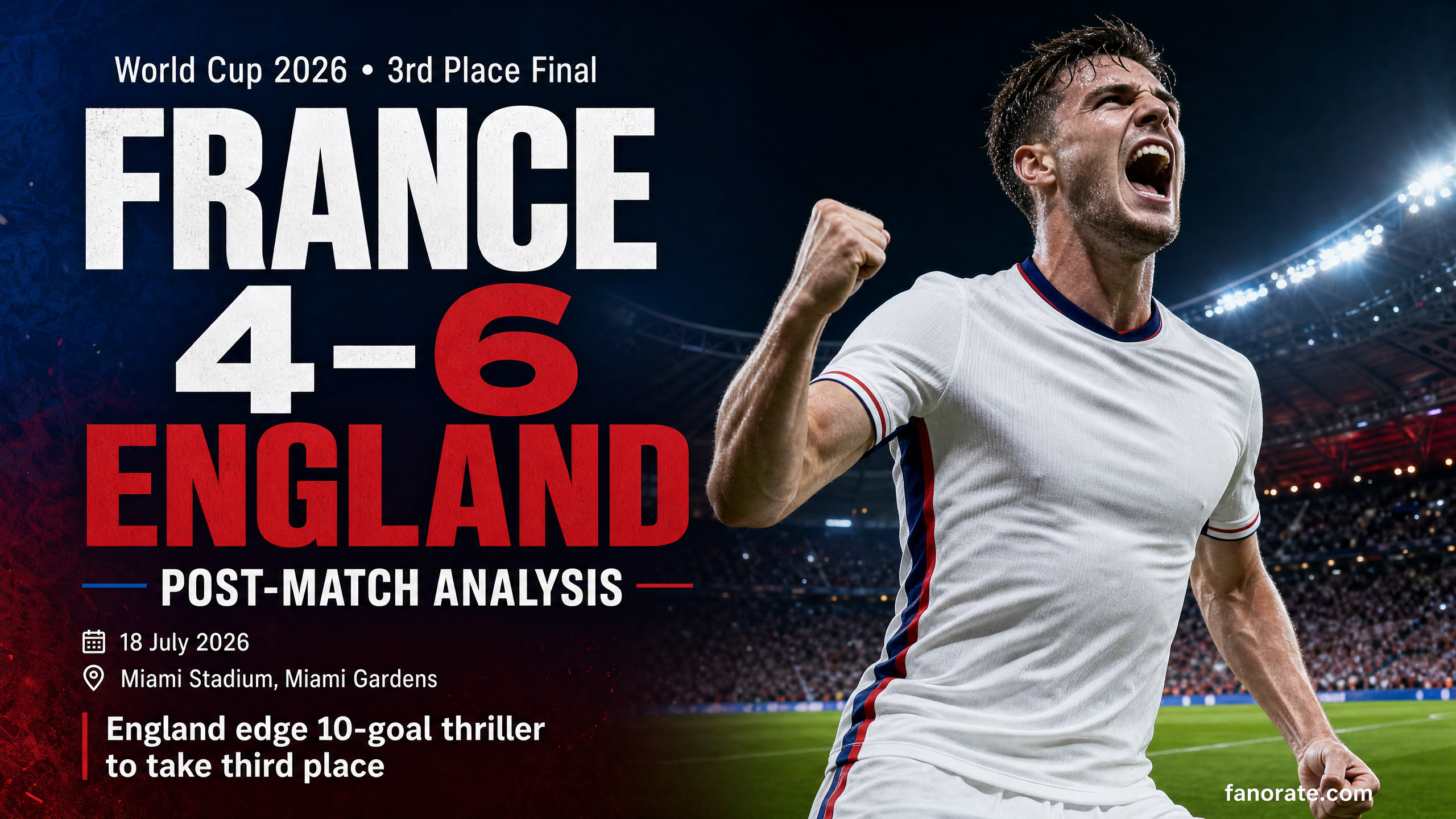
England 6-4 France: Three Lions Claim World Cup 2026 Third Place in Miami Thriller
A pulsating ten-goal classic at Miami Stadium saw England claim third place at FIFA World Cup 2026 with a 6-4 victory over France, surviving a dramatic second-half collapse to end their tournament on a historic high.
England win 6-4 after full time
What happened
Under overcast Florida skies, Miami Stadium hosted one of the most extraordinary World Cup encounters in recent memory. England dismantled France 0-4 in a dominant first half, only for Les Bleus to storm back to 4-4 before Jude Bellingham’s 98th-minute thunderbolt ultimately secured a 6-4 victory for the Three Lions. This was not just a match — it was a tournament valediction that will be replayed for decades. England finish FIFA World Cup 2026 in third place, their best result since 1966, while France are left to contemplate another near-miss on the global stage.
How it was won and lost
England’s First-Half Blitz: Pressing Intensity and Clinical Execution
Gareth Southgate’s side — or whoever managed this England squad — came out with an intensity rarely seen at this level. England dominated possession at 54% and registered 19 total shots, with a staggering 16 inside the box. In the opening 45 minutes, their high press suffocated France’s build-up, denying Les Bleus any rhythm through midfield. Declan Rice was the conductor of this pressing structure, winning the ball high up the pitch before converting England’s opening goal in just the third minute. The full-backs pushed aggressively to provide width, while Bukayo Saka exploited the channels relentlessly. England’s 91% pass accuracy and 25 successful dribbles from 25 attempts in the half illustrated total control — they were simply unplayable.
France’s Halftime Overhaul: Five Substitutions, Total Reset
France manager Didier Deschamps made a bold and decisive call at halftime, introducing five substitutes simultaneously — Bradley Barcola, Mathis Cherki, Ibrahima Konaté, Lucas Digne, and Desire Doué all came on. This wholesale change fundamentally altered the dynamic of the contest. The fresh legs of Barcola and the returning dynamism of a reorganized Mbappé-led attack immediately put England on the back foot. France generated 55 dangerous attacks across the match — the majority after the break — and their xG-implied pressure in the second period was relentless. The substitutions shifted France from passive passengers to a side capable of generating big chances at will.
Mbappé’s Second-Half Resurrection: Danger from Deep
Michael Olise’s role as the primary architect of France’s comeback cannot be overstated. He registered assists on both of Kylian Mbappé’s second-half goals — at 48′ and 66′ — finding his captain with precision deliveries that bypassed England’s increasingly exhausted defensive block. Mbappé, who had been largely nullified in the first half, shifted his movement to exploit space behind the retreating English full-backs as fatigue began to set in. France’s 9 successful headers to England’s 4 also suggests Les Bleus won the aerial battle decisively in the second period, adding another dimension to their comeback.
England’s Defensive Fragility Exposed Under Pressure
England’s defensive structure that had looked so imperious in the first half began to crumble under the weight of France’s second-half onslaught. France’s dangerous attacks (55) nearly doubled England’s (27), and the Three Lions conceded four goals — all after the break. The late introduction of Reece James at right back (83′) and Trevoh Chalobah as a defensive option spoke to the urgency of stabilizing a backline that had given up huge amounts of space in behind. England’s tackles (25) versus France’s (16) reflects how deep and desperate the Three Lions were forced to defend in the closing stages, absorbing wave after wave of French pressure.
Set Pieces and Penalty Drama: England’s Clinical Edge
England’s set-piece threat proved decisive across the match. Declan Rice’s early goal showed alertness from a dead-ball situation, while Ezri Konsa’s 18th-minute header — assisted by Rice — demonstrated aerial threat from corners. England won 4 corners to France’s 3, but converted their moments with ruthless efficiency. The 87th-minute penalty dispatched by Bukayo Saka — England’s third — extended the lead to 5-4 at that stage following France’s comeback, giving the Three Lions crucial breathing room. Bellingham’s dramatic late goal in the 98th minute then sealed what had become a white-knuckle finish.
Who decided it
Bukayo Saka
EnglandSaka was simply sensational, finishing the match with a brace — goals at 37′ and 45+1′ — plus a penalty conversion in the 87th minute for effectively three contributions to the scoresheet. He registered the assist from Rashford on his first goal and from Eze for the second, showcasing his two-way chemistry with England’s creative midfield. His 19 total shots contribution (team stat context) and dribble threat were constants throughout.
Operating primarily on the right flank, Saka’s ability to cut inside onto his left foot and drive at the French defence created chaos. His late penalty in the 87th minute proved to be the decisive blow that ultimately sealed England’s third-place victory. Arguably England’s best player of the entire tournament.
Declan Rice
EnglandRice announced himself on the grandest stage with a goal in the third minute and an assist for Konsa’s header — a stunning double contribution in the first half that set the tone for England’s dominance. His pressing triggers and energy in midfield were the engine behind England’s devastating 45-minute blitz.
Rice dictated England’s high-press structure from a box-to-box role, winning possession in dangerous areas and converting when the opportunity arrived. His ability to arrive late into the box while maintaining defensive discipline made him near-impossible to contain in the first half.
Kylian Mbappé Lottin
FranceThe French captain was quiet in a difficult first half but transformed into a wrecking ball after the interval, scoring twice — at 48′ and 66′ — both from Michael Olise assists. He drove France’s improbable comeback single-handedly, dragging Les Bleus back from 0-4 to 4-4 with relentless intensity.
Mbappé’s willingness to drop deeper in the second half and link with Olise before making incisive runs in behind exposed England’s retreating defensive shape. His pace and directness on the counter-attack were devastating, and only England’s clinical late scoring denied him a historic comeback victory.
Jude Bellingham
EnglandBellingham entered as a substitute in the 79th minute at a moment when England were clinging to a lead and France were threatening to complete one of football’s greatest comebacks. He responded in the most dramatic fashion possible — scoring in the 98th minute to seal the result at 6-4 and put the game beyond France.
His late introduction injected fresh energy and game-intelligence into England’s midfield at a critical juncture. The 90+8′ goal was the exclamation mark on England’s tournament — a reminder that even from the bench, this side possess match-winning quality.
Michael Olise
FranceThe Bayern Munich winger was France’s standout creative force after the restart, registering two assists for Mbappé’s goals (48′ and 66′). His incisive passing in tight spaces and willingness to drive forward gave France their offensive backbone in a second half that was almost entirely dominated by Les Bleus.
Olise’s combination play with Mbappé was the tactical cornerstone of France’s comeback. His crosses and through-balls bypassed England’s midfield screen repeatedly, and his accuracy — completing 1 of 6 total crosses accurately across the match — reflected the quality required to pick out elite runners in transition.
Bradley Barcola
FranceThe PSG winger was one of the five halftime substitutes and made an immediate impact, scoring France’s second goal of the second half at the 54th minute off a Mbappé assist. His direct running and pace caused England constant problems down the left channel after the restart.
Barcola’s introduction fundamentally shifted France’s attacking profile — from static and ponderous to direct and explosive. His goal gave France the belief that a comeback was genuinely possible, and his running created space for Olise and Mbappé to operate in central areas.
Where it sits in history
England’s 6-4 victory over France in the FIFA World Cup 2026 third-place playoff stands as one of the most remarkable results in Three Lions history. It is England’s first World Cup medal since the 1966 World Cup triumph on home soil — a 60-year wait finally ended. For France, this result extends their frustrating recent tournament record: Les Bleus have now failed to claim a podium finish at consecutive World Cups despite possessing one of the most talented squads in international football. The ten goals scored across this match represent one of the highest-scoring World Cup third-place finals in history, comparable to the legendary battles of the tournament’s early decades. The France-England rivalry, rooted in centuries of cultural and sporting competition, produced its most breathtaking chapter yet in the Florida heat.
Inside the ground
Miami Stadium, with a capacity of 65,326, was a cauldron of colour and noise under an overcast Florida sky — an atmospheric canvas befitting the magnitude of the occasion. England supporters, draped in white and red, outnumbered their French counterparts in the stands but both sets of fans delivered a wall of sound from kick-off. The first half saw delirious Three Lions celebrations with each goal, the decibel levels rising with every Saka or Rice contribution. But the second half brought tension and disbelief as France’s comeback unfolded — the England end experiencing the full spectrum of emotions, from euphoria to anxiety. Bellingham’s 98th-minute winner sparked pandemonium, a release of 60 years of longing made manifest in a sun-soaked American city.
Looking ahead
England conclude FIFA World Cup 2026 in third place — their finest tournament finish in six decades. The Three Lions will return home to hero’s welcomes, with the performance providing a platform to build toward the 2028 UEFA European Championship on home soil. Key players like Bukayo Saka, Jude Bellingham, and Declan Rice have cemented themselves as the foundation of a genuinely formidable England generation. For France, the work begins immediately on rebuilding confidence and tactical cohesion. Mbappé and Olise remain world-class — but Deschamps or his successor will need to find a more consistent 90-minute structure that doesn’t depend on halftime overhauls to unlock the team’s true potential. The FIFA World Cup 2026 trophy itself goes to the winner of the final, played separately, but this third-place classic will be remembered long after the dust settles.
The bottom line
-
England win FIFA World Cup 2026 third-place playoff 6-4 against France in Miami
-
Bukayo Saka scores twice and adds a penalty — the match’s outstanding individual performance
-
Declan Rice scores and assists in a dominant first-half display
-
England lead 4-0 at halftime before France’s historic second-half fightback to 4-4
-
Kylian Mbappé scores twice after the restart to inspire France’s remarkable comeback
-
Jude Bellingham enters as substitute and seals the result with a 98th-minute goal
-
England claim their first World Cup medal since winning the 1966 World Cup
-
This match produced one of the highest-scoring third-place finals in World Cup history
-
France’s five halftime substitutions transformed the game but ultimately fell short
-
England’s 91% pass accuracy and 84% dribble success rate in first half illustrated total dominance
