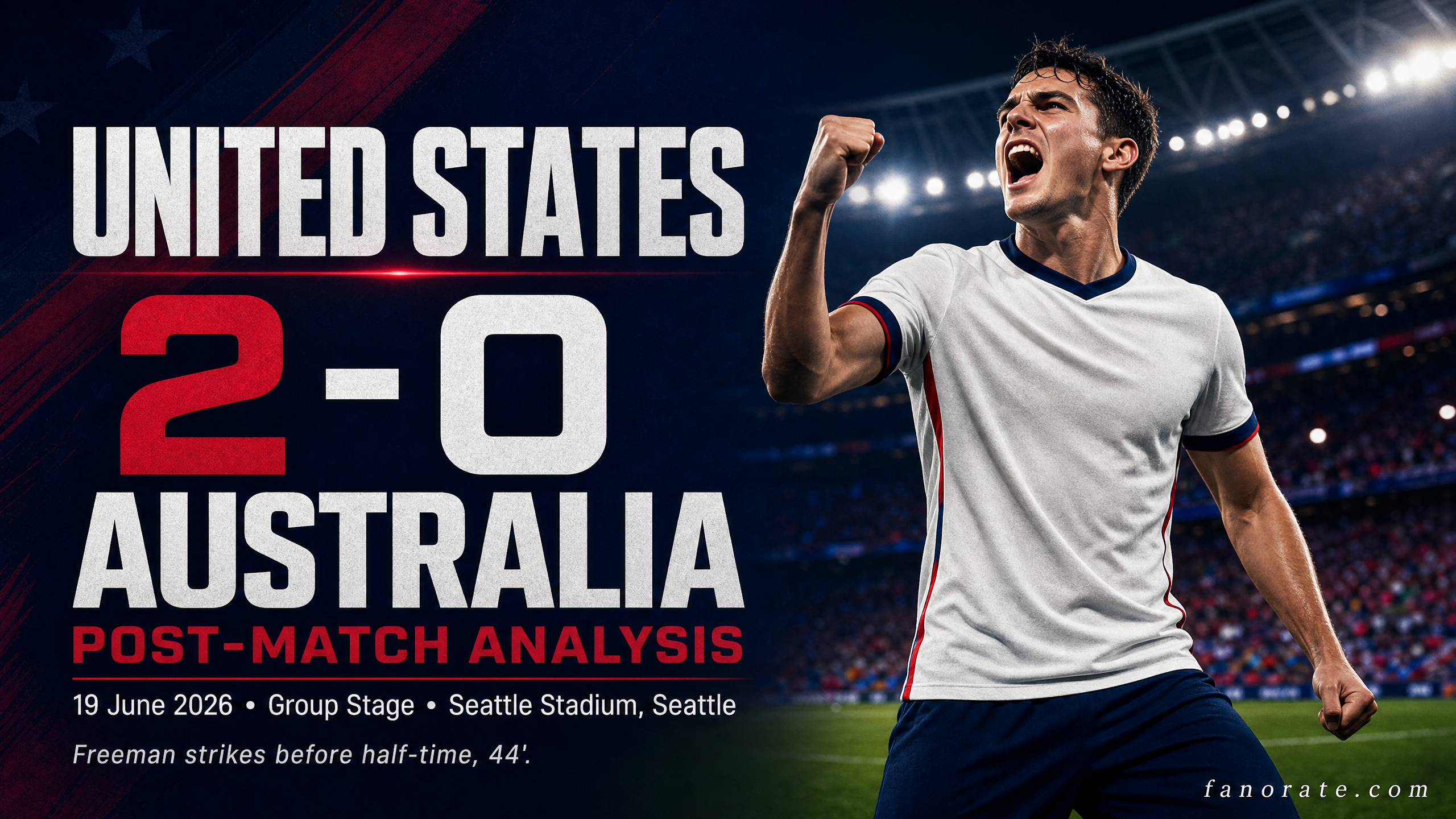
USA 2-0 Australia: Freeman’s Header Seals Group Stage Win at Seattle Stadium | FIFA World Cup 2026
A clinical first-half display and Alexander Freeman’s decisive header sent a jubilant Seattle crowd into raptures as the United States claimed a 2-0 Group Stage victory over Australia at the FIFA World Cup 2026. The USMNT were dominant across the board — outpassing, outpressing, and outclassing the Socceroos under the Pacific Northwest sky.
What happened
The United States came out of the blocks with the sharpest of intent at a sold-out Seattle Stadium, turning in a commanding Group Stage performance to defeat Australia 2-0 in their FIFA World Cup 2026 opener. The USMNT controlled every key metric — completing 446 accurate passes to Australia’s 221, winning the territory battle, and creating double the scoring opportunities. Alexander Freeman announced himself on the World Cup stage with a decisive header just before the break, and a well-organised defensive structure ensured Australia rarely threatened Matt Turner’s goal. For the home nation, it was the kind of opening statement that sends a message to the rest of Group Stage contenders.
How it was won and lost
USMNT Dominance in Possession and Field Coverage
The United States finished the match with 522 total passes compared to Australia’s 308 — an 85% accuracy rate against Australia’s 72%. That disparity wasn’t accidental. The USMNT operated in a structured mid-block that compressed space centrally but used wide outlets aggressively through Antonee Robinson on the left and Sergino Dest on the right to stretch Australia’s defensive shape. The result was a team that controlled territory, won second balls, and denied the Socceroos any sustained rhythm in the final third.
First-Half Control and the Decisive Moment
The opening 45 minutes belonged entirely to the United States. With Australia managing just 0 goals and a modest 0.5957 xG in the first half, the Socceroos struggled to generate quality chances. Meanwhile, the USMNT built patiently before Freeman’s 44th-minute header — arriving with precision from close range — gave them a commanding half-time lead. The timing was crushing for Australia, whose Cameron Burgess had a 11th-minute shot attempt that failed to threaten Turner, setting the tone for a one-sided afternoon.
Australia’s Triple Half-Time Substitution Fails to Shift Momentum
Australian head coach made a bold tactical statement at the break, introducing three fresh players simultaneously — Jason Kato Geria replacing Cameron Burgess, Nestory Irankunda coming on for Mohamed Toure, and Connor Metcalfe replacing Nishan Velupillay. Despite the aggressive reshuffle, Australia managed zero goals in the second half and their xG total only reached 0.77 across the full 90 minutes. The changes disrupted Australia’s own structure more than they unsettled the USMNT’s defensive block.
USMNT Defensive Discipline and Set-Piece Solidity
The United States conceded zero shots on target from open play of genuine danger. With Chris Richards and Miles Robinson commanding the backline, and Tyler Adams acting as the first line of press resistance in midfield, the USMNT looked composed against Australia’s limited attacking threat. The Socceroos managed just 13 total shots with a low conversion quality — their xG of 0.77 reflecting a side struggling to create clear-cut chances against a well-drilled defensive unit. Late yellow-card incidents and unsporting behaviour from both Folarin Balogun and Australian players Jacob Italiano and Harry Souttar in the 89th minute highlighted the frustration boiling over as the match slipped away from the Socceroos.
Press Structure and Transition Efficiency
Weston McKennie and Tyler Adams formed a double-pivot that combined hard pressing with intelligent recycling. The USMNT registered 21 ball recoveries compared to Australia’s 12, demonstrating their press was not passive. When the press was beaten, Scally, Trusty, and Richards provided structural cover to prevent dangerous counters. The United States also benefited from 9 corner kicks to Australia’s 3, highlighting their territorial and set-piece dominance throughout the contest.
Who decided it
Alexander Freeman
United StatesFreeman was the match-defining figure, scoring the crucial opening goal just before half-time with a well-executed header. His movement in the box and arrival at the far post demonstrated a striker who understands the geometry of the penalty area.
Freeman’s goal at the 44th minute — a header from what the timeline confirms as a deliberate run into the box — gave the USMNT a two-goal cushion heading into the break and effectively ended Australia’s realistic hopes of a comeback. His movement stretched the Socceroos’ defensive line and created space for supporting runners.
Weston McKennie
United StatesMcKennie operated as the engine of the USMNT midfield, combining press-trigger instincts with distribution quality. His ability to win duels and recycle possession kept the United States flowing through their patterns consistently across 90-plus minutes.
As the senior controlling presence in the double-pivot alongside Tyler Adams, McKennie’s ball-winning ability allowed the USMNT to dominate the midfield battle. He was replaced by Giovanni Reyna in the 90th minute, a luxury substitution that underscored just how comfortable the United States were.
Antonee Robinson
United StatesRobinson was electric down the left flank, providing width, overlapping runs, and defensive solidity when required. He was so impactful that when replaced in the 81st minute by Auston Trusty, it reflected game management rather than poor form.
Robinson’s overlapping runs stretched Australia’s right side and created space centrally for McKennie and Freeman to exploit. His crossing and pressing contributions were integral to the USMNT’s territorial control throughout the first half in particular.
Matt Turner
United StatesTurner was largely untroubled but composed when called upon. Australia’s 0.77 xG across the full match reflects a clean sheet that required professional game-reading rather than heroics, and Turner’s command of his penalty area was authoritative.
Turner’s organisation of the USMNT backline and his ability to play comfortably under pressure gave the entire defensive structure confidence. His clean sheet in a World Cup Group Stage opener is an important psychological foundation for the tournament ahead.
Cameron Burgess
AustraliaBurgess attempted a left-foot shot in the 11th minute — Australia’s best early chance — but was unable to convert. He was substituted at half-time as part of Australia’s tactical reshuffle, having struggled to deal with the movement of the USMNT forward line.
Burgess’s early attempt gave the Socceroos a brief moment of hope, but his inability to convert and subsequent replacement highlighted Australia’s struggle to generate meaningful attacking moments from defensive positions. His exit at the break was a sign of the tactical adjustments Australia needed but ultimately could not execute.
Where it sits in history
The United States and Australia have met sporadically at senior international level, but this fixture carries unique historical weight as both nations featured prominently in the lead-up to the expanded 48-team FIFA World Cup 2026. For the USMNT, hosting a World Cup on home soil for the first time since 1994 — when the US famously reached the Round of 16 — adds enormous domestic expectation. A 2-0 opening win mirrors the kind of authoritative home starts that successful tournament hosts have traditionally needed. For Australia, their FIFA World Cup 2022 run to the Round of 16 in Qatar had raised expectations of the Socceroos as genuine Group Stage disruptors. However, this defeat opens their 2026 campaign with a significant deficit and calls into question their attacking output in the absence of established veterans.
Inside the ground
Seattle Stadium delivered the kind of World Cup atmosphere that only a home nation can generate. With a capacity of 68,740 and a crowd that was overwhelmingly pro-USMNT, the Pacific Northwest became a fortress of noise from the first whistle. The roar that greeted Freeman’s header in the 44th minute was captured by every camera present — a moment that will define early World Cup 2026 highlight packages for weeks. Under broken cloud skies, the setting felt cinematic: an American city hosting a World Cup match for a generation of US fans who grew up watching the 1994 tournament and dreaming of this moment. The late unsporting behaviour incidents added edge to the final minutes, but the dominant soundtrack was pure USMNT euphoria.
Looking ahead
The United States will look to build on this momentum with their next Group Stage fixture, knowing that a second positive result could secure early progression in a 48-team tournament where the stakes are recalibrated. For Australia, the task becomes urgent — they must regroup tactically, address their attacking deficiencies, and find a way to generate genuine xG in their remaining matches. With three substitutions made at half-time already, the Socceroos coaching staff face difficult selection decisions. Watch for Australia to be more aggressive from kick-off in their next fixture, while the USMNT will look to maintain their possession-based control and exploit the energy of another partisan home crowd.
The bottom line
-
The United States won 2-0 against Australia in their FIFA World Cup 2026 Group Stage opener at Seattle Stadium.
-
Alexander Freeman scored the decisive goal with a header in the 44th minute to put the USMNT 2-0 up before half-time.
-
The US dominated possession with 522 passes completed at 85% accuracy versus Australia’s 308 at 72%.
-
Australia’s xG of 0.77 reflected a toothless attacking display despite a bold triple substitution at half-time.
-
The USMNT recorded 21 ball recoveries to Australia’s 12, underlining their superior pressing structure.
-
Weston McKennie and Tyler Adams controlled the midfield battle, giving the US a platform from first whistle to last.
-
Matt Turner kept a comfortable clean sheet as the US backline restricted Australia to minimal meaningful chances.
-
Late unsporting behaviour from players on both sides in the 89th minute reflected Australia’s mounting frustration.
-
The USMNT’s territorial dominance was reflected in 9 corner kicks to Australia’s 3.
-
The result sets the United States up strongly for Group Stage progression at a home World Cup for the first time since 1994.
