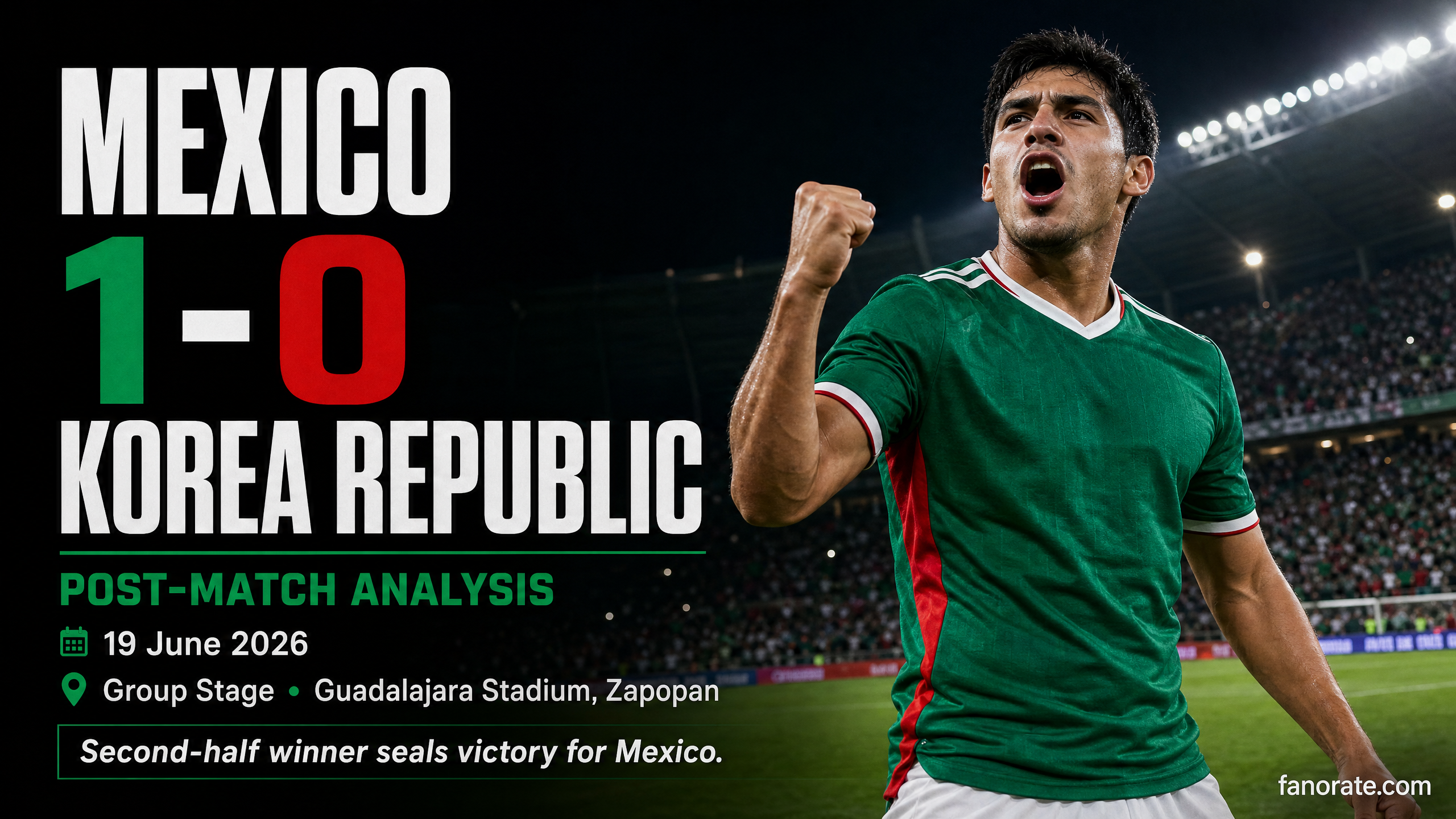
Mexico 1-0 Korea Republic: El Tri Grind Out Home Soil Victory in FIFA World Cup 2026 Group Stage
A solitary second-half strike from Luis Romo was enough to give Mexico a crucial 1-0 victory over Korea Republic in the FIFA World Cup 2026 Group Stage at Guadalajara Stadium. El Tri were far from flawless, but the home crowd roared them over the line in a tight, tactically disciplined contest that Korea will feel they could have taken something from.
What happened
Mexico edged Korea Republic 1-0 in a tense, hard-fought FIFA World Cup 2026 Group Stage encounter at Guadalajara Stadium on June 19. Luis Francisco Romo Barrón’s right-footed effort five minutes into the second half proved to be the match’s only moment of clinical precision — a slender margin that El Tri defended with grit and organization as Korea threw bodies forward in search of an equalizer. The xG data tells a nuanced story: Korea Republic actually generated more expected goals (1.48 vs 1.10), suggesting Hong Myung-bo’s side were not far off salvaging a point, but Mexico’s defensive resolve and home advantage ultimately won the day on Mexican soil in front of a passionate Guadalajara crowd.
How it was won and lost
Mexico’s Compact Mid-Block Suffocates Korean Creativity
Mexico set up in a structured mid-block, prioritizing defensive shape and denying Korea Republic space between the lines. El Tri’s defensive unit, anchored by Edson Álvarez and Johan Vásquez at the heart of defense, was disciplined in its positioning, rarely being pulled out of shape. With 56% possession, Mexico controlled the tempo without necessarily dominating in attacking areas, using the ball efficiently with 350 accurate passes from 429 total. Korea Republic, meanwhile, attempted 578 passes with 486 accurate — a higher volume suggesting they dominated in certain periods but found El Tri hard to break down in central zones.
Romo’s Strike: The Decisive Moment in a Game of Fine Margins
The match’s defining moment arrived on 50 minutes when Luis Francisco Romo Barrón unleashed a right-foot shot that found the net — a piece of individual quality that sliced through Korea’s defensive shape. Mexico had been patient and pragmatic in the first half, which ended goalless, and Romo’s strike rewarded that patience immediately after the restart, capitalizing on a moment when Korea were still finding their second-half rhythm.
Korea’s Tactical Response: Son and Substitutes Push for Equalizer
Korea Republic’s coaching staff reacted swiftly to the deficit, making a double substitution on 57 minutes — introducing Hee-Chan Hwang for Jae-Sung Lee and Hyun-Gyu Oh for captain Heung-Min Son. The decision to remove Son early underscored the urgency felt on the Korean bench. A further triple change on 71 minutes brought Ji-Sung Eom, Hyun-Jun Yang, and fresh energy to stretch Mexico’s backline. Korea generated 6 shots on target versus Mexico’s 3, and registered 17 attacks in the final third compared to Mexico’s more restrained approach, but lacked the final clinical touch.
Mexico’s Substitution Strategy Prioritizes Defensive Solidity
El Tri’s bench management in the closing stages reflected a team protecting a lead rather than chasing the game. Orbelín Pineda and Obed Vargas entered on 71 minutes to provide fresh legs in midfield, followed by Santiago Giménez — the in-form striker — on 80 minutes to provide an outlet and help Mexico manage transitions. Israel Reyes added defensive coverage, while César Huerta’s introduction on 84 minutes gave Mexico an additional creative option to relieve pressure. The overall substitution pattern was pragmatic and tactically sound from the Mexican coaching staff.
Set-Piece and Aerial Battle: Marginal Edge to Korea
Korea Republic won more duels in the air and generated slightly more danger from wide areas, attempting 101 attacking actions compared to Mexico’s 96 in total actions recorded. Mexico’s type_52 statistic — recording 1 compared to Korea’s 0 — suggests El Tri landed the decisive big chance conversion. Korea’s inability to convert their superior xG (1.48) into goals ultimately cost them in a match decided by fine margins.
Who decided it
Luis Francisco Romo Barrón
MexicoThe match-winner. Romo was industrious throughout in central midfield, covering ground effectively and providing the decisive moment with a composed right-foot strike just five minutes into the second half. His goal was not a fluke — it reflected an all-around performance full of energy, press-breaking, and calculated aggression.
Romo’s goal changed the entire tactical dynamic of the match, forcing Korea to abandon their cautious approach and commit more men forward. His workrate in the press and ability to arrive late into shooting positions made him El Tri’s most dangerous midfield presence on the night.
Edson Álvarez
MexicoThe defensive midfielder and defensive linchpin marshalled Mexico’s structure beautifully, winning key duels in central areas and ensuring Korea’s attackers had minimal time on the ball in dangerous zones. Álvarez was imperious in the press and composed on the ball, linking defense to attack with authority.
Álvarez’s positional discipline was central to Mexico’s success. His ability to screen the back four and cut off Korea’s supply lines to their forward runners proved decisive in keeping the clean sheet intact under late Korean pressure.
Heung-Min Son
Korea RepublicThe Korean captain had a frustrating evening before being substituted on 57 minutes, struggling to find consistent space against a well-organized Mexican defensive structure. Son showed flickers of quality but was starved of service in dangerous positions and ultimately sacrificed for a more physically direct option as Korea chased the game.
Son’s early withdrawal highlighted both Korea’s desperation after conceding and the degree to which Mexico’s defensive plan had been built specifically to nullify his influence. The decision to substitute him was bold and underlined how quickly Korea’s tactical plan needed to shift.
Kang-In Lee
Korea RepublicThe PSG playmaker was Korea’s most creative threat before his side fell behind, registering an early foul that hinted at Mexico’s physical approach to stopping him. Lee probed intelligently in tight spaces and attempted to orchestrate Korea’s attacking build-up with quick combinations.
Lee’s creativity was Korea’s primary weapon in the first half, drawing fouls and attempting to unlock Mexico’s compact shape with dribbles and through-ball attempts. His influence waned after the goal, as Korea became more direct in their approach.
Where it sits in history
Mexico and Korea Republic have crossed paths at previous World Cups, most memorably in the 1998 FIFA World Cup group stage, where El Tri secured a 3-1 victory. This 2026 encounter adds another chapter to a modest but meaningful World Cup rivalry between the two nations. For Mexico, playing a FIFA World Cup 2026 group stage match on home soil — with the tournament co-hosted by the United States, Canada, and Mexico — carries enormous emotional and national significance. El Tri are one of the few nations in World Cup history to have reached the Round of 16 in seven consecutive tournaments from 1994 to 2018, a streak they will be desperate to extend and ultimately surpass in 2026. For Korea Republic, the memories of their extraordinary 2002 World Cup semi-final run on home soil remain a high watermark the nation has been chasing ever since, making every World Cup campaign a reminder of what once was — and what could again be possible.
Inside the ground
Guadalajara Stadium was a cauldron of green, white and red. The home crowd, fiercely patriotic and deeply invested in every El Tri campaign, created the kind of wall of noise that can shift momentum in tight matches. When Romo’s shot hit the net just after the hour mark was approached, the eruption inside the 45,664-capacity stadium was seismic — a release of tension that had been building since kick-off. The Mexican faithful, singing, drumming, and waving flags throughout, provided their team with an unquestionable home advantage. The Korean contingent in attendance — visible in their distinctive red — gave their team vocal support throughout, especially as the substitutes came on and the pressure mounted, but the night ultimately belonged to the sea of green.
Looking ahead
Mexico will take three crucial Group Stage points into their next fixture, buoyed by a home win and a clean sheet that will do wonders for confidence and defensive morale. El Tri know that a second victory would likely seal progression to the knockout rounds, and the return of Santiago Giménez from the bench — still a genuine world-class attacking threat — hints that their sharpest weapon has yet to be fully unleashed. Korea Republic face a must-react moment. Despite the xG data suggesting they were competitive, results in group stage football are binary — and they now need a positive result in their next match to keep their FIFA World Cup 2026 knockout stage ambitions alive. The coaching staff will need to address their finishing and clinical edge if Korea are to recover and progress from the group.
The bottom line
-
Mexico defeated Korea Republic 1-0 in the FIFA World Cup 2026 Group Stage at Guadalajara Stadium, Zapopan
-
Luis Francisco Romo Barrón scored the decisive goal with a right-foot strike on 50 minutes
-
Korea Republic generated more expected goals (xG 1.48 vs 1.10) but were unable to convert their chances
-
Mexico’s disciplined mid-block and Edson Álvarez’s midfield screening were central to the clean sheet
-
Heung-Min Son was substituted on 57 minutes as Korea chased an equalizer, signalling tactical desperation
-
Mexico made five second-half substitutions, managing the game intelligently to secure the win
-
The result continues Mexico’s strong home World Cup tradition with the tournament co-hosted on Mexican soil
-
Korea Republic must now respond in their next group game to keep knockout stage hopes alive
