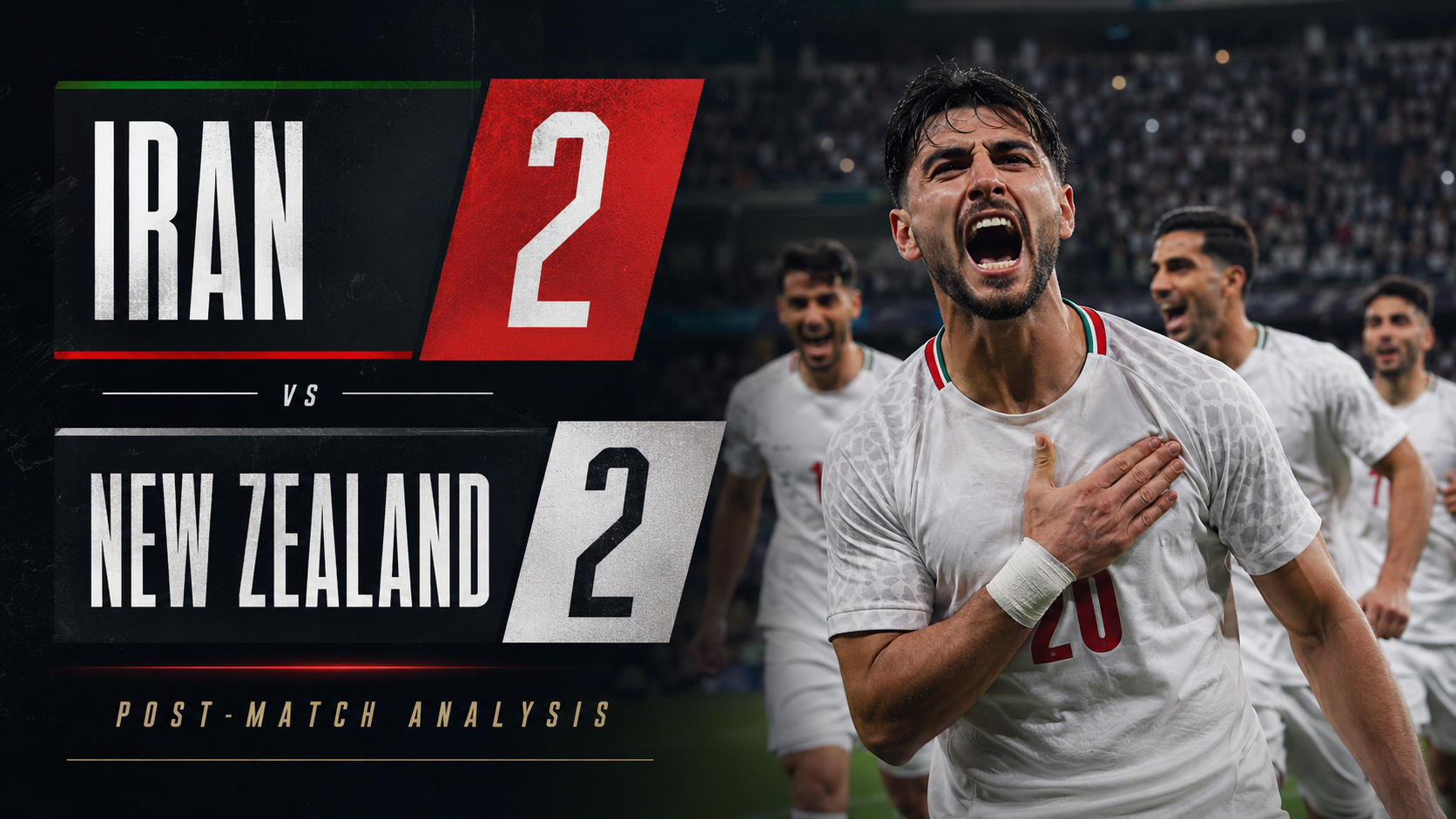
Iran vs New Zealand 2-2 Draw: FIFA World Cup 2026 Group Stage Recap & Tactical Analysis
A pulsating 2-2 draw at Los Angeles Stadium saw Iran and New Zealand share the spoils in a fiercely contested FIFA World Cup 2026 Group Stage opener. Elijah Just struck twice for the All Whites, while Ramin Rezaeian and Mohammad Mohebi kept Team Melli level in a match that swung dramatically across both halves.
What happened
Under clear Los Angeles skies and in front of 70,000 fans packed into one of the tournament’s most iconic venues, Iran and New Zealand delivered one of the early surprises of FIFA World Cup 2026 — a breathless, back-and-forth 2-2 draw that leaves both sides with a point apiece and much to reflect on heading into their next fixtures. New Zealand’s Elijah Just announced himself on the global stage with a brace, the second arriving just nine minutes into the second half to restore parity, only for Iran’s Mohammad Mohebi to restore it again from a Ramin Rezaeian assist in the 64th minute. It was a match defined by momentum swings, tactical adjustments, and the kind of raw competitive intensity that makes World Cup group football so compelling.
How it was won and lost
New Zealand’s Early High Press Forces Iran Deep
New Zealand came out with an aggressive high press from the first whistle, looking to exploit any hesitation in Iran’s build-up play. The All Whites sat in a compact mid-block when out of possession but triggered intense pressing traps in the final third of their own half. It was this pressure that created the opening goal — Chris Wood’s intelligent hold-up play drew defenders and fed Elijah Just, who finished confidently with his right foot in the 7th minute. Iran’s backline, anchored by Shoja Khalilzadeh and Milad Mohammadi, was visibly uncomfortable when pressed into quick decisions early on.
Iran’s Equalizer Built on Width and Right-Side Combination Play
Iran’s response was measured rather than panicked. They leaned on Ramin Rezaeian’s dynamism from right-back, using overlapping runs to stretch New Zealand’s mid-block. The equalizer in the 32nd minute was a product of this width — Shahriar Moghanlou linked play centrally before Rezaeian drove into the half-space and fired a precise right-footed effort past the New Zealand keeper. Iran’s ability to move the ball quickly through central lines, aided by Saeid Ezatolahi’s positioning as a midfield anchor, allowed them to build controlled pressure in the first half’s final quarter.
Half-Time Adjustments and a Fast Second-Half Start by New Zealand
Both managers made tactical changes at the break. Iran’s coach introduced Mehdi Ghaedi for Aria Yousefi almost immediately at the start of the second half, signaling a desire for more creative output in wider areas. But it was New Zealand who struck first in the second period — Just completing his brace in the 54th minute again from a Chris Wood assist, almost mirroring the opening goal in its geometry. New Zealand’s double pivot in midfield, marshalled by Joe Bell and Marko Stamenic, was effective in recycling possession and denying Iran easy central access in the minutes surrounding that second goal.
Iran’s Counter-Pressing and Set-Piece Quality Restore Parity
Iran’s response after going behind again showed genuine resilience. The substitution of Ali Alipour in the 53rd minute added a direct physical presence up front alongside Mehdi Taremi, giving Iran a more potent aerial threat. That investment paid dividends in the 64th minute when Ramin Rezaeian delivered an incisive cross from the right that Mohammad Mohebi converted with a powerful header — a textbook set-piece sequence that exploited New Zealand’s vulnerability to inswinging delivery. Iran’s xG of 1.54 slightly edged New Zealand’s 1.40, suggesting they carried marginally greater threat in the final third across the full 90 minutes.
Late Substitutions and Game Management in the Final Quarter
The final 25 minutes became a chess match of substitutions and risk management. New Zealand introduced Benjamin Old and Ryan Thomas in the 68th minute to shore up their midfield and inject fresh legs, while Iran responded with Amirhossein Hosseinzadeh for Taremi in the 80th. Ehsan Hajsafi’s foul in the 89th minute gave away a dangerous late free-kick but Iran’s defense held firm. New Zealand’s late double change of Tyler Bindon and Jesse Randall in stoppage time was purely precautionary as both sides settled for a point that neither will fully celebrate nor lament.
Who decided it
Elijah Henry Just
New ZealandThe undisputed man of the match for the All Whites. Just scored both of New Zealand’s goals — one in the 7th minute and another in the 54th — each assisted by the ever-dangerous Chris Wood. His movement off the ball was sharp, his finishing clinical, and his second-half strike proved he could maintain quality under World Cup pressure.
Just’s intelligent runs in behind Iran’s defensive line repeatedly stretched the backline, creating vertical corridors that Wood and the midfield could exploit. His ability to receive the ball at pace and shoot quickly with his right foot gave Iran’s center-backs no time to set.
Ramin Rezaeian
IranRezaeian was Iran’s most consistent threat throughout the match. He scored the 32nd-minute equalizer and delivered the cross that led to Mohebi’s header in the 64th. His work rate down the right flank was relentless, contributing both offensively and defensively across 90 minutes.
His overlapping runs from right-back consistently created numerical overloads on New Zealand’s left side. His delivery quality — both shooting and crossing — was a key weapon in Iran’s equalizing efforts and kept the All Whites’ left back occupied throughout the game.
Chris Wood
New ZealandThe veteran All Whites striker didn’t get on the scoresheet but was central to everything New Zealand created. He provided assists for both of Just’s goals, demonstrating the kind of intelligent target-man play that has defined his international career.
Wood’s hold-up play was exceptional, drawing multiple defenders and creating pockets of space for Just and the supporting midfield. His ability to link play under pressure gave New Zealand a reliable outlet when Iran pressed high and disrupted their build-up.
Mohammad Mohebi
IranMohebi’s 64th-minute header was the decisive moment that restored parity for Iran after they had fallen behind for the second time. It was a composed, powerful finish from a well-timed run into the near post.
Mohebi’s movement in the box made him a constant nuisance for New Zealand’s center-backs. His willingness to make late runs into the area from a deeper midfield starting position made him difficult to track, and his goal was the reward for consistent intelligent movement throughout the second half.
Where it sits in history
For Iran, this result continues a pattern of hard-fought World Cup group stage battles. Team Melli have appeared at multiple FIFA World Cups, often facing elimination in the group stage, and a point against a competitive New Zealand side represents a solid, if imperfect, foundation. For New Zealand, reaching the FIFA World Cup 2026 group stage is itself a landmark achievement, and a draw against Iran — a team with far more international pedigree and competitive tournament experience — will be viewed as a genuine statement of intent. The All Whites have historically struggled to progress beyond the group stage on the rare occasions they have qualified, making this point a psychologically valuable one. A 2-2 scoreline in a group-stage opener always carries particular significance: both sides remain alive, and the group standings remain entirely open heading into the next round of fixtures.
Inside the ground
Los Angeles Stadium was a vibrant, multi-cultural cauldron befitting one of the world’s most cosmopolitan cities. The large Iranian diaspora community in Southern California brought immense passion to the stands, with flags, drums, and chants that surged every time Taremi or Rezaeian touched the ball in dangerous areas. New Zealand supporters, far from home but loud in their section, responded with their own fervent backing — particularly after Just’s brace. The clear evening sky over Los Angeles added a cinematic quality to proceedings, and the 70,000-strong crowd created an atmosphere that elevated what was already a tactically absorbing contest into a genuine World Cup occasion.
Looking ahead
Both sides will know that this group remains wide open following the 2-2 draw. Iran will need to tighten their defensive structure in wide areas and reduce the space New Zealand — and future opponents — found in behind their defensive line. Mehdi Taremi’s influence on the game needs to grow in upcoming matches if Iran are to advance. For New Zealand, the belief gained from taking the lead twice against an experienced side will be invaluable. Chris Wood’s creative partnership with Elijah Just could become a genuine attacking weapon as the tournament progresses. With the expanded 48-team format offering more pathways to the knockout rounds, a point from the opening match is far from catastrophic for either side — but both will know that wins, not draws, ultimately define group stage fates.
The bottom line
-
Elijah Just scored twice for New Zealand, both goals assisted by Chris Wood, to announce himself as a player to watch at FIFA World Cup 2026.
-
Iran equalised twice through Ramin Rezaeian (32′) and Mohammad Mohebi (64′), showing resilience and set-piece quality.
-
New Zealand’s high press created significant problems for Iran in the early stages of both halves.
-
Iran’s xG of approximately 1.54 slightly exceeded New Zealand’s 1.40, reflecting marginally greater overall threat despite the shared points.
-
Both managers made significant tactical changes at half-time, with the game’s second-half narrative shaped by those substitutions.
-
The 2-2 draw leaves the group wide open and both nations with everything still to play for in FIFA World Cup 2026.
-
Chris Wood’s intelligent target-man play was central to New Zealand’s attacking structure even without a goal to his name.
