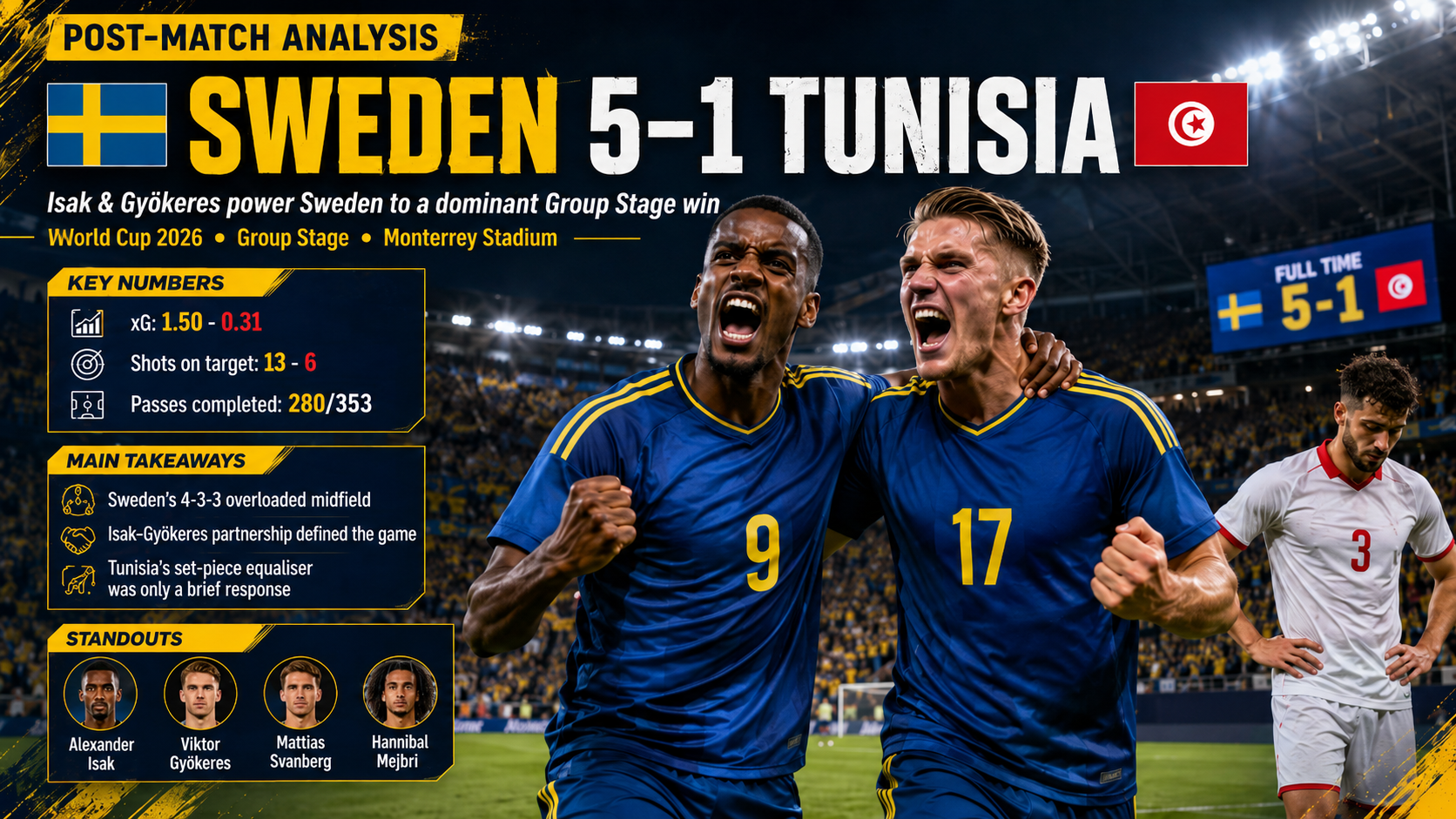
Sweden 5-1 Tunisia: Isak & Gyökeres Demolish Eagles of Carthage in FIFA World Cup 2026 Group Stage
Sweden delivered a statement performance at Monterrey Stadium, dismantling Tunisia 5-1 in a commanding FIFA World Cup 2026 Group Stage opener. With Alexander Isak pulling strings and Viktor Gyökeres providing the finishing muscle, the Blågult announced themselves as a genuine tournament force — despite a brief Tunisian scare just before half-time.
What happened
Sweden were imperious at Monterrey Stadium on a cloud-covered Monday night in Guadalupe, sweeping Tunisia aside with a 5-1 victory that sent a clear signal to the rest of the FIFA World Cup 2026 field. The Blågult were clinical, creative, and ultimately irresistible — powered by a devastating attacking partnership between Alexander Isak and Viktor Gyökeres that caused Tunisia’s backline problems from the opening whistle. Tunisia showed brief flashes of quality, particularly through Hannibal Mejbri and a composed header from Omar Rekik that levelled the scores at 1-1 heading into the break. But the second half belonged entirely to Sweden, who scored three unanswered goals to seal a dominant opening victory and move to the top of their World Cup group.
How it was won and lost
Sweden’s 4-3-3 Overloads Tunisia’s Midfield Block
Sweden set up in a fluid 4-3-3 shape that gave them numerical superiority in central midfield. With Jesper Karlström acting as the deepest midfielder, Benjamin Nygren and Lucas Bergvall offered dynamic box-to-box energy on either side. This midfield triangle consistently bypassed Tunisia’s two-bank defensive structure, recycling possession efficiently — Sweden completed 280 of their 353 passes — and creating space for the front three to exploit vertical channels. Tunisia’s defensive mid Rani Khedira struggled to contain the transitions, earning a foul in the 54th minute that disrupted his team’s shape at a crucial early second-half moment.
The Isak-Gyökeres Axis: A World-Class Attacking Partnership
The tactical highlight of the match was undoubtedly the symbiotic relationship between Alexander Isak and Viktor Gyökeres. The two forwards constantly interchanged — Isak dropping deep to link play and draw defenders, Gyökeres attacking the space left behind. Their connection produced two direct goal contributions: Isak assisted Gyökeres’s 60th-minute strike, and Gyökeres had earlier returned the favour in the 30th. This fluid, rotating front line is tactically sophisticated and exceptionally difficult to pin down, combining Sweden’s xG of 1.50 against Tunisia’s 0.31 in a telling statistical contrast.
Tunisia’s Set-Piece Threat and the 43rd-Minute Equaliser
Tunisia’s most dangerous moments came from dead-ball situations and Hannibal Mejbri’s creative orchestration in the final third. The 43rd-minute header from Omar Rekik — delivered from a Mejbri assist — demonstrated Tunisia’s aerial threat at set-pieces and temporarily restored parity heading into the interval. It was a tactically well-designed delivery, exploiting a slight lapse in Sweden’s zonal marking. However, the Tunisian coaching staff was unable to replicate that threat after the break, and Sweden’s defensive structure, anchored by Victor Nilsson Lindelöf and Isak Hien, remained largely untroubled.
Second-Half Dominance Through Width and Substitute Impact
Sweden’s coaching staff made decisive adjustments at the 65-minute mark, introducing Elliot Stroud for Gabriel Gudmundsson and Lucas Bergvall for Benjamin Nygren. These changes injected pace down the flanks and ensured Tunisia’s retreating defensive block had no opportunity to consolidate. Mattias Svanberg’s introduction in the 84th minute proved immediately impactful — he found the net within seconds of entering the pitch, completing a sweeping move assisted by Isak. Sweden’s ability to score with a substitute in the 86th minute underlined the depth and tactical adaptability at Janne Andersson’s disposal. Anthony Elanga’s late introduction further underscored Sweden’s luxury of attacking options.
Tunisia’s Triple Substitution Came Too Late
Tunisia’s coaching staff made a bold triple substitution in the 72nd minute — bringing on Mohamed Elias Achouri, Mohamed Belhaj Mahmoud, and Sebastian Tounekti — in an attempt to change the dynamic of the match. However, by this stage Sweden led 3-1 and were controlling the tempo with confidence. The fresh legs did little to alter the tactical picture; Sweden’s defensive organisation and transition efficiency suffocated any Tunisian resurgence. Tunisia finished the match with only 6 shots on target compared to Sweden’s 13, reflecting the one-sided nature of the second period.
Who decided it
Alexander Isak
SwedenIsak was the creative heartbeat of Sweden’s attack, constantly involved in build-up play, linking defence to attack with assured footwork and intelligent movement. He directly assisted Viktor Gyökeres’s 60th-minute goal and laid on Mattias Svanberg’s 86th-minute strike late in the game, finishing the match with at least two assists in what was a masterclass in modern centre-forward play.
Isak’s movement between the lines pulled Tunisia’s centre-backs into uncomfortable positions, creating space for Gyökeres and the wider attackers. His press resistance and ability to play under pressure in tight areas allowed Sweden to progress through Tunisia’s midfield line with regularity. A world-class World Cup debut for the Newcastle United striker on this stage.
Viktor Gyökeres
SwedenGyökeres was relentless in his pressing and devastating in the final third. He scored Sweden’s third goal in the 60th minute after a perfectly weighted through ball from Isak and had earlier assisted the opening Isak goal at the half-hour mark, demonstrating his contribution in both scoring and creating.
Gyökeres’s physical power and tireless pressing unsettled Tunisia’s defensive line from the first whistle. He pressed high, disrupted Tunisia’s attempts to play out from the back, and consistently made intelligent runs behind the defensive line. His combination play with Isak was the defining feature of Sweden’s attacking game.
Hannibal Mejbri
TunisiaIn a difficult afternoon for Tunisia, Mejbri was their standout performer — the most creative presence in their ranks and the architect of their only goal. His delivery for Omar Rekik’s 43rd-minute header showed technical quality and tactical awareness, and he consistently attempted to drive forward and unlock Sweden’s defensive structure.
Mejbri operated as Tunisia’s primary creator in the number ten role, linking midfield and attack with incisive passing and direct running. While the system around him was ultimately overwhelmed by Sweden’s quality, his individual contribution highlighted why he remains one of North Africa’s most exciting midfield talents on the international stage.
Mattias Svanberg
SwedenSvanberg entered as a substitute in the 84th minute and made an immediate impact, scoring within two minutes of his introduction after connecting with an Isak assist. His goal, officially awarded in the 86th minute, killed any lingering hope of a Tunisian comeback and confirmed Sweden’s dominant scoreline.
Svanberg’s introduction demonstrated the tactical depth available to Sweden’s manager. His energy and directness in the final moments of the match typified Sweden’s second-half control, ensuring the scoreline accurately reflected their overwhelming superiority across the ninety minutes.
Omar Rekik
TunisiaRekik was a composed and dangerous presence in Tunisia’s attacking set-piece routine, heading home Mejbri’s precise cross in the 43rd minute to level the match at 1-1. His goal gave Tunisia a platform to push for the lead before half-time, though Sweden responded with greater urgency after the interval.
Rekik’s goal highlighted Tunisia’s aerial threat from dead-ball situations, a tactic clearly prepared in advance by their coaching staff. While primarily deployed as a centre-back, his runs into the attacking box on set-pieces provided a secondary dimension to Tunisia’s offensive game — one of the few tactical bright spots in a difficult match.
Where it sits in history
Sweden’s 5-1 victory over Tunisia represents one of their most emphatic winning margins in FIFA World Cup Group Stage history and continues a generally positive record for Scandinavian football on the global stage. For Tunisia, the Eagles of Carthage have historically struggled to progress beyond the World Cup Group Stage, with their only standout tournament performances coming in 1978 — when they became the first African side to win a World Cup match — and their Group Stage involvement in 2018 in Russia. A 5-1 defeat on this occasion deepens the challenge facing Tunisian football as it attempts to build a competitive identity at the highest level of the international game. Sweden, meanwhile, have a rich World Cup tradition, reaching the final as recently as 1958 on home soil, and this performance suggests the current generation — built around elite Premier League and top European league talent — has the quality to make a deep run at FIFA World Cup 2026 on North American soil.
Inside the ground
Monterrey Stadium in Guadalupe provided an evocative backdrop under overcast skies, with a capacity of 53,500 offering a wall of noise that grew increasingly animated as Sweden’s goals mounted. The Mexican host city, known for its passionate football culture, embraced both sets of supporters, and the Tunisian faithful — colourful and vociferous in the stands — were briefly electrified by Rekik’s equaliser in the 43rd minute. The second half, however, belonged to Sweden’s travelling support, who serenaded each goal with growing confidence. The atmosphere carried the unmistakable electric charge of a FIFA World Cup Group Stage match — colourful, loud, and emotionally charged, a fitting stage for a performance of real quality.
Looking ahead
Sweden’s emphatic 5-1 opening victory propels them to the top of their World Cup 2026 group with maximum points and a commanding goal difference. Their next Group Stage fixture will be crucial in consolidating top spot and potentially securing qualification for the knockout rounds. The Isak-Gyökeres partnership will strike fear into all remaining group opponents, and Sweden’s manager will be encouraged by the depth and adaptability shown through substitutions. For Tunisia, the defeat is a serious blow to their Group Stage qualification hopes. They must regroup quickly, address their defensive vulnerabilities — particularly against high-pressing, technically superior opposition — and rediscover the set-piece potency that gave them their brief moment of hope. A response in their next match is essential if they are to remain in World Cup 2026 contention.
The bottom line
-
Sweden defeated Tunisia 5-1 in their FIFA World Cup 2026 Group Stage opener at Monterrey Stadium, Guadalupe.
-
Alexander Isak and Viktor Gyökeres were Sweden’s standout performers, combining for multiple goals and assists in a world-class attacking display.
-
Tunisia pulled level at 1-1 through an Omar Rekik header assisted by Hannibal Mejbri in the 43rd minute, briefly threatening a dramatic first-half comeback.
-
Sweden dominated the second half with three unanswered goals, including a debut substitute impact from Mattias Svanberg who scored within two minutes of entering the pitch.
-
Sweden’s xG of approximately 1.50 compared to Tunisia’s 0.31 reflects the overwhelming tactical superiority of the Blågult throughout the match.
-
Tunisia’s triple substitution in the 72nd minute failed to alter the course of the match, with Sweden’s defensive structure remaining largely unbreachable.
-
The result puts Sweden at the top of their World Cup 2026 group and signals their credentials as a serious tournament contender on North American soil.
