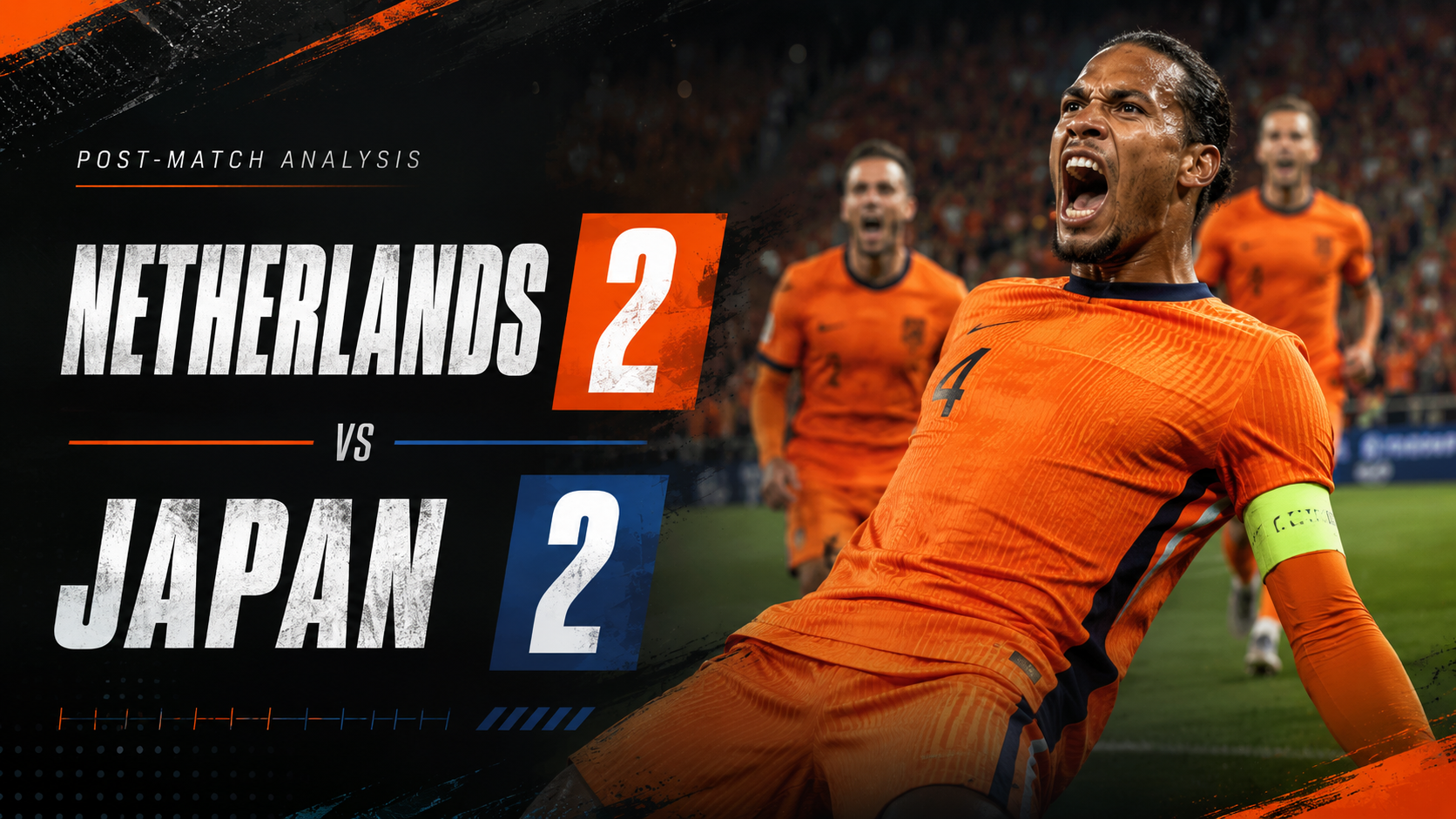
Netherlands 2-2 Japan: Dramatic Late Equaliser Stuns Oranje at Dallas Stadium | FIFA World Cup 2026
A second-half spectacle under the Arlington lights saw the Netherlands twice lead, only for Japan to show the grit and quality that has made them one of world football’s most compelling stories. Virgil van Dijk and Crysencio Summerville had Oranje in control, but Keito Nakamura and a late Daichi Kamada header ensured the spoils were shared in a breathless FIFA World Cup 2026 Group Stage encounter.
What happened
Dallas Stadium was alive with 80,000 spectators expecting Netherlands to impose their quality on a disciplined Japanese side, but what unfolded across 90 minutes was one of the tournament’s most gripping group stage contests. The entire match was decided in a frantic second half, with all four goals arriving after the break in a game that swung on momentum, substitutions, and individual brilliance. The Netherlands, boasting elite technical quality and physical superiority on paper, found themselves pegged back twice by a Japanese team that refused to capitulate, ultimately earning a point that could prove critical as the group unfolds.
How it was won and lost
Goalless First Half: Cautious Structure from Both Sides
With neither side finding the net in the opening 45 minutes, the tactical tone was set early. The Netherlands controlled possession significantly — finishing the game with 525 passes to Japan’s 342 — but Japan set up in a compact, resolute defensive shape, limiting Oranje’s central penetration and forcing play wide. Japan’s defensive discipline was disciplined and cohesive, with their low block absorbing Dutch pressure while looking to exploit transitions through the speed of Takefusa Kubo and Keito Nakamura on the counter.
Van Dijk Breaks the Deadlock from a Set-Piece
The Netherlands finally found the opener on 51 minutes through the most reliable of Dutch weapons: a Virgil van Dijk header from a Ryan Gravenberch delivery. The goal underscored the Netherlands’ aerial threat from set-pieces, with van Dijk’s towering presence a persistent danger throughout the match. It was a classic Dutch set-piece goal — patient build-up, quality delivery, and a dominant centre-back finishing with authority.
Japan’s Immediate Response Through Nakamura
Japan’s response was rapid and clinical. Just six minutes after going behind, Keito Nakamura levelled with a composed right-foot finish, assisted by Takefusa Kubo. The goal was a demonstration of Japan’s counter-pressing quality — Kubo’s ability to turn defence into attack in moments, drawing in Dutch pressure before releasing Nakamura into dangerous space. It exposed a momentary vulnerability in the Dutch defensive line during a transitional phase.
Summerville’s Clinical Left-Foot Finish Restores Dutch Lead
Crysencio Summerville had drawn a foul just three minutes before his moment of quality, and at 64 minutes he punished Japan with a sharp left-foot shot from a Gravenberch assist to restore the Netherlands’ advantage. Summerville’s directness — driving at defenders, creating overloads on the left flank — was a persistent problem for Japan’s right side. The goal highlighted the Dutch ability to re-establish control through individual quality after momentum shifts.
Substitution Waves Reshape the Game
The 66th to 85th-minute window saw a flood of substitutions from both camps that radically altered the game’s shape and energy. The Netherlands introduced Memphis Depay, Teun Koopmeiners, and Quinten Timber among others, signalling a shift toward securing the result. Japan countered with Junya Ito, Koki Ogawa, and Takehiro Tomiyasu, refreshing their attacking threat. These changes ultimately proved significant — Japan’s fresh legs unsettled the Dutch rearguard in the closing stages.
Kamada’s 89th-Minute Header Stuns Oranje
The defining moment came in the 89th minute when Daichi Kamada met a Koki Ogawa delivery to head home Japan’s equaliser, sending the Japanese contingent in Arlington into euphoria. The goal was a direct product of Japan’s substitution strategy — Ogawa, introduced at 75 minutes, provided the cross that Kamada converted. Mickey van de Ven’s professional foul in added time underlined the Dutch desperation as they attempted to salvage what had looked like a comfortable position. The Netherlands’ inability to manage the game in its final stages proved costly.
Who decided it
Crysencio Summerville
NetherlandsSummerville was the Netherlands’ most dynamic attacking outlet, contributing a goal and consistently threatening Japan’s defensive structure with his direct, pacey running down the left channel. He drew a foul and then punished Japan minutes later with a precise left-foot finish assisted by Gravenberch.
His movement created overloads on Japan’s right side and provided the Netherlands with a genuine vertical threat when central routes were blocked. His substitution at 70 minutes removed that danger at a critical time.
Ryan Gravenberch
NetherlandsGravenberch was central to the Netherlands’ most dangerous moments, registering two assists — one for van Dijk’s opener and one for Summerville’s goal. He provided quality in the half-spaces and showed composure in delivery.
His ability to play line-breaking passes and time his runs into advanced positions gave the Netherlands an extra dynamic in midfield transitions, acting as the key creative link between defence and attack.
Virgil van Dijk
NetherlandsThe Netherlands captain led from the front, heading home the opening goal from a set-piece and providing the defensive leadership that kept Japan at bay for long periods. His aerial dominance was a constant threat at corners and free-kicks.
Van Dijk’s presence anchored the Dutch defensive structure and his set-piece threat forced Japan to assign defensive resources to tracking him, creating space for others in attacking phases.
Keito Nakamura
JapanNakamura’s composed right-foot finish to equalise just six minutes after Japan fell behind showcased his quality and composure at the highest level. His movement off Kubo’s assist was intelligent and clinical.
Nakamura’s goal immediately swung momentum back toward Japan, preventing the Netherlands from building psychological control after the opener. His movement in the channels between Dutch centre-backs was a recurring problem.
Daichi Kamada
JapanIntroduced as a substitute, Kamada delivered the game’s most dramatic moment — a composed header in the 89th minute from Koki Ogawa’s cross to snatch Japan a point that looked beyond them.
Kamada’s arrival brought composure and intelligent movement to Japan’s late attacking phases. His header demonstrated the quality of Japan’s substitute options and the effectiveness of their late game-management strategy.
Takefusa Kubo
JapanKubo was Japan’s creative heartbeat, providing the assist for Nakamura’s equaliser and constantly threatening with his technical dribbling and intelligent positioning in the Dutch half.
His pressing triggers, movement between lines, and ability to attract pressure before releasing quick passes created Japan’s best counter-attacking moments and kept the Dutch defence unsettled throughout.
Where it sits in history
This draw adds another chapter to what has become a genuinely compelling Dutch-Japanese World Cup rivalry. Japan have developed a reputation as giant killers on the world stage — their 2022 FIFA World Cup campaign in Qatar saw them defeat both Germany and Spain in the group stage before a heartbreaking penalty shootout exit to Croatia. Facing European heavyweights no longer carries the fear factor it once might have for the Samurai Blue. For the Netherlands, a 2-2 draw echoes frustrating memories from past tournaments where their quality has not always translated into results. Oranje reached the 2010 World Cup Final and the 2014 semi-finals, but consistency has eluded them in the years since. This result, surrendering a 2-1 lead in the final minutes, will sting deeply in a group stage where every point matters.
Inside the ground
Dallas Stadium’s 80,000-capacity venue was a cauldron of noise across two contrasting halves. The first half carried a tense, expectant energy as both sets of supporters waited for the game to ignite. The second half delivered an atmosphere that matched the drama on the pitch — the roar when van Dijk nodded home, the stunned silence followed by Japanese jubilation when Nakamura equalised, the tension during the substitution flurry, and then the eruption of Japanese supporters in the final minutes when Kamada’s header hit the net. The broken cloud skies over Arlington added a cinematic backdrop to a game that had everything a World Cup encounter should offer.
Looking ahead
Both sides will need to regroup quickly and assess where points were won and lost in this enthralling draw. The Netherlands must address their game management in the final stages — surrendering a lead with minutes remaining in a World Cup group game is a costly habit they cannot afford to repeat. Their attacking quality is evident, but defensive concentration across 90 minutes remains a concern. Japan, meanwhile, will take enormous confidence from this result. Twice they were behind against one of European football’s traditional powers and twice they found a way back. Their substitution strategy proved decisive, and Hajime Moriyasu will be encouraged by the character shown. Both teams now face critical decisions about their next group stage fixtures, knowing that a win could significantly ease their path to the knockout rounds.
The bottom line
-
All four goals were scored in the second half in a goalless-first-half classic that exploded after the break
-
Virgil van Dijk opened the scoring with a header from a Ryan Gravenberch delivery at 51 minutes
-
Keito Nakamura equalised within six minutes, showcasing Japan’s rapid counter-attacking quality
-
Crysencio Summerville restored the Dutch lead at 64 minutes with a composed left-foot finish
-
Daichi Kamada’s 89th-minute header completed Japan’s comeback and secured a dramatic point
-
Ryan Gravenberch delivered two assists, proving his creative importance to the Dutch attacking structure
-
Japan’s substitution strategy — particularly the introduction of Koki Ogawa and Kamada — proved decisive
-
The Netherlands’ inability to manage the game in the final stages cost them what could have been a crucial three points
-
Netherlands dominated possession with 525 passes to Japan’s 342 but were unable to protect their lead
-
Both teams share the points in a result that sets up tense scenarios for the remainder of the group stage
