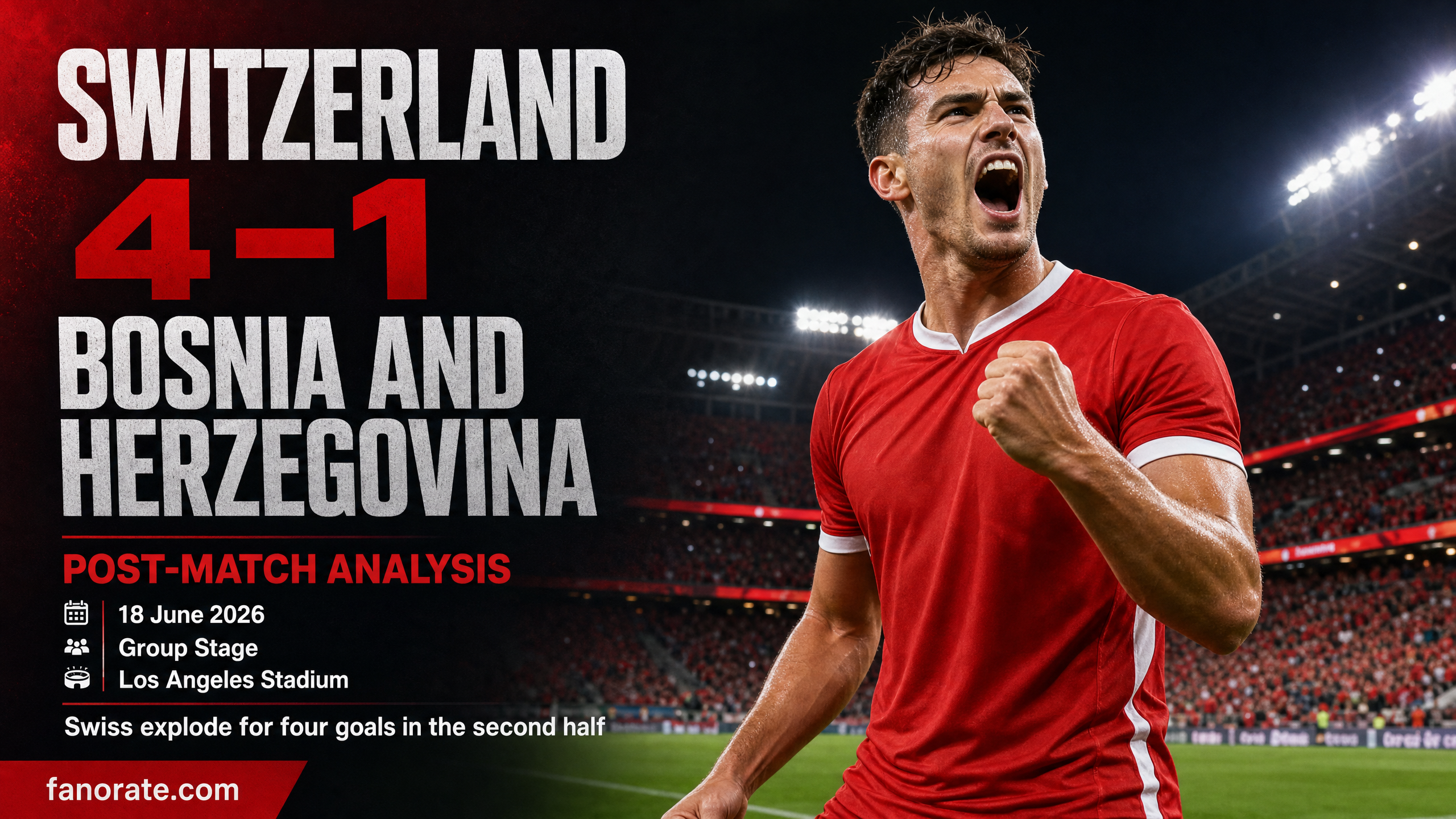
Switzerland 4-1 Bosnia and Herzegovina: Swiss Surge in Second Half Delivers Dominant World Cup 2026 Group Stage Win
A scoreless first half gave way to Swiss dominance as Switzerland unleashed four second-half goals to crush Bosnia and Herzegovina 4-1 in their FIFA World Cup 2026 group stage opener at Los Angeles Stadium. Johan Manzambi announced himself on the global stage while Granit Xhaka’s late strike sealed a statement victory.
What happened
Switzerland arrived at Los Angeles Stadium with something to prove, and by the final whistle, they had delivered one of the most emphatic second-half performances of the FIFA World Cup 2026 group stage. A tight, goalless first half concealed the storm that was coming. From the 56th minute onwards, the Swiss machine clicked into gear — substitutions sparked the turnaround, quick transitions punished a tiring Bosnian backline, and Johan Manzambi tormented defenders throughout. Four unanswered Swiss goals against a single Bosnian consolation told the complete story: Switzerland are serious contenders in 2026.
How it was won and lost
First Half Stalemate: Defensive Discipline Reigns
The opening 45 minutes were a tactical chess match. Bosnia and Herzegovina, organized in a compact defensive shape, managed to frustrate Switzerland’s attacking intent and keep the game scoreless at the break. Switzerland probed with possession — finishing the match with 587 passes completed at an 88% accuracy rate compared to Bosnia’s 285 at 81% — but struggled to find the final vertical pass to unlock the Bosnian block. The Swiss dominated territory and ball retention but lacked the incisiveness to test Nikola Vasilj before the interval.
Second-Half Substitutions Detonate Swiss Attack
The game turned decisively after the hour mark. Switzerland’s coaching staff made a triple substitution in the 71st minute, introducing Johan Manzambi, Djibril Sow, and Ruben Vargas — a bold tactical overhaul that immediately recalibrated the team’s attacking geometry. The fresh legs stretched Bosnia horizontally, created overloads in wide areas, and generated the pace and directness that had been missing. With 13 shots on target across the match and 22 total attempts, Switzerland’s second-half pressure was relentless.
Manzambi’s Width and Transition Threat
Johan Manzambi’s introduction proved to be the decisive tactical shift. Operating with pace down the right channel, he exploited the spaces left behind by a Bosnia side that had committed men forward in search of a foothold. His right-foot strikes in the 74th and 90th minutes — the latter assisted by Ruben Vargas — demonstrated a striker not just running channels but finishing crisply under pressure. Switzerland’s xG of 2.06 (non-penalty xG) reflected genuine, high-quality chance creation rather than speculative efforts.
Bosnia’s Defensive Fragility Exposed
Bosnia and Herzegovina carried a structural vulnerability on their left side once the game opened up. Tarik Muharemovic’s professional foul in the 80th minute — earning a red card as last man — was symptomatic of a defensive unit increasingly overwhelmed by Swiss transitions. With an xG of just 0.32, Bosnia rarely threatened Gregor Kobel’s goal in open play, and their only consolation came in the 90+3rd minute through Ermin Mahmić from a set-piece situation, underlining that dead-ball situations were their only credible threat route.
Xhaka as the Metronome and Late Executioner
Granit Xhaka’s impact was twofold: as the central conductor orchestrating Switzerland’s passing cycles in the first half, and as the late executioner who sealed the win with a clinical left-foot strike in the 90+7th minute. Switzerland’s press resistance — completing passes at 88% accuracy — was built around Xhaka’s spatial awareness and ability to recycle possession under pressure. He embodied the tactical intelligence that makes Switzerland one of Europe’s most cohesive international sides.
Who decided it
Johan Manzambi
SwitzerlandIntroduced as a 71st-minute substitute, Manzambi immediately changed the match’s complexion. He scored twice — a right-foot strike in the 74th minute and another in the 90th — and was a constant menace in transition, combining effectively with Ruben Vargas to unpick Bosnia’s defensive shape.
Manzambi’s introduction as a high-tempo, direct forward stretched Bosnia’s defensive line vertically, creating the space that Switzerland’s patient first-half possession had failed to manufacture. His off-the-ball movement and finishing sharpness were the catalyst for the Swiss scoring burst.
Ruben Vargas
SwitzerlandAnother substitute who made an immediate impact, Vargas scored with a composed right-foot finish in the 84th minute assisted by Breel-Donald Embolo, and then turned provider with the assist for Manzambi’s second in the 90th minute.
Vargas brought width, dribbling intent, and combination play to the Swiss attack. His interplay with Embolo on the right flank created the overlapping dynamics that overloaded Bosnia’s retreating defenders in the final quarter of the game.
Granit Xhaka
SwitzerlandThe skipper controlled Switzerland’s tempo throughout, completing passes at a high rate to maintain Swiss dominance in midfield. He capped a commanding display with a left-foot strike in the 90+7th minute to complete the 4-1 scoreline.
Xhaka’s press resistance and positional discipline formed the spine of Switzerland’s build-up structure. His ability to find pockets between the Bosnian defensive and midfield lines kept Switzerland’s rhythm consistent even during Bosnia’s brief spells of pressure.
Breel-Donald Embolo
SwitzerlandOperating as a focal point in the Swiss attack, Embolo provided the assist for Vargas’s 84th-minute goal and linked play intelligently before being withdrawn for Cédric Itten in the 89th minute. His hold-up play and link-up movement were central to Switzerland’s second-half offensive fluidity.
Embolo’s physical presence and clever movement off the ball created the forward passing outlets that unlocked Bosnia’s structured defensive line, with his layoff for Vargas being a highlight of Switzerland’s clinical transitional play.
Gregor Kobel
SwitzerlandThe Swiss goalkeeper was largely untroubled throughout, facing minimal serious chances from a Bosnia side that registered an xG of just 0.32. His command of the penalty area and distribution contributed to Switzerland’s overall composure.
Kobel’s security at the back allowed Switzerland’s defensive line to push high and support attacks with confidence, knowing there was a reliable last line behind them. His clean sheet until stoppage time reflected a dominant defensive performance.
Where it sits in history
Switzerland have long been established as one of Europe’s most consistent World Cup qualifiers, but their ability to translate group stage competence into knockout stage progression has defined their modern tournament narrative. This 4-1 victory echoes the clinical second-half football Switzerland displayed during their memorable Euro runs and recalls their group stage dominance at the 2022 World Cup in Qatar where they topped Group G. For Bosnia and Herzegovina, this defeat continues a painful FIFA World Cup journey — their only previous appearance came at Brazil 2014, and a result like this underlines the significant gap they must close to compete at the sport’s highest level. Switzerland’s xG superiority of 2.06 to 0.32 suggests this was not a fortunate result but a genuinely earned thrashing built on tactical intelligence and clinical finishing.
Inside the ground
Los Angeles Stadium — with its 70,242-capacity roaring under the California sky — provided a spectacular backdrop for Switzerland’s group stage statement. The stadium, one of the iconic centerpieces of FIFA World Cup 2026’s North American hosting, drew a cosmopolitan crowd reflecting Los Angeles’s diverse football culture. Swiss supporters celebrated each second-half goal with increasing euphoria, while the Bosnian contingent, vocal throughout the opening exchanges, fell into stunned silence as their side conceded four times after the interval. The scattered clouds overhead did nothing to dampen the electric atmosphere as Switzerland’s substitutes wrote themselves into their nation’s World Cup story.
Looking ahead
Switzerland’s emphatic 4-1 victory places them in a commanding position at the top of their FIFA World Cup 2026 group standings after matchday one. Their xG of 2.06 and 22 total attempts signal a team with genuine cutting edge and tactical flexibility — the triple substitution gambit that unlocked this game will worry future opponents. Bosnia and Herzegovina face a difficult path to recovery, needing to regroup both defensively and psychologically before their next group fixture. For Switzerland, the challenge will be maintaining this level of performance while managing squad fitness across the group stage, particularly with the depth and impact contributions that Manzambi, Vargas, and Sow demonstrated from the bench.
The bottom line
-
Switzerland scored all four goals in the second half, demonstrating exceptional tactical adaptability and substitution impact.
-
Johan Manzambi scored twice after coming on as a 71st-minute substitute, announcing himself as Switzerland’s wildcard weapon.
-
Switzerland completed 587 passes at 88% accuracy, significantly outclassing Bosnia’s 285 at 81% in the possession battle.
-
Switzerland’s xG of 2.06 versus Bosnia’s 0.32 confirms the scoreline was a fair reflection of the match’s one-sided nature.
-
Tarik Muharemovic’s red card for a professional foul in the 80th minute compounded Bosnia’s defensive misery.
-
Granit Xhaka’s late left-foot strike sealed the win and reaffirmed his status as Switzerland’s heartbeat and leader.
-
Bosnia’s only goal came in the 90+3rd minute through Ermin Mahmić, a consolation that masked a thoroughly difficult evening.
-
Switzerland’s squad depth — evidenced by five impactful substitutions — positions them as a serious FIFA World Cup 2026 contender.
