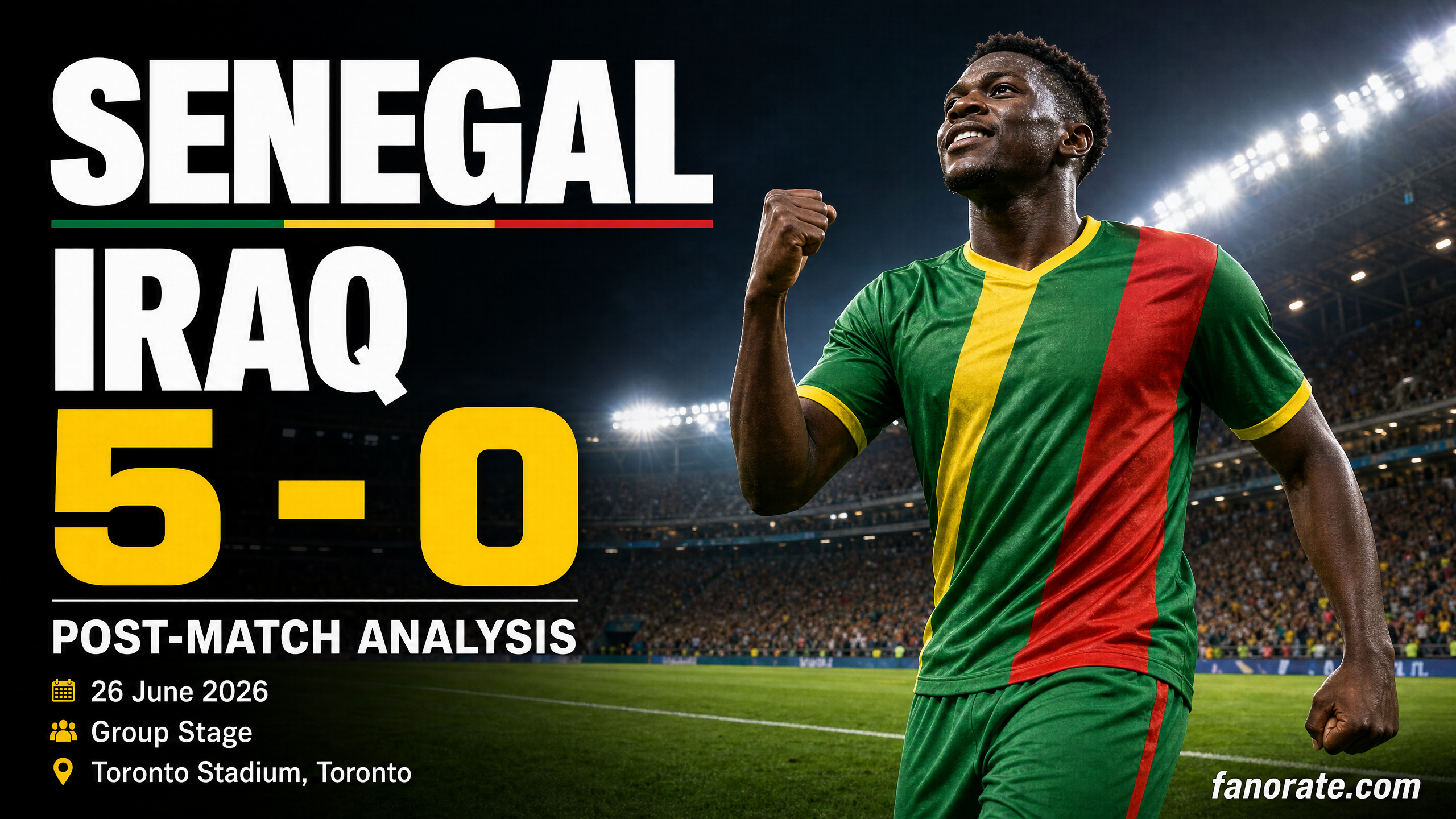
Senegal 5-0 Iraq: Lions of Teranga Destroy Ten-Man Iraq in FIFA World Cup 2026 Group Stage Rout
Senegal delivered a statement performance at Toronto Stadium, dismantling Iraq 5-0 in the FIFA World Cup 2026 Group Stage. A third-minute opener was followed by an Iraqi red card, and the Lions of Teranga turned ruthless after half-time with four unanswered goals in a dominant display of attacking intent.
Senegal win comprehensively after Iraq reduced to ten men in the 13th minute
What happened
Senegal turned Toronto Stadium into their own cathedral of football, producing one of the most commanding performances of the FIFA World Cup 2026 Group Stage with a emphatic 5-0 dismantling of Iraq. What began as a tightly contested affair was shattered by a red card in the 13th minute that irreversibly tilted the encounter. From that moment, Aliou Cissé’s Lions of Teranga suffocated Iraq with relentless possession, suffocating pressing, and a second-half attacking barrage that left the Gulf side shellshocked. Mouhamadou Diarra’s early opener set the tone, while Pape Gueye’s brace and strikes from Ismaïla Sarr and Iliman Ndiaye completed a scoreline that announced Senegal’s World Cup credentials loud and clear.
How it was won and lost
Early Goal, Early Red: The Game’s Defining Ten Minutes
Senegal were barely four minutes old in the tournament when Mouhamadou Diarra broke the deadlock, finishing off a move involving Abdoulaye Seck to give the Lions an electric early lead. But it was the events of the 13th minute that truly defined the contest. Iraq’s Rebin Ghareeb Sulaka Adhamat received a red card — confirmed by VAR — leaving the Middle Eastern side to face 77 minutes with ten men against one of Africa’s most physically imposing and technically gifted squads. From that moment, the tactical battle became structural containment versus siege warfare.
Possession Dominance as a Weapon
Senegal’s statistics tell the story of utter control. A 69% possession share, 586 passes with an 88% accuracy rate, and 129 recorded attacks underline how completely they suffocated Iraq. With an extra man, Cissé’s side stretched the pitch wide, utilizing 25 crosses and generating 12 corners. The Lions moved the ball patiently in the first half — perhaps too patiently — before unleashing their full firepower after the interval. Iraq, restricted to 264 passes at just 70% accuracy, were reduced to a purely reactive shape, inviting pressure and relying on long clearances and a goalkeeper who made six saves to avoid a heavier defeat.
The Second-Half Blitz: Four Goals in 34 Minutes
The scoreline remained a single goal at half-time, suggesting Iraq’s ten men had marshalled their defensive lines with discipline through the opening 45. But Senegal’s triple substitution wave on 57 minutes — bringing on Pape Gueye, Nicolas Jackson, and Iliman Ndiaye — was a tactical masterstroke. Within two minutes of Gueye’s introduction, Ismaïla Sarr had made it 2-0 from a Lamine Camara assist, and Gueye himself tapped in a third just minutes later. The floodgates had opened. Senegal’s wider attacking combinations and direct pressing after the break overwhelmed Iraq’s exhausted defensive structure, culminating in Gueye’s second and Ndiaye’s emphatic finish before the final whistle.
Width, Combinations, and Crossing Volume
Senegal’s attacking structure was built on width and combination play. Twenty-five attempted crosses — seven of which were accurate — alongside 23 key passes demonstrated the variety of attacking threat Cissé’s side possessed. With Jackson’s movement stretching the last line and Ndiaye operating in pockets between the lines, Iraq’s ten defenders were constantly pulled in multiple directions. The Lions also hit the woodwork once, further emphasizing their dominance in the final third. Ninety dangerous attacks to Iraq’s 15 encapsulates the one-sided nature of the second half.
Iraq’s Defensive Resilience in Context
With eleven men, Iraq may have offered a more competitive encounter — they registered six total shots and 54 attacks, showing some attacking ambition through Ali Al-Hamadi and Ahmed Qasem in the first half. Their goalkeeper made six saves to prevent further humiliation. However, conceding a red card before the 15th minute in a World Cup group game against Senegal was always going to be an insurmountable obstacle. Their 20 tackles and seven interceptions reflected spirited effort, but the numerical disadvantage ultimately made sustained resistance impossible across 90 minutes.
Who decided it
Pape Gueye
SenegalIntroduced as a second-half substitute on 57 minutes, Gueye instantly altered the game’s rhythm with his physical presence and late runs into the box. He scored twice — in the 59th and 72nd minutes — to put Senegal’s victory beyond any doubt and earned a yellow card for his efforts late on, underlining his combative impact.
Gueye’s introduction as part of Senegal’s triple substitution provided an immediate attacking injection in central midfield. His ability to arrive late into the penalty area — assisted by Sarr and Ndiaye respectively — demonstrated sharp movement and smart reading of the game, giving Senegal a new dimension beyond their patient wide build-up play.
Ismaïla Sarr
SenegalSarr was a constant menace down Senegal’s right flank, scoring the crucial second goal on 56 minutes from a Lamine Camara assist and providing the assist for Gueye’s first. He was a consistent outlet throughout, combining pace, direct running, and end product in a high-quality individual display.
Sarr’s directness in behind Iraq’s defensive line repeatedly stretched their shape and created overloads for Senegal in wide areas. His crossing and ability to cut inside gave Iraq’s makeshift ten-man defence persistent problems, and his involvement in two goals in three second-half minutes helped break Iraqi resistance decisively.
Iliman Ndiaye
SenegalNdiaye came off the bench as part of the 57th-minute wave and made an immediate impact, providing the assist for Gueye’s second goal before finishing emphatically himself in the 82nd minute to seal the rout. His creativity between the lines was a constant source of danger.
Operating in the half-spaces between Iraq’s lines, Ndiaye’s technical quality and quick combination play suited Senegal’s positional game perfectly. His goal and assist in the final half-hour underlined the quality depth Cissé possesses and the tactical intelligence of bringing fresh legs into a game that was already won but needed finishing.
Mouhamadou Diarra
SenegalDiarra opened the scoring in just the fourth minute, setting the tone for Senegal’s dominant display. His goal — assisted by Abdoulaye Seck — came from intelligent movement and sharp finishing, giving the Lions the perfect platform from which Iraq’s subsequent red card became all the more devastating.
Diarra’s early goal forced Iraq to commit forward in search of an equaliser, which in turn opened spaces that Senegal’s wide attackers could exploit. It set the psychological framework for the entire match and reinforced Senegal’s intent to impose themselves on the tournament from the opening group fixture.
Lamine Camara
SenegalCamara was a driving force in Senegal’s midfield throughout the match, registering the assist for Sarr’s goal and helping maintain the Lions’ rhythmic possession game. His engine and progressive carrying from deep were consistent features of Senegal’s dominant midfield display.
Operating as a box-to-box presence in Senegal’s midfield, Camara’s vertical passing and ability to break lines with the ball under pressure gave the Lions consistent momentum. His assist for Sarr exemplified his willingness to make runs beyond the first phase of play and connect the midfield with the attack.
Where it sits in history
This 5-0 victory ranks among Senegal’s finest performances on the World Cup stage. The Lions of Teranga famously reached the quarter-finals in 2002 under Bruno Metsu and triumphed at AFCON 2021 and 2022 under Aliou Cissé, establishing themselves as one of Africa’s elite footballing nations. A five-goal margin in a World Cup group game is a statement of intent — only three African sides have previously scored five or more goals in a single World Cup match. For Iraq, making only their second-ever FIFA World Cup appearance, this defeat is a harsh introduction to the tournament’s highest level, compounded by the early numerical disadvantage that derailed any genuine chance of a competitive result.
Inside the ground
Toronto Stadium — a multi-sport venue converted for the World Cup — provided a vibrant backdrop as the Canadian city’s large and passionate West African diaspora transformed the stands into a sea of green and gold. Under overcast Canadian skies, the atmosphere evolved from focused tension in the opening minutes following Diarra’s goal, to electric release with each second-half strike. Senegalese supporters, many draped in the colours of club heroes like Sadio Mané and Ismaïla Sarr, celebrated each goal with percussion, song, and a festival energy that made the stadium feel thousands of miles from home. Toronto’s multicultural identity made it a natural home for an African giant on the world stage.
Looking ahead
Senegal’s commanding victory propels them to the top of their World Cup 2026 group with a stunning +5 goal difference after the opening matchday. The Lions of Teranga have immediately established themselves as contenders not just to progress from the group stage, but to make a deep run in the tournament. Iraq, meanwhile, face serious questions about their ability to recover from this opening defeat — they will need to reassess both their discipline and structural approach for their remaining group fixtures if they are to have any chance of advancing. All eyes now turn to Senegal’s next assignment, where Cissé’s side will look to build on one of the tournament’s most emphatic opening results.
The bottom line
-
Senegal thrashed Iraq 5-0 in a dominant FIFA World Cup 2026 Group Stage performance at Toronto Stadium in Canada
-
Iraq’s Rebin Ghareeb Sulaka Adhamat was sent off in the 13th minute via VAR, fundamentally altering the contest
-
Senegal registered 69% possession, 28 total shots, 90 dangerous attacks and five big chances created
-
Pape Gueye scored twice and provided an assist after coming off the bench in the 57th minute
-
Ismaïla Sarr scored and assisted in a three-minute second-half burst that broke Iraq’s resistance
-
Iliman Ndiaye finished the rout with an 82nd-minute strike after also providing an assist
-
Senegal used all five substitutions strategically, with the triple change at 57 minutes triggering the goal avalanche
-
Iraq’s goalkeeper made six saves in a valiant but ultimately futile effort to limit the damage
-
Senegal’s +5 goal difference gives them a commanding start atop their FIFA World Cup 2026 group
-
This is among the most emphatic opening World Cup group-stage victories in Senegalese football history
