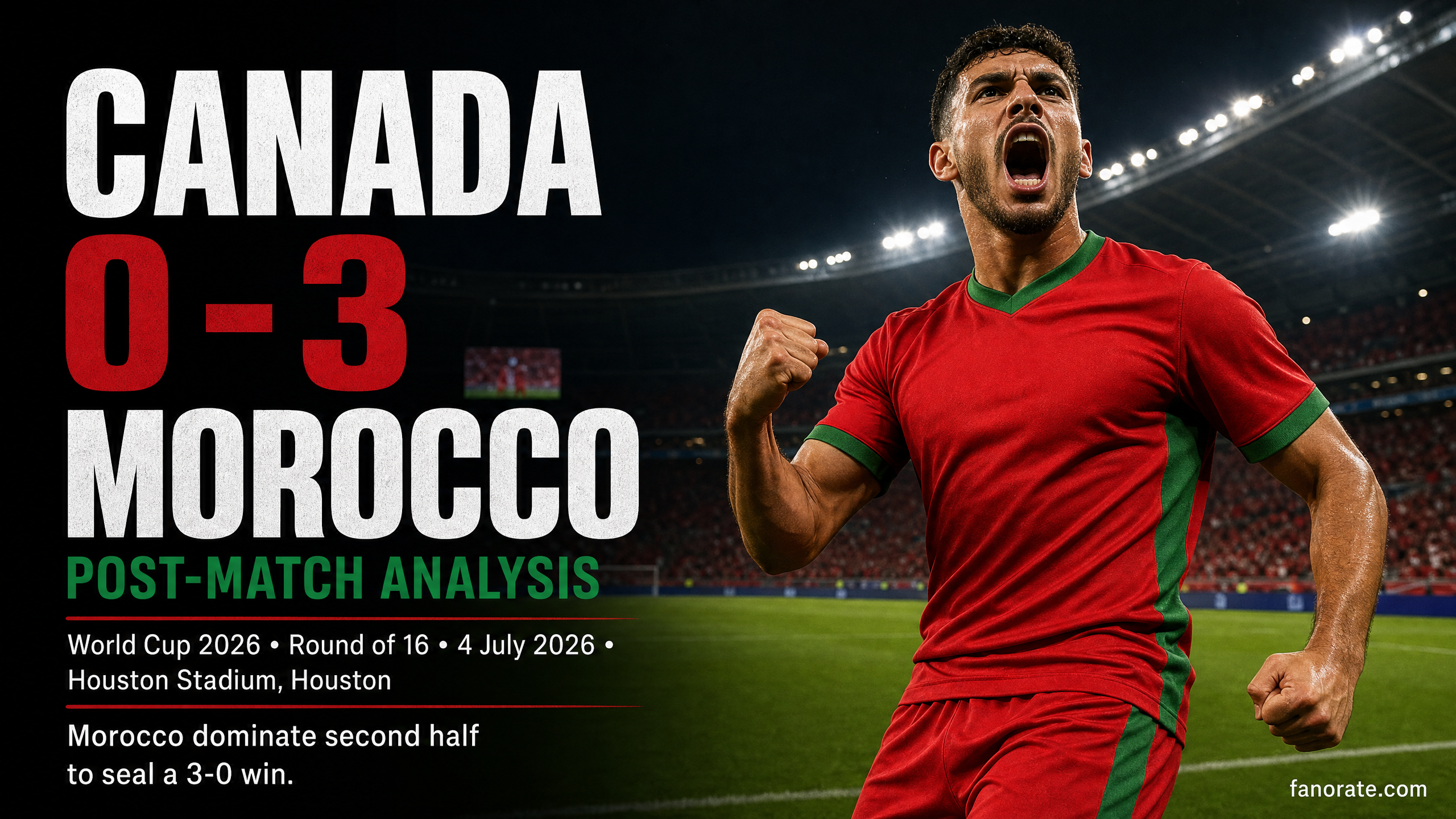
Morocco Crush Canada 3-0 to Advance in FIFA World Cup 2026 Round of 16
A dominant second-half display from Morocco ended Canada’s World Cup 2026 dream in Houston. Azzedine Ounahi’s brace and a late Soufiane Rahimi strike sealed a commanding 3-0 victory for the Atlas Lions.
Morocco advance to the FIFA World Cup 2026 quarter-finals with a dominant 3-0 victory
What happened
Morocco delivered one of the tournament’s most controlled knockout performances to eliminate Canada 3-0 at Houston Stadium, booking their place in the FIFA World Cup 2026 quarter-finals. The Atlas Lions were disciplined, direct, and devastating on the counter, with Azzedine Ounahi the architect of their destruction — scoring in the 50th and 82nd minutes before Soufiane Rahimi added a clinical third deep into stoppage time. Canada, despite generating 11 shots and winning 11 corners, could not convert their pressure into goals, and Morocco punished them with surgical efficiency. The result was as emphatic as the final scoreline suggests — and perhaps even flattering to the hosts.
How it was won and lost
Morocco’s Low-Block Counter System Suffocated Canada’s Wide Overloads
Walid Regragui set Morocco up in a compact mid-block that consistently forced Canada to the flanks. With 55% possession and an 82% pass accuracy rate, the Atlas Lions were disciplined in their shape, absorbing pressure before transitioning quickly through Brahim Diaz and Achraf Hakimi. Canada’s 29 crossing attempts produced only 8 accurate deliveries — a clear sign that Morocco’s defensive structure was winning the aerial and wide duel battle convincingly. Hakimi’s overlapping runs from right-back stretched Canada vertically while also serving as a key outlet for transitions that led directly to Ounahi’s first goal.
Canada’s High Volume, Low Efficiency Problem
Canada generated 70 dangerous attacks — the highest of either side — but converted just 3 shots on target from 11 total. Their 11 corners and 29 crosses speak to a team that was pushing hard, particularly in wide areas through Richie Laryea and Tajon Buchanan, but the quality in the final third was simply not there. Jonathan David, typically lethal in front of goal, was largely isolated and even picked up a yellow card in frustration before half-time. Big chances created: just 1. Against a Moroccan side that has conceded very little across this tournament, that attacking output was always likely to be insufficient.
The Yellow Card Storm — How Discipline Nearly Derailed Both Sides
Six yellow cards were distributed across both teams in an increasingly fractious first half, with four of them coming in the final five minutes of the opening 45. Morocco’s Azzedine Ounahi, Achraf Hakimi, Bilal El Khannous, and Redouane Halhal all picked up bookings, while Canada’s Jonathan David and Richie Laryea were cautioned in quick succession. The tension boiled over repeatedly, but Morocco managed to channel that edge into focused aggression after the break rather than letting it derail their shape. Canada, by contrast, seemed to lose their tactical composure under the pressure of those accumulating cards.
Ounahi’s Second-Half Masterclass and Brahim Diaz’s Creative Engine
Morocco were transformed after the interval. Azzedine Ounahi, who had been cautioned before the break, channelled his energy into the game’s defining moments — arriving late into the penalty area to convert Hakimi’s assist on 50 minutes, then doing the same from a Brahim Diaz delivery on 82 minutes. Diaz was central to Morocco’s second-half fluency, providing two assists and repeatedly drifting into pockets between Canada’s midfield and defence. His ability to combine short passes with sudden acceleration gave Morocco’s attack a creative unpredictability that Canada’s backline could not neutralize. Soufiane Rahimi, introduced as a substitute early in the second half, completed the rout in stoppage time — applying the finish that confirmed Morocco’s quality throughout.
Substitution Strategy — Regragui’s Decisive Hand
Morocco’s coaching staff showed tactical intelligence with their substitutions. Soufiane Rahimi came on at 63 minutes for Ismael Saibari, immediately injecting pace and directness into the Moroccan attack — and ultimately scoring the third goal in the 90th+8 minute. Sofyan Amrabat’s introduction also helped Morocco control the midfield in the closing stages. Canada’s changes, bringing on Cyle Larin, Jacob Shaffelburg, and Promise Akinpelu, failed to alter the game’s dynamic — largely because Morocco’s structure was too disciplined to be disrupted by fresh legs alone.
Who decided it
Azzedine Ounahi
MoroccoThe midfielder was booked before half-time but responded with arguably the performance of the round, scoring twice — in the 50th and 82nd minutes — to effectively end Canada’s World Cup. His movement into the box, his timing of runs, and his composure in front of goal were exceptional.
Ounahi operated as a box-to-box catalyst for Morocco, pressing high to win the ball back and arriving late to convert crosses and cutbacks. His two goals were decisive momentum shifts that broke Canada’s resistance completely.
Brahim Diaz
MoroccoThe Real Madrid playmaker was Morocco’s most technically gifted presence in the second half, supplying two assists and consistently finding space between Canada’s defensive lines. His dribbling and incisive passing were a constant threat.
Diaz functioned as Morocco’s creative hub in transition, linking the midfield to the attack with short, sharp combinations. His assists for both Ounahi’s second goal and Rahimi’s late strike demonstrated his ability to unlock a defensive opponent with precision.
Achraf Hakimi
MoroccoThe PSG full-back was a dominant force down the right flank, providing the assist for Morocco’s opening goal and consistently pushing forward to stretch Canada’s defensive shape. Despite picking up a yellow card, he remained one of the game’s most influential presences.
Hakimi’s ability to function as both a right-back and an attacking outlet created constant numerical overloads on Morocco’s right side. His delivery for Ounahi’s first goal demonstrated his elite-level crossing ability from advanced positions.
Soufiane Rahimi
MoroccoIntroduced as a substitute in the 63rd minute, Rahimi justified his selection with a clinical finish in the 90th+8 to complete the rout. His pace and intelligent movement caused Canada problems from the moment he entered the game.
Rahimi’s injection of speed and directness in the second half stretched Canada’s backline further and prevented them from committing men forward in search of a consolation. His goal killed the match definitively.
Yassine Bounou
MoroccoThe Morocco goalkeeper made three saves to keep his clean sheet intact, dealing comfortably with Canada’s limited attempts on target. His distribution was also clean and contributed to Morocco’s build-up play from the back.
Bounou’s composure behind a well-organized defensive line allowed Morocco to press higher up the pitch. His 3 saves, while not all spectacular, were reliable and denied Canada any foothold back into the match.
Where it sits in history
This result continues Morocco’s remarkable trajectory as one of football’s most compelling rising powers. Their famous run to the semi-finals of the 2022 FIFA World Cup in Qatar was not a one-off — this Atlas Lions squad has refined that blueprint into something even more potent. A 3-0 knockout stage victory over a CONCACAF nation hosting the tournament is a significant statement, and it places Morocco among the genuine contenders for the title. For Canada, the defeat is a bittersweet chapter — the country co-hosted this World Cup and generated genuine excitement reaching the knockout rounds, but the gulf in quality against a Morocco side operating at international elite level proved too great. Canada’s footballing renaissance, nonetheless, represents a generational leap for the program.
Inside the ground
Houston Stadium was charged with colour and passion from both sets of supporters. The Moroccan diaspora in the United States turned sections of the ground into a wall of red and green, with drumbeats and chants echoing throughout. Canada’s supporters — buoyed by the rare experience of a home-continent World Cup — were vocal through the first half as their team pressed and forced corner after corner. But as Morocco’s goals arrived, the emotional pendulum swung entirely to the Atlas Lions supporters, who celebrated each goal with scenes of pure elation. The 72,220-capacity stadium was a fitting stage for a knockout match that delivered the kind of drama the tournament demands.
Looking ahead
Morocco advance to the FIFA World Cup 2026 quarter-finals where they will face a new challenge on the path toward what would be the most extraordinary World Cup triumph in African football history. Their defensive solidity, creative midfield depth, and clinical attacking options make them a genuine threat to any remaining side in the draw. For Canada, the journey ends here — but the development of this generation, including Jonathan David, Alphonso Davies, and Stephen Eustaquio, signals that Canadian football will remain a competitive force for World Cups to come. The program has foundations now that simply did not exist a decade ago.
The bottom line
-
Morocco defeated Canada 3-0 in the FIFA World Cup 2026 Round of 16 at Houston Stadium
-
Azzedine Ounahi scored twice — in the 50th and 82nd minutes — to secure the victory
-
Soufiane Rahimi added a third goal in the 90th+8 minute after coming on as a substitute
-
Brahim Diaz provided two assists and was Morocco’s most creative force in the second half
-
Canada generated 70 dangerous attacks and 11 corners but converted just 3 shots on target
-
Both sides accumulated 4 yellow cards each in a fiercely contested and physically intense match
-
Morocco advance to the World Cup 2026 quarter-finals, continuing their run as one of football’s elite knockout tournament sides
-
Canada’s World Cup 2026 campaign ends at the Round of 16 on home soil
