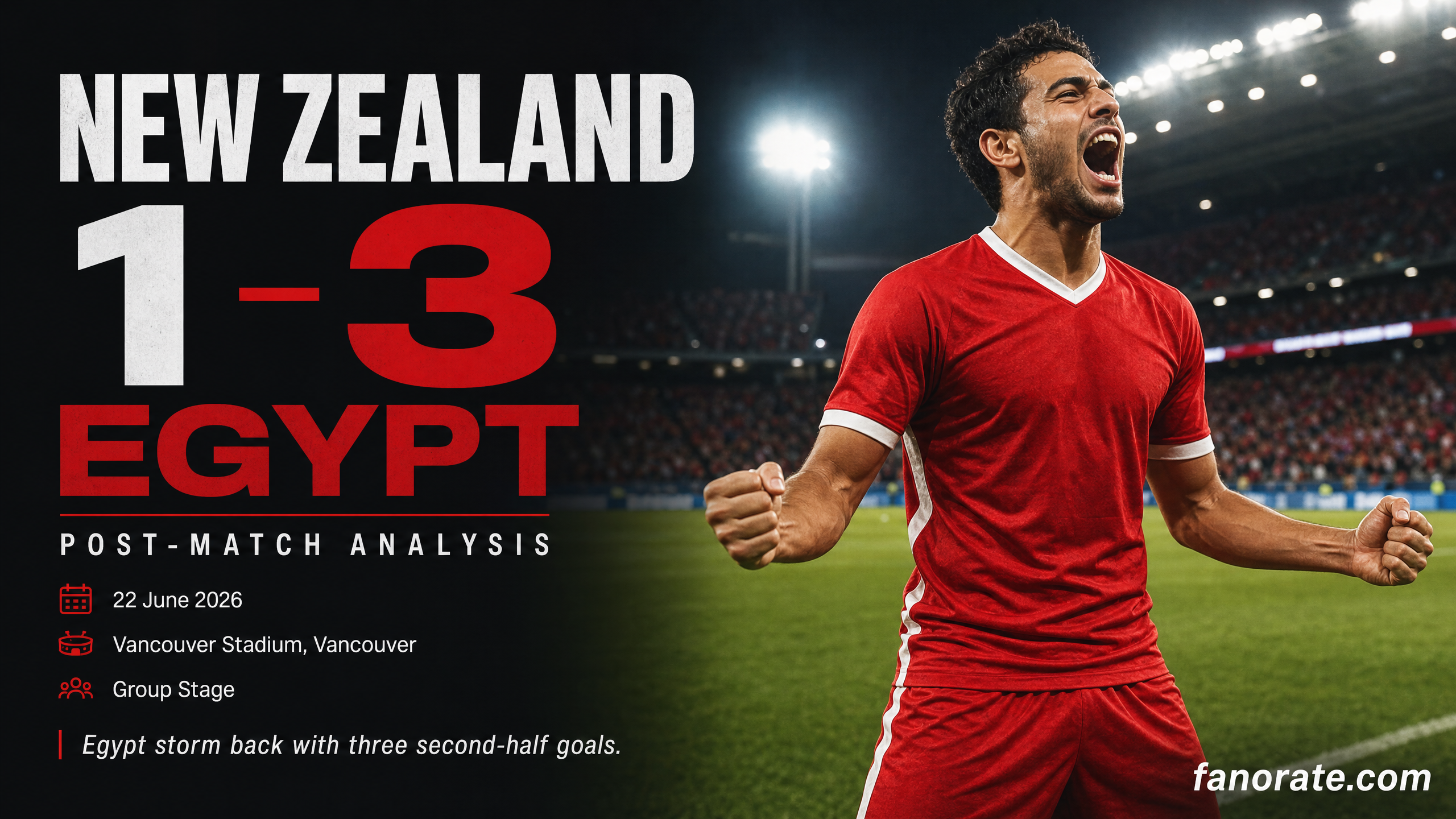
Egypt Stun New Zealand 3-1 at FIFA World Cup 2026: Mostafa Mohamed Leads Second-Half Comeback
Egypt trailed at the break but unleashed a devastating second-half blitz at Vancouver Stadium, scoring three unanswered goals to overturn New Zealand’s first-half lead and claim a commanding 3-1 Group Stage victory at FIFA World Cup 2026.
Egypt win
What happened
New Zealand looked set for a famous upset when Finn Surman’s 15th-minute header gave the All Whites the lead inside a sunlit Vancouver Stadium. But Egypt had other ideas. Completely transformed at half-time and ruthless from the 58th minute onward, the Pharaohs steamrolled their way to a 3-1 victory through a Mostafa Mohamed header, a clinical Mohamed Salah Ghaly finish, and a late Mahmoud Ibrahim Hassan header — three second-half goals that rewrote the story entirely. Egypt’s xG of 1.92 versus New Zealand’s 1.11 tells a tale of Egyptian dominance that the scoreline ultimately reflected. This was a tournament statement from the Pharaohs.
How it was won and lost
New Zealand’s Bright Start Exploited Egyptian High Line
The All Whites were disciplined and direct in the opening quarter, building quickly through the channels and punishing Egypt’s high defensive line. Finn Surman’s opener at 15 minutes — a well-timed header assisted by Tim Payne — came from a set-piece delivery that Egypt’s backline failed to deal with. New Zealand generated 11 total shots by full-time and showed early resilience, sitting in a compact mid-block and inviting Egypt to build through the thirds. The home side’s 44% possession share was a tactical choice, not a failing.
Egypt’s Half-Time Reset and Tactical Shift Proved Decisive
Egypt entered the break trailing despite generating the lion’s share of possession — 56% — and outpassing New Zealand 528 to 420 completed passes. The introduction of Rami Hisham Abdel Aziz Rabia before the break signalled a tactical adjustment, and by the 58th minute Egypt had levelled. The Pharaohs increased their width, exploited overloads on the flanks, and leveraged Mohamed Hany Eldemerdash’s delivery from left back to unlock a New Zealand side that had no answer to Egypt’s second-half tempo surge.
Mostafa Mohamed — The Focal Point Egypt Built Their Second Half Around
Mostafa Mohamed Zaki Abdelraouf was central to everything dangerous for Egypt after the interval. His 58th-minute equaliser came via a towering header from a Eldemerdash cross — a move that showed Egypt’s wide delivery as a potent weapon. He also created directly for Mohamed Salah Ghaly’s 67th-minute finish and received the assist credit on the substitution that brought Hamza Abdel Karim into the game. With Egypt recording 19 shots and 12 on target, Mostafa’s hold-up play and aerial presence stretched New Zealand’s defence beyond its limits.
Substitution Wave at 76 and 85 Minutes Sealed Egyptian Control
Egypt’s coaching staff sent on Hamza Abdel Karim and Mahmoud Ibrahim Hassan in the 76th minute wave, with the latter arriving for Omar Marmoush. It was an inspired move — Hassan headed home from a Mohamed Salah Ghaly cross at the 82nd minute to make it 3-1 and put the match to bed. New Zealand also made multiple changes at 76 and 85 minutes but could not find the attacking cohesion to threaten El Shenawy’s goal, managing only 3 shots on target throughout the contest compared to Egypt’s 7.
Egypt’s Passing Volume and Press Resistance Overwhelmed New Zealand
Egypt completed 528 passes to New Zealand’s 420, with an 88% accuracy rate compared to New Zealand’s 80%. Egypt’s higher progressive passes and superior ball retention in the final third underlined their technical quality. While New Zealand’s 10 ball recoveries showed admirable work rate, Egypt’s 18 successful tackles and 22 recoveries gave them a physical edge in the second half that proved insurmountable.
Who decided it
Mostafa Mohamed Zaki Abdelraouf
EgyptThe Egyptian striker was the pivotal figure in the comeback, scoring the 58th-minute equaliser with a header and creating the assist for Ghaly’s decisive third goal. His movement, aerial ability, and link-up play were central to Egypt’s second-half dominance.
Mostafa’s presence as a target striker stretched New Zealand’s centre-backs and created spaces in behind for Salah Ghaly and the Egyptian wide midfielders to exploit. His xG contribution was the highest on the pitch and his involvement in three of Egypt’s four decisive moments made him the match’s standout performer.
Mohamed Salah Ghaly
EgyptThe number 10 delivered a composed left-footed finish in the 67th minute to make it 2-1, converting Mostafa Mohamed’s lay-off with precision. He also provided the cross that led to Hassan’s 82nd-minute header and was a constant creative threat throughout the second half.
Salah Ghaly operated in the half-spaces behind New Zealand’s midfield, creating overloads centrally and transitioning Egypt from build-up to penetration. His ability to play the final pass and finish himself gave Egypt a dual threat that New Zealand’s defensive shape could not contain.
Mahmoud Ibrahim Hassan
EgyptIntroduced as a substitute in the 76th minute, Hassan made an immediate and decisive impact — heading home from close range at 82 minutes to seal Egypt’s 3-1 victory from a Salah Ghaly cross.
Hassan’s introduction brought fresh energy and aerial power to Egypt’s attack at a critical juncture. His instinctive header showed exactly the kind of clinical substitute impact that wins Group Stage matches at World Cups.
Finn Surman
New ZealandThe All Whites midfielder gave New Zealand the perfect start with a composed 15th-minute header, capitalising on Tim Payne’s assist to put his side in front. He was bright in the first half but like his teammates couldn’t maintain influence as Egypt dominated after the break.
Surman’s goal showed New Zealand’s set-piece preparation was sharp and deliberate. His ability to arrive late and meet the delivery demonstrated the All Whites had done their homework — but ultimately New Zealand couldn’t protect the lead or add to it.
Mohamed Hany Eldemerdash
EgyptThe left back was Egypt’s most effective creative outlet from deep, providing the assist for Mostafa Mohamed’s equalising header with an incisive cross from the left flank in the 58th minute.
Eldemerdash’s overlapping runs and delivery quality gave Egypt an extra dimension going forward. His involvement in the equaliser highlighted how Egypt’s fullbacks were weaponised in the second-half game plan, stretching New Zealand’s defensive width and creating the space for headers in the box.
Where it sits in history
Egypt’s appearance at FIFA World Cup 2026 continues the Pharaohs’ resurgence on the international stage after their long absence from the tournament’s later rounds. For New Zealand, qualifying for the World Cup remains an achievement in itself — the All Whites have historically punched above their weight against stronger opposition, but converting early leads into results remains a recurring challenge at this level. A 3-1 defeat despite leading at half-time is a painful reminder of the quality gap at FIFA World Cup Group Stage football. Egypt’s ability to win from a losing position reflects a squad with genuine tournament mentality — and the xG data (1.92 vs 1.11 in Egypt’s favour) suggests the final scoreline was a fair reflection of second-half dominance.
Inside the ground
Vancouver Stadium bathed in clear skies provided a vivid World Cup backdrop for what became one of the Group Stage’s more dramatic turnarounds. New Zealand’s supporters were in full voice after Surman’s opener — a goal that sparked genuine belief among the All Whites faithful that an upset was on. But as Egypt’s substitutions began to take effect and the Pharaohs’ technical superiority took hold, the atmosphere shifted dramatically. Egyptian fans responded with growing intensity, their celebrations at 58, 67 and 82 minutes building in decibels until Vancouver erupted at full-time. For the neutral, this was exactly the kind of Group Stage match that makes the expanded FIFA World Cup 2026 format so compelling.
Looking ahead
Egypt’s 3-1 victory puts the Pharaohs in an excellent position in their World Cup 2026 Group Stage standings, with three points on the board and a positive goal difference. They will look to build on this performance and Mohamed Salah Ghaly’s creative form in their next group fixture. New Zealand, despite the defeat, showed enough in the first half to suggest they can compete — but their inability to defend the lead and find a second goal when momentum was with them will be a concern for their coaching staff. The All Whites now face a must-not-lose situation if they are to have any realistic hope of progressing from the group, with their next fixture set to prove decisive for their World Cup 2026 campaign.
The bottom line
-
Egypt trailed 1-0 at half-time before producing a dominant second-half comeback to win 3-1
-
All three Egypt goals came after the 58th minute — making it one of the most dramatic second-half turnarounds of the World Cup 2026 group stage
-
Mostafa Mohamed was involved in all three Egypt goals — scoring one, assisting one, and serving as the focal point throughout
-
Egypt’s passing volume (528 completed passes, 88% accuracy) highlighted their technical superiority over New Zealand
-
New Zealand’s Finn Surman gave the All Whites a dream start with a 15th-minute header but the lead lasted just 43 minutes
-
Egypt’s xG of 1.92 vs New Zealand’s 1.11 confirms the Pharaohs were the deserving winners on the balance of play
-
Substitute Mahmoud Ibrahim Hassan sealed the victory with a header just six minutes after coming on — a game-changing impact off the bench
-
Egypt’s coaching staff made all the right calls with bold second-half substitutions that reshaped the contest entirely
