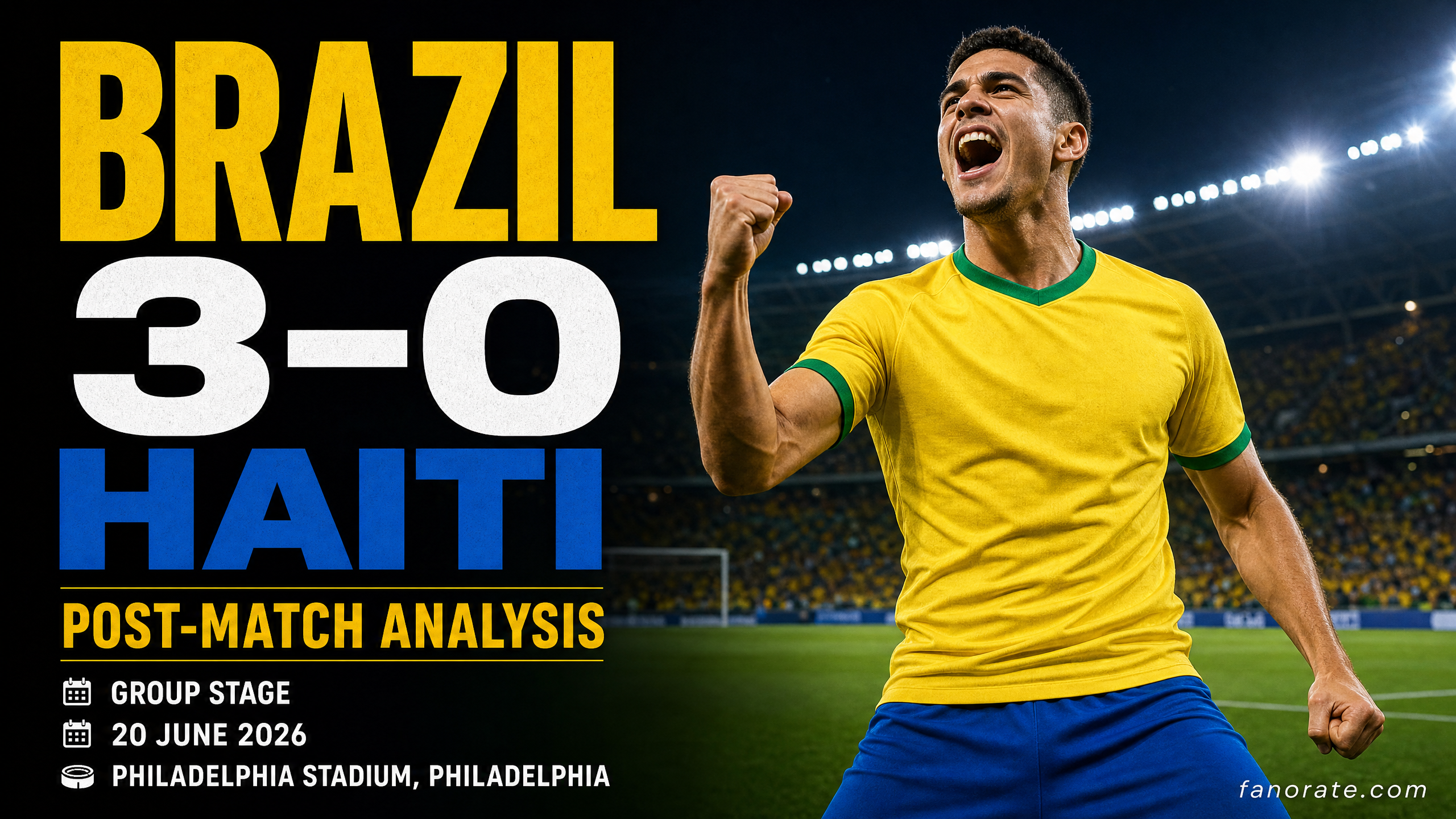
Brazil 3-0 Haiti: Cunha Brace & Vinicius Jr Strike Seal Dominant Group Stage Win | FIFA World Cup 2026
Brazil turned on the style in Philadelphia, dismantling Haiti 3-0 with a devastating first-half blitz that was all but over before the break. Matheus Cunha announced himself on the World Cup stage with a clinical brace, while Vinicius Jr’s added-time strike put the gloss on a supremely controlled Seleção performance.
What happened
Under the clear Philadelphia sky, Brazil delivered a statement of intent in their FIFA World Cup 2026 Group Stage opener, overwhelming Haiti with a ruthless and technically superior first-half display. All three goals arrived before the halftime whistle, a trio of strikes that illustrated the enormous gulf in quality between the two nations at this level. Matheus Cunha, deployed as Brazil’s central attacking pivot, was unstoppable in the opening 45 minutes — scoring twice with his left foot and tormenting Haiti’s defensive structure throughout. Vinicius Jr punctuated the first half in added time, converting a Lucas assist to make it three. The second half was an exercise in squad rotation and game management, with Brazil’s coaching staff using the occasion to blood substitutes including teenage sensation Endrick. Haiti, to their credit, never stopped competing, but the scoreline was a fair reflection of a chasm in class, resources, and experience.
How it was won and lost
Brazil’s High Press and Positional Dominance
Brazil set up in what appeared to be a 4-2-3-1 shape, with Casemiro and Bruno Guimarães forming a double pivot that controlled the tempo and protected the backline. The full-backs — Alex Sandro and Danilo — pushed high and wide to create overloads in the wide channels, allowing Vinicius Jr and Raphinha to operate in half-spaces. Brazil’s press was purposeful and coordinated, winning the ball back high up the pitch on multiple occasions and preventing Haiti from building through their lines. With 522 total passes to Haiti’s 398 and an 88% pass accuracy compared to Haiti’s 83%, Brazil’s positional play suffocated their opponents throughout the opening period.
Haiti’s Defensive Shape and the Gaps That Were Exploited
Haiti organized into a disciplined mid-block, looking to stay compact and frustrate Brazil’s intricate passing game. However, the gaps between their midfield and defensive lines proved fatal. Cunha repeatedly dropped deep to receive and then spun into space, while Vinicius Jr’s dynamism on the left created constant problems. Haiti’s high foul count — including Carlens Arcus being penalized as early as the 4th minute — was symptomatic of a defensive unit struggling to cope with the physicality and pace Brazil brought to transitions. Their xG conceded of approximately 1.29 against an expected goals generated figure for Brazil of 1.95 tells a story of a team under siege.
First-Half Blitz: Three Goals in 45 Minutes
The match was effectively decided in the first half as Brazil executed their attacking patterns with precision. Cunha’s first goal came via a composed left-foot finish in the 24th minute, rewarding sustained Brazil pressure. His second, in the 36th minute, was assisted by Vinicius Jr — a combination that threatened to develop into one of the most potent partnerships at this tournament. The third, deep in first-half stoppage time, saw Lucas Tolentino deliver for Vinicius Jr to slot home, capping a dominant 45-minute performance and allowing the Seleção coaching staff to manage the second half as they saw fit.
Squad Rotation and Second-Half Management
With the game already secured, Brazil made sweeping changes in the second half. Endrick Felipe replaced Cunha at the 64th minute, giving the teenage prodigy valuable World Cup experience, while Gabriel Martinelli came on for Lucas. Bruno Guimarães was withdrawn in the 81st minute, along with Danilo and Vinicius Jr, signaling that the technical staff were happy to cruise to the final whistle. The second half produced no goals, but it served a clear strategic purpose — maintaining fitness for the knockout phase while integrating fringe players into the tournament rhythm.
Who decided it
Matheus Cunha
BrazilMatheus Cunha was the architect of Brazil’s first-half dominance, scoring twice from his left foot and creating havoc through his intelligent movement in and around Haiti’s penalty area. His first goal was a composed finish in the 24th minute, and his second — assisted by Vinicius Jr — showcased his ability to arrive late into goal-scoring positions. He was substituted in the 64th minute, having done more than enough to stake his claim as a key weapon for Brazil at this tournament.
Cunha’s ability to drop deep, receive under pressure, and then accelerate into dangerous areas repeatedly broke Haiti’s defensive shape. His link play with Vinicius Jr on the left channel was particularly potent, and his willingness to run across the defensive line created lane-opening opportunities for Brazil’s midfielders.
Vinícius Jr
BrazilVinicius Jr was his electric self throughout the first half, combining directness with technical brilliance. He contributed the assist for Cunha’s second goal in the 36th minute before adding his own strike in first-half stoppage time from a Lucas assist. His pace and dribbling ability created constant anxiety for Haiti’s right flank.
Vinicius Jr’s positioning on the left half-space, combined with his tendency to cut inside, created an overload that Haiti’s defenders struggled to track. His partnership with Alex Sandro overlapping allowed for dynamic two-against-one situations that frequently broke down Haiti’s defensive structure.
Bruno Guimarães
BrazilThe Newcastle man was measured and commanding in the double pivot alongside Casemiro. He controlled the tempo when Brazil had possession and provided crucial press-resistance in transitions. His 81-minute shift before being replaced demonstrated the trust the coaching staff place in him as a structural anchor.
Bruno Guimarães’s ability to play forward quickly under pressure served as the engine of Brazil’s attacking transitions. His interception count and passing accuracy kept Haiti from establishing any meaningful counter-attacking outlets.
Jean-Ricner Bellegarde
HaitiBellegarde was Haiti’s most technically capable player and their primary creative outlet in midfield. He attempted to bridge the gap between defense and attack and showed flashes of quality on the ball, though the enormity of the task against Brazil’s double pivot was evident.
Despite the overwhelming scoreline, Bellegarde’s work rate and technique gave Haiti some brief moments of offensive intent. He will be crucial to Haiti’s chances of causing an upset later in the group stage.
Where it sits in history
Brazil enter the FIFA World Cup 2026 as five-time world champions — the most decorated nation in the tournament’s history — and this commanding display against Haiti was a reminder of why they are perennial favorites. The Seleção had endured a difficult qualification campaign, but their talent depth has never been in question, and a squad featuring Vinicius Jr, Endrick, Martinelli, Cunha, and Bruno Guimarães represents one of the most exciting generations Brazil have fielded in years. Haiti, making just their second-ever World Cup appearance — having famously qualified for the 1974 tournament in West Germany — were always going to face monumental odds here. Their 2026 qualification was a landmark achievement for Haitian football, but the task of competing against a Brazil side in this kind of form is almost without precedent for a Caribbean nation at this stage of the competition.
Inside the ground
Philadelphia Stadium was a cauldron of noise under the clear summer sky, with the Brazilian diaspora — one of the most passionate and vocal fan communities in world football — turning the ground into a sea of yellow and green. The famous Seleção chants reverberated around the 69,176-capacity venue from the first whistle, and each Brazilian goal was met with an eruption of sound that briefly lit up the Philadelphia night. Haiti’s traveling supporters, smaller in number but enormous in spirit, brought their own carnival energy and drumbeats, refusing to be drowned out even as the scoreline mounted. The atmosphere captured everything that makes the FIFA World Cup such a unique and irreplaceable global sporting event — two football cultures, separated by thousands of miles, colliding in an American city on the biggest stage the sport offers.
Looking ahead
Brazil will now turn their attention to their next Group Stage fixture, where three points would put them in pole position to advance to the knockout rounds. A 3-0 opening win, achieved with the luxury of heavy second-half rotation, sends a clear message to their group rivals and beyond. For Haiti, the challenge now is to regroup, recover, and attempt to find a foothold in a tournament that has so far shown them little mercy. If Bellegarde and Isidor can find form, and if their defensive structure holds for longer stretches, an upset against a weaker group opponent is not entirely beyond imagination. But the margin between Haiti and world football’s elite, laid bare in Philadelphia, is significant.
The bottom line
-
Brazil were ruthless and efficient, scoring all three goals in the first half to end the contest early.
-
Matheus Cunha announced himself as one of the tournament’s players to watch with a composed and clinical two-goal display.
-
Vinicius Jr added a goal and an assist, continuing his status as one of the world’s most dangerous attacking players on the global stage.
-
Brazil’s double pivot of Casemiro and Bruno Guimarães provided excellent structural balance, allowing the attacking players to express themselves freely.
-
The Seleção’s use of rotation in the second half — including Endrick’s introduction — highlighted the extraordinary depth available to their coaching staff.
-
Haiti competed with discipline and spirit but were ultimately overwhelmed by a technically and physically superior opponent.
-
Brazil’s xG of approximately 1.95 versus Haiti’s 0.28 reflects the dominance of their attacking performance in Philadelphia.
-
The result puts Brazil in a strong position in their FIFA World Cup 2026 group, with goal difference already a valuable asset.
