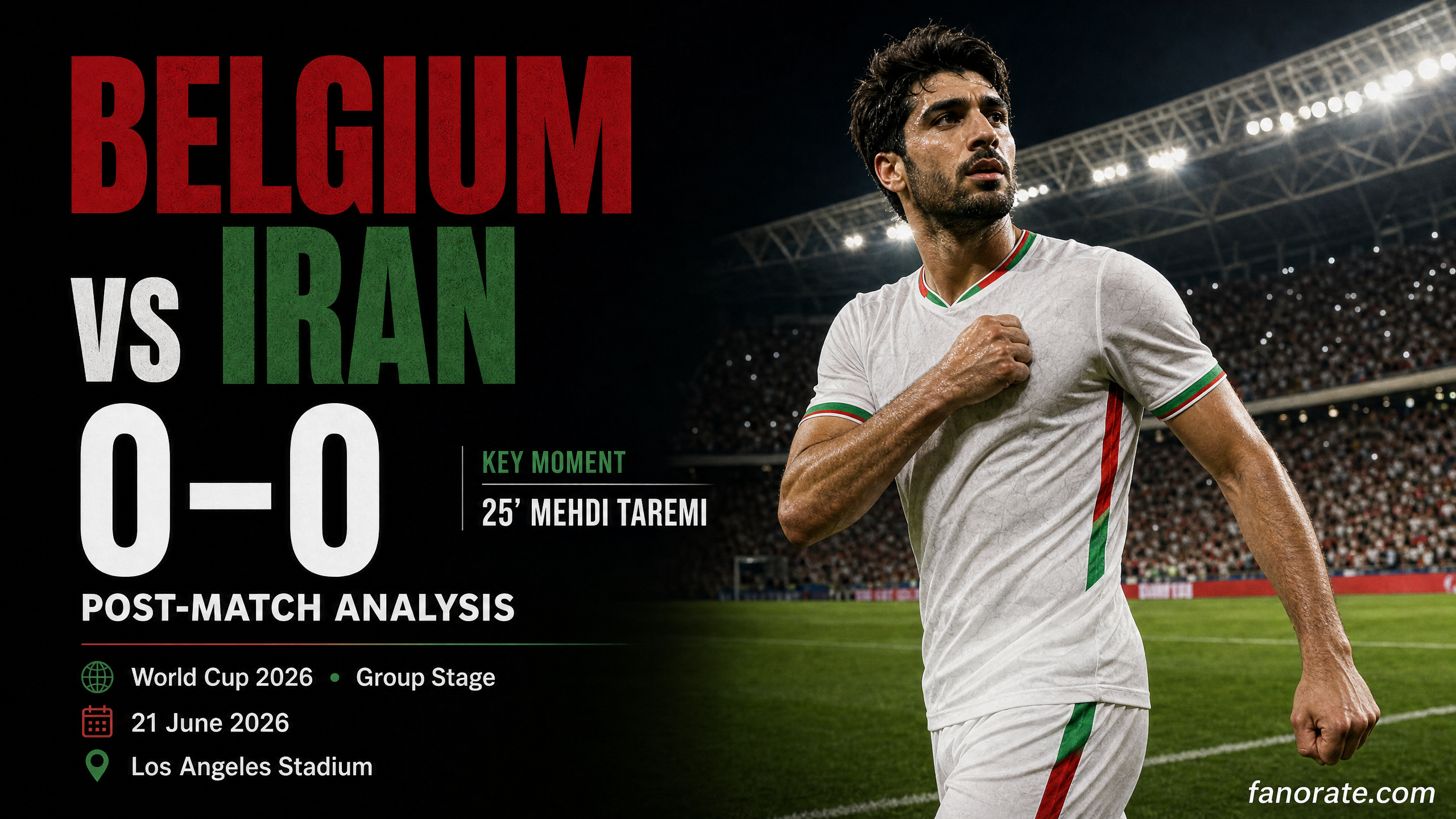
Belgium vs Iran: 0-0 FIFA World Cup 2026 Group Stage Tactical Breakdown & Match Analysis
A disciplined Iran side frustrated Belgium’s Golden Generation in a tense 0-0 stalemate at Los Angeles Stadium, as Mehdi Taremi’s disallowed goal and a wave of Belgian substitutions failed to break the deadlock in Group Stage action at FIFA World Cup 2026.
What happened
Under the lights of Los Angeles Stadium, Belgium and Iran produced one of the World Cup’s most compelling tactical chess matches — a 0-0 draw that told a richer story than the scoreline suggests. Belgium dominated possession overwhelmingly, completing 535 accurate passes to Iran’s 198, and generating a dominant xG of 2.08 compared to Iran’s 0.69. Yet for all their statistical superiority, Roberto Martinez’s successor could not find a way past an Iranian defensive structure that was disciplined, resolute, and expertly organised. The Red Devils had chances, the moments of quality flickered — but Iran’s back line and the heroics of goalkeeper Alireza Beiranvand ensured the clean sheet held. A point apiece, but the two sides will feel very different emotions walking off the pitch in Los Angeles.
How it was won and lost
Belgium’s Possession Dominance Without Clinical Edge
Belgium controlled the game from the first whistle, recording 622 total passes — more than double Iran’s 268 — and holding a 62% share of possession. Their build-up was structured and patient, with Kevin De Bruyne orchestrating from deep, probing Iran’s mid-block with short combinations and diagonal switches. However, despite generating 21 shots and an xG of 2.08, Belgium’s final-third execution was blunt. Romelu Lukaku, who drew an early foul in the 3rd minute, struggled to impose himself against a compact Iranian defensive line that showed exceptional positional discipline. Belgium’s 13 shots on target from 21 attempts suggests a volume-over-quality approach that Iran’s goalkeeper and defenders were well-prepared to handle.
Iran’s Low Block and Defensive Masterclass
Iran set up in a disciplined low block, prioritising compactness and denying Belgium space in behind. The Iranian defensive unit — anchored by Shoja Khalilzadeh and Ehsan Hajsafi — maintained their shape through waves of Belgian pressure, limiting clear-cut opportunities despite conceding territory. Iran recorded just 268 passes and 40% possession, making clear their game plan was never about controlling the ball but about controlling space. Their xG of 0.69 illustrates how few genuine scoring chances they created, but the disallowed Taremi goal in the 25th minute showed Iran’s threat on the counter was real — a reminder that their defensive setup was not purely passive.
The Taremi Disallowed Goal: A Momentum Flashpoint
The most dramatic moment of the match came in the 25th minute when Mehdi Taremi’s strike was ruled out. The decision proved pivotal — had the goal stood, Iran’s defensive game plan would have been transformed from disciplined containment to counter-attacking fortress football. Instead, Belgium remained pressing for a breakthrough with increasing urgency. The disallowance shifted the psychological momentum back toward Belgium but ultimately didn’t translate into a goal, as Iran’s defensive organisation remained intact for the full 90 minutes.
Belgium’s Triple Substitution at the Hour Mark
Belgium’s technical staff moved decisively at the 58th minute, introducing Dodi Lukebakio, Hans Vanaken, and replacing Timothy Castagne with Thomas Meunier — a triple change designed to inject directness and creativity into a stalling attack. The move signalled clear tactical intent: shift from patient possession to more vertical, attacking-phase pressure. Lukebakio’s pace on the left flank was designed to stretch Iran’s defensive width, while Vanaken’s box presence offered an aerial threat from set-pieces. Despite the changes, Iran’s defensive structure absorbed the pressure without breaking. Romelu Lukaku was eventually replaced in the 73rd minute by Arthur Theate, an unusual like-for-unlike substitution that suggests Belgium shifted to a more defensive shape as the game wound down.
Pressing and Transition Dynamics
Belgium registered 32 recoveries and pressed aggressively in Iran’s half, winning 6 corners to Iran’s 3. Iran’s counter-pressing was limited — they completed just 198 accurate passes and recorded only 3 shots on target from 7 total attempts — but their compactness in the defensive third meant Belgium’s pressing rarely created direct goal-scoring opportunities. Nathan Ngoy’s professional foul in the 66th minute, stopping a potential last-man opportunity, underlined how close Iran came to exploiting transition moments, and also reflected Belgium’s vulnerability on the counter despite their overall control.
Who decided it
Alireza Beiranvand
IranThe Iranian goalkeeper was Belgium’s greatest obstacle throughout the 90 minutes. Facing 21 shots and 13 on target, Beiranvand delivered a commanding performance — commanding his area, making crucial saves, and organising Iran’s defensive shape from goal. His shot-stopping was the foundation upon which Iran’s famous point was built.
Beiranvand’s ability to deal with Belgium’s set-piece deliveries — Belgium had 7 corners — and his shot-stopping under sustained pressure were central to Iran holding the clean sheet. His distribution also helped Iran transition quickly from defence to counter-attack moments.
Kevin De Bruyne
BelgiumBelgium’s talisman was the creative heartbeat throughout, pulling strings from deep and attempting to unlock Iran’s defensive block with incisive passing and movement. His replacement by Matias Fernandez Pardo in the 87th minute underlined his importance, as Belgium managed his minutes carefully in the summer heat.
De Bruyne’s passing range and his ability to shift the point of attack were Belgium’s primary tools for breaking Iran down. His link play with Lukaku and Trossard created the majority of Belgium’s most dangerous sequences, even if a final cutting pass consistently eluded him.
Mehdi Taremi
IranIran’s captain and talisman was central to every moment Iran threatened going forward. His disallowed goal in the 25th minute was the match’s defining individual moment, and throughout the game he served as Iran’s focal point in transition — holding the ball, winning fouls, and drawing Belgian defenders out of position.
Taremi’s movement and work rate against Belgium’s back line created gaps that Iran’s counter-attacks sought to exploit. His physicality in dueling with Belgium’s centre-backs provided Iran with vital relief from defensive pressure and gave the team a credible attacking outlet.
Saeid Ezatolahi
IranThe midfield anchor was integral to Iran’s defensive structure, completing interceptions and breaking up Belgian attacks throughout the match. His physical presence and positional intelligence helped Iran maintain their compact mid-block across the full 90 minutes despite relentless Belgian pressure.
Ezatolahi’s discipline in the pivot role shielded Iran’s defensive line effectively, reducing the space available to Belgium’s attacking players between the lines. His substitution in the 85th minute came only after the outcome was effectively settled.
Where it sits in history
Belgium and Iran have met rarely on the international stage, but their encounters carry outsized narrative weight. Belgium’s ‘Golden Generation’ — built around De Bruyne, Lukaku, and Thibaut Courtois — has long been considered one of international football’s great underachieving eras, with the core of that generation now in their final World Cup cycles. Iran, meanwhile, have continued to develop as an Asian football powerhouse, qualifying consistently for World Cups and demonstrating growing tactical sophistication on the global stage. A point against Belgium in the FIFA World Cup 2026 Group Stage would represent one of Iran’s most significant results in tournament history, while for Belgium, the dropped points extend a pattern of underperformance relative to individual talent in major tournament football.
Inside the ground
Los Angeles Stadium — with a capacity of over 70,000 — provided a spectacular backdrop for a match that drew large contingents of both Belgian and Iranian supporters. The Iranian diaspora community, which is particularly large across Southern California, created a remarkable atmosphere whenever Iran threatened on the counter or held firm under Belgian pressure. The tension inside the stadium was palpable each time Taremi received the ball in dangerous areas, and the disallowance of his 25th-minute goal provoked enormous emotional reactions from both sets of supporters. Under a few clouds but with the energy of a genuine World Cup occasion, Los Angeles proved it belongs on the global football stage.
Looking ahead
Both Belgium and Iran will now turn their attention to their next Group Stage fixtures, where the stakes will escalate significantly. Belgium, having failed to convert their dominant possession and xG advantage into goals, will need to sharpen their attacking efficiency — particularly in the final third, where Lukaku’s impact must improve. Iran, emboldened by their disciplined performance against one of Europe’s top-ranked nations, will carry renewed confidence into their next match, knowing their defensive structure is World Cup-level. A point each leaves both sides with work to do, but Iran will feel they have the harder-earned result.
The bottom line
-
Belgium dominated possession with 62% and completed 535 accurate passes but failed to convert their xG of 2.08 into goals
-
Iran’s defensive discipline was exceptional — their low-block structure neutralised Belgium’s attacking talent across 90 minutes
-
Mehdi Taremi’s disallowed goal in the 25th minute was the match’s defining moment and potential turning point
-
Belgium made five substitutions by the 73rd minute in a desperate search for a breakthrough, but Iran’s shape remained intact
-
Nathan Ngoy’s professional foul in the 66th minute highlighted Belgium’s vulnerability on the counter despite overall control
-
Alireza Beiranvand delivered a man-of-the-match performance, facing 13 shots on target and keeping a clean sheet
-
Iran earned a historically significant point against Belgium at the FIFA World Cup 2026 in Los Angeles
-
Belgium’s Golden Generation continues to struggle to convert individual quality into tournament results on the World Cup stage
