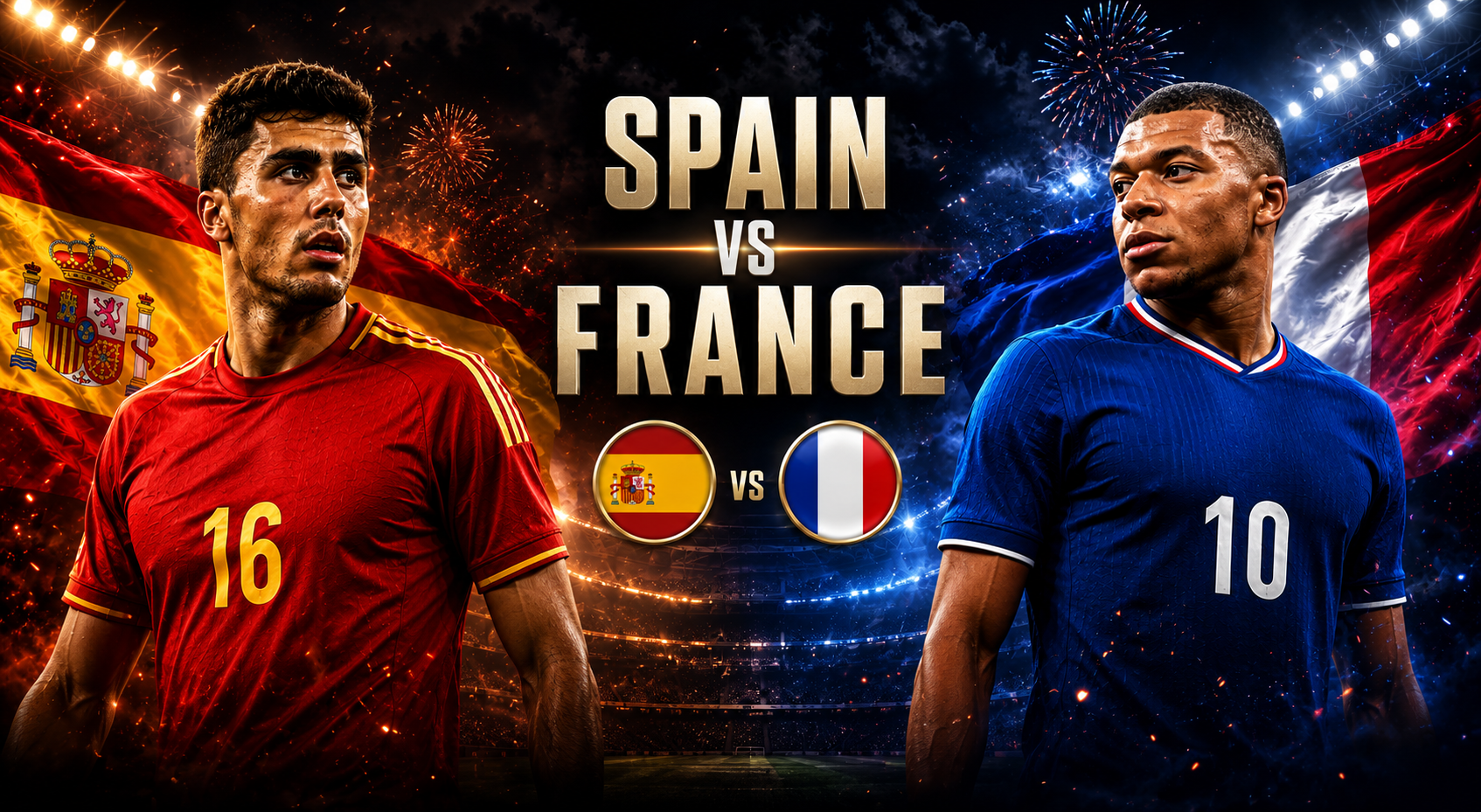
The Semifinal Where Control Meets Chaos
Spain’s suffocating control meets France’s lethal transitions in the FIFA World Cup 2026 semifinal on July 14 at AT&T Stadium. We break down every tactical battle, both predicted lineups, the team news, the odds, and deliver a transparent statistical prediction for a rematch two years in the making.
- July 14, 2026 Tuesday
- AT&T Stadium Arlington
- Kick-Off 3:00 PM ET
Control meets chaos
The roof will be closed. Outside AT&T Stadium on Tuesday afternoon it will be roughly 101°F on the Arlington concrete, the kind of Texas July heat that warps the air above the parking lots. Inside, it will be 72 degrees, still, and silent in the way only 80,000 people holding their breath can be silent — because somewhere on that immaculate imported grass, Lamine Yamal, one day past his 19th birthday, will be standing over the ball, and Kylian Mbappé will be forty yards away, waiting for Spain to lose it.
That is the entire match in a single frozen frame. Spain have gone six games at this World Cup conceding once, hoarding the ball like a state secret. France have won six from six by giving the ball away almost cheerfully, then hitting the space behind you in four seconds flat.
They did this at Euro 2024, in Munich, and Spain won 2-1. They did it again in last year’s Nations League semifinal, a 5-4 fever dream. Now, for the third consecutive major tournament, Spain and France meet one step from the final — on Bastille Day, in a football cathedral built for the Dallas Cowboys.
One of these ideas of football is going to the final at MetLife Stadium on July 19. The other is going home — and, in Didier Deschamps’ case, going home forever.
Everything you need at kickoff
- Date
- Tuesday, July 14, 2026 Semifinal 1 · Match 101
- Kickoff (US)
- 3:00 PM ET 12:00 PM PT
- Kickoff (Europe)
- 8:00 PM UK (BST) 9:00 PM Spain & France (CEST)
- Venue
- AT&T Stadium Arlington, Texas (Dallas–Fort Worth)
- Capacity
- ~80,000 Expandable above 90,000
- Roof / Climate
- Retractable roof, expected closed Climate control near 72°F
- Weather
- ~101°F outside, heat index ~106°F Roof closed, ~72°F inside
- TV — USA
- FOX, Telemundo FOX One app, Peacock
- TV — UK
- ITV / ITVX
- TV — Spain
- RTVE (La 1) Free-to-air
- TV — France
- M6 and M6+ Plus beIN Sports 1
- Referee
- Appointment pending As of July 12
- Winner faces
- Argentina or England Final, Sun July 19, MetLife Stadium
- If level after 90
- Two 15-min periods of extra time Then a penalty shootout
All broadcast details as reported July 11–12, 2026; check local listings on matchday.
A place in the final — and a shot at history for both
A place in the final — and a shot at history for both. France are attempting to become only the third nation ever to reach three consecutive World Cup finals, after Germany (1982–90) and Brazil (1994–2002). Spain are chasing just their second World Cup final appearance — and their first semifinal since they won it all in South Africa in 2010.
Deschamps’ last stand. Didier Deschamps has confirmed this is his final tournament after 14 years in charge; Tuesday will be his 26th World Cup match as a head coach, breaking Helmut Schön’s long-standing record of 25. Win two more matches and one of the great international coaching careers ends with a second star as manager. Lose, and it ends in Arlington.
The Ballon d’Or subplot. Mbappé leads the Golden Boot with eight goals. Ousmane Dembélé arrives as the reigning Ballon d’Or holder. Michael Olise has been named among 2026 Ballon d’Or contenders. On the other side, Yamal — last year’s Ballon d’Or runner-up — has been building toward full sharpness since a spring hamstring injury.
A genuine clash of footballing ideologies. This is the cleanest stylistic contrast the tournament could have produced: the team with the best defensive record and the most control (Spain: one goal conceded in six games) against the team with the most frightening open-field attack (France: 16 goals in six wins, and no team has yet stopped their front four). Possession versus transition is the oldest tactical argument in modern football, and this is its championship round.
A rivalry with real recent scar tissue. Third straight major-tournament semifinal between these two — Spain won at Euro 2024 (2-1) and in the 2025 Nations League (5-4); France won their only prior World Cup meeting, 3-1 back in 2006. Spain have won seven of the last ten meetings overall.
The final matchup it sets up. The winner gets Argentina (the holders, with Messi leading the all-time World Cup scoring chart at 21) or England (runners-up at the last two Euros, with Kane and a resurgent Bellingham).
Every possible final — Spain–Argentina, France–Argentina (a 2022 final rematch), Spain–England (a Euro 2024 final rematch), France–England — is a heavyweight event.
Tale of the tape
Spain’s route was moderate in difficulty — no elimination-round opponent ranked in the world’s top eight until Belgium — but has been emotionally taxing: three straight one-goal knockout wins, two decided in the 88th minute or later. The engine (Rodri, Pedri, Cubarsí, Cucurella) has played heavy minutes, and the itinerary has been brutal. Tactically, the evolution is clear: less spectacular than Euro 2024, more controlled, with the winning moments increasingly outsourced to the bench.
Six wins from six, 16 scored, two conceded, clean sheets in all three knockout rounds. France’s route has been slightly kinder in terms of scoreline stress — they have not trailed in the knockout phase and haven’t needed extra time, and they’ve had one extra day of rest. The warning label: Tchouaméni’s thigh injury forced a midfield reshuffle, and Mbappé took an ankle knock in the quarterfinal.
De la Fuente’s Spain line up nominally in a 4-2-3-1. Everything starts with Rodri, back to full prominence after missing most of 2024-25 — the spine around which everything else is organised. Cubarsí’s range of progressive passing lets Spain build asymmetrically. Spain’s counterpress is the hidden foundation of the defensive record — opponents rarely get the second pass away, which matters doubly on Tuesday, because the second pass is where France live. The defining in-tournament evolution: Spain’s matches are now designed in two acts — 60-70 minutes of control that drains the opponent, then fresh legs attacking tired structures.
Deschamps’ shape on paper is a 4-2-3-1, but in practice France defend in a compact 4-4-2 mid-block and attack in whatever shape the counterattack demands. The revelation of this tournament is that Deschamps is relaxing the reins in his farewell. No team so far has been able to stop France’s front four: Mbappé (8 goals) attacks the left channel; Dembélé (5 goals) floats centrally as a connector-finisher; Olise, the tournament’s leading creator, delivers the final pass from the right. Mbappé and Dembélé have created 19 chances for each other this tournament.
Delivery from Baena, Olmo and Yamal (inswing from the right); targets Laporte, Cubarsí, Merino and Rodri lurking at the edge. Spain’s most repeatable routine is less about the first ball than the second: both Merino winners came from chaos-phase play in and around the box — a rebound and a broken sequence.
Olise’s delivery is elite, and Upamecano, Saliba, Konaté plus Rabiot’s late runs give France three or four genuine aerial threats to Spain’s two — a real mismatch against the smallest starting XI left in the tournament. And note the spot-kick ledger inside France’s week: Mbappé scored the penalty that beat Paraguay and missed one against Morocco.
- The best ball-retention structure in world football
- Elite counterpress
- A settled, ball-playing back four
- A game-closing bench
- The tournament’s most lethal transition attack
- Center-back recovery speed
- Squad depth in attack that turns substitutions into escalations
- Tournament-management experience nobody can match
- Limited squad width with Williams/Pino short of rhythm
- A No. 9 (Oyarzabal) three rounds without a goal
- Laporte’s pace in a high line
- A penalty-shootout record that haunts them
- Central creativity against a set deep block when the space behind disappears
- Digne’s defensive athleticism at 32 against elite wide play
- The Upamecano fitness question
- A captain playing through an ankle knock
Rest defense vs transition: the match inside the match
Possession control: who actually wants the ball? Both teams will be happy with the same distribution: Spain 60-65%, France 35-40%. That’s what makes this fixture fascinating rather than a stylistic stalemate — neither side needs to be dragged out of its identity. The lesson from Euro 2024 and the 2025 Nations League 5-4: Spain’s control is real, but France score against Spain.
Midfield progression vs the 4-4-2 block. Rodri will be shadowed by Dembélé’s cover shadow in France’s first line, with Koné ready to jump onto Pedri. Expect long spells where Spain’s possession is real but sterile, probing at the edge of a 30-yard defensive band.
Rest defense vs transition: the match inside the match. When Spain commit Porro high and Baena inside, their rest defense is Cubarsí, Laporte and Rodri against Mbappé, Dembélé and whoever joins. Ninety minutes of France’s four-second breaks against Spain’s five-second recoveries will decide the final’s participant more than any set-piece or moment of individual chaos.
The wide areas and half-spaces. Spain’s right (Yamal + Porro) vs France’s left (Digne + Doué/Barcola) is the flank where Spain will believe the match is winnable. Spain’s left (Baena + Cucurella) vs France’s right (Koundé + Olise) is more balanced — but every yard Cucurella advances is a yard Mbappé inherits. The team that better protects its targeted fullback wins the flank war.
How each team changes after the first goal. If Spain lead, this becomes the hardest match in football — chasing a possession team that defends with the ball. If France lead, Deschamps’ teams historically drop into a 4-4-2 low-mid block and play for the kill on the counter. Neither team panics.
Key individual battles
Lamine Yamal vs Lucas Digne
Spain’s clearest athletic mismatch and the axis of their chance creation. Advantage: Yamal, if his post-injury sharpness holds.
Rodri vs Ousmane Dembélé (the shadow war)
France’s block starts with Dembélé screening Rodri; Spain’s whole progression depends on freeing him. Advantage: Rodri positionally, Dembélé in what happens after a turnover.
Kylian Mbappé vs Pedro Porro (and the channel behind him)
France’s primary scoring mechanism is Mbappé attacking the space vacated by an attacking right-back. Advantage: Mbappé, emphatically, if the space exists.
Spain’s center-backs vs France’s runners
Cubarsí–Laporte vs Mbappé–Dembélé; one mistimed line-step is a goal. Advantage: France in space, Spain in structure.
Goalkeeper distribution: Simón vs Maignan under pressure
Forcing long kicks toward Mbappé-less zones is Spain’s quiet win-condition. Advantage: Simón, more practiced as a build-up hub.
Second balls: Merino/Rabiot arrival zones
In a match this controlled, loose-ball regains in midfield are the hidden possession stat. Advantage: even — Rabiot from the start, Merino after 65′.
Spain’s rotations vs France’s transition defense
Every rotation leaves a station unmanned when the ball turns over. Advantage: Spain while the ball moves; France the instant it stops.
Three questions decide it: Can Spain’s counterpress strangle France’s first outlet pass — or does Koné’s carrying beat the first wave? Who defends Spain’s left-half-space overloads — and does doing so pin France’s right-side counter? Does De la Fuente hold his bench discipline in a semifinal?
The names that decide it
One goal this tournament, but the gravitational field is intact: he attracts two markers and still finds the exit pass, opening the half-spaces for Pedri and Olmo. Turns 19 on July 13 — the eve of the match.
The 2024 Ballon d’Or winner, back after missing most of 2024-25. Every Spanish possession chain routes through him; his positioning is also Spain’s first line of counter-attack insurance.
Ever-present in a defense that conceded once in six games; it was his shot Lammens spilled for the quarterfinal winner. At 19, plays like the oldest man on the pitch.
The tempo-setter. If he plays between Koné and Rabiot rather than in front of them, Spain’s progression works; if not, the match strangles.
Six consecutive World Cup clean sheets before De Ketelaere scored — the longest streak in World Cup history.
Eight goals, tournament top scorer. Became France’s all-time leading scorer against Senegal. Now on roughly 20 career World Cup goals — one behind Messi’s all-time record of 21. Playing through a minor ankle sprain.
Not a controller in the Spanish sense — a de-controller. His carries out of pressure are France’s answer to being pressed, and the reason Tchouaméni’s injury never became a crisis.
Three knockout clean sheets; the recovery pace that permits France’s whole risk model.
The tournament’s assist leader (5 per ESPN, 6 per FOX) in his first World Cup. Set-piece taker, far-post finder, and now a named Ballon d’Or contender.
Two goals conceded all tournament; commands the transition-heavy structure behind a team that concedes territory by design.
Five most likely game-changing substitutes
Mikel Merino (Spain): two knockout winners as a sub; the single most predictable unpredictable weapon in the tournament.
Nico Williams (Spain): if fit, 30 minutes of verticality against a tiring right side is Spain’s biggest tactical upgrade.
Bradley Barcola (France): scored as a sub vs Senegal; fresh legs into space against Spain’s highest line of the night.
Marcus Thuram (France): the plan-B physical reference if Spain’s block forces France to play in front of them.
Ferran Torres (Spain): assisted one Merino winner, can play all three front positions.
Third straight semifinal, first World Cup rematch since 2006
Third straight semifinal
This is the third consecutive major tournament in which Spain and France meet in the semifinal — Euro 2024, the 2025 Nations League, now the 2026 World Cup.
One prior World Cup meeting
France’s 3-1 win over Spain in 2006 is the only previous World Cup meeting between two of Europe’s three most decorated football nations.
Merino, the super-sub for the ages
Mikel Merino is the first player in World Cup history to score the winner in two knockout ties as a substitute.
Dembélé’s blitz
Ousmane Dembélé’s first-half hat-trick against Norway was the second-fastest in World Cup history.
No extra time, no deficit
Neither semifinalist has trailed at any point of the knockout rounds, and neither has played a minute of extra time.
Mbappé chases Messi’s record
Mbappé sits on approximately 20 career World Cup goals — two on Tuesday would make him the all-time leader, passing Messi’s 21.
Three straight finals in sight
France would join Germany (1982-90) and Brazil (1994-2002) as the only nations to reach three consecutive World Cup finals.
Deschamps’ record night
Deschamps’ 26th World Cup match as a coach — breaking Helmut Schön’s record of 25, set across 1966-78.
Yamal turns 19
Lamine Yamal turns 19 on July 13 — and plays a World Cup semifinal the next day, two years after his Euro 2024 semifinal goal against France came the day after his 17th birthday.
Best guess at kickoff
Probable XIs per the consensus of ESPN and Sports Mole predicted XIs, July 12. Spain’s decisive call is Baena vs a recalled Nico Williams on the left; France’s is Upamecano’s foot — Ibrahima Konaté is the like-for-like replacement alongside Saliba.
Spain 2-1, second goal after the 80th minute, scored by a substitute. You’ve read this tournament; you know which one.
The market’s underdog is Spain — bookmakers opened France around -144/-148 to advance with Spain near +120 — even though Spain are No. 1 in both the FIFA ranking and Elo (2,177 vs 2,143, July 7). A 0-0 at the hour is a Spanish game state, not a neutral one: Spain’s three knockout wins have all been decided from the 66th minute onward; France’s knockout wins have all been effectively sealed by the 66th. If Spain reach minute 60 level, the fixture’s momentum physics flip — fresh Spanish attackers against the first tired French block of the tournament.
The unexpected heroes nobody is talking about
Mikel Merino (Arsenal), Spain. Already the first man ever to win two World Cup knockout ties as a scoring substitute. Also scored against France in last year’s 5-4. If this match has an 88th-minute author, we know his name.
Marcus Thuram (Inter), France. The bench forward whose profile — aerial, physical, channel-running — is most unlike France’s starters, and most like what breaks a tired Spanish block. His father Lilian scored twice the last time France won a World Cup semifinal on home soil, in 1998.
France 2-1 Spain after extra time (1-1 at 90). Spain will control the match’s territory but not its two or three decisive transitions; France’s extra rest day, set-piece superiority and unmatched depth of fresh attacking legs tilt the extra-time period this fixture’s balance points toward. Man of the Match: Kylian Mbappé (if France win); Rodri (if Spain win).
Confidence: 5/10. Our own model says 53/47; intellectual honesty requires the confidence score to say the same. The one factor that breaks this prediction: Mbappé’s ankle. Every French probability in this preview assumes his acceleration is intact — if he’s visibly at 85%, flip the pick.
