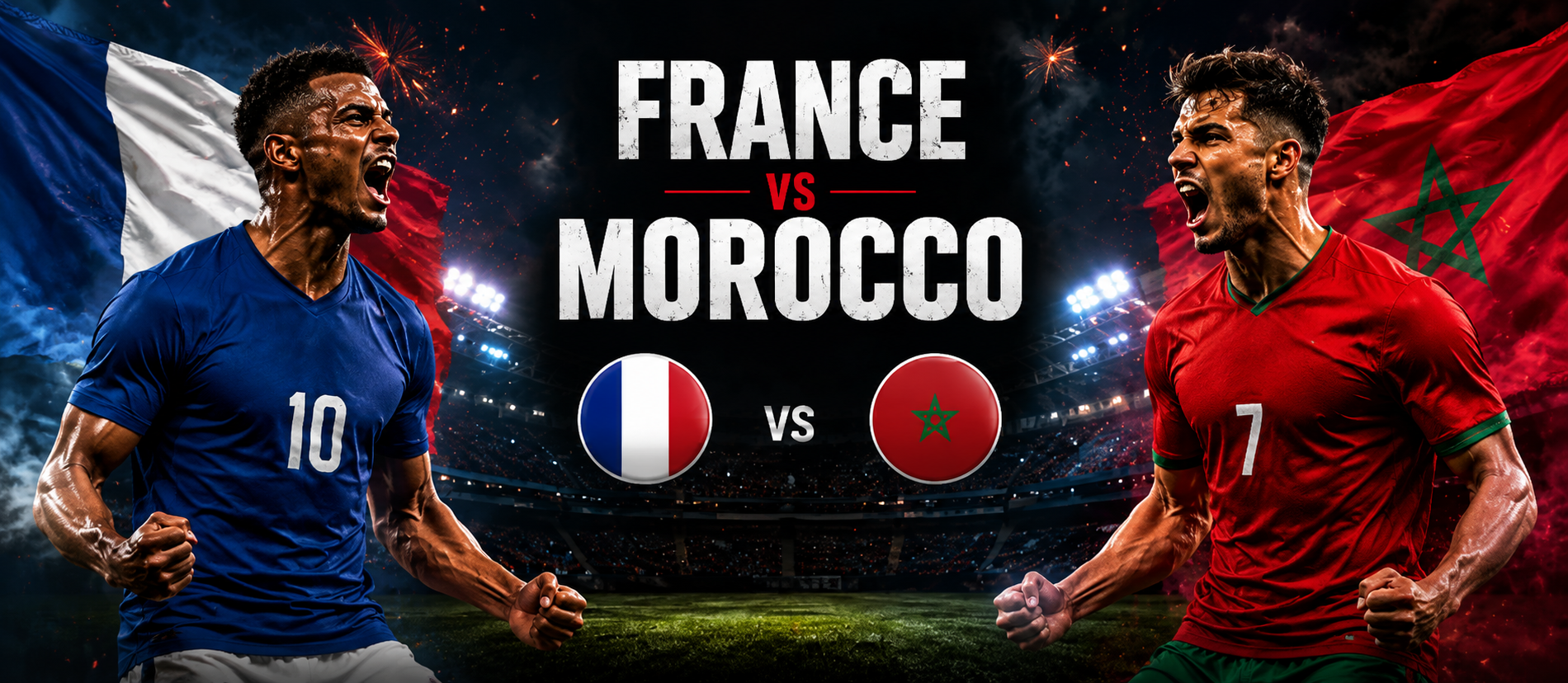
A 2022 Semifinal Rematch
France vs Morocco World Cup 2026 Quarterfinal preview — the 2022 semifinal rematch at Gillette Stadium, full squads, yellow-card risks, tactics and a reasoned final prediction.
- July 9, 2026 Thu
- Gillette Stadium Foxborough
- Kick-Off 4:00 PM ET
A 2022 semifinal, replayed a round early.
Quarterfinal Match 97 at Gillette Stadium, Foxborough, Thursday July 9, 2026, 4:00 p.m. ET. An all-Argentine officiating crew led by Facundo Tello has been confirmed. NWS forecasts a sunny, 87°F afternoon with no rain expected. Both teams enter on five days’ rest after Round of 16 wins decided in regulation on July 4 (France 1-0 Paraguay, Morocco 3-0 Canada); Morocco’s only extra fatigue comes from a Round of 32 penalty shootout against the Netherlands.
The winner advances to a Dallas Semifinal against the Spain-Belgium winner. This is a rematch of the 2022 World Cup semifinal, won 2-0 by France, and Moroccan media have already raised concerns about officiating bias given that history, despite this year’s crew being entirely different.
Everything you need at kickoff
- Date
- Thu, July 9, 2026
- Kickoff
- 4:00 p.m. ET
- Venue
- Gillette Stadium Foxborough, MA
- Stage
- Quarterfinal Match 97
- Referee
- Facundo Tello All-Argentine crew
- Weather
- Mostly sunny, ~87°F SW wind 5-9 mph
- Rest
- 5 days each Both won R16 on July 4
The winner advances to a Semifinal against the Spain vs Belgium winner, reported for Tuesday, July 14 at AT&T Stadium, Dallas.
More than a rematch
Pressure sits somewhat more heavily on France, given the historical and reputational expectations attached to Les Bleus — a two-time recent finalist expected to beat a side they defeated in the 2022 semifinal, compounded by Deschamps’ ‘swan song’ narrative. Morocco play with elevated stakes but underdog freedom: already matching their best-ever quarterfinal and one win from equaling the 2022 semifinal run, but framed as the team with less to lose.
The winner advances to face the winner of Spain vs Belgium in Dallas on July 14. For France, a third consecutive semifinal would extend one of the most sustained tournament runs in the modern game, potentially crowning Deschamps’ final competition in charge. For Morocco, victory would surpass their historic 2022 run by reaching a first-ever World Cup final — a landmark for African and Arab football and validation of Mohamed Ouahbi’s rapid managerial transition.
For Morocco, a win would surpass their historic 2022 run by reaching a first-ever World Cup final.
The narratives around this rematch
A 2022 semifinal rematch
The first meeting since France beat Morocco 2-0 in the 2022 World Cup semifinal — a Quarterfinal this time, but the emotional charge is real, with nine players from that Morocco squad still involved.
An all-Argentine crew
Facundo Tello leads the tournament’s first fully single-nation officiating crew; Moroccan media have already revisited the 2022 officiating and flagged concern about bias, despite an entirely different crew now appointed.
Seven players, one yellow from a ban
Three France players (Olise, Barcola, Koné) and four Morocco players (Halhal, Hakimi, Ounahi, El Khannouss) carry a caution into this tie; a second yellow means missing the Semifinal.
Mbappé’s record chase
Mbappé arrives with seven goals, already France’s all-time leading scorer after passing Thierry Henry in the Senegal opener.
Morocco’s resilience
Morocco have trailed or been level deep into matches against Brazil, Haiti and the Netherlands, and found an answer every time, including a penalty shootout.
Same fixture as the 2022 semifinal, one round earlier this time.
Tale of the tape
France is built around individual devastation at the top of the pitch — Mbappé’s seven tournament goals, Dembélé’s career-best form, and increasingly meaningful contributions from Doué, Barcola and Olise — layered over Didier Deschamps’ pragmatism. Deschamps, in what may be his final tournament in charge, has shown he can win expansively against weaker sides or grind out patient wins against disruptive opponents. Emerging weaknesses are administrative rather than tactical: three players (Olise, Barcola, Koné) are one caution from missing a semifinal, and Tchouaméni’s fitness for this match is genuinely uncertain.
Morocco is a team that has already exceeded expectations twice over — reaching the 2022 semifinal and now a second consecutive quarterfinal, under a new manager (Mohamed Ouahbi) after Walid Regragui’s March 2026 resignation. The throughline across five matches is resilience rather than control: Morocco have trailed or been level deep into matches against Brazil, Haiti, and the Netherlands, needing late goals, bench contributions, and a penalty shootout to advance. Nine players remain from the 2022 semifinal squad.
Match 1 (Senegal): patient 4-2-3-1/4-3-3 hybrid needing 66 minutes to break down resistance. Match 2 (Iraq): direct and immediate, scoring inside 14 minutes. Match 3 (Norway, dead rubber): full attacking intent producing Dembélé’s hat-trick, though skewed by Norway’s wholesale rotation. Round of 32 (Sweden): controlled professional win, Olise’s creativity increasingly central. Round of 16 (Paraguay): the toughest tactical puzzle yet — patience over tempo against a deliberately physical low block, resolved via a penalty rather than open play. Throughline: France are close to unplayable in space but can be temporarily neutralized by a side willing to sacrifice possession for disruption.
Match 1 (Brazil): composed counter-punching shape, scored first before being pegged back. Match 2 (Scotland): most ruthless version of Morocco, instant goal then disciplined protection of the lead. Match 3 (Haiti): chaotic and error-prone, an own goal and a second concession before attacking depth pulled them through. Round of 32 (Netherlands): backs-to-the-wall resilience, forcing extra time and winning on penalties. Round of 16 (Canada): scoreless, cagey first half exploding into a ruthless second-half performance, but with a chaotic disciplinary record. Throughline: under new manager Mohamed Ouahbi, Morocco’s attacking players have decided matches even when the defense is stretched — and the defense has been stretched in four of five matches.
- Elite, multi-source attacking talent.
- A manager with the most knockout-round experience of anyone left in the tournament.
- Comfortable rest — five days, no extra time used.
- Proven penalty-shootout composure.
- A deep and impactful bench (Rahimi, Yassine).
- A captain in Hakimi contributing goals and creativity from right-back.
- A settled goalkeeper in Bounou with big-game pedigree.
- A live yellow-card cluster heading into a physical Moroccan side.
- Midfield injury uncertainty around Aurélien Tchouaméni.
- A first half against Paraguay that showed France can be nullified by a team willing to break up rhythm.
- A defense that has conceded in every match except the 1-0 Scotland win.
- Four players carrying yellow cards into a Quarterfinal against a foul-drawing France front line.
- A fitness question over their most in-form attacker, Ismael Saibari.
Deschamps’ résumé vs Ouahbi’s momentum
Didier Deschamps brings the deeper résumé — a World Cup winner as player and manager, potentially in his final tournament in charge — and has shown he can win expansively or patiently. His challenge is squad management: Tchouaméni’s fitness is uncertain and three players are one card from a semifinal ban. Deschamps has publicly called Morocco ‘a very, very strong side,’ saying ‘no one reaches the World Cup quarterfinals by pure chance.’
Mohamed Ouahbi, promoted mid-cycle after Walid Regragui’s March 2026 resignation, is younger and less experienced at this level but has already navigated a penalty shootout and a chaotic knockout win. His tactical signature — Saibari as a fluid false nine, a more press-oriented setup than Regragui’s 2022 template — faces its sternest test yet if Saibari is unavailable.
Key duels to watch
Kylian Mbappé vs Morocco’s back line
Mazraoui, Diop, and whichever centre-back partners him if Riad is unavailable — Mbappé’s pace in behind against a defense already vulnerable in transition.
Brahim Díaz vs France’s midfield screen
Kanté/Rabiot/Zaïre-Emery, with Tchouaméni’s availability uncertain — Díaz’s creativity against a potentially weakened French midfield.
Ousmane Dembélé vs Noussair Mazraoui / Achraf Hakimi
Explosive French form against Morocco’s attacking full-back pairing.
Azzedine Ounahi vs France’s double pivot
Ounahi’s late box arrivals against whoever anchors France’s midfield.
Achraf Hakimi vs Michael Olise / France’s left flank
Two attacking duels in one, with Hakimi balancing attacking instincts against his own yellow-card risk.
Goalkeeper comparison: Mike Maignan vs Yassine Bounou
An untested but composed Maignan against a busier, battle-tested Bounou fresh off a penalty-shootout save.
Edge: Deschamps on résumé and squad depth; Ouahbi on having already passed the tournament’s two toughest in-game composure tests — a shootout and a card-strewn, momentum-shifting knockout match.
The names that decide it
Outstanding. Seven goals through five matches, France’s talisman and captain, decisive against Senegal, Iraq, Sweden and Paraguay.
Outstanding. First-half hat-trick against Norway, career-best tournament form.
Good, with an asterisk. Multiple assists across the knockout rounds, but a contested yellow card and suspension risk hang over his semifinal availability.
Good. Stoppage-time goal against Norway and won the decisive Paraguay penalty.
Unrated (injury-limited). Key midfield presence when fit, but availability for this match is genuinely uncertain.
Good. Untested by real goalkeeping pressure so far, reliable when called upon.
Outstanding, injury permitting. Two goals and the tournament’s fastest strike before going off injured against Canada; his availability is the biggest swing factor for Morocco’s attack.
Outstanding. Match-deciding brace against Canada, now the focal point of Morocco’s second-half surges, but one yellow card from missing a semifinal.
Outstanding. Tournament-long creative force with a reported African-record four assists through five matches.
Good. A goal and multiple creative contributions from right-back, captaining the side, but carrying a yellow card into this Quarterfinal.
Good. Penalty-shootout hero against the Netherlands, though his defense has been breached in four of five matches.
Good (impact role). Decisive goals off the bench in both the Haiti and Canada matches.
One Yellow From a Ban
France: Michael Olise (card under a pending FFF appeal), Bradley Barcola and Manu Koné each carry a single caution into this Quarterfinal — a second yellow rules them out of the Semifinal.
Morocco: Redouane Halhal, Achraf Hakimi, Azzedine Ounahi and Bilal El Khannouss all picked up cautions in the chaotic Round of 16 win over Canada — four players, including the captain, one booking from missing a Semifinal.
Fitness watch: Aurélien Tchouaméni (France) and Ismael Saibari (Morocco) are both genuine doubts whose availability could swing the tie.
The numbers behind the tie
A 2022 semifinal rematch
This is the first meeting since France beat Morocco 2-0 in the 2022 World Cup semifinal, a result that ended Morocco’s historic run as the first African nation to reach a World Cup semifinal.
A first all-Argentine crew
Facundo Tello leads an all-Argentine officiating crew — the first fully single-nation crew of this tournament.
Nine survivors of 2022
Nine players from that 2022 Morocco squad remain involved, including Achraf Hakimi, Yassine Bounou and Sofyan Amrabat.
Mbappé’s record haul
Mbappé has seven goals this tournament and passed Thierry Henry as France’s all-time leading scorer in the Senegal opener.
An African assist record
Brahim Díaz has a reported African-record four assists through five matches, including the decisive Round of 16 assist.
Best guess at kickoff
Neither manager has confirmed a starting XI. These are best-available projections based on group-stage, Round of 32, and Round of 16 selections; treat Tchouaméni’s and Saibari’s status as uncertain until team sheets are published.
Kylian Mbappé scores again, extending his tournament tally past seven and keeping him in the Golden Boot conversation.
Brahim Díaz registers another assist, extending his tournament-leading creative tally. Expect at least one VAR review, and the France federation’s appeal over Michael Olise’s yellow card to remain a live pre-match or in-match storyline regardless of its outcome.
Morocco's super-sub factor
Soufiane Rahimi has scored decisive goals off the bench in both the Haiti and Canada matches — arguably Morocco’s most reliable super-substitute, and exactly the kind of impact option that could decide a tight Quarterfinal.
Man of the match: Kylian Mbappé — with Brahim Díaz or Azzedine Ounahi the most likely standout for Morocco even in defeat. The turning point: a cautious opening 30-45 minutes in which Morocco create a clear chance through Saibari, Díaz, or Ounahi, followed by a French goal shortly before or after halftime that forces Morocco to open up, creating transition space.
Morocco’s resilience, shootout composure, and 2022 revenge motivation make this a live threat, and Morocco should find the net given their record of scoring in four of five matches. But France’s superior top-end quality, deeper knockout experience, and broader squad options should be enough to see them through, provided discipline holds and Tchouaméni’s fitness resolves manageably. Confidence in the result is medium; the exact scoreline is low confidence.
Edge France, but Morocco find answers
France are confident, with a caveat — five wins from five and the tournament’s most productive attacker, but the Paraguay performance showed France can be nullified in open play, plus a live discipline cluster and Tchouaméni’s fitness uncertainty. Morocco are steady and battle-hardened — unbeaten but not controlling matches wire-to-wire, conceding first or drawing level in four of five games, while repeatedly finding late answers.
France’s individual talent gap at the top of the pitch remains real and consistently productive: Mbappé, Dembélé, and growing contributions from Doué, Barcola and Olise give Deschamps more ways to break down a defense already breached in four of five Moroccan matches. Morocco’s pattern of finding answers under pressure is a genuine asset of its own.
Something has to give Thursday in Massachusetts.
