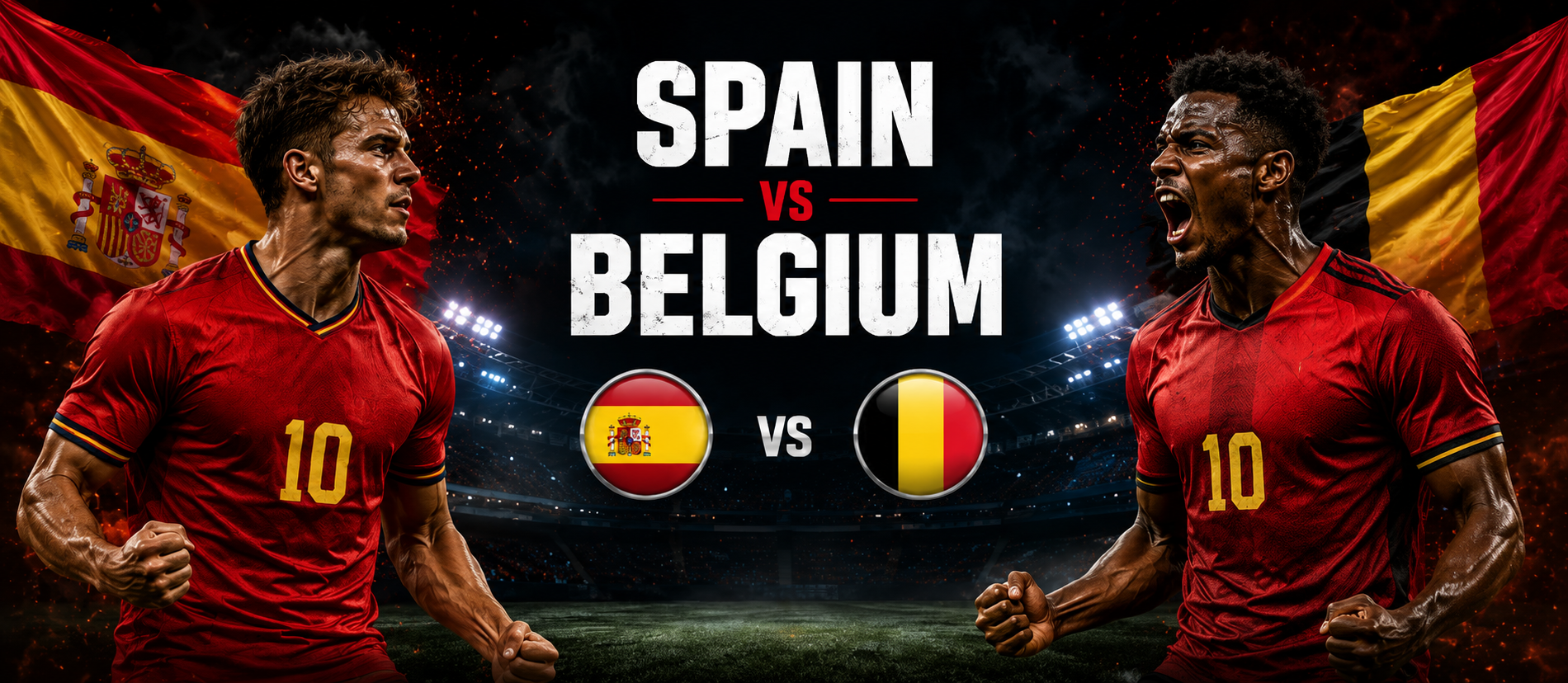
A Perfect Record vs the Red Devils
Spain vs Belgium World Cup 2026 quarterfinal preview — SoFi Stadium tactics, squads, Ronaldo’s Spain conquerors, yellow-card risks and a reasoned final prediction.
- July 10, 2026 Fri
- SoFi Stadium Inglewood
- Kick-Off 12:00 PM ET
A semifinal place on the line at SoFi.
Spain vs Belgium, Quarterfinal (Match 98), SoFi Stadium, Inglewood, California, Friday July 10, 2026, 12:00 p.m. ET. Winner advances to Semifinal Match 101 against the France vs Morocco winner, reported for July 14 at Dallas Stadium, Arlington, Texas. No referee assignment confirmed as of writing. SoFi Stadium is fully roofed, so weather should not be a factor.
Both teams have four days’ rest since their Round of 16 ties (both played July 6), but Belgium’s Round of 32 win over Senegal went to extra time (120+ minutes) while Spain’s Round of 32 win over Austria did not, creating a cumulative fatigue gap even though calendar rest days are level.
Everything you need at kickoff
- Date
- Fri, July 10, 2026
- Kickoff
- 12:00 p.m. ET 9:00 a.m. PT
- Venue
- SoFi Stadium Inglewood, CA
- Stage
- Quarterfinal Match 98
- Referee
- Unconfirmed Check FIFA match centre
- Weather
- Roofed venue Climate-controlled
- Rest
- 4 days each Belgium played 120'+ vs Senegal in R32
The winner advances to a Semifinal against the France vs Morocco winner, reported for July 14 at Dallas Stadium (AT&T Stadium), Arlington, Texas — to be reconfirmed once the France-Morocco result is known.
A golden generation’s last shot
Pressure sits high on both sides for different reasons. Spain, as reigning European champions and a pre-tournament favorite, would view anything short of a deep run as underachievement, and the Cape Verde scare left a lingering doubt despite subsequent results. For Belgium, this is widely viewed as the last realistic World Cup for the De Bruyne-Courtois-Lukaku golden generation, adding a now-or-never emotional weight, with expectations raised further after eliminating co-host USA.
For Spain, reaching a first World Cup semifinal since 2010 would validate a tournament that began with real doubt and put a European Championship-winning core within two matches of a first World Cup title since 2010. For Belgium, a semifinal berth would be a landmark achievement, raising the question of whether this squad can finally deliver the breakthrough that eluded the more talented 2018 vintage, which finished third.
A semifinal berth would be a landmark for what is widely described as the final realistic World Cup for the De Bruyne-Courtois-Lukaku generation.
The stories shaping SoFi
A golden generation’s last shot
Belgium’s quarterfinal is widely viewed as the final realistic World Cup for the De Bruyne-Courtois-Lukaku generation.
Ronaldo’s conquerors
Spain eliminated Portugal in the Round of 16, likely ending Cristiano Ronaldo’s World Cup career, via a 91st-minute Mikel Merino winner.
Six straight clean sheets
Spain arrive on a tournament-record six consecutive World Cup clean sheets.
The Lukaku super-sub pattern
Belgium’s most reliable X-factor is Romelu Lukaku off the bench, directly involved in rescue acts against Egypt, New Zealand, Senegal and the USA.
A discipline subplot
Brandon Mechele and head coach Rudi Garcia were both booked against Senegal and are one caution from missing the semifinal.
Belgium have not beaten Spain at a World Cup in normal time in either prior meeting.
Tale of the tape
Spain is built on relentless positional control with a genuinely ruthless edge layered on top of the old possession identity. De la Fuente’s side survived a scare against Cape Verde but responded with increasing control across every subsequent match, culminating in a tournament-record six consecutive World Cup clean sheets.
Belgium is a team that has needed adversity to find its level all tournament. Rudi Garcia’s group stage was defined by a frustrating draw with Egypt, a goalless red-card-marred stalemate with Iran, and only a true statement performance once qualification was essentially secure against New Zealand. The Round of 32 against Senegal encapsulated the profile: trailing 2-0 with under 30 minutes left, Belgium’s individual quality and bench depth rescued and then won the tie in extra time.
Match 1 (Cape Verde): patient, expansive 4-3-3, overwhelming shot volume but no breakthrough against a deep block. Match 2 (Saudi Arabia): sharper, faster circulation exploiting a mid-block opponent’s space. Match 3 (Uruguay): more cautious and controlled, decided by a single moment of quality. Round of 32 (Austria): a return to overwhelming control combined with clinical edge, arguably Spain’s most complete performance. Round of 16 (Portugal): the most conservative version yet, with the winning moment manufactured by fresh legs and substitute quality rather than open-play dominance. Throughline: Spain’s control is remarkably consistent, but goal threat has increasingly depended on individual moments and bench impact in knockout football.
Match 1 (Egypt): cautious base 4-3-3 that struggled to create chances until Lukaku’s introduction. Match 2 (Iran): extended, fruitless territorial dominance undermined by Ngoy’s red card. Match 3 (New Zealand): front four finally clicked in open play against a weaker opponent. Round of 32 (Senegal): poor, disorganized first hour conceding twice, followed by a mentally resilient fightback through 120-plus minutes. Round of 16 (USA): sharp, clinical response with quick reactions to concede-and-respond situations. Throughline: Belgium trended from toothless (Egypt, Iran) to increasingly ruthless (New Zealand, USA), with Senegal as the character-revealing outlier that also exposed unresolved defensive fragility.
- Elite technical control in central areas.
- A front line that scores freely once games open up.
- A bench that has twice produced decisive knockout contributions.
- Match-winning bench impact (Lukaku).
- A golden-generation spine (De Bruyne, Courtois, Lukaku) still capable of brilliance.
- De Ketelaere’s emergence as a genuine focal point.
- Can be nullified by a deep, disciplined low block for long stretches.
- A wide-forward injury crisis (Nico Williams, Yeremy Pino).
- A lack of direct penetration when the first goal does not arrive early.
- A defense exposed against direct, physical opposition.
- A reliance on substitutes to change games.
- Cumulative fatigue after 120-plus extra-time minutes against Senegal.
Control vs adversity
Luis de la Fuente arrives with the stronger recent pedigree — reigning European champions, a bold squad selection omitting every Real Madrid player, and a system that has delivered a tournament-record six straight World Cup clean sheets. His double substitution producing the Merino winner against Portugal showed real knockout sharpness. His challenge is squad availability at wide areas (Williams, Pino) and finding penetration against a direct Belgium side.
Rudi Garcia, appointed January 2025, has preached ‘possession with purpose’ and built his tournament through gradual trust rather than early conviction — a cautious group stage, a chaotic Round of 32 escape act, and a clinical Round of 16 statement. His captaincy call (Tielemans over De Bruyne, Courtois, or Lukaku) has paid off, and his pattern of introducing Lukaku as a momentum-shifting substitute has repeatedly unlocked matches. Garcia also carries personal disciplinary risk after being booked from the touchline against Senegal.
Key duels to watch
Mikel Oyarzabal vs Belgium’s centre-back pairing (De Winter/Debast or Mechele)
Oyarzabal’s four tournament goals against a back line exposed repeatedly by Senegal’s direct running.
Pedri vs Youri Tielemans / Amadou Onana midfield zone
Spain’s progressive possession control against Belgium’s physical duel-winning and vertical passing threat.
Lamine Yamal vs Timothy Castagne / Arthur Theate
Spain’s most explosive dribbler against Belgium’s experienced but occasionally exposed full-backs.
Charles De Ketelaere vs Spain’s back line (Cucurella/Pau Cubarsí/Laporte)
A genuine litmus test of Spain’s near-flawless defensive record against a player in career-best tournament form.
Goalkeeper comparison: Unai Simón vs Thibaut Courtois
Simón protected by an outstanding defensive structure, Courtois individually tested more often but with strong big-game pedigree.
Romelu Lukaku (impact sub) vs Spain’s tiring defensive line late
Lukaku’s proven super-substitute pattern is one of the most reliable X-factor moments in this tie.
Edge: De la Fuente on control, structure, and disciplinary cleanliness; Garcia on proven bench-impact substitutions and a team that has already shown it can win from a losing position under real pressure.
The names that decide it
Outstanding. Four goals across five matches, decisive against Saudi Arabia and Austria, Spain’s most consistent attacking threat.
Good. A goal against Saudi Arabia and growing influence, though quieter in the more cautious Uruguay and Portugal matches.
Good. The tempo-setter in Spain’s midfield, central to controlling matches even when not scoring freely.
Good. Steady, experienced anchor after a lengthy injury-recovery arc; structurally vital as captain.
Good. Scored the stoppage-time winner against Portugal from the bench, Spain’s biggest individual contribution in the knockout rounds.
Good. Part of a six-consecutive-clean-sheet defensive record, though rarely individually tested.
Outstanding. A brace against the USA and increasingly Belgium’s most dangerous individual attacking presence.
Outstanding. A goal and the extra-time winning penalty against Senegal, plus captaincy responsibilities.
Good. Directly involved in rescue acts against Egypt, New Zealand, Senegal, and a stoppage-time goal vs USA as Belgium’s super-substitute.
Average, trending up. Limited minutes and evident rust after a long injury layoff, but a goal against New Zealand shows quality remains.
Good. A brace against New Zealand and the assist for Tielemans’s extra-time equalizer against Senegal.
Good. Kept Belgium level against Iran with a strong performance, though beaten with some regularity when the back line is exposed.
One Yellow From a Ban
Belgium: Brandon Mechele and head coach Rudi Garcia were both booked in the Round of 32 win over Senegal; a second caution against Spain would rule them out of the semifinal. No Spain player carries a similar risk.
Fitness watch: Spain’s Nico Williams (groin) and Yeremy Pino (shoulder) are doubts on the wings; Belgium’s Kevin De Bruyne is being managed carefully after a long muscle-tear layoff, his match sharpness an open question.
The numbers behind the tie
Six straight clean sheets
Spain arrive on a tournament-record six consecutive World Cup clean sheets.
Ronaldo’s likely farewell
Spain’s Round of 16 win over Portugal likely marked Cristiano Ronaldo’s final World Cup appearance — his sixth and last edition.
A third World Cup meeting
This will be the third World Cup meeting between the sides: Belgium won the first on penalties at Mexico 1986, and Spain won the second 2-1 at Italy 1990.
The latest goal in World Cup history
Youri Tielemans converted a contested 125th-minute penalty to beat Senegal, reported as the latest goal in World Cup history.
A 91st-minute winner
Mikel Merino came off the bench to score a 91st-minute winner against Portugal, assisted by fellow substitute Ferran Torres.
Best guess at kickoff
No starting XI has been confirmed. These are best-available projections based on group-stage and knockout selections; Nico Williams’s and Yeremy Pino’s fitness for Spain and Kevin De Bruyne’s role for Belgium remain uncertain until team sheets are published.
Mikel Oyarzabal extends his tournament tally, continuing his case as one of the competition’s most in-form strikers.
Romelu Lukaku is directly involved in a Belgium goal for at least the fourth time this tournament, most likely as a substitute, and Kevin De Bruyne is introduced from the bench with a telling impact — in what could be a defining moment of his farewell World Cup.
Belgium's super-substitute weapon
Romelu Lukaku has been directly involved in rescue acts against Egypt, New Zealand, Senegal and the USA — Belgium’s proven momentum-shifting option, most dangerous introduced around the hour mark rather than started.
Man of the match: Mikel Oyarzabal — with Charles De Ketelaere or Youri Tielemans the most likely standout for Belgium even in defeat. The turning point: a cagey opening 30-40 minutes broken by a Spain goal built from patient central buildup, followed by a Belgium response through Lukaku’s introduction or a De Ketelaere moment, before Spain’s bench options see the match through late.
Spain’s tournament-long defensive record, spotless disciplinary sheet, and reliable knockout-stage substitute pattern make them the stronger side on balance. But Belgium’s demonstrated resilience under pressure, a front line in genuine current form, and Lukaku’s repeated super-substitute impact make this a live threat rather than a formality. Belgium’s clearest realistic outcome beyond an outright shock is extra time, where their recent experience and Courtois’s penalty pedigree become assets. Confidence in the result is medium; the exact scoreline is low confidence.
Composure vs the knack to find a way
Spain are confident — four straight wins, six consecutive World Cup clean sheets, a spotless disciplinary sheet, and increasingly composed knockout performances after surviving the Cape Verde scare. Belgium are steady and trending toward confident — a shaky group campaign gave way to two increasingly assured knockout wins, though the Senegal win required a dramatic extra-time rescue rather than clean control.
Spain should be favored on the strength of a genuinely elite defensive record combined with an attack that scores freely whenever it finds rhythm, and a bench that has twice produced the decisive goal in knockout football. But Belgium’s knack for finding a way to win is its own form of momentum.
Something has to give Friday in Los Angeles.
