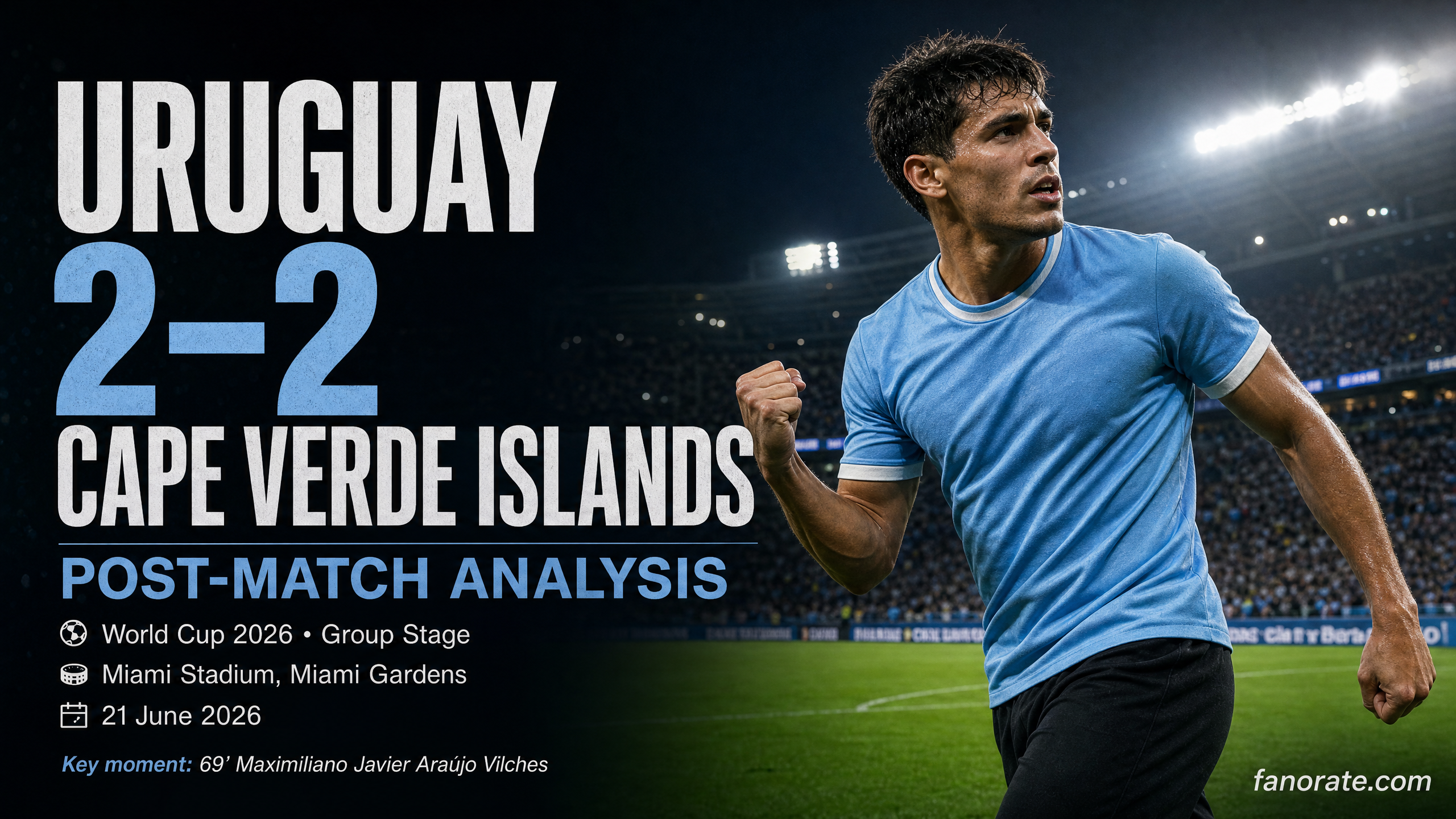
Uruguay vs Cape Verde Islands: 2-2 World Cup 2026 Group Stage Thriller in Miami — Match Analysis
In a rain-soaked Miami Stadium, Uruguay squandered a two-goal first-half lead as Cape Verde Islands stormed back to claim a stunning 2-2 draw in the FIFA World Cup 2026 Group Stage — a result that sends shockwaves through the group and announces the Blue Sharks as genuine contenders.
What happened
Under the weight of very heavy rain in Miami Gardens, Uruguay arrived at Miami Stadium as heavy favourites against Cape Verde Islands — a side making waves at just their second-ever FIFA World Cup. But football rarely follows the script, and this Group Stage encounter will be remembered as one of the tournament’s most dramatic early results. Uruguay raced into a commanding 2-0 lead by half-time, with Maximiliano Araújo’s header and Agustín Canobbio’s clinical finish giving Marcel Bielsa’s side every reason for confidence heading into the break. Yet Cape Verde refused to be written off. A second-half fightback — highlighted by Hélio Varela’s composed finish after coming off the bench — ensured the Blue Sharks left Miami with a share of the points and a growing reputation as the tournament’s most compelling underdog story. The final score: Uruguay 2-2 Cape Verde Islands.
How it was won and lost
Uruguay’s First-Half Dominance Built on Width and Set-Piece Threat
Uruguay were tactically precise in the first half, exploiting their superior athleticism and technical quality to pin Cape Verde back. Their passing volume was significant — 511 total passes compared to Cape Verde’s 277 — reflecting a side that controlled territory and tempo. Maximiliano Araújo was central to Uruguay’s attacking plan, operating with freedom on the left flank and generating width that stretched Cape Verde’s defensive shape. His 44th-minute header from a set-piece situation demonstrated Uruguay’s rehearsed delivery patterns from wide areas. Moments before half-time, Canobbio converted from close range after Araújo again provided the decisive contribution, this time with an assist that punished Cape Verde’s inability to clear their lines under pressure. With a 2-0 lead at the break, Uruguay had the game exactly where they wanted it.
Cape Verde’s Half-Time Reset and Tactical Overhaul Change the Game
Cape Verde’s coaching staff acted decisively at the interval, introducing Deroy Duarte in the 46th minute — just seconds after the restart — signalling an immediate tactical shift. By the 58th minute, two further substitutions arrived simultaneously: Nuno Jóia replaced Gilson Tavares, and Hélio Varela came on for Garry Mendes Rodrigues. The triple change fundamentally altered Cape Verde’s energy and attacking intent. Within three minutes, Varela had found the net — his right-footed finish in the 61st minute immediately reducing the deficit and rewarding the bold rotation. Cape Verde’s xG of 0.45 compared to Uruguay’s 1.94 illustrates how efficient the Blue Sharks were with their limited opportunities, converting moments of quality into a genuine comeback.
VAR Intervenes as Uruguay’s Araújo Has Goal Cancelled
Uruguay’s attempt to restore their two-goal cushion was thwarted in the 69th minute when Araújo’s effort was cancelled — a moment that visibly shifted momentum back toward Cape Verde and galvanised the underdogs. Bielsa responded at the 70th minute with a double substitution, introducing Diego De La Cruz for Manuel Ugarte and sending on Darwin Núñez for Federico Viñas in search of a goal that would settle nerves. However, Uruguay’s defensive structure appeared less secure in the second half, registering zero clean-sheet moments as Cape Verde’s direct running caused repeated problems. Cape Verde’s pressing intensity rose noticeably after their substitutions, reflected in their higher second-half press completion and more aggressive transition into Uruguay’s half.
Set-Piece Vulnerability and Defensive Fragility Cost Uruguay
Uruguay conceded more than just a goal in the second half — they conceded control. Cape Verde’s second equaliser completed the comeback and exposed a defensive fragility that Marcel Bielsa must address. Uruguay won 8 corners and generated 17 shots across the match, yet failed to close the game out from a position of two-goal dominance. Defensively, Uruguay’s foul count was notable — Rodrigo Bentancur was cautioned early, and Mathías Olivera was penalised in the second half as Cape Verde won more free-kick opportunities in dangerous positions. The late argument involving Cape Verde’s Edilson Borges in the 90th minute added an edgy postscript to a match that had long since escaped Uruguay’s control.
Who decided it
Maximiliano Javier Araújo Vilches
UruguayAraújo was Uruguay’s most dangerous attacking weapon, registering a goal and an assist in the first half. His header in the 44th minute opened his personal account on the night, and his assist for Canobbio moments before half-time showcased his ability to combine effectively in tight spaces. He had a second goal disallowed by VAR in the 69th minute and was eventually substituted in the 82nd minute, having given everything across the 90 minutes.
Operating primarily down Uruguay’s left flank, Araújo provided width, direct running, and set-piece involvement that consistently troubled Cape Verde’s defensive organisation. His ability to arrive late into the box from wide positions created the kind of second-phase danger that Cape Verde simply could not cope with in the first half.
Agustín Canobbio Graviz
UruguayCanobbio’s clinical right-footed finish in the 45+6th minute — converting Araújo’s assist with composure — gave Uruguay their two-goal cushion heading into the break. His movement in and around Cape Verde’s defensive line was sharp, and he was a consistent menace throughout the first period.
Canobbio’s off-ball movement and ability to time his runs into the penalty area provided Uruguay with a natural finisher in the half-spaces. His goal was emblematic of Uruguay’s first-half superiority and their capacity to punish defensive lapses at the right moment.
Hélio Sandro Oliveira Alves Varela
Cape Verde IslandsIntroduced as a substitute in the 58th minute, Varela transformed the match within three minutes of his arrival. His composed right-footed finish in the 61st minute sparked Cape Verde’s comeback and injected urgency and belief into the Blue Sharks’ performance. He was the catalyst for everything that followed.
Varela’s direct running and clinical finishing immediately gave Cape Verde a focal point in attack that had been absent. His impact from the bench was arguably the most decisive tactical contribution of the entire match, turning a 2-0 deficit into a platform for a remarkable second-half fightback.
Federico Santiago Valverde Dipetta
UruguayValverde operated with his customary energy and box-to-box industry throughout, providing both defensive cover and attacking thrust in the middle third. Uruguay generated 29 attacking actions through central zones, with Valverde’s pressing intensity and passing range a constant feature.
As Uruguay’s engine in midfield, Valverde’s role in maintaining first-half dominance was critical. Uruguay’s passing accuracy of 82% and 511 total passes reflected a team that kept the ball well, with Valverde at the heart of that structure. His inability to prevent the second-half collapse, however, underlines how dramatically the game’s balance shifted after the interval.
Where it sits in history
Cape Verde Islands are making only their second appearance at the FIFA World Cup, having debuted at the tournament in recent years as African football’s most exciting emerging nation. Their Blue Sharks — so nicknamed for the nation’s Atlantic island identity — have become renowned for punching far above their weight on the continental stage, winning the Africa Cup of Nations and making deep runs in AFCON competition. For Uruguay, one of football’s most storied nations with two World Cup titles to their name (1930 and 1950), surrendering a two-goal lead against an African minnow represents a significant warning. La Celeste have historically been defined by their gritty, battle-hardened competitive edge — a quality associated with the legendary ‘Garra Charrúa’ spirit — but this performance in Miami suggested that resilience must be matched by clinical finishing and defensive concentration if they are to progress deep into FIFA World Cup 2026.
Inside the ground
Miami Stadium, with a capacity of 65,326, provided a vivid backdrop for one of the tournament’s early shocks. The very heavy rain that fell throughout the evening added a dramatic, cinematic quality to the evening’s events — slick surfaces, spray from every tackle, and goalmouth scrambles made more chaotic by the conditions. A significant Cape Verde diaspora presence in Florida made their voices heard throughout, turning sections of the stadium into a sea of blue and white as the comeback unfolded. When Varela’s goal hit the net in the 61st minute, the roar from Cape Verde supporters rivalled anything a home crowd could generate. By the time the final whistle confirmed the 2-2 draw, Miami Gardens had witnessed something genuinely memorable — the kind of World Cup night that reminds you why this tournament is incomparable.
Looking ahead
The draw leaves both sides with critical decisions to make ahead of their next Group Stage fixtures. Uruguay, expected to progress comfortably from their group, now face serious questions about their defensive organisation and ability to close out matches. Marcel Bielsa must address the second-half collapse urgently, particularly the vulnerability exposed when Cape Verde’s substitutes arrived with fresh legs and renewed intensity. For Cape Verde Islands, this result is transformative. A point against Uruguay — one of South America’s elite — demonstrates they belong at this level and carries genuine belief into their remaining group games. The Blue Sharks will travel to their next fixture knowing they have already written their name into FIFA World Cup 2026 history.
The bottom line
-
Uruguay surrendered a 2-0 first-half lead to draw 2-2 with Cape Verde Islands at Miami Stadium in the FIFA World Cup 2026 Group Stage.
-
Maximiliano Araújo was Uruguay’s standout performer, scoring a header and assisting Canobbio’s goal before having a second-half effort cancelled by VAR.
-
Cape Verde’s triple substitution at the 58th minute — including the introduction of Hélio Varela — completely changed the game’s momentum.
-
Hélio Varela scored within three minutes of coming on as a substitute, igniting Cape Verde’s second-half comeback.
-
Uruguay dominated possession (511 passes vs 277) and the xG metrics (1.94 to 0.45) yet failed to convert their superiority into a winning result.
-
Very heavy rain in Miami Gardens created difficult conditions throughout and added to the drama of Cape Verde’s stunning fightback.
-
The result raises significant questions about Uruguay’s defensive concentration and ability to manage games from winning positions at World Cup level.
-
Cape Verde Islands continue to announce themselves as one of African football’s most compelling stories at FIFA World Cup 2026.
