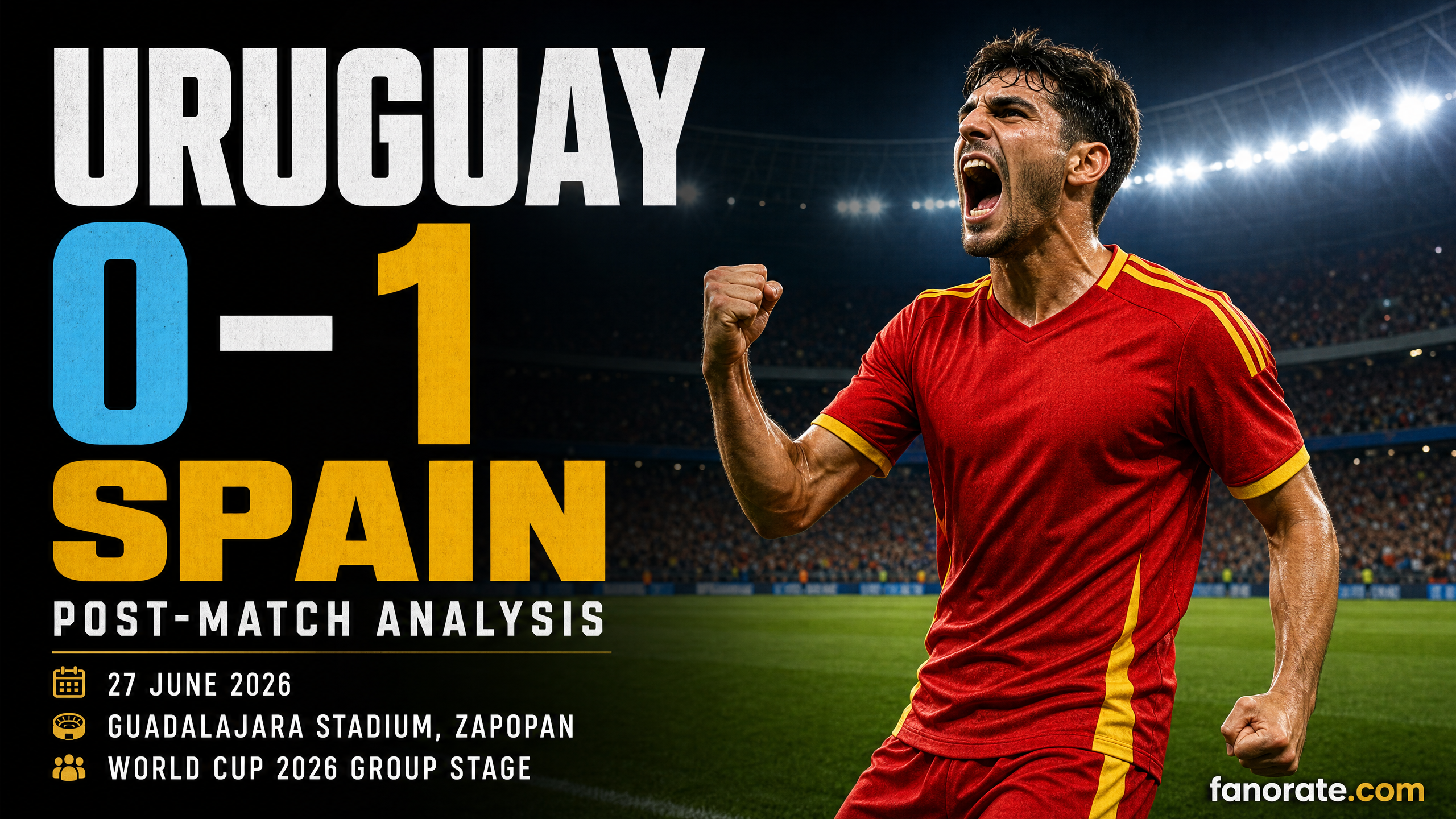
Spain Beat Uruguay 1-0 at FIFA World Cup 2026: Baena Strike Sends La Roja Through
A composed, tactically disciplined Spain side defeated Uruguay 1-0 at the Guadalajara Stadium in Zapopan, with Alejandro Baena’s 42nd-minute strike — assisted by Marcos Llorente — proving the difference in a wet, tense World Cup 2026 Group Stage encounter.
Spain won after full-time
What happened
Under light rain in Zapopan, Spain delivered a masterclass in controlled dominance to defeat Uruguay 1-0 in a high-stakes FIFA World Cup 2026 Group Stage encounter. Alejandro Baena Rodríguez’s composed finish just before half-time — created by the surging run of Marcos Llorente — was all La Roja needed. With 67% possession, 623 passes, and an 89% pass accuracy rate, Luis de la Fuente’s side suffocated a resilient but limited Uruguayan outfit that finished the match with ten men following Agustín Canobbio’s red card in stoppage time. Spain looked every inch a World Cup contender. Uruguay, for all their battling spirit, were outclassed.
How it was won and lost
Spain’s Possession Maze Dismantles Uruguay’s Low Block
Spain’s approach was relentlessly systematic. With 623 passes at an 89% accuracy rate compared to Uruguay’s 301 at 76%, La Roja constructed an overwhelming positional dominance that denied Uruguay any rhythm in transition. The wide areas were exploited through Grimaldo on the left and Llorente’s marauding runs from midfield, with six corners earned as a byproduct of sustained pressure. Uruguay’s compact 4-4-2 defensive shape was stretched horizontally, and once spaces opened in the half-spaces, Spain’s technical quality proved decisive.
Baena’s Clinical Strike: The Moment That Settled It
The only goal of the game arrived in the 42nd minute and was a product of Spain’s intelligent positional play rather than individual brilliance alone. Marcos Llorente’s penetrating run split Uruguay’s midfield block, and Baena arrived with perfectly timed movement to finish clinically. The goal came at a psychologically crucial moment — just before half-time — robbing Uruguay of any chance to reset at the interval with the score level. Baena’s subsequent yellow card in the 46th minute added an edge to his evening, but he had already done the defining work.
Uruguay’s Long-Ball Desperation Betrays Tactical Limitations
With just 33% possession, Uruguay resorted to a long-ball strategy that yielded little. Their 43 long passes — of which only 35% were successful — reflected the difficulty they had in bypassing Spain’s compact midfield press. Darwin Núñez was isolated as a lone frontrunner, starved of service, while De Arrascaeta and Valverde were unable to generate the dynamic link-play Uruguay needed. The 5 offsides further highlighted their disjointed attacking structure under sustained Spanish pressure.
Spain’s Substitution Strategy: Control Over Chaos
Luis de la Fuente’s tactical flexibility was evident in a wave of measured substitutions after the break. Daniel Olmo and Fabián Ruiz entered on 60 minutes to reinforce central control, while Yeremi Pino replaced the booked Baena shortly after to preserve discipline. The introduction of Ferrán Torres and Nico Williams in the 76th minute added fresh legs and directness on the flanks as Spain sought to kill the game. The changes reflected a team managing a result intelligently rather than chasing a second goal recklessly.
Uruguay’s Disciplinary Collapse Compounds Tactical Failure
Three yellow cards and a late red card for Canobbio in the 95th minute underlined the frustration coursing through Uruguay’s camp. The bookings for Sanabria, Varela, and De La Cruz were emblematic of a side resorting to physical interventions when outplayed technically. Canobbio’s dismissal in stoppage time was a fitting symbol of Uruguay’s evening — a talented squad unable to assert themselves against Spain’s structured superiority, eventually cracking under the pressure they could not relieve.
Who decided it
Alejandro Baena Rodríguez
SpainThe match’s decisive figure, Baena scored the only goal with a composed 42nd-minute finish assisted by Llorente. He was bright, energetic, and dangerous in the half-spaces before being replaced in the 66th minute following a precautionary yellow card.
Baena’s movement between the lines disrupted Uruguay’s midfield shape repeatedly. His ability to arrive late into dangerous areas made him nearly impossible to track, and his clinical finish proved the difference between two tightly matched defences.
Marcos Llorente Moreno
SpainA constant threat from a hybrid midfield-right flank role, Llorente registered the assist for Baena’s goal with a penetrating run that split Uruguay’s defensive block. His dynamic carrying and positioning made him one of Spain’s most effective attacking outlets.
Llorente’s ability to overload the right channel gave Spain consistent width and depth simultaneously. His late runs from deeper positions were difficult for Uruguay to track, and his assist was the direct result of the positional chaos he created.
David Raya Martin
SpainThe Arsenal goalkeeper was largely untroubled but made two saves when called upon. His distribution was confident throughout, contributing to Spain’s build-up rhythm from the back.
Raya’s composure in possession allowed Spain to build from the goalkeeper with conviction, maintaining their passing structure and pressing triggers even when Uruguay attempted to press high in short spells.
Darwin Gabriel Núñez Ribeiro
UruguayNúñez worked tirelessly against Spain’s high defensive line but was isolated by poor supply. His physical presence was neutralised by Spain’s well-organised centre-back pairing, and he was unable to generate meaningful shots on target.
With Uruguay relying on long-ball delivery and transition, Núñez needed service that never arrived consistently. Spain’s defensive structure — marshalled by Laporte and Eric García — effectively removed him from the contest as a genuine attacking threat.
Where it sits in history
Spain and Uruguay have met across multiple World Cup tournaments, with both nations carrying rich footballing traditions into every encounter. For Spain, this victory continues a dominant modern era that saw them win the World Cup in 2010 and reach multiple knockout stages since. La Roja’s tactical identity under successive national coaches has remained rooted in possession-based football, and this performance was a textbook expression of that philosophy. Uruguay, meanwhile, carry the proud legacy of two World Cup titles — 1930 and 1950 — but have struggled to consistently replicate that golden era in modern tournament football. A defeat of this nature, against a technically superior European side, reflects the broader challenge Uruguay face in bridging the gap between individual talent and collective tactical cohesion at the highest level of the game.
Inside the ground
The Guadalajara Stadium in Zapopan, one of Mexico’s iconic football venues with a capacity of over 45,000, provided an atmospheric backdrop despite the light rain that fell throughout the evening. A significant Spanish contingent generated sustained noise, particularly after Baena’s goal just before half-time, while Uruguayan supporters remained defiant until the late stages. The wet conditions added a physical edge to proceedings and contributed to the tight, scrappy passages in midfield that punctuated Spain’s otherwise fluid possession play. As the final whistle approached and Canobbio received his red card, the atmosphere shifted — Spain’s fans celebrating a controlled, professional victory while Uruguay’s travelling support processed a difficult defeat.
Looking ahead
Spain advance through the FIFA World Cup 2026 Group Stage with momentum and confidence intact, their possession-based system looking as effective as ever at international level. La Roja will expect to progress deep into the knockout rounds and will be among the strongest contenders for the title. Uruguay, meanwhile, face a pivotal moment. Depending on results elsewhere in the group, they must regroup quickly — both tactically and psychologically — if they are to recover their World Cup 2026 campaign. The red card suspension for Canobbio and multiple yellow cards will concern their coaching staff ahead of what could be a must-win next match. The tournament stakes are rising, and Uruguay’s capacity to respond will define whether this World Cup becomes a forgettable chapter or a redemption story.
The bottom line
-
Spain defeated Uruguay 1-0 in the FIFA World Cup 2026 Group Stage in Zapopan
-
Alejandro Baena scored the decisive goal in the 42nd minute, assisted by Marcos Llorente
-
Spain dominated possession with 67% and completed 553 of 623 passes at 89% accuracy
-
Uruguay struggled with just 33% possession and a poor 35% success rate on long passes
-
Agustín Canobbio was sent off in the 95th minute as Uruguay’s discipline crumbled
-
Spain’s intelligent substitution strategy preserved the result and managed momentum effectively
-
Uruguay’s Darwin Núñez was effectively neutralised by Spain’s organised defensive structure
-
Spain look like serious World Cup 2026 contenders based on this controlled, dominant display
