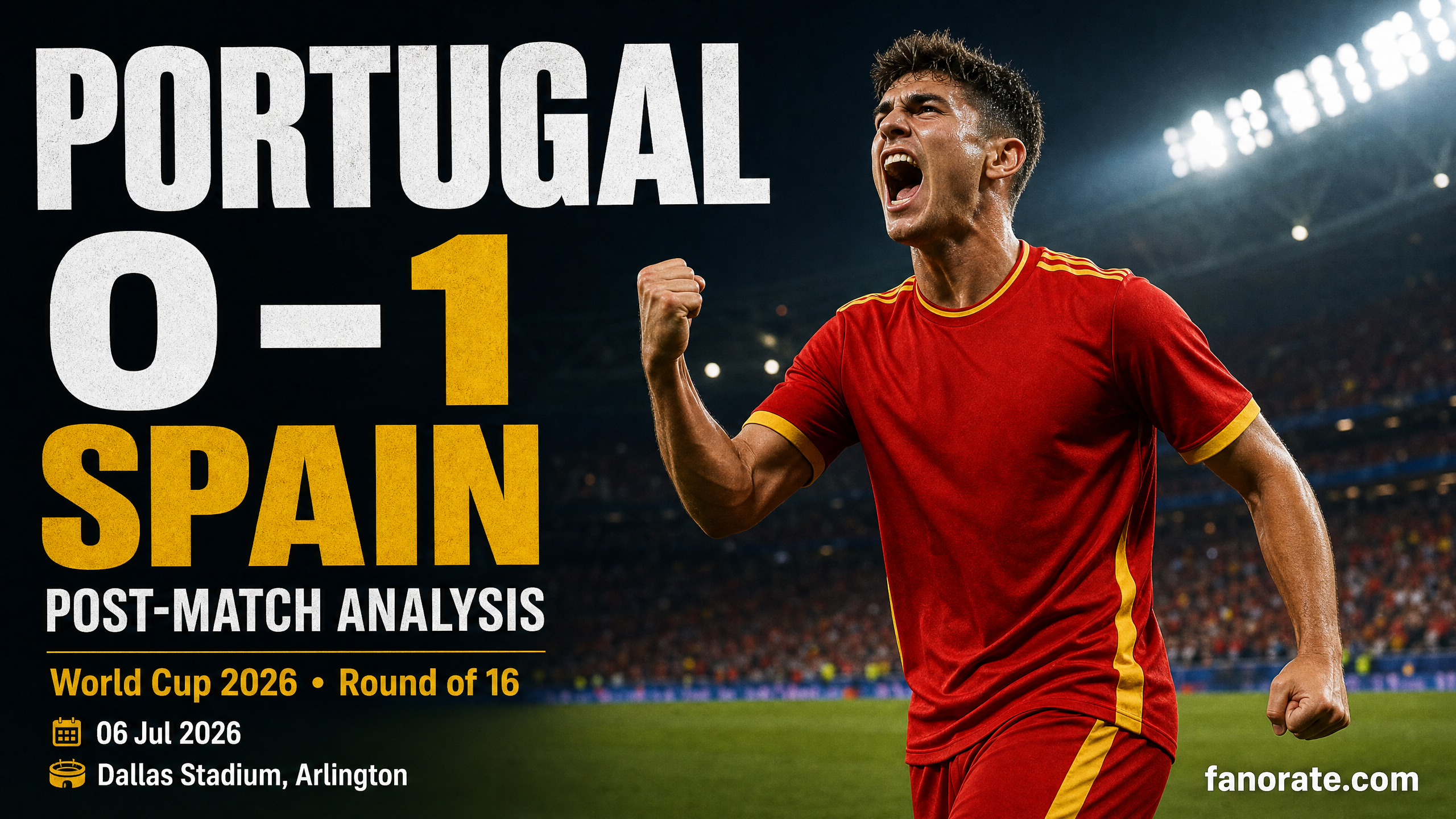
Spain Stun Portugal in Last-Gasp Thriller: Merino’s 90+1 Stunner Sends La Roja Into World Cup 2026 Quarter-Finals
Mikel Merino delivered one of the World Cup’s most dramatic moments, heading home Ferrán Torres’ cross in the first minute of stoppage time to send Spain past Portugal and into the quarter-finals of FIFA World Cup 2026 with a breathless 1-0 victory at Dallas Stadium.
Mikel Merino 90+1'
What happened
It took until the very last heartbeat of regulation, but Spain found a way through. Mikel Merino, introduced just six minutes earlier as a substitute, climbed highest to meet Ferrán Torres’ cross and plant a devastating header past Diogo Costa in the 91st minute, silencing a Portuguese support that had dared to believe extra time was coming. In a match of suffocating tension, shrewd tactical chess, and precious few clear openings, Spain’s superior possession game ultimately carved out the moment that mattered most. Portugal, who hit the woodwork and won more duels across the pitch, are left to rue a lack of clinical edge at the sharp end. La Roja march on.
How it was won and lost
Spain’s Possession Dominance Sets the Platform
Spain controlled the tempo throughout, finishing the match with 55% possession and an extraordinary 531 passes at an 88% accuracy rate. Under their structured build-up system, Rodri — deployed as the deep-lying pivot — was the metronome through which nearly every Spanish move flowed. Dani Olmo and Fabián Ruiz provided interior movement off him, constantly shifting Portugal’s midfield shape and creating brief windows of penetration. With 96 total attacks and 50 classified as dangerous, Spain consistently probed without finding the decisive final ball — until Torres came off the bench and changed the equation entirely.
Portugal’s Low Block and Transition Plan
Roberto Martínez set Portugal up to frustrate, deploying a disciplined mid-to-low block that ceded territory but aimed to exploit Spain on the counter through Cristiano Ronaldo and João Félix’s movement in behind. Portugal attempted a remarkable 23 dribbles — the most aggressive dribbling output in the match — and won 43 duels compared to Spain’s 35, signalling a willingness to fight in the physical trenches. With 53 long passes attempted, Martínez’s plan clearly involved bypassing Spain’s press quickly and releasing runners into space, though the execution lacked the final-third quality to genuinely threaten David Raya.
The Merino Masterstroke — Luis de la Fuente’s Decisive Substitutions
Spain’s bench decisions proved decisive. Ferrán Torres replaced Baena in the 75th minute, injecting directness and width into a Spain attack that had grown predictable. Merino then entered for Dani Olmo in the 85th minute, adding a physical aerial presence that Portugal’s defence had not been tested by. The combination clicked almost immediately — Torres, roaming the left channel, whipped in a delivery that Merino attacked with conviction, directing his header low and hard beyond Diogo Costa. It was a substitution-driven goal of the highest order, a reminder of La Roja’s bench depth in this tournament.
Portugal Hit the Woodwork — The Fine Margins of Elimination
Portugal’s most agonising moment came when a shot struck the woodwork — one of nine total shots for the Seleção, with only two on target against Spain’s six. With five saves required from Diogo Costa compared to just two from David Raya, the scoreline’s one-sidedness in terms of clear opportunities tells its own story. Portugal’s big chance missed count matches Spain’s two, and with just one big chance created across 90 minutes, the inability to convert those rare moments of danger ultimately cost Martínez’s side their World Cup.
Set-Piece Superiority and Crossing Patterns
Spain generated seven corners to Portugal’s three, and while their crossing accuracy was poor — just 1 of 16 crosses found a teammate — their volume and persistence in wide areas wore Portugal’s defensive structure thin over time. Grimaldo and Porro offered relentless width, and it was ultimately from a wide position that the winning goal originated. Portugal’s four accurate crosses from 13 attempts represented better efficiency, but without a striker capable of converting that aerial delivery, the statistic counted for nothing.
Who decided it
Mikel Merino
SpainEntered the pitch in the 85th minute and needed just six minutes to write himself into World Cup folklore. His run into the box and powerful downward header from Torres’ cross won the match for Spain in the first minute of stoppage time.
Merino’s late introduction added a physical, aerial dimension to Spain’s attack that Portugal had no answer for. His goal was a textbook example of how a tactically astute substitution can unlock a match that has resisted 85 minutes of patient build-up play.
Ferrán Torres
SpainCame on in the 75th minute and immediately created problems with his direct running and crossing intent. His delivery for Merino’s winner was inch-perfect — driven hard and low across the face of goal with exactly the right weight.
Torres provided Spain with the direct, unpredictable width that had been missing. His ability to beat his man one-on-one and deliver from the left flank in stoppage time was the catalyst for the decisive goal.
Diogo Costa
PortugalPortugal’s goalkeeper made five saves in a match where Spain’s dominance of possession created sustained pressure. Costa kept his side in the contest and could do little about Merino’s late header.
Costa’s shot-stopping ensured Portugal remained competitive deep into the match. His five saves — against Spain’s two for Raya — underline how the goalkeeping burden fell heavily on the Portuguese end, reflective of the overall balance of play.
Bruno Fernandes
PortugalPortugal’s captain and creative fulcrum worked tirelessly to link midfield and attack, contributing six key passes and showing the technical quality to unlock Spain’s press on occasion. However, the final product in the decisive moments eluded him.
Fernandes was Portugal’s most dangerous creative outlet and the player most likely to produce a moment of individual brilliance, but Spain’s midfield discipline — particularly Rodri’s positioning — limited the space he needed to operate at his most dangerous.
Lamine Yamal
SpainThe teenage sensation was a constant threat on Spain’s right flank, using his pace and dribbling to stretch Portugal’s defensive shape throughout the match. His ability to draw defenders wide created the interior spaces Spain’s midfielders exploited.
Yamal’s directness and unpredictability prevented Portugal from committing extra bodies centrally, keeping the defensive line honest and contributing to the spatial dynamics that eventually led to the winning goal.
Where it sits in history
This was an Iberian rivalry played out on the grandest possible stage — a World Cup knockout tie between two nations who have defined European football for the better part of two decades. Spain, former World Champions in 2010 and three-time European Champions, have historically held the edge in major tournament encounters, and this result continues that pattern. For Cristiano Ronaldo, now on what may be his final World Cup stage, the defeat cuts particularly deep — another chapter in a tournament career that has produced individual brilliance but ultimate collective disappointment. Spain’s late-winner culture is also notable: they have an extraordinary history of finding goals in the closing stages of tight knockout matches, and Merino’s header adds to that legacy.
Inside the ground
Dallas Stadium — packed to its 80,000 capacity under clear Texas skies — provided a thunderous backdrop for one of the World Cup’s most electric Iberian encounters. The Portuguese support, enormous across North America given the diaspora communities spread throughout the United States, created an atmosphere that belied the neutral venue tag. Spanish fans, equally passionate, reached a fever pitch when Merino’s header hit the net, and the scenes in the stadium in those final frantic minutes — three yellow cards issued after the goal — captured the raw, uncontrollable emotion of World Cup football at its most intense. The late drama only amplified what had been a slow-burning, tension-drenched evening in Arlington.
Looking ahead
Spain advance to the FIFA World Cup 2026 quarter-finals riding a wave of momentum and confidence. Luis de la Fuente’s squad have demonstrated both tactical discipline and the bench quality to win tight knockout matches — a combination that makes them genuinely dangerous as the tournament enters its decisive phase. Portugal, meanwhile, face a painful summer of reflection. For Cristiano Ronaldo, questions about international retirement will dominate the conversation, while Roberto Martínez must consider whether his system is capable of unlocking knockout football at the highest level. Spain’s quarter-final opponents and fixture details are to be confirmed, but La Roja will fear no one in this bracket.
The bottom line
-
Mikel Merino scored the winner in the 90+1 minute with a header from Ferrán Torres’ cross to send Spain through
-
Spain dominated possession with 55% and 531 passes at 88% accuracy, controlling the match’s tempo throughout
-
Portugal won more duels (43 vs 35) and attempted more dribbles (23 vs 10) but lacked clinical quality in front of goal
-
Diogo Costa made five saves to keep Portugal in the match, while Raya was barely tested with just two saves required
-
Portugal struck the woodwork in a sign of the fine margins that ultimately decided their World Cup exit
-
Luis de la Fuente’s substitutions — Torres and Merino — proved the decisive tactical intervention of the match
-
Spain’s victory extends their historical edge over Portugal in major tournament knockout football
