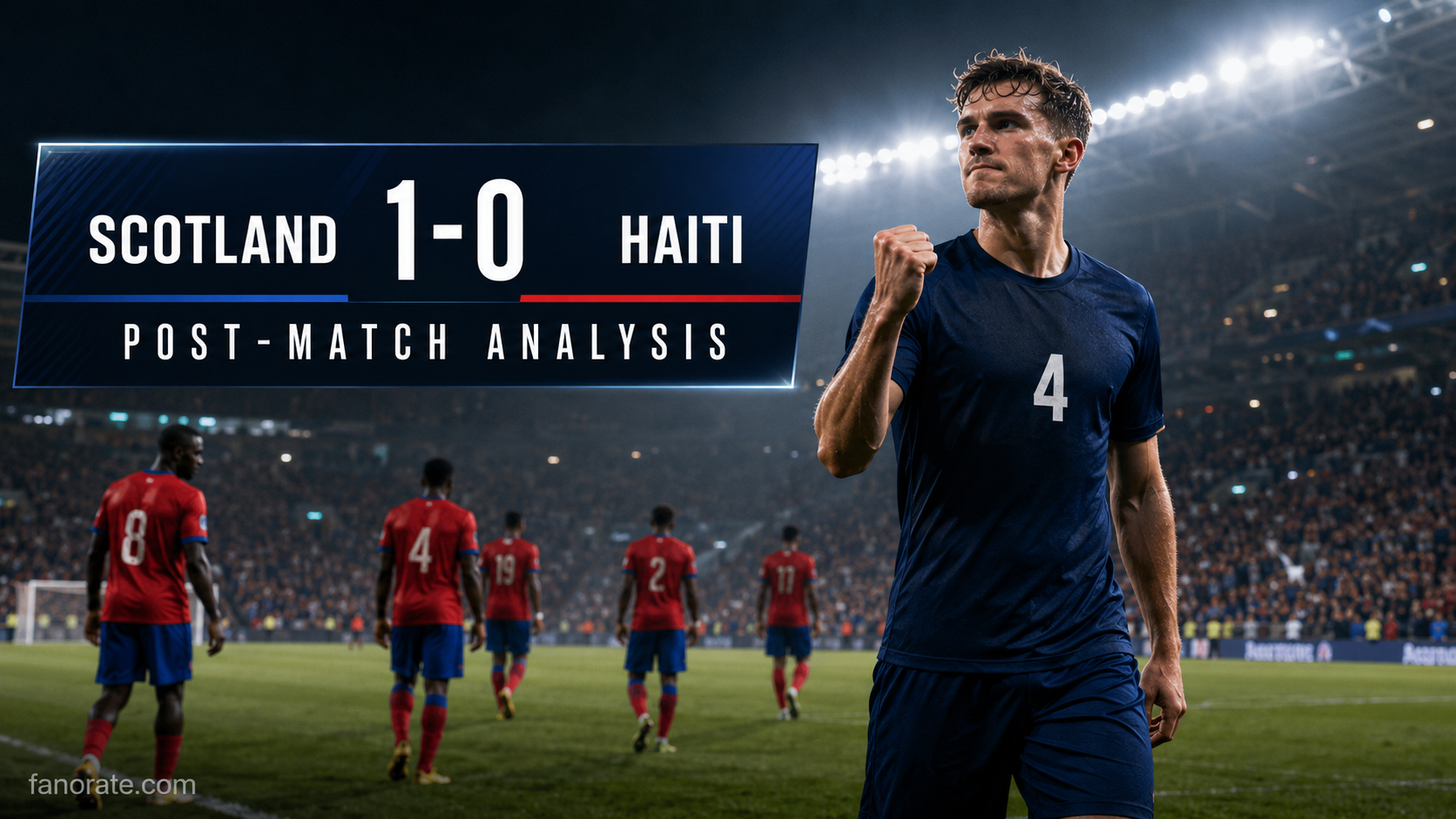
Scotland Beat Haiti 1-0 at FIFA World Cup 2026: McGinn Goal Seals Group Stage Win
John McGinn’s composed 28th-minute finish was enough for Scotland to claim a hard-fought 1-0 victory over Haiti in their FIFA World Cup 2026 Group Stage opener at Gillette Stadium, Foxborough. A disciplined defensive display and clinical finishing secured a historic three points for Steve Clarke’s side.
Scotland win
What happened
Under a clear Massachusetts sky, Scotland took their first FIFA World Cup 2026 steps with quiet authority, claiming a 1-0 Group Stage victory over Haiti at Gillette Stadium in Foxborough. John McGinn, Scotland’s talismanic midfielder, broke the deadlock in the 28th minute with a composed left-footed finish, and that single moment of quality proved enough. Haiti pushed with admirable energy — particularly in the second half — but Scotland’s defensive shape held firm, and Angus Gunn was rarely tested in a way that threatened to derail the result. For Scotland’s supporters, many of whom have waited decades to witness their nation compete on football’s grandest stage, this was a moment of profound emotional release wrapped inside a professional, measured performance.
How it was won and lost
Scotland’s Disciplined Defensive Block
Scotland operated in a compact mid-block for large portions of this match, limiting Haiti’s ability to play through central zones. With two banks of four consistently referenced across the positional data — Scotland conceded just 7 shots on target across the match — the Scots were difficult to break down. Haiti generated more touches in the attacking third (110 vs Scotland’s 76) and more overall touches (431 vs 373), suggesting Scotland were content to absorb pressure and hit on the counter, particularly after securing the lead.
McGinn’s Goal: Movement and Execution
John McGinn’s 28th-minute left-footed strike was the defining moment of the match. The goal reflected Scotland’s ability to create quality in transition — moving the ball quickly into McGinn’s preferred zones inside the opposition half. With an xG of 1.31 for Scotland compared to Haiti’s 1.07, the Scots generated the slightly superior expected goals volume despite spending less time in possession, underlining the efficiency of their attacking structure.
Haiti’s Second-Half Pressure Falls Short
Haiti responded to going behind with increased attacking intent after the interval. Their touches in the final third, combined with 17 ball recoveries in the attacking half compared to Scotland’s 13, suggested a team pushing desperately for an equaliser. However, Haiti’s conversion of their xG was poor — with an xG of 1.07 but zero goals scored — pointing to a lack of clinical edge in the final third. Bellegarde’s foul in the 39th minute and the general physicality of Haiti’s approach hinted at frustration building against a well-drilled Scottish defence.
Scotland’s Substitution Strategy: Protecting the Lead
Steve Clarke’s triple substitution in the 75th minute — introducing Ben Doak for Ryan Christie, Che Adams for Lyndon Dykes, and Nathan Patterson for Aaron Hickey — was a clear tactical signal. Fresh legs on the flanks, additional defensive cover at right-back, and an energetic forward in Adams to hold the ball up and run channels all pointed to a manager prioritising game management over further attacking ambition. Haiti’s response — Lenny Joseph on for Wilson Isidor in the 76th minute — came too late to alter the scoreline.
Transition Play and Width
Scotland used the width of the pitch effectively through Aaron Hickey on the right and Andrew Robertson on the left, creating overloads that stretched Haiti’s defensive shape. Robertson’s positioning and delivery remained a consistent outlet, while Hickey’s forward runs before his substitution added vertical threat. Haiti’s defensive line struggled to manage Scotland’s movement off the ball, particularly in the first half when McGinn arrived into space centrally to score.
Who decided it
John McGinn
ScotlandMcGinn was Scotland’s standout performer from the first whistle. His 28th-minute left-footed strike, the only goal of the game, was a moment of composed brilliance under World Cup pressure. He covered enormous ground across the pitch, combining defensive diligence with incisive forward runs, before being replaced by Findlay Curtis in the 82nd minute.
McGinn’s movement between the lines constantly caused Haiti problems. He arrived into pockets of space behind Haiti’s midfield line, dragging defensive shape out of position and creating the decisive opening. His substitution in the 82nd minute with the lead intact underlined his central importance to Scotland’s performance.
Jean-Ricner Bellegarde
HaitiBellegarde was Haiti’s most dangerous creative player and the focal point of their attacking play. His 39th-minute foul — earned through sharp ball-carrying that forced a defensive foul — illustrated his ability to drive forward and unsettle opponents. Despite his industry and creativity, he was unable to produce the decisive moment Haiti needed.
Operating in the number 10 role or as an advanced midfielder, Bellegarde was tasked with linking Haiti’s attacking structure. His willingness to carry the ball forward and draw fouls provided Haiti with set-piece opportunities and territorial momentum, but Scotland’s defensive organisation ultimately nullified his influence in the final third.
Andrew Robertson
ScotlandScotland’s captain and left-back was a constant presence in wide areas, providing both defensive solidity and attacking width. Robertson’s experience and reading of the game helped Scotland manage Haiti’s right-side pressure throughout the second half.
Robertson’s positional discipline and distribution were critical to Scotland’s ability to play out from the back under pressure and transition quickly into attack. His ability to identify and exploit width stretched Haiti’s defensive line and contributed to Scotland’s superior transition game.
Angus Gunn
ScotlandThe Scotland goalkeeper was relatively untroubled in the first half but faced increased pressure in the second period as Haiti pushed for an equaliser. Gunn was composed when called upon and distributed effectively to keep Scotland’s defensive shape organised.
While Haiti generated more possession and touches overall, Gunn’s command of his penalty area and clean sheet was central to Scotland’s victory. His shot-stopping was not dramatically tested — a testament to Scotland’s defensive structure rather than any individual goalkeeping heroics, but his calm authority in the box was reassuring.
Where it sits in history
Scotland’s appearance at FIFA World Cup 2026 marks a significant moment in the nation’s football story. The Scots famously qualified for numerous World Cups between the 1950s and 1990s but endured a long and painful absence from the tournament, missing every edition from France 1998 until this cycle. Their return to the World Cup — now expanded to 48 teams — is a watershed moment, and this opening 1-0 victory over Haiti provides the ideal foundation. For Haiti, this is one of their rare appearances on the World Cup stage. The Caribbean nation has historically struggled to reach the tournament with any consistency, making their FIFA World Cup 2026 qualification a proud achievement in its own right, even if this opening result went against them.
Inside the ground
The atmosphere inside Gillette Stadium, Foxborough was electric from the opening whistle, with Scotland’s travelling support making themselves heard under a clear New England sky. The famous Tartan Army — renowned as one of world football’s most passionate travelling supporters — brought noise, colour, and an emotional energy that reflected the sheer magnitude of Scotland’s return to the World Cup stage. Haiti’s supporters, though smaller in number, brought vibrant Caribbean colour and rhythmic energy to their end of the stadium. When McGinn’s goal hit the net in the 28th minute, the eruption from the Scottish section was visceral — decades of World Cup absence momentarily washed away in a single left-footed strike.
Looking ahead
Scotland will now prepare for their second FIFA World Cup 2026 Group Stage fixture, knowing that a second positive result could put them in a commanding position to advance to the knockout rounds for the first time in their history. The tactical blueprint laid down against Haiti — disciplined defensively, clinical on the counter, and composed in managing the game — will be tested further against stronger opposition. Haiti, meanwhile, must regroup quickly and find the attacking cutting edge that eluded them here if they are to remain in World Cup contention. Both sides will monitor injury concerns given the intensity of the match and the volume of substitutions made in the closing stages.
The bottom line
-
Scotland claimed a historic 1-0 victory over Haiti in their FIFA World Cup 2026 Group Stage opener at Gillette Stadium, Foxborough.
-
John McGinn’s composed 28th-minute left-footed strike was the only goal of the game and Scotland’s decisive moment of quality.
-
Scotland’s xG of 1.31 edged Haiti’s 1.07, reflecting a well-structured attacking game despite spending less time in possession.
-
Haiti dominated possession and touches (431 vs 373) but lacked clinical finishing, registering zero goals from their xG total.
-
Steve Clarke’s triple substitution in the 75th minute was a clear game-management decision to protect Scotland’s lead.
-
Scotland’s compact defensive mid-block was central to their clean sheet, limiting Haiti’s ability to create clear-cut chances.
-
Andrew Robertson’s width and John McGinn’s central movement were the tactical cornerstones of Scotland’s attacking game.
-
Scotland’s return to the World Cup after a lengthy absence adds enormous emotional weight to this three-point opening result.
