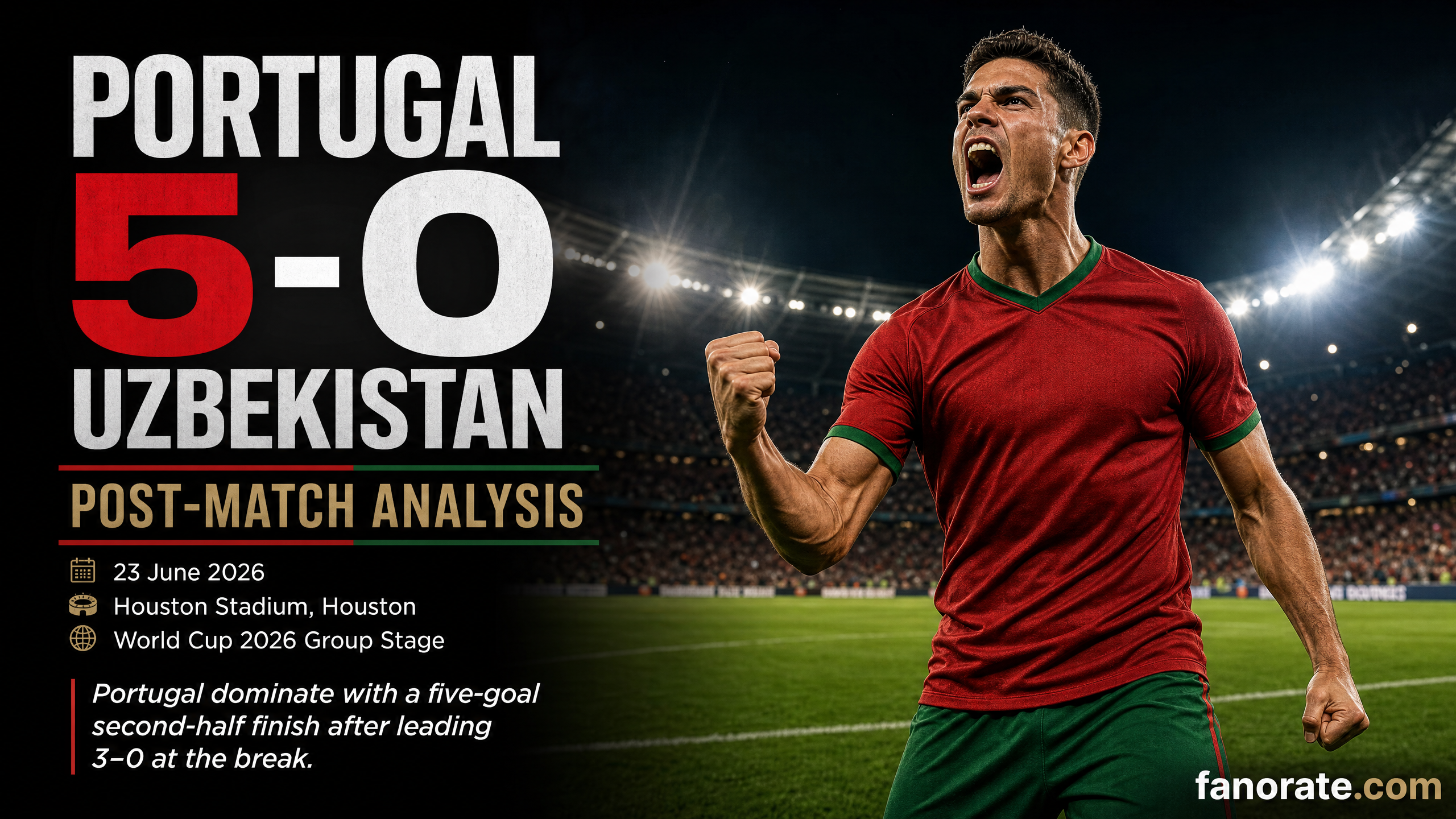
Portugal 5-0 Uzbekistan: Ronaldo Leads Demolition in Houston | FIFA World Cup 2026
Portugal delivered one of the tournament’s most commanding performances so far, dismantling Uzbekistan 5-0 at Houston Stadium to send a thunderous statement across FIFA World Cup 2026. Cristiano Ronaldo opened and extended the scoring, while an own goal and a Rafael Leão late strike capped a ruthless evening for the European giants under the Texas sky.
What happened
There are performances that manage results, and then there are performances that make statements. Portugal’s annihilation of Uzbekistan at a sun-baked Houston Stadium was firmly the latter. From the sixth minute, when Cristiano Ronaldo swept home a João Cancelo assist with the clinical ease of a man who has been doing this at the highest level for two decades, Portugal were in total command. The final scoreline of 5-0 barely flattered them. With possession touching 90% pass accuracy, 22 total shots, and an xG of 2.68 compared to Uzbekistan’s 0.39, this was a footballing mismatch managed with precision, flair, and just enough swagger to remind the world why Portugal are genuine FIFA World Cup 2026 contenders. Roberto Martínez’s squad did not just win — they imposed. They pressed without mercy, transitioned with pace, and created space through intelligent movement across all three attacking lines. Uzbekistan, making their presence felt on the grandest stage, could not live with the quality arrayed against them, though a disallowed goal for Azizjon Ganiev at the 31st minute offered a brief flicker of defiance from the Central Asian side before the tide swallowed them entirely.
How it was won and lost
Portugal’s High Press Suffocated Uzbekistan from the First Whistle
Portugal set up in what appeared to be a fluid 4-3-3 that rapidly shifted into a 4-2-3-1 in the defensive phase, with Ronaldo leading a front-line press that cut off Uzbekistan’s build-up options almost immediately. Uzbekistan managed just 319 passes to Portugal’s 616, with an accuracy of 81% compared to Portugal’s 90% — a telling indicator of how thoroughly Martínez’s men controlled the territorial and possession battle. Uzbekistan were pinned back into their own half for extended stretches, particularly in the opening 45 minutes when Portugal scored three times. The press was disciplined: Bruno Fernandes served as the key press-trigger from the number ten position, forcing Uzbekistan’s central defenders into rushed decisions and turnovers in dangerous zones.
Width and Overloads: João Cancelo and Nuno Mendes Dominated the Flanks
Portugal’s full-backs were central to the attacking blueprint. João Cancelo, starting at right-back, was the architect of the opening goal with a precise assist for Ronaldo in the sixth minute, constantly underlapping and overlapping to create two-on-one situations. On the left, Nuno Mendes added a goal himself in the 17th minute, bursting forward to complete a move that showcased Portugal’s ability to involve both full-backs simultaneously in attacking sequences. With João Félix and Bernardo Silva operating in the half-spaces behind Gonçalo Ramos, Uzbekistan’s defensive shape was stretched horizontally and vertically beyond its limits.
Half-Time Substitutions Reshaped Both Teams but Portugal’s Depth Only Increased Their Dominance
Both managers made multiple changes at the break. Portugal brought on Francisco Conceição to replace Pedro Neto, maintaining their attacking width. Uzbekistan introduced Khodjiakbar Alidjanov and Akmal Mozgovoy in an attempt to shore up their midfield and defensive structure after conceding three first-half goals, while also withdrawing João Cancelo. The changes did not alter the narrative. The 60th minute own goal from Abduvohid Nematov was symptomatic of the pressure Portugal continued to generate, and with Trincão entering for João Félix in the 63rd minute and Bernardo Silva replaced by João Neves in the 76th, Portugal’s engine room never truly dropped below top gear.
Uzbekistan’s Disallowed Goal: A Moment of Brief Resistance
The one genuine moment of tension came in the 31st minute when Azizjon Ganiev appeared to pull one back for Uzbekistan, only for the goal to be disallowed. While the specific reason is not confirmed from available data, such moments in a 5-0 match tell their own story — Uzbekistan were not entirely passive and did attempt to create, recording four shots and 25 long balls, but their attacking threat was limited to isolated moments rather than sustained pressure. Portugal’s defensive unit, marshalled by Rúben Dias and Tomás Araújo at centre-back, remained largely untroubled throughout.
Rafael Leão’s Late Impact Sealed the Statement Scoreline
Portugal’s decision to introduce Rafael Leão in the 83rd minute proved inspired even in the context of a comprehensive victory. The AC Milan winger took just four minutes to register his name on the scoresheet with a right-footed strike in the 87th minute, making it 5-0 and ensuring the margin of victory would be impossible to overlook in group-stage calculations. It was a reminder of Portugal’s extraordinary attacking depth — a player of Leão’s calibre capable of arriving as a late substitute and still influencing the scoreline at a World Cup.
Who decided it
Cristiano Ronaldo dos Santos Aveiro
PortugalTwo goals — in the 6th and 39th minutes — to anchor Portugal’s dominant first half. Ronaldo’s opener came via a Cancelo assist, his second from a Bruno Fernandes delivery. Clinical, composed, and utterly authoritative in central positions.
Ronaldo’s movement off the ball was as important as his goals. He dragged Uzbekistan’s centre-backs into uncomfortable positions, creating the half-space channels that João Félix, Bernardo Silva, and Bruno Fernandes exploited throughout. His press-leading role in the first phase was equally significant in Portugal’s high-intensity structure.
Bruno Miguel Borges Fernandes
PortugalFernandes was the creative engine in the heart of Portugal’s midfield, providing the assist for Ronaldo’s second goal and dictating the tempo throughout the 90 minutes. His passing range and press-triggering responsibilities were at the core of Portugal’s tactical identity on the night.
Operating as the advanced midfielder in what became a fluid 4-3-3 shape, Fernandes linked the lines consistently, combining short-range triangles with longer switches of play that kept Uzbekistan’s defensive block constantly reactive rather than proactive.
Nuno Mendes
PortugalThe PSG left-back capped a marauding performance with a goal in the 17th minute, confirming his status as one of the most dynamic attacking full-backs in world football. His positional aggression and pace down the left were a constant threat.
Mendes effectively created a left-side overload with João Félix inside him, giving Uzbekistan’s right flank an impossible differential to manage. His ability to arrive late into the box without sacrificing defensive positioning makes him a uniquely dangerous outlet in Martínez’s system.
Rafael Alexandre Conceição Leão
PortugalIntroduced in the 83rd minute and on the scoresheet by the 87th with a right-footed finish to make it 5-0. It was a cameo that underlined Portugal’s extraordinary attacking depth and Leão’s instinctive ability to influence games in minimal time.
Even in a limited substitution role, Leão’s directness and acceleration created an immediate shift in energy on the left side, offering a different kind of threat — pace in behind — compared to the more combinatorial play Portugal had relied on for the first 80 minutes.
João Pedro Cavaco Cancelo
PortugalCancelo was withdrawn at half-time but left his mark on the match with the assist for Ronaldo’s opening goal and a consistently aggressive attacking contribution throughout the first 45 minutes. His technical quality and reading of space were exceptional.
As the right-sided full-back, Cancelo operated almost as a second playmaker, regularly drifting inside to create three-man triangles in the central zone while right-sided attackers pushed wide. His assist demonstrated that vision and execution in a World Cup context.
Where it sits in history
Portugal’s 5-0 victory over Uzbekistan is one of the most emphatic group-stage wins in recent World Cup history for a European side. For Cristiano Ronaldo, now a veteran of multiple World Cup campaigns stretching back to 2006, scoring twice in a single group-stage match adds further chapters to one of football’s most extraordinary individual tournament stories. Portugal’s xG of 2.68 and a final tally of five goals with zero conceded reflects the kind of dominance that historically signals deep tournament runs — only twice since 2002 has a team with this calibre of group-stage attacking output failed to reach the knockout semi-finals. Uzbekistan, competing at their first-ever FIFA World Cup, face a steep learning curve but their disallowed goal and occasional moments of technical composure showed flashes of why they earned their place in this expanded 48-team tournament.
Inside the ground
Houston Stadium, with its capacity of 72,220, provided a sun-soaked, electric backdrop for what became a night of celebration for Portuguese supporters. The clear skies over Texas set the stage for an open, free-flowing spectacle, and the travelling Portuguese faithful made their presence felt from the moment Ronaldo’s name appeared on the team sheet. With each goal, the stadium erupted in waves of celebration — and by the time Leão added the fifth in the 87th minute, the mood had shifted from intense to joyous. The Uzbek supporters, present in smaller but spirited numbers, showed passionate backing for their historic World Cup debut, even as the scoreline grew increasingly one-sided.
Looking ahead
Portugal’s commanding 5-0 victory puts them in an exceptionally strong position in their FIFA World Cup 2026 group, with goal difference likely to play a significant role in final standings. The depth of quality shown — five different scorers or contributors across the lineup — suggests Roberto Martínez will have options to rotate without diminishing Portugal’s threat. Uzbekistan, meanwhile, must recover quickly and reassess their tactical approach for their remaining group matches. A concession of five goals in a single game is a sobering introduction to World Cup football at this level, but Central Asian football’s presence on this stage represents progress worth building on regardless of the eventual group outcome.
The bottom line
-
Portugal won 5-0 against Uzbekistan in the FIFA World Cup 2026 Group Stage at Houston Stadium
-
Cristiano Ronaldo scored twice — in the 6th and 39th minutes — to continue his remarkable World Cup scoring record
-
Nuno Mendes added Portugal’s second goal in the 17th minute from the left-back position
-
An Abduvohid Nematov own goal in the 60th minute extended Portugal’s advantage in the second half
-
Rafael Leão came on as a substitute in the 83rd minute and scored within four minutes to seal the 5-0 scoreline
-
Portugal dominated possession with 616 passes at 90% accuracy versus Uzbekistan’s 319 at 81%
-
Portugal registered 22 shots to Uzbekistan’s 4, with an xG of 2.68 compared to just 0.39 for Uzbekistan
-
A Azizjon Ganiev goal for Uzbekistan was disallowed in the 31st minute — the visitors’ only moment of genuine attacking optimism
-
Both managers made heavy use of the half-time substitution window, with four combined changes at the interval
-
Portugal’s attacking depth was on full display with multiple world-class players impacting the game from the bench
