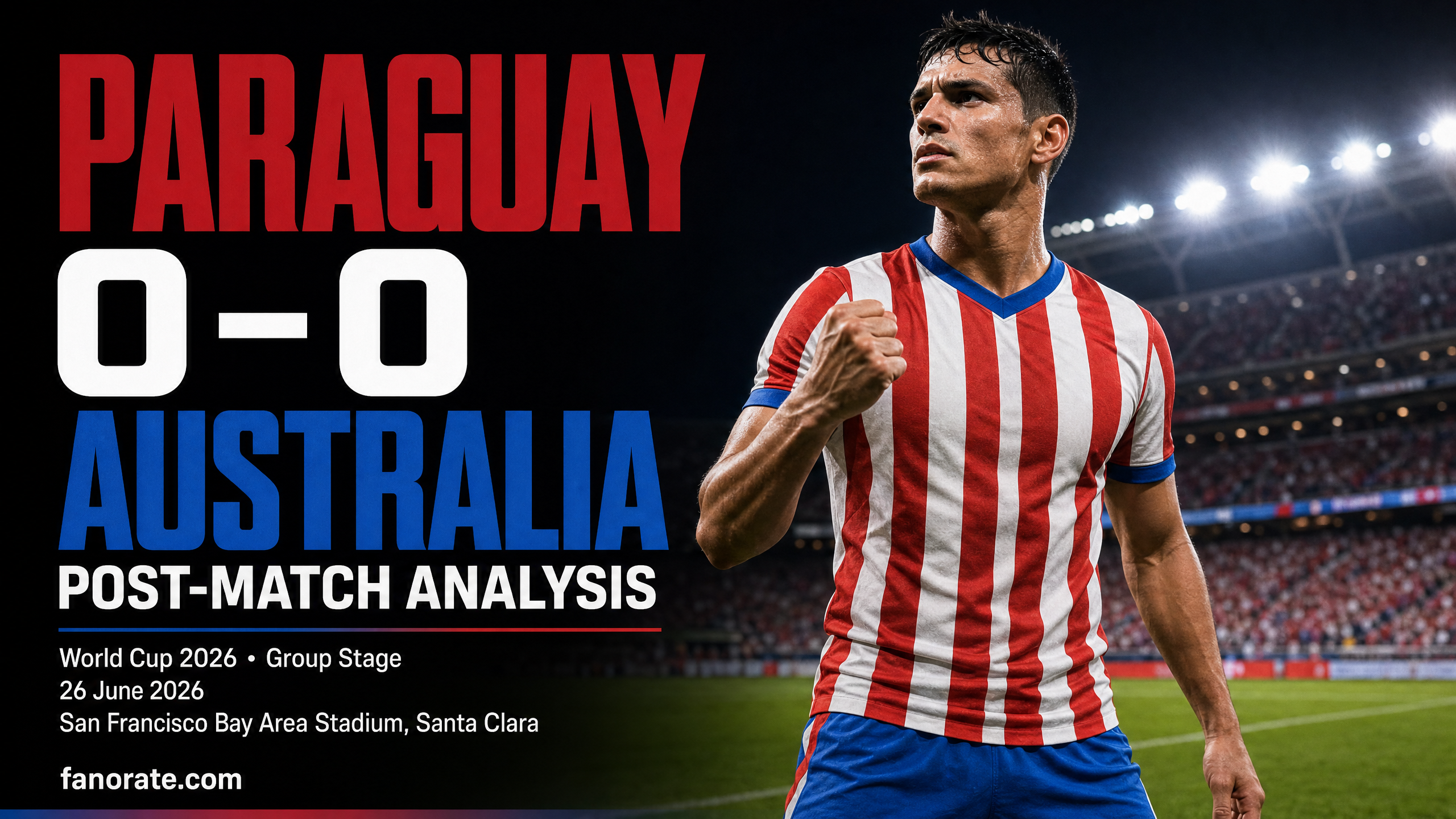
Paraguay 0-0 Australia: Socceroos Hold Firm in Goalless Group Stage Stalemate | FIFA World Cup 2026
A disciplined, hard-fought goalless draw at Santa Clara’s San Francisco Bay Area Stadium saw Australia dominate possession and territory but ultimately fail to break down a resolute Paraguay side. The Socceroos’ 56% possession and 12 shots told only half the story in a match defined by defensive grit and missed final-third quality.
Full Time – Goalless Draw
What happened
Under clear Californian skies at the San Francisco Bay Area Stadium, Australia and Paraguay cancelled each other out in a goalless stalemate that will leave both camps wrestling with frustration and opportunity in equal measure. The Socceroos bossed the ball with 56% possession and registered 12 shots, yet Paraguay’s goalkeeper Roberto Fernández Torres stood firm with five saves in a performance of composed defiance. For Australia, the clinical edge that could turn territorial dominance into goals remained elusive. For Paraguay, a point earned with minimal attacking ambition — just two shots on target — may yet prove valuable depending on how the group unfolds.
How it was won and lost
Australia’s Possession-Based Control Without the Cutting Edge
The Socceroos set up with clear intent to dominate the ball and suffocate Paraguay through structured possession, completing 439 of 536 passes at an 82% success rate. With 116 attacks and 45 dangerous attacks compared to Paraguay’s 95 and 21 respectively, Australia consistently pushed play into threatening areas. However, only 5 of their 12 shots found the target, and 7 were off target entirely — a conversion rate that highlighted a persistent problem in the final third. The 13 total crosses with just 4 accurate further illustrated how Paraguay’s disciplined defensive block frustrated Australia’s wide outlets, with Awer Mabil and the attacking players unable to consistently create clear-cut chances despite the volume of possession.
Paraguay’s Defensive Resolve and Low-Block Structure
Paraguay were content to absorb pressure and defend deep, deploying a compact low-block that limited Australia’s penetration through the central channels. With 25 tackles and 8 interceptions, the Albirroja were aggressive in transition and combative in duels, winning 55 duel contests despite being outpossessed significantly. Their goalkeeper Roberto Fernández Torres was their standout performer, making 5 crucial saves to preserve the clean sheet. Paraguay’s 77% pass accuracy and just 330 successful passes reflected their cautious, containment-first approach — a calculated tactical decision that sacrificed attacking ambition for defensive solidity.
Substitution Patterns and Second-Half Adjustments
Both managers made significant changes as the match wore on. Australia’s Tony Popovic introduced Ajdin Hrustic for Cristian Volpato in the 58th minute, seeking greater technical creativity and direct threat in midfield. The double substitution of Paul Okon-Engstler for Jackson Irvine and Tete Yengi for Nestory Irankunda in the 84th minute signalled a late push for a winner that never materialised. Paraguay were equally active in rotation, making five substitutions in total — including Alex Arce for Gabriel Ávalos at 67′ and José Canale for Omar Alderete at 84′ — suggesting Daniel Garnero was managing fatigue and protecting his defensive structure rather than chasing a goal.
Pressing and Transition Dynamics
Australia’s press was organised but not consistently high in its line, with the Socceroos preferring to compact the midfield and win the ball in central areas rather than press aggressively from the front. With 19 tackles and 7 interceptions, they showed defensive discipline without being overly aggressive, accumulating just 6 fouls. Paraguay’s transition play was limited — their 29% successful dribble rate and only 5 successful dribbles from 17 attempts underlined how rarely they were able to carry the ball forward effectively on the break. Their zero accurate crosses from 7 attempted told the story of a side that created little in open play and relied almost entirely on defensive resilience.
Who decided it
Roberto Júnior Fernández Torres
ParaguayThe Paraguay goalkeeper was unquestionably the man of the match, producing 5 saves to frustrate Australia’s attack throughout. His positioning and composure under sustained pressure were central to Paraguay’s ability to secure the point.
Fernández Torres’s shot-stopping provided the foundation for Paraguay’s entire defensive game plan. Without his contributions, Australia’s 5 shots on target would likely have translated into at least one goal, making him the difference between a draw and a defeat for the Albirroja.
Jackson Irvine
AustraliaThe Australia captain picked up a yellow card in the 47th minute and was eventually substituted in the 84th minute, but Irvine was a consistent presence in midfield — industrious, combative, and central to Australia’s structural shape throughout the match.
Irvine’s work rate and positional discipline helped Australia maintain their 82% pass accuracy in midfield and provided the platform for the Socceroos’ sustained territorial dominance. His yellow card mid-match added a layer of risk management that may have impacted his intensity in the second half.
Ajdin Hrustic
AustraliaIntroduced in the 58th minute for Cristian Volpato, Hrustic arrived with technical quality and direct ambition, looking to unlock Paraguay’s deep defensive block with incisive passing and movement.
Hrustic’s introduction represented Australia’s clearest tactical statement of intent — a move to increase creativity and unpredictability in midfield. While the goal never came, his presence added a different dimension to Australia’s attacking structure in the final quarter of the match.
Diego Gómez Amarilla
ParaguayParaguay’s most technically gifted midfielder, Gómez Amarilla was active in possession and attempted to drive forward on the counter. He received a yellow card in the 77th minute before being substituted in added time.
Gómez Amarilla served as Paraguay’s primary ball-carrier and link between defence and attack, though his limited success in dribbling — reflective of Paraguay’s overall 29% dribble success rate — illustrated how difficult Australia made it for the Albirroja to progress in open play.
Where it sits in history
Australia and Paraguay have met rarely on the world stage, making this World Cup 2026 group stage encounter a historically significant fixture for both nations. The Socceroos last appeared at a FIFA World Cup at the 2022 tournament in Qatar, where they memorably reached the Round of 16 before falling to Argentina. For Paraguay, this marks a return to the biggest stage after years of absence — the Albirroja having not featured at a World Cup since South Africa 2010, where they famously reached the quarter-finals. A 0-0 draw in the group stage carries different weight for each side depending on their broader group context, but the point represents at minimum a foundation upon which both nations must build quickly in the compressed tournament schedule.
Inside the ground
The San Francisco Bay Area Stadium in Santa Clara provided a vibrant backdrop for the encounter, with the 68,500-capacity venue hosting supporters from across the Americas and beyond. Paraguay’s passionate fanbase — known for their carnival-like energy — created noise and colour throughout, while Australia’s travelling Socceroos supporters were well-represented in the Californian sunshine. The clear skies added to the festival atmosphere of FIFA World Cup 2026 on North American soil, with both sets of fans creating an electric environment despite the scoreless nature of the match. Late in the game, Australian supporters grew vocal in urging their side forward, while Paraguayan fans celebrated every clearance and save with the relief and joy of a side defying the odds.
Looking ahead
Both Australia and Paraguay will now assess their group stage standings carefully as the tournament progresses. Australia, despite their statistical dominance in this match, will need to sharpen their attacking efficiency if they are to advance from the group. The Socceroos’ inability to convert 12 shots and sustained possession into a goal will be a primary concern for the coaching staff ahead of their next fixture. Paraguay, meanwhile, will draw confidence from Roberto Fernández Torres’s heroics and their defensive organisation, but Daniel Garnero’s side will know they must contribute more offensively in their remaining group games if they are to progress. With just 7 shots and 2 on target, the Albirroja’s attacking output requires urgent improvement. The group race is very much alive for both nations.
The bottom line
-
Australia dominated possession with 56% and registered 12 shots but were unable to score against a resolute Paraguay defensive block.
-
Paraguay goalkeeper Roberto Fernández Torres was the standout performer, producing 5 crucial saves to preserve the clean sheet.
-
Paraguay’s attacking output was extremely limited — just 2 shots on target and 0 accurate crosses from 7 attempted.
-
Australia’s 82% pass accuracy reflected their technical control, but a lack of clinical quality in the final third proved costly.
-
Both teams made multiple substitutions in the second half, reflecting the tactical urgency as neither side could find a breakthrough.
-
A 0-0 draw means both nations remain alive in their FIFA World Cup 2026 group but must improve in subsequent fixtures.
-
Diego Gómez Amarilla and Jackson Irvine both received yellow cards, adding disciplinary considerations for their next matches.
