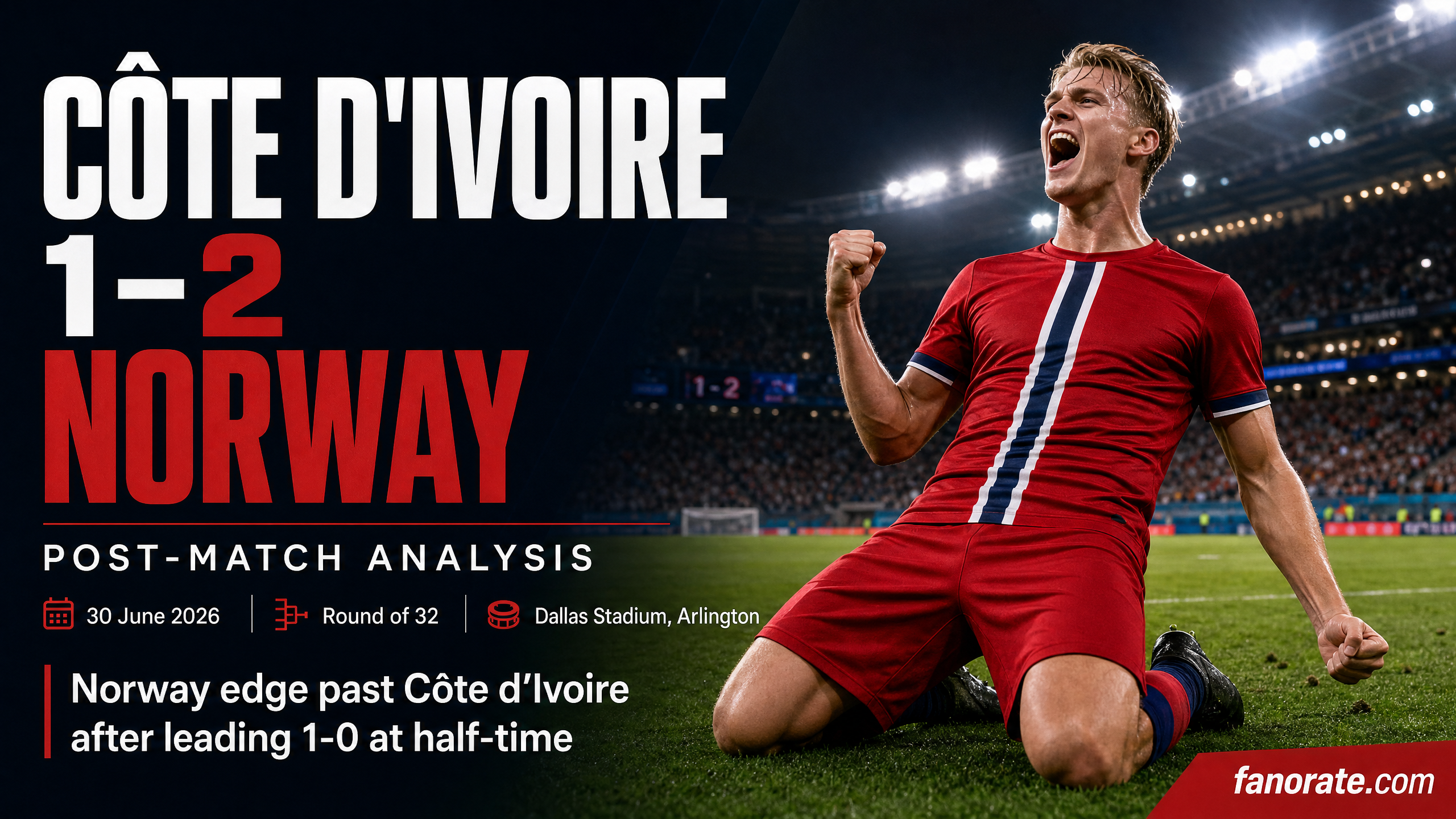
Norway Beat Côte d’Ivoire 2-1 in FIFA World Cup 2026 Round of 32 | Match Report & Tactical Analysis
Erling Håland delivered when it mattered most, converting a late winner to send Norway into the next round of the FIFA World Cup 2026 with a hard-fought 2-1 victory over Côte d’Ivoire at a roaring Dallas Stadium.
Norway advance to the Round of 16
What happened
Under a clear Texas sky at the 80,000-capacity Dallas Stadium, Norway edged past Côte d’Ivoire in one of the most emotionally charged knockout ties of the FIFA World Cup 2026 so far. Antonio Nusa opened the scoring before half-time with a fine finish assisted by captain Martin Ødegaard, only for Amad Diallo Traoré to level with a composed strike midway through the second half. Then, with four minutes left on the clock, Erling Håland — the man the whole football world was watching — rose to the occasion and prodded home a Patrick Berg delivery to send Norway marching into the last 16. It was the kind of World Cup moment the Scandinavian nation has dreamed of for decades.
How it was won and lost
Norway’s Controlled Possession Game Suffocated Ivory Coast Early
With 53% ball possession and an 88% pass accuracy rate on 473 passes, Norway were methodical and deliberate in the opening stages. Ødegaard operated as a deep-lying orchestrator, recycling possession and dictating the tempo from central areas. Sander Berge and Patrick Berg provided the engine-room structure that allowed Ødegaard the freedom to advance, while Håland’s intelligent movement constantly stretched the Ivorian defensive line. Norway generated 116 attacks to Côte d’Ivoire’s 59, reflecting their dominance in territorial control.
Nusa’s Breakthrough — A Reward for Width and Combinations
Norway’s opener on 39 minutes was a product of their structured wide-play. Nusa, operating on the left flank, made a sharp run in behind before finishing with composure, capping an assist from Ødegaard who threaded a precise through ball between Ivorian defenders. Norway’s 10 total crosses and 5 accurate deliveries demonstrated how consistently they attacked wide channels, stretching Côte d’Ivoire’s defensive shape and creating the space that ultimately led to the goal.
Côte d’Ivoire’s Set-Piece Threat Was Relentless But Wasteful
The Elephants generated a remarkable 14 corners across the 90 minutes — an extraordinary number that underlines how desperately they pushed for parity and then a winner. Despite 29 total crosses and 10 shots inside the box, only 5 were on target and Côte d’Ivoire created just 2 big chances against a resolute Norwegian backline. Their 7 accurate crosses from 29 attempts reflect a crossing accuracy of just 24%, suggesting the delivery quality into the box was inconsistent even when the volume was high.
The Tactical Reset: Amad’s Introduction Changes Everything
Ivory Coast coach acted decisively at the hour mark, withdrawing Ange-Yoan Bonny and introducing Amad Diallo Traoré. The impact was immediate. Amad’s directness, pace, and willingness to drive at defenders gave Côte d’Ivoire a new dimension on the right. His 35% successful dribble rate from the team’s 20 attempts reflected an overall Ivorian willingness to take opponents on — and it paid dividends when Amad curled a composed finish past Nyland on 74 minutes from a Nicolas Pépé assist to level the tie.
Håland’s Late Strike — Clinical When It Had to Be
Norway entered the final ten minutes under sustained Ivorian pressure, with the Elephants pouring bodies forward chasing a winner. But in knockout football, transitions are lethal. On 86 minutes, Patrick Berg picked out Håland in a central position and the world’s most feared striker needed no second invitation. He converted with characteristic efficiency. It was Norway’s 4th shot on target against just 1 save made by Ivorian goalkeeper Yahia Fofana, illustrating how Norway turned minimal moments into decisive outcomes.
Norway’s Defensive Discipline Held Under Enormous Pressure
With Côte d’Ivoire launching 13 total shots and winning 14 corners, Norway’s backline — anchored by Kristoffer Ajer and Leo Oestigaard — was tested repeatedly in the final stages. Goalkeeper Ørjan Nyland made 4 saves and Norway’s outfield players contributed 19 tackles and 6 interceptions. The collective defensive structure absorbed wave after wave of Ivorian pressure, especially in the closing stages when the game was stretched and space opened up behind the Ivory Coast press.
Who decided it
Erling Håland
NorwayHåland was the decisive figure in the most important moments of the match. While not constantly involved in build-up play, his movement, physicality and predatory instincts caused Côte d’Ivoire’s defenders constant discomfort throughout. His 86th-minute winner was composure personified — the hallmark of a player who lives for these stakes.
Håland’s late run exploited the space left by Côte d’Ivoire pushing men forward. His ability to hold the defensive line deep and then accelerate into finishing positions ensured Norway always maintained a counter-attacking threat, even when under sustained set-piece pressure.
Martin Ødegaard
NorwayThe Norway captain was the metronome of his side’s performance. His assist for Nusa’s opener showed his quality in the final third — a precise, penetrating through ball that split the Ivorian defence. He pressed intelligently, maintained composure under pressure, and provided the tactical intelligence that held Norway’s shape together in the difficult moments after conceding.
Ødegaard’s ability to operate between the lines gave Norway an extra passing option in central zones, ensuring their 88% pass success rate was built on genuine quality rather than safe recycling. His work-rate off the ball was equally important in controlling mid-field transitions.
Antonio Eromonsele Nordby Nusa
NorwayThe young Norwegian winger was electric in the first half, scoring the opening goal and repeatedly testing the Ivorian full-back down the left channel. He was replaced at 71 minutes having done his job effectively, and his yellow card just after the break suggested the level of intensity he brought to his battles with opposition defenders.
Nusa’s ability to beat his man and combine with Ødegaard in tight spaces gave Norway unpredictable vertical options in the attacking half. His movement created the width that stretched Côte d’Ivoire’s defensive block and opened the central channels for Berg and Berge.
Amad Diallo Traoré
Côte d'IvoireIntroduced at the hour mark when Côte d’Ivoire needed a spark, Amad Diallo Traoré delivered immediately. His energy and directness transformed the Ivorian attack and his composed finish on 74 minutes, turning onto a Pépé pass and finishing low past Nyland, gave the Elephants a lifeline in what was a spectacular equaliser.
Amad’s introduction shifted Côte d’Ivoire’s attack from a labour-intensive crossing strategy to a more direct, dribble-based threat. His 35% team dribble success rate — compared to Norway’s 15% — reflected how the Ivorians found more traction in individual duels when Amad was operating with freedom.
Patrick Berg
NorwayThe understated but vital midfield presence for Norway, Berg put in a tireless shift covering ground both defensively and offensively. His assist for Håland’s winner — a carefully delivered pass in behind a stretched Ivorian defence — was the most important contribution of his evening and sealed Norway’s passage.
Berg’s positioning alongside Berge gave Norway midfield stability to absorb the pressure of Côte d’Ivoire’s high-volume attack. His forward runs in the final third created an additional runner that the Ivorians couldn’t track, ultimately leading to the decisive goal.
Where it sits in history
Norway’s progression to the FIFA World Cup 2026 Round of 16 is a landmark moment for Scandinavian football. The Norwegians have historically struggled to translate their domestic and club-level talents into deep tournament runs at major international tournaments. With Erling Håland — widely considered among the greatest forwards of his generation — now delivering on the World Cup stage, this campaign carries the weight of a nation’s footballing ambitions. For Côte d’Ivoire, the elimination represents another painful exit at the knockout stage for a golden generation of talent. The Elephants boast remarkable individual quality across their squad but have repeatedly found it difficult to convert that talent into deep World Cup runs. Their performance against Norway was full of spirit and creativity, but ultimately the clinical edge that Håland and Ødegaard provide proved to be the difference.
Inside the ground
Dallas Stadium was a cauldron of noise as two passionately supported nations clashed under the brilliant Texas sunshine. The Norwegian contingent — dressed in red and white — created an electric northern European atmosphere inside an 80,000-seat arena, their voices rising to a crescendo when Nusa broke the deadlock before half-time. The Ivorian supporters, a sea of orange, green, and white, responded magnificently when Amad equalised, creating an atmosphere that temporarily shook Norway’s composure. The final whistle, greeted with erupting Norwegian joy and Ivorian heartbreak, was a reminder of exactly what makes the FIFA World Cup the greatest sporting event on earth.
Looking ahead
Norway now advance to the FIFA World Cup 2026 Round of 16, where Ødegaard, Håland, and their teammates will face another elimination test with the pressure of an entire nation behind them. The question will be whether Norway can sustain the same controlled, efficient football that dismantled Côte d’Ivoire, and whether Håland continues his knockout-stage form. For Côte d’Ivoire, attention turns to the future — a young squad featuring players like Amad Diallo Traoré, Simon Adingra, and Yan Diomande offers genuine hope that the Elephants will return to this stage stronger.
The bottom line
-
Norway defeated Côte d’Ivoire 2-1 in the FIFA World Cup 2026 Round of 32 at Dallas Stadium, Arlington
-
Antonio Nusa opened the scoring on 39 minutes with a Martin Ødegaard assist
-
Amad Diallo Traoré equalised for Côte d’Ivoire on 74 minutes following a brilliant substitution impact
-
Erling Håland delivered a crucial 86th-minute winner assisted by Patrick Berg
-
Norway dominated possession with 53% and completed 88% of their 473 passes
-
Côte d’Ivoire created 14 corners and pressed relentlessly but lacked the clinical edge
-
Norway advance to the Round of 16 while Côte d’Ivoire exit the 2026 World Cup
