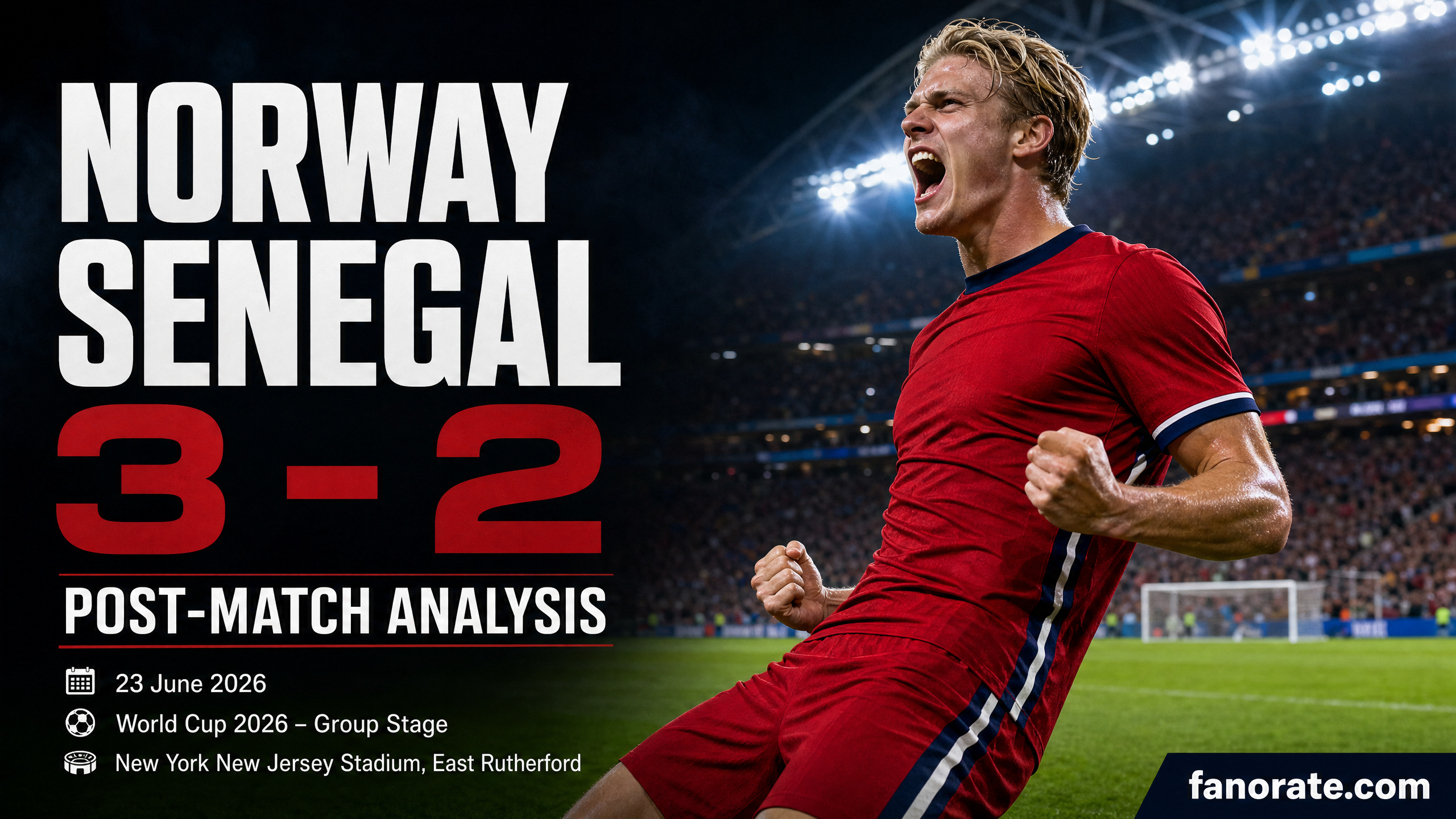
Norway 3-2 Senegal: Håland Fires Vikings Into World Cup 2026 Last 16 With Thrilling Group Stage Win
Erling Håland delivered when it mattered most, scoring twice in a pulsating second-half display as Norway defeated Senegal 3-2 in a breathless FIFA World Cup 2026 Group Stage encounter at New York New Jersey Stadium. Marcus Holmgren Pedersen opened the scoring in a tight first half, before Håland and Senegal’s Ismaïla Sarr traded blows in a frantic second period that kept 82,500 fans on the edge of their seats until the final whistle.
What happened
On a cloud-heavy June night in East Rutherford, Norway delivered a World Cup performance of genuine quality and nerve. In front of a packed New York New Jersey Stadium, Erling Håland reminded the footballing world exactly why he is the most feared striker on the planet, scoring twice in a dominant second-half surge that ultimately proved enough to see off a spirited Senegal side who pushed every inch of the way. Marcus Holmgren Pedersen set the tone with a composed first-half goal, before the match truly exploded after the break. Håland’s brace, sandwiching a stunning Ismaïla Sarr reply, gave Norway breathing room — but Sarr struck again deep into stoppage time to make it a nervy finish. Norway held firm. Three points secured. The Vikings march on.
How it was won and lost
Norway’s Pragmatic First Half Sets the Platform
Norway set up in a disciplined mid-block in the opening 45 minutes, prioritising defensive shape and pressing Senegal’s build-up at the right moments. With Sander Berge and Patrick Berg — who entered early via substitution for Fredrik Aursnes — anchoring the midfield double pivot, Norway restricted Senegal’s passing lanes into Sadio Mané and Nicolas Jackson. The single first-half goal from Marcus Holmgren Pedersen at 43 minutes arrived from a right-sided delivery, a moment of precision that rewarded Norway’s patient, low-risk approach. Senegal, with 60% possession at half-time and 487 passes completed across the match compared to Norway’s 352, dominated the ball but struggled to penetrate a well-organised Norse defensive block. Martin Ødegaard’s role between the lines was vital — controlling tempo and transitioning quickly when possession was won.
Håland Unleashed: Norway’s Second-Half Blitz
The second half was a different match entirely. Norway emerged with greater directness and verticality, and within three minutes of the restart, Erling Håland had struck — assisted by the influential Martin Ødegaard. The goal was a signal of intent. Norway’s transition game became their primary weapon: winning the ball back quickly and releasing Håland in behind Senegal’s high defensive line with minimum touches. Håland’s second arrived at 58 minutes, this time set up by Patrick Berg, showcasing Norway’s ability to combine through the middle and punish any momentary disorganisation in Senegal’s defensive shape. Norway’s 10 successful dribbles and 13 big chances created (type_53) underline the clinical edge they found in the second period.
Senegal’s Double Substitution Gambit and Sarr’s Response
Senegal head coach responded to going two goals down by making two simultaneous substitutions at the 54-minute mark — Ismail Jakobs replacing El Hadji Malick Diouf and Ibrahim Mbaye coming on for Pape Gueye — in an attempt to inject wider energy and aerial presence. The move partially worked. Ismaïla Sarr, already dangerous throughout, pulled one back at 53 minutes from a Sadio Mané assist before Norway’s second Håland goal. Senegal’s shift to a more expansive, risk-taking shape opened the game up but also left them vulnerable on the counter. Sarr’s late header in the 90+3rd minute from a Nicolas Jackson assist — bringing the score to 3-2 — showed Senegal’s never-say-die attitude but ultimately came too late to change the outcome.
Set-Piece Threat and Defensive Resilience
Norway’s defensive structure held despite significant pressure. Senegal registered 16 shots and 22 total attempts, with xG data (type_5304) showing Senegal’s 2.19 xG slightly outperforming Norway’s 1.84 — meaning Norway’s goalkeeper Ørjan Håskjold Nyland was tested and delivered. Norway’s backline, marshalled by Kristoffer Vassbakk Ajer and Leo Skiri Oestigaard — who came on late in the match — dealt effectively with Senegal’s aerial threat from set-pieces. Senegal won more corners (6 vs Norway’s 11) but Norway’s threat from dead-ball situations — winning 11 corners — highlighted their own set-piece menace, particularly given Håland’s physical presence in the box.
Who decided it
Erling Håland
NorwayTwo goals. Two moments of world-class finishing. Håland’s 48th and 58th-minute strikes were the defining acts of this match — clinical, composed, and ruthless. He was assisted by Ødegaard and Berg respectively, demonstrating his ability to finish from layoffs inside and outside the box. His movement off the ball dragged Senegal’s central defenders out of position repeatedly.
Håland’s directness forced Senegal’s backline into deeper positioning after half-time, effectively stretching their defensive shape and creating space for Ødegaard and Berg to operate in. His presence alone changed Senegal’s defensive priorities and opened lanes for Norway’s wide players to exploit.
Martin Ødegaard
NorwayThe Norway captain was the creative engine throughout. His assist for Håland’s first goal was a moment of perfect timing and vision, threading a pass through Senegal’s midfield press. Ødegaard’s press resistance and ability to find pockets of space between Senegal’s lines was a constant problem for the African champions.
Operating as the advanced playmaker in Norway’s shape, Ødegaard linked midfield and attack with incisive one-twos and diagonal switches of play. His positioning regularly drew Senegal’s midfield out of shape, creating the vertical channels that Håland exploited.
Ismaïla Sarr
SenegalSarr was Senegal’s most dangerous attacking threat throughout, scoring twice — at 53 minutes and deep into stoppage time at 90+3 — to give Senegal hope and cause Norway genuine late anxiety. His pace and directness on the right flank repeatedly troubled Norway’s left side, and his clinical finishing, both with a Mané-assisted effort and a Jackson-teed-up header, underlined his quality.
Sarr’s movement pulled Norway’s defensive shape wide and created space centrally for Mané and Jackson. His two goals both came from intelligent runs into dangerous areas, exposing the gaps left by Norway’s attacking full-backs when out of possession.
Marcus Holmgren Pedersen
NorwayA standout performer in an unlikely role, Holmgren Pedersen contributed not only the crucial first goal at 43 minutes but played a key part in Norway’s right-flank dynamics. His goal — a right-footed finish — rewarded a first-half of disciplined, energetic work down the right channel.
His ability to overlap and offer width on the right allowed Ødegaard to tuck inside and find space between the lines. The combination play between Holmgren Pedersen and the attacking midfielders was a recurring pattern that Senegal struggled to consistently contain.
Ørjan Håskjold Nyland
NorwayFacing a Senegal side that generated an xG of 2.19, Nyland was required to make key saves throughout, particularly as Senegal poured forward in the final twenty minutes. His composure under aerial pressure and command of his area were central to Norway seeing out the result.
Nyland’s distribution and shot-stopping allowed Norway to defend deep and absorb Senegal’s late pressure without panic, maintaining the team’s structural discipline when the Lions of Teranga turned up the intensity.
Where it sits in history
Norway’s victory marks a significant moment in their World Cup journey. The Scandinavian nation has historically been a sporadic World Cup presence — with their most celebrated tournament run coming at France 1998 where they reached the Round of 16. A 3-2 win over an African heavyweight like Senegal in the group stage signals that this Norwegian generation, built around the generational talent of Erling Håland, has genuine ambitions beyond merely participating. Senegal, meanwhile, are African champions and World Cup quarter-finalists from Qatar 2022, making this a result that will sting. Their campaign is not over, but dropping points to Norway will complicate their path through what is expected to be a competitive group. For Norway, it echoes the spirit of their famous 2-1 defeat of Brazil at France 1998 — proof that when the big players deliver on the big stage, this nation can upset any opposition.
Inside the ground
New York New Jersey Stadium — one of the crown jewels of FIFA World Cup 2026’s host infrastructure — delivered an electric atmosphere befitting the occasion. With a capacity of 82,500, the stadium was a cauldron of colour and noise, with Senegal’s iconic fanbase — their ‘Lions’ support renowned across global football for their drumbeats, yellow-and-green colour blocks, and extraordinary vocal energy — matching Norway’s travelling contingent in every decibel. The New York-New Jersey metro area’s substantial West African diaspora ensured Senegal had a near-home crowd feel in the stands, creating one of the most visually striking atmospheres of the early tournament. Each Ismaïla Sarr goal sparked an eruption that shook the upper tiers. When the final whistle came, the Norwegian end was a sea of red and blue, with Håland’s name echoing long into the East Rutherford night.
Looking ahead
Norway will take enormous confidence from this result as they progress in FIFA World Cup 2026 Group Stage competition. With three points on the board and their talisman Erling Håland already among the tournament’s top scorers, Ståle Solbakken’s side will approach their remaining group fixtures with belief and momentum. Senegal cannot afford another slip — Sadio Mané and company will need to regroup quickly and find greater defensive solidity while maintaining their formidable attacking threat. Their next match is now a must-not-lose scenario if they are to realistically challenge for a place in the Round of 16. The Lions will be dangerous — wounded and motivated. For neutral fans, both fixtures involving these sides next are must-watch events at the 2026 World Cup.
The bottom line
-
Erling Håland scored twice in the second half to fire Norway to a crucial 3-2 Group Stage victory over Senegal at the FIFA World Cup 2026.
-
Marcus Holmgren Pedersen’s 43rd-minute opener gave Norway a first-half lead they defended superbly until the break.
-
Ismaïla Sarr scored twice for Senegal — at 53 minutes and 90+3 — but could not prevent the Lions of Teranga from suffering defeat.
-
Norway’s tactical discipline in the first half and clinical counter-attacking in the second were the defining features of their performance.
-
Martin Ødegaard’s creativity and press resistance were central to Norway’s ability to exploit Senegal’s defensive structure.
-
Senegal dominated possession with 487 completed passes to Norway’s 352 but were undone by Norway’s clinical finishing and structured press.
-
Senegal’s xG of 2.19 exceeded Norway’s 1.84, underlining that Nyland’s goalkeeping and defensive organisation were critical to the result.
-
Norway’s victory echoes their historic capacity to punch above their weight at World Cups, particularly when Håland is in lethal form.
-
The match was played in front of a sold-out 82,500-capacity New York New Jersey Stadium with a spectacular dual-nation atmosphere.
-
Both nations now head into their next Group Stage fixtures with very different levels of pressure — Norway in control, Senegal in pursuit.
