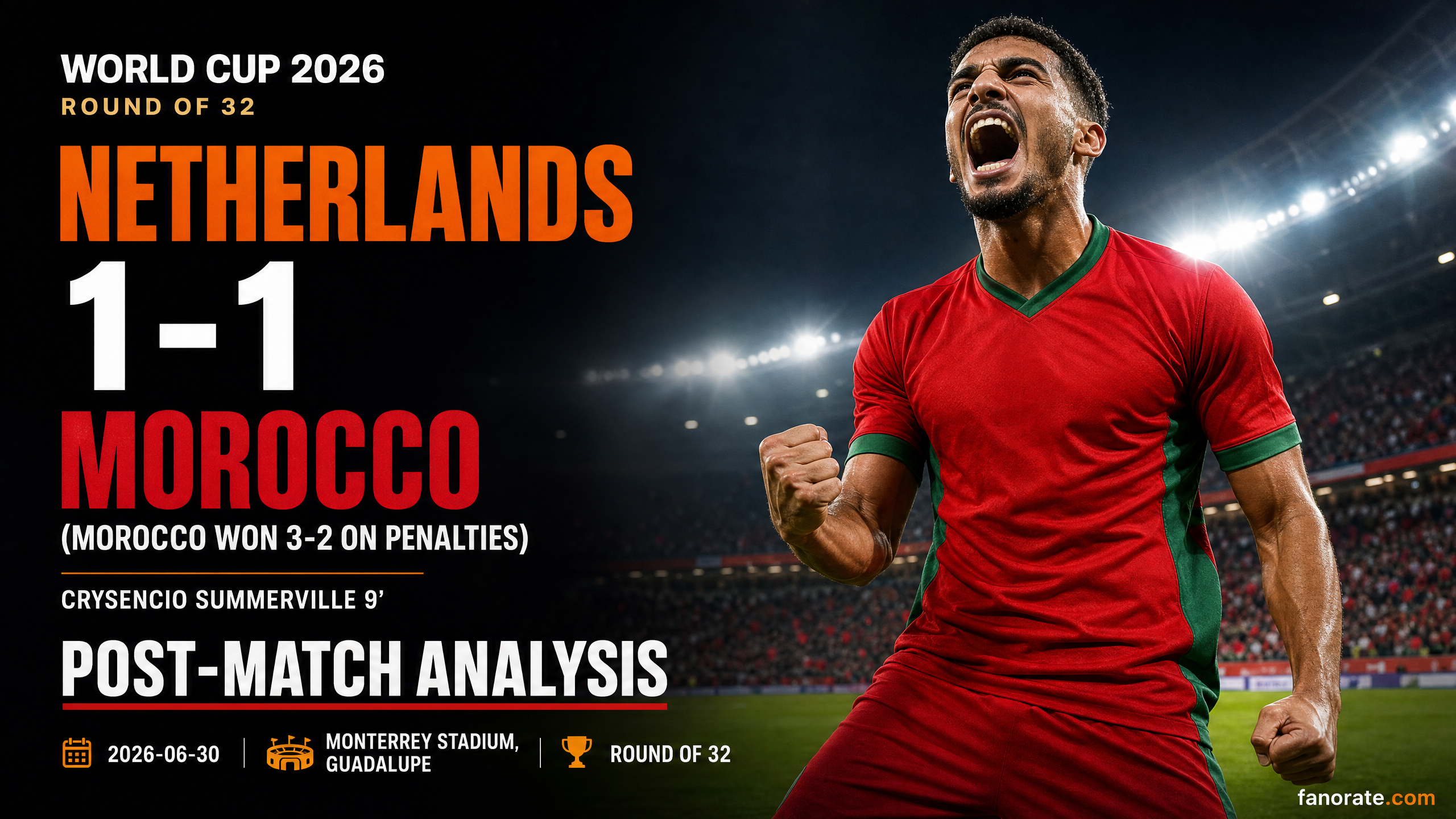
Netherlands vs Morocco: Atlas Lions Knock Out Oranje on Penalties in World Cup 2026 Thriller
A dramatic late equalizer from Issa Diop cancelled out Cody Gakpo’s second-half opener as Morocco edged Netherlands 3-2 on penalties in a pulsating World Cup 2026 Round of 32 clash at Monterrey Stadium.
Morocco win 3-2 on penalties
What happened
Under overcast skies in Guadalupe, Morocco delivered one of the standout performances of the FIFA World Cup 2026 group knockout phase, dominating possession with an extraordinary 70% share yet finding themselves trailing before a stunning Issa Diop header deep into stoppage time forced extra time. When neither side could be separated across 120 minutes, the Atlas Lions held their nerve in the penalty shootout, winning 3-2 to send a stunned Netherlands squad crashing out. It was a result that will reverberate around the tournament — the Oranje, despite riding the momentum of Cody Gakpo’s 72nd-minute opener, were ultimately undone by Morocco’s relentless pressure, clinical set-piece delivery, and icy composure from the spot.
How it was won and lost
Morocco’s Possession Dominance Suffocates Dutch Build-Up
The statistics tell a story that is almost impossible to believe for a World Cup knockout match — Morocco controlled 70% of possession, completing an astonishing 800 of 878 passes at a 91% accuracy rate, compared to Netherlands’ 373 passes at just 79%. Morocco’s midfield trio pressed high and recycled possession with composure, forcing the Oranje into a low-block defensive shape for long stretches. Netherlands’ 30% possession share underlines just how rarely Ronald Koeman’s side were able to assert themselves in open play, managing just six shots in total across 120 minutes compared to Morocco’s eleven.
Netherlands’ Counter-Attacking Threat and Gakpo’s Clinical Finish
Despite being pinned back, Netherlands were dangerous on the counter. The double substitution in the 71st minute — Koopmeiners replacing Aké and Weghorst replacing Brobbey — immediately changed Dutch dynamics. Within 60 seconds of those changes taking effect, Crysencio Summerville delivered a precise assist for Cody Gakpo to fire the Oranje ahead at the 72-minute mark. The goal highlighted Netherlands’ low-volume but high-impact attacking model: only one big chance created across the entire match, yet it was taken ruthlessly. Their 19 successful aerial duels also demonstrated a willingness to absorb pressure and transition quickly through long passes.
Morocco’s Set-Piece Delivery Proves the Great Equaliser
Morocco created five big chances throughout the match and had eight corners, and it was from a late set-piece situation that they found their equaliser. In the 91st minute, substitute Chemsdine Talbi — who had been on the pitch for barely four minutes — delivered the ball for Issa Diop to head Morocco level, turning the entire narrative of the match on its head. The goal was a testament to Morocco’s physicality in the air, where they recorded 11 successful headers, and their ability to manufacture dangerous situations from dead-ball situations. Morocco hitting the woodwork once during normal time further illustrated how close they came to winning it before extra time.
Extra Time Stalemate and the Battle of the Penalty Spot
Both sides were cautious and fatigued across 30 minutes of extra time, with neither able to conjure a decisive moment. Netherlands made further changes, introducing Marten de Roon for Frenkie de Jong in the 110th minute and Justin Kluivert for Gakpo in the 113th, but neither altered the balance significantly. In the shootout itself, the Dutch were undone by misses from Justin Kluivert, Quinten Timber, and Crysencio Summerville. Morocco’s eliminations came from Neil El Aynaoui and a pressure-laden miss from Achraf Hakimi, but Koopmeiners, Weghorst, Rahimi, and Talbi all converted with composure. Netherlands’ costly penalty misses from three players proved fatal.
Morocco’s Defensive Organisation Under Pressure
Despite their attacking dominance, Morocco were tested on the break by Netherlands’ pace and directness. They recorded 19 tackles, 10 interceptions, and 51 duels won as they matched the physical intensity of a powerful Oranje side. Issa Diop’s yellow card in the 47th minute added an element of jeopardy to Morocco’s defensive effort, but the Atlas Lions managed discipline well for the remainder of normal time. Bounou made just one save — a reflection not of negligence but of how effectively Morocco’s defensive shape limited clear Dutch openings.
Who decided it
Cody Mathès Gakpo
NetherlandsGakpo was Netherlands’ most incisive attacking threat throughout the match, and his composed 72nd-minute finish from Summerville’s assist gave the Oranje what looked like a match-winning lead. He was sacrificed for Kluivert in extra time at the 113th minute, but his goal was the defining moment in open play.
Gakpo’s movement between the lines on the counter-attack repeatedly stretched Morocco’s defensive structure, and his goal underlined the clinical edge Netherlands carry even with minimal possession. His ability to time runs and finish cleanly under pressure was central to the Dutch game plan.
Issa Diop
MoroccoThe defender had an eventful evening — picking up a yellow card in the 47th minute before becoming an unlikely hero with a stoppage-time headed equaliser in the 91st minute. His goal from Chemsdine Talbi’s delivery completely changed the course of the match and set Morocco on the path to a penalty shootout victory.
Diop’s aerial presence proved decisive at both ends of the pitch. His willingness to push forward for set-pieces despite carrying a booking reflected Morocco’s boldness and belief, and his header from close range was the culmination of sustained Moroccan set-piece pressure throughout the match.
Crysencio Summerville
NetherlandsSummerville was one of the Netherlands’ liveliest performers in open play, registering the assist for Gakpo’s goal with a well-timed delivery in the 72nd minute. His direct running caused problems for Morocco’s defensive line on the transition, though his missed penalty in the shootout was a cruel end to an otherwise impressive personal performance.
Operating with width and pace on the Dutch left, Summerville helped Netherlands maintain a vertical threat despite their limited possession. His cross for the goal was the product of sustained individual pressure in transition, precisely the type of play Netherlands relied on throughout a match they spent largely out of possession.
Chemsdine Talbi
MoroccoIntroduced as a substitute in the 87th minute, Talbi’s impact was immediate and match-defining. He delivered the set-piece delivery for Issa Diop’s 91st-minute equaliser within minutes of stepping onto the pitch, and then stepped up with composure to convert his penalty in the shootout.
Talbi’s contribution epitomises the depth and squad quality Morocco brought to this tournament. His set-piece delivery from a dead-ball situation was precise and dangerous, and his calmness in the penalty shootout — as one of Morocco’s confirmed scorers — highlighted the mental fortitude running through the Atlas Lions squad.
Teun Koopmeiners
NetherlandsKoopmeiners came on as a substitute in the 71st minute and was the first Dutch player to score in the penalty shootout, converting his spot-kick with authority. His introduction added technical quality to Netherlands’ midfield in the final stages, though he could not prevent the overall Dutch exit.
Koopmeiners’ composed penalty conversion gave Netherlands early hope in the shootout, and his introduction in the second half helped stabilise the Dutch midfield during the period when they were holding onto their lead. His set-piece quality and technical composure added a different dimension to the Oranje’s play in the closing stages.
Where it sits in history
This result carries significant historical weight. Morocco’s progression mirrors and extends the legacy built at the 2022 FIFA World Cup in Qatar, where the Atlas Lions became the first African nation to reach the semi-finals. Their defeat of Netherlands in the 2026 Round of 32 continues their status as African football’s most formidable World Cup force, eliminating a traditional European power for the second major tournament running. For Netherlands, the early exit represents a painful chapter in the post-Louis van Gaal era — a side brimming with talent from Gakpo to Frenkie de Jong, yet unable to replicate the deep tournament runs that defined Dutch football at its peak. The Oranje have now exited back-to-back major tournaments before the quarter-final stage, a sobering reflection for a nation that reached the 2022 World Cup semi-finals and the 2024 Euros semi-finals.
Inside the ground
Guadalupe’s Monterrey Stadium, with a capacity of 53,500, provided a vibrant backdrop to one of the tournament’s most dramatic knockout encounters. Morocco’s support — passionate, vocal, and unwavering — created an atmosphere that seemed to grow louder with every Moroccan possession sequence. The stadium was alive with North African chants and flag displays, and when Issa Diop headed in the equaliser deep in stoppage time, the noise was seismic. Netherlands’ orange contingent, though outnumbered in voice, remained steadfast through extra time but fell silent one by one as the penalties unfolded. It was the kind of night that encapsulates why the World Cup remains the greatest sporting event on the planet — a penalty shootout under floodlights, two sets of supporters daring to dream, and an outcome that will be replayed for years to come.
Looking ahead
Morocco advance to the Round of 16 at FIFA World Cup 2026, where their combination of possession football, defensive solidity, set-piece menace and penalty shootout nerve will make them one of the most feared sides remaining in the draw. With Hakimi, Bounou, Amrabat, Diaz, and a deep, versatile squad at their disposal, the Atlas Lions have the tools to go deep into the tournament once again. Netherlands, meanwhile, face an uncomfortable post-tournament review. Ronald Koeman’s side showed their counter-attacking bite through Gakpo’s goal, but their inability to build sustained pressure with only 30% possession and their collapse in the penalty shootout raises serious questions about squad depth and mentality in the biggest moments.
The bottom line
-
Morocco dominated possession with 70% and 878 passes, completing 91% of their passes across the match
-
Cody Gakpo’s 72nd-minute goal gave Netherlands a lead that appeared match-winning until the 91st minute
-
Issa Diop’s stoppage-time header from Chemsdine Talbi’s delivery forced extra time and changed the entire match narrative
-
Morocco won the penalty shootout 3-2 with Dutch misses from Kluivert, Timber, and Summerville proving fatal
-
Netherlands were eliminated with just six total shots across 120 minutes, reflecting their minimal possession share
-
Morocco’s progression continues their status as African football’s most powerful World Cup force
-
Talbi and Rahimi were composed under shootout pressure as key Morocco substitutes made decisive impacts
-
Netherlands exit the 2026 World Cup at the Round of 32, raising questions about Koeman’s tactical approach
