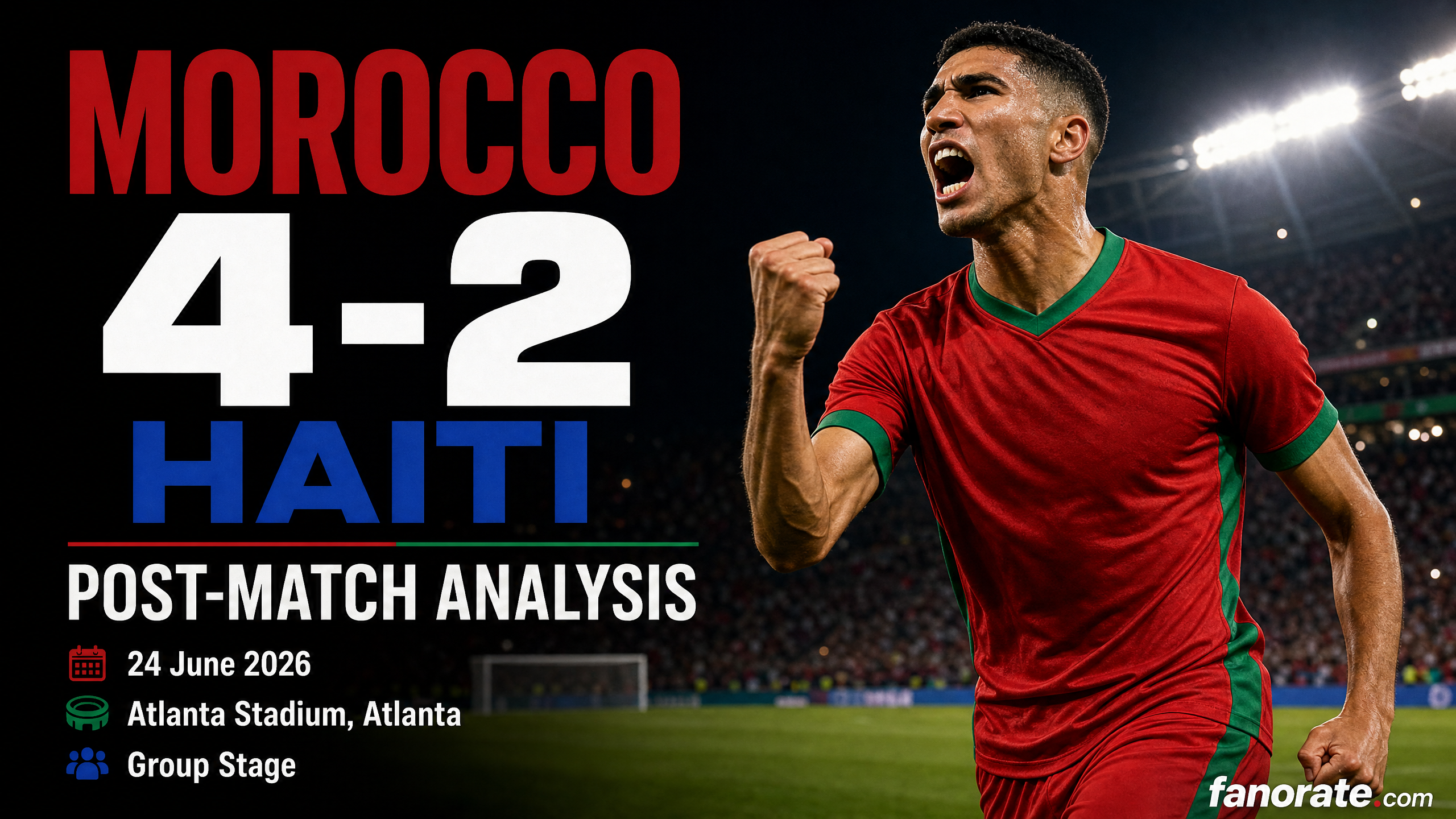
Morocco 4-2 Haiti: Atlas Lions Roar Back From Deficit in Atlanta Thriller | FIFA World Cup 2026
Morocco produced a stunning second-half comeback to defeat Haiti 4-2 at Atlanta Stadium, turning a two-goal deficit into a commanding Group Stage victory at the FIFA World Cup 2026.
Morocco comeback from 0-2 down to win 4-2
What happened
In one of the most dramatic Group Stage turnarounds of the FIFA World Cup 2026, Morocco overcame a shocking early deficit to dismantle Haiti 4-2 at a sold-out Atlanta Stadium. What began as a nightmare for the Atlas Lions — an own goal from Yassine Bounou gifting Haiti the lead inside ten minutes — transformed into a showcase of Morocco’s attacking depth and tactical resilience. Four unanswered goals, two from substitutes, and a masterclass in second-half dominance delivered one of the tournament’s most compelling narratives so far.
How it was won and lost
Early Chaos and Bounou’s Own Goal Disrupts Morocco’s Shape
Morocco’s carefully constructed defensive structure was undone in the 10th minute when goalkeeper Yassine Bounou turned the ball into his own net, handing Haiti an unexpected foothold in the contest. The early setback forced Morocco to push the tempo higher than initially planned, stretching their defensive line and creating pockets of space that Haiti — despite just 31% possession — exploited on the counter. Haiti’s compact 4-4-2 block absorbed Morocco’s early pressure well, relying on 25 tackles and 14 interceptions to frustrate the Atlas Lions in the first half.
Haiti’s Clinical Breakaway Doubles the Lead Before Half-Time
Haiti’s second goal on 43 minutes, scored by Wilson Isidor with an assist from Jean-Kevin Duverne, was the product of disciplined counter-attacking structure. With just 248 passes completed across the entire match, Haiti showed no interest in possession battles — their game plan was ruthlessly functional: sit deep, defend with numbers, and strike on the break. It was an approach that worked brilliantly for 43 minutes, putting the Atlas Lions in territory they rarely occupy at this level.
Achraf Hakimi Sparks the Fightback
Hakimi’s involvement in the 39th-minute goal — though a VAR review followed — proved a crucial psychological spark for Morocco. The Paris Saint-Germain full-back’s marauding runs down the right flank are a fundamental component of Morocco’s attacking blueprint, and his assist for Ismael Saibari’s 45+1 goal ensured the Atlas Lions went into the break level at 2-2 rather than facing an impossible mountain to climb. Hakimi’s combination of overlapping runs and precise final-ball delivery stretched Haiti’s defensive shape in ways that created the overloads Morocco needed.
Tactical Substitutions Unlock Morocco’s Second-Half Dominance
Head coach Walid Regragui’s triple substitution on 70 minutes — introducing Azzedine Ounahi, Soufiane Rahimi, and Gessime Yassine — proved transformative. Morocco’s possession had already been dominant at 69%, completing 478 of 542 passes at an 88% success rate, but it was the added directness and movement of the fresh legs that finally broke Haiti open. The second half saw Morocco outscore Haiti 2-0 in the second half only, with Rahimi netting on 78 minutes and Yassine adding the killer fourth on 89 minutes to seal the comeback in style.
Morocco’s Pressing and Width Overwhelm a Tiring Haiti Side
As the match progressed, Morocco’s 109 attacks and 61 dangerous attacks told the story of a team that simply refused to relent. Their 22 total crosses and 9 corners illustrate how wide areas became the primary route to goal, with full-backs and wide midfielders continuously overloading Haiti’s defensive banks. The Atlas Lions’ 57% successful dribble rate and 15 key passes in the match underline how technically superior they were in the final third. Haiti’s discipline visibly deteriorated as fatigue set in, collecting three yellow cards in the final 11 minutes of the contest.
Who decided it
Achraf Hakimi Mouh
MoroccoHakimi was the catalyst for Morocco’s comeback, directly contributing to the goal that made it 1-2 before providing the assist for Saibari’s equaliser in first-half stoppage time. His relentless runs from right-back position and precise crossing created consistent danger against Haiti’s left side.
Hakimi’s ability to act as both a defensive anchor and an attacking outlet gave Morocco a permanent numerical advantage on the right channel. His assist for the equaliser changed the psychological complexion of the match entirely, sending Morocco into the break level rather than trailing.
Soufiane Rahimi
MoroccoIntroduced as a substitute on 70 minutes, Rahimi wasted little time making his mark, scoring Morocco’s third goal on 78 minutes and providing the assist for Gessime Yassine’s decisive fourth on 89 minutes. His impact off the bench was decisive and clinical.
Rahimi’s direct running and finishing sharpness immediately changed Morocco’s attacking dynamic after the introduction. His arrival stretched Haiti’s tiring defensive unit in central areas, creating the space that Yassine would ultimately exploit for the game-sealing fourth.
Gessime Yassine
MoroccoAnother substitute impact, Yassine scored Morocco’s fourth and final goal on 89 minutes assisted by Rahimi, putting the result beyond any doubt. His goal survived a VAR review in the 90+1 minute, confirming the victory.
Yassine’s movement in behind gave Morocco a different attacking dimension in the final stages, offering a direct goal threat that complemented the creative play of Rahimi and Hakimi’s overlapping presence.
Ismael Saibari Ben El Basra
MoroccoSaibari scored the crucial equaliser in the 45+1 minute from a Hakimi assist, converting under pressure to deny Haiti their half-time lead. His clinical finish at a psychologically critical moment ensured the momentum shift was firmly with Morocco heading into the break.
The timing of Saibari’s goal was as important as the goal itself. Scoring on the stroke of half-time completely deflated Haiti’s defensive resolve and gave Morocco the belief and energy to launch their second-half assault.
Wilson Isidor
HaitiIsidor was Haiti’s most dangerous attacking threat, scoring the 43rd-minute goal that briefly put Les Grenadiers 2-0 ahead. His movement in transition and intelligent positioning on the counter showcased why he is considered one of Haiti’s most capable forwards.
Isidor’s goal came at the worst possible moment for Morocco — deep in first-half stoppage time when a halftime deficit could have been psychologically crippling. His ability to convert in tight spaces on the counter-attack embodied Haiti’s entire tactical approach in this match.
Where it sits in history
Morocco’s performance carries echoes of their extraordinary FIFA World Cup 2022 campaign in Qatar, where they became the first African nation to reach the semi-finals. This Atlas Lions side has been rebuilt with renewed ambition, and their ability to recover from a two-goal deficit speaks to the mental fortitude Regragui has instilled in this group. For Haiti, this World Cup represents historic territory — their qualification alone represents a monumental achievement for Caribbean football, and while the 4-2 defeat is a difficult result, the fact they led Morocco 2-0 at any stage of this match will be remembered as a landmark moment in their footballing history.
Inside the ground
Atlanta Stadium, with a capacity of 71,000, roared through every momentum swing of what became one of the Group Stage’s most emotional encounters. The diverse crowd — encompassing Morocco’s huge diaspora base across North America and enthusiastic Haitian supporters — created an atmosphere that shifted dramatically with each goal. The noise when Saibari’s equaliser went in moments before half-time was deafening, and the full-time roar as Morocco sealed their comeback victory resonated throughout one of the tournament’s most vibrant host venues.
Looking ahead
Morocco’s four-goal haul and comeback victory sends a powerful statement to their Group Stage rivals, confirming their credentials as one of Africa’s most dangerous sides in the tournament. Three crucial points in the bank, combined with the attacking threat shown by their substitutes, provides Regragui with the tactical luxury of squad rotation going forward. For Haiti, the challenge now is regrouping quickly — they showed enough in 43 first-half minutes to suggest they can compete with stronger opposition, but they will need significantly more going forward to secure a result in their next Group Stage fixture.
The bottom line
-
Morocco overturned a 0-2 half-time deficit to win 4-2, scoring four unanswered goals from the 45+1 minute onwards
-
Yassine Bounou’s own goal on 10 minutes gave Haiti an unexpected advantage in the opening exchanges
-
Achraf Hakimi provided a key assist for the equaliser, showcasing his dual attacking and defensive impact
-
Substitute Soufiane Rahimi scored and assisted in just 19 minutes on the pitch after coming on at the 70-minute mark
-
Morocco dominated possession with 69% and registered 22 total crosses, creating 4 big chances across the match
-
Haiti’s disciplined counter-attacking approach worked effectively for over 40 minutes before fatigue and Morocco’s quality told
-
Gessime Yassine’s late goal survived a VAR review to confirm Morocco’s commanding 4-2 victory
-
Morocco’s second-half-only score was 2-0, underlining how comprehensively they controlled the second period
