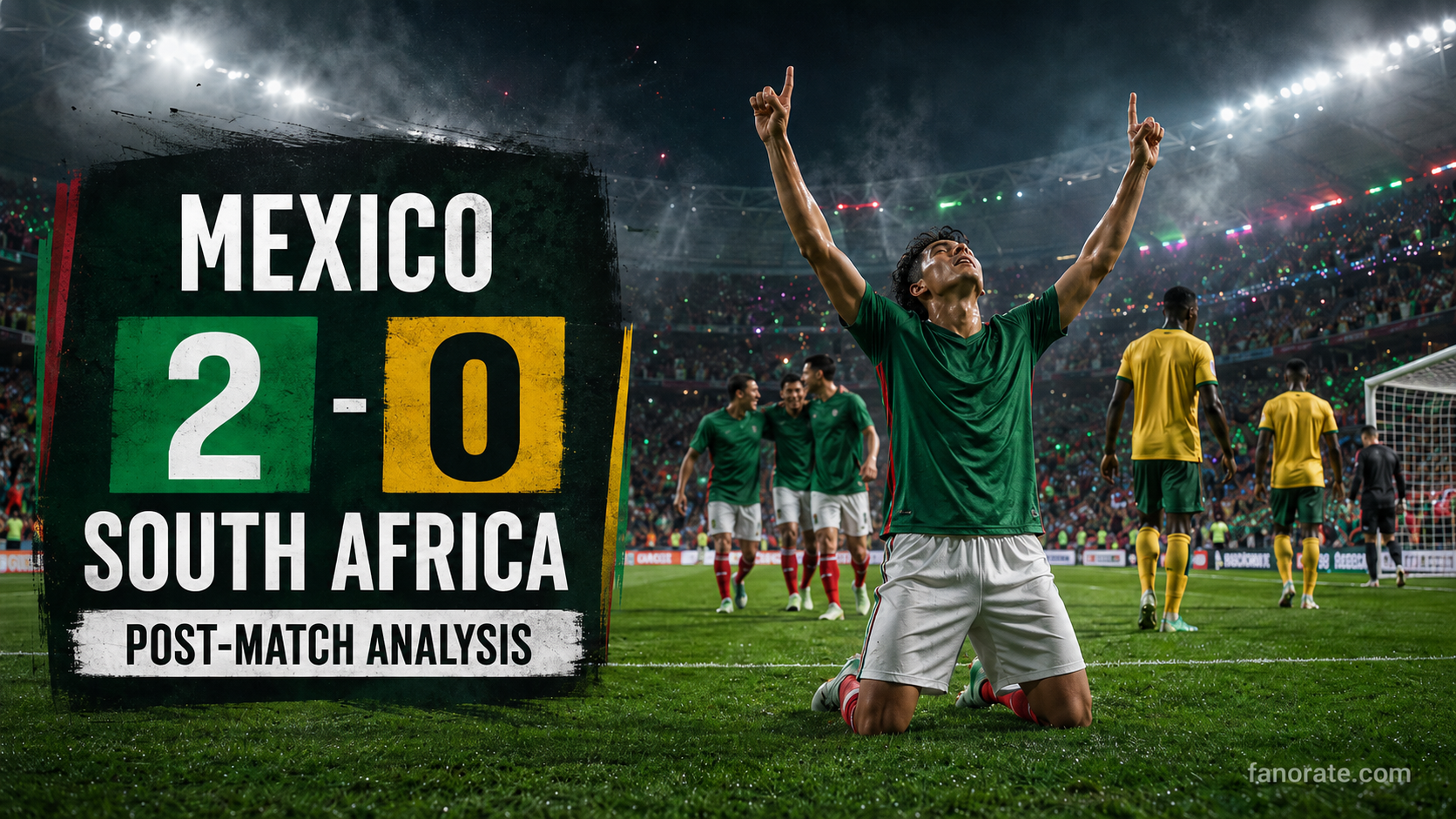
Mexico 2-0 South Africa: El Tri Dominate in Mexico City
A first-half strike from Julián Quiñones and a second-half header from Raúl Jiménez sealed a confident 2-0 win for Mexico over South Africa at a rain-soaked Mexico City Stadium, giving El Tri an ideal start to their FIFA World Cup 2026 campaign on home soil.
What happened
Mexico announced their World Cup 2026 intentions in emphatic fashion, dispatching South Africa 2-0 in a dominant home performance at the cavernous Mexico City Stadium. Julián Andrés Quiñones broke the deadlock with a composed right-foot finish in the ninth minute, and Raúl Jiménez powered home a second-half header to seal three points for El Tri. Playing in front of an 87,000-capacity fortress amid moderate rain, Mexico controlled the tempo, outshot South Africa by a remarkable margin, and never looked threatened. It was the kind of authoritative Group Stage opening that host nations dream of.
How it was won and lost
Mexico’s Possession Dominance Set the Tone Early
Mexico were tactically superior from the opening whistle, completing 467 of 520 attempted passes for a 90% accuracy rate compared to South Africa’s 81%. El Tri’s midfield trio, anchored by Érik Lira Méndez and Álvaro Fidalgo, consistently recycled possession and denied Bafana Bafana any sustained foothold in the match. The home side registered 98 attacking actions to South Africa’s 69, dictating both the press structure and the vertical transitions through the lines with clinical discipline.
Quiñones Exploits Early Space on the Right Flank
The opening goal arrived as early as the ninth minute, a product of Mexico’s aggressive wide play. Assisted by Érik Lira Méndez, Julián Quiñones drove into the South African penalty area and finished calmly with his right foot. Mexico’s wide overloads were a constant theme in the first half, with South Africa’s defensive shape struggling to cope with pace and movement in behind. El Tri generated 12 shots in total to Bafana Bafana’s 1, a stat that underlines just how one-sided the territorial battle was.
South Africa’s Defensive Fragility Exposed at Set Pieces
South Africa’s second concession arrived on 67 minutes from a cross delivered by Roberto Carlos Alvarado Hernández, with Raúl Jiménez beating the South African defence to power home a header. The goal exposed chronic vulnerability at aerial set pieces, a structural weakness that future opponents will have noted carefully. South Africa won only 39% of their duels and were repeatedly punished when Mexico switched the point of attack and delivered quality balls into the box.
Sphephelo Sithole’s Red Card Effectively Ended the Contest
The 49th-minute professional foul by Sphephelo Sithole as the last defender fundamentally altered the dynamic of the second half. With South Africa reduced to ten men, Jeremiah Sithole’s dismissal invited Mexico to play with greater width and patience, knowing the opposition lacked the numbers to press high or threaten on the counter. El Tri’s subsequent double substitution on 66 minutes, bringing on Luis Chávez and Gilberto Mora, reinforced the tactical execution of a more controlled, possession-based second-half display.
South Africa’s Late Aggression Undid Their Discipline
Themba Zwane’s violent conduct in the 84th minute — following an earlier card adjustment — typified South Africa’s frustrated second half. Reduced to ten men and chasing the game, discipline broke down in the closing stages, and Zwane’s dismissal compounded Bafana Bafana’s misery. Mexico, to their credit, managed the numerical advantage calmly rather than over-committing, keeping their defensive shape intact and conceding nothing.
Who decided it
Julián Andrés Quiñones Quiñones
MexicoQuiñones was electrifying on Mexico’s right flank, opening the scoring in just the ninth minute with a clinical right-foot finish assisted by Lira Méndez. His pace, directness, and ability to run in behind the South African defensive line created constant problems throughout the first half before he was replaced late in the second period.
His early goal settled the home crowd and forced South Africa into a reactive shape, allowing Mexico’s midfield to impose further control. His width and runs in behind stretched Bafana Bafana’s defensive structure and created pockets of space for Fidalgo and the midfield runners to exploit centrally.
Raúl Alonso Jiménez Rodríguez
MexicoThe experienced striker led the line with authority and was rewarded with a second-half header on 67 minutes, meeting Roberto Alvarado’s cross to double Mexico’s lead. Jiménez showed why he remains El Tri’s most dangerous aerial threat and his movement and hold-up play linked midfield and attack effectively throughout.
Jiménez’s goal was the result of intelligent movement into the South African box, capitalising on their aerial vulnerability. His presence as a focal point in the attack forced South Africa to defend deep and wide, creating room for overlapping runs from Mexico’s fullbacks.
Érik Antonio Lira Méndez
MexicoLira Méndez was the creative engine in Mexico’s midfield, registering the assist for Quiñones’s opening goal and consistently driving forward with precision. He operated as a progressive carrier in the transition, contributing to Mexico’s superior passing volume and territorial control before being withdrawn for Edson Álvarez on 76 minutes.
His ability to break lines with vertical passes and drive from deep gave Mexico an additional dimension in the midfield press. Replacing him with the more defensive Álvarez in the later stages signalled Mexico’s intent to protect the lead and control the final 15 minutes with composure.
Roberto Carlos Alvarado Hernández
MexicoAlvarado was a constant menace from wide positions, delivering the cross that led to Jiménez’s header on 67 minutes. His delivery quality from deep and half-space positions was a defining feature of Mexico’s attacking play in the second half, frequently finding teammates in dangerous areas inside the South African box.
Alvarado’s crossing ability and movement in the half-spaces created overloads that Bafana Bafana — already reduced to ten men — simply could not cope with. His assist underscored Mexico’s structural advantage on the wings and their ability to convert wide superiority into central goal-scoring opportunities.
Teboho Mokoena
South AfricaMokoena was South Africa’s most competitive midfield presence, working hard to press and disrupt Mexico’s build-up play despite the overall one-sided nature of the contest. He picked up an early foul in the 17th minute but continued to contest energetically throughout the first half in an attempt to keep Bafana Bafana competitive.
Despite his individual effort, Mokoena was ultimately overwhelmed by Mexico’s numerical superiority in midfield. His ability to win the ball and transition quickly was South Africa’s best route to creating anything in attack, but without consistent support, those moments were too infrequent to threaten El Tri’s defence.
Where it sits in history
Mexico enter the FIFA World Cup 2026 as co-hosts alongside the United States and Canada, and this victory in Mexico City resonates far beyond three Group Stage points. El Tri have historically performed strongly on home soil, and opening with a dominant clean-sheet win echoes the excitement of their earlier World Cup campaigns at the Estadio Azteca in 1970 and 1986. For South Africa, this is a reminder of the step up in quality required to compete at the top level of international football, though their continental performances have shown they are capable of moments of brilliance. Mexico’s xG of approximately 1.29 in shots on target versus South Africa’s 0.07 tells the story of a match that was never truly competitive, and El Tri’s positional dominance — 62% possession in their own stadium — suggests a side that is tactically prepared and motivated for a deep tournament run on home soil.
Inside the ground
The Mexico City Stadium was a cauldron of green and gold under the rain-soaked night sky, with close to 87,000 supporters packed into every corner of the iconic venue. From the moment Quiñones struck in the ninth minute, the stadium erupted with the kind of primal roar that only a World Cup on home soil can generate. The rain added a cinematic quality to the occasion — floodlights glinting off the wet pitch, flares of colour in the stands, and the thunderous drumbeat of Mexican support pulsing through the humid evening air. Even as South Africa’s frustrations boiled over in the final ten minutes, the home crowd only grew louder, willing El Tri forward with every touch and celebrating Jiménez’s header with scenes of pure, unbridled joy.
Looking ahead
Mexico will carry maximum confidence and three vital Group Stage points into their next fixture, knowing that a second win could effectively secure their progression to the knockout rounds. South Africa, meanwhile, face an urgent need to regroup and recalibrate after this defeat, particularly following the red cards for Sithole and Zwane, which will trigger automatic suspensions. Bafana Bafana must tighten their aerial defensive structure and restore discipline if they are to have any hope of advancing further in FIFA World Cup 2026. The tournament chess board is already shifting, and Mexico’s emphatic opening statement will have sent a warning to every team in the group.
The bottom line
-
Mexico secured a dominant 2-0 victory over South Africa in their FIFA World Cup 2026 Group Stage opener in Mexico City.
-
Julián Quiñones opened the scoring in the 9th minute with a right-foot finish, with Raúl Jiménez adding a second-half header on 67 minutes.
-
Mexico massively outshot South Africa, registering 12 shots to Bafana Bafana’s 1, reflecting total attacking dominance.
-
South Africa were reduced to ten men in the 49th minute when Sphephelo Sithole received a red card for a professional foul as the last defender.
-
Themba Zwane was dismissed for violent conduct in the 84th minute, compounding South Africa’s disciplinary nightmare.
-
Mexico’s passing accuracy of 90% versus South Africa’s 81% reflected El Tri’s clear technical superiority throughout the match.
-
Mexico’s xG of approximately 1.29 in shots on target dwarfed South Africa’s 0.07, confirming the scoreline reflected the balance of play.
-
Playing in front of a near-capacity 87,000 home crowd, Mexico demonstrated the significant advantage of hosting World Cup 2026 on their own soil.
