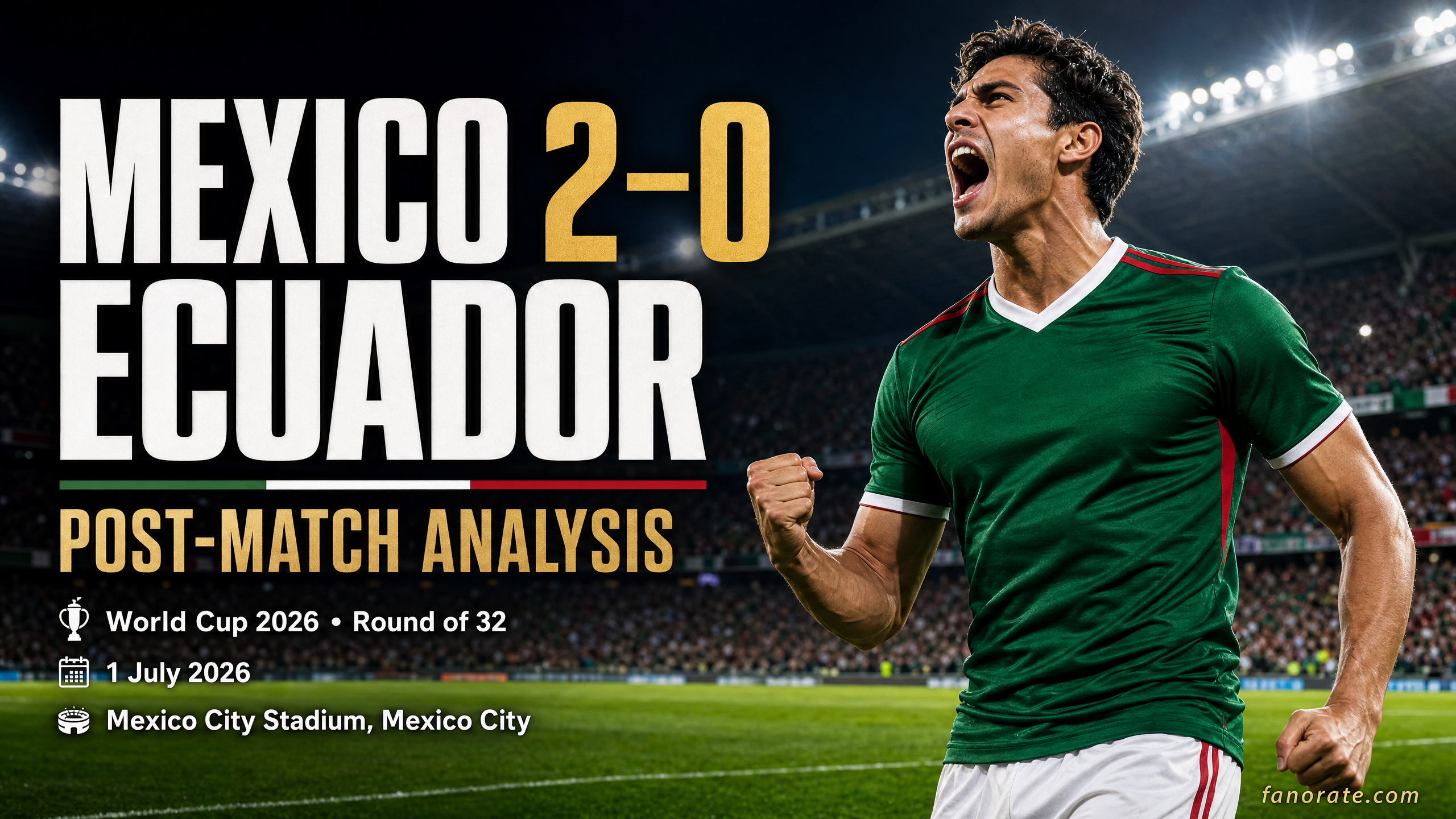
Mexico 2-0 Ecuador: El Tri Dominate Round of 32 with Clinical First Half | FIFA World Cup 2026
Playing in front of 87,000 passionate fans at Mexico City Stadium, El Tri delivered a statement performance in the FIFA World Cup 2026 Round of 32, dismantling Ecuador 2-0 with two clinical first-half strikes from Julián Quiñones and Raúl Jiménez to book their place in the next round.
Mexico advance to the Round of 16 with a commanding 2-0 victory
What happened
Under overcast skies in Mexico City, El Tri silenced any lingering nerves about the host nation’s knockout-stage pedigree with a dominant, disciplined performance against Ecuador. Two goals in the first 31 minutes — a sharp finish from Julián Andrés Quiñones followed by a clinical Raúl Jiménez header — gave Mexico an unassailable lead they never looked like surrendering. Ecuador had the ball for much of the night, recording 57% possession and pumping 25 crosses into the box, yet managed just one shot on target. This was a masterclass in low-block efficiency from Javier’s men: absorb, transition, and execute. El Tri are through, and Mexico City is dreaming again.
How it was won and lost
Mexico’s Ruthless Low-Block Counter-Attack Blueprint
Mexico set up in a compact defensive shape, deliberately inviting Ecuador to carry the ball and construct from deep. With just 43% possession, El Tri were happy to cede territory and operate on the counter. Their dangerous attack numbers — only 25 compared to Ecuador’s 57 — tell the story of a team that prioritised quality over quantity. When they did transition, they were lethal. Both goals came from incisive vertical passes that bypassed Ecuador’s midfield press and exposed space in behind the La Tri defensive line. Mexico’s 14 key passes against Ecuador’s six underscores how efficiently El Tri converted possession into genuine threat.
Ecuador’s Possession Trap: All Ball, No Bite
Ecuador dominated the ball with 57% possession and attempted a staggering 25 crosses, yet their final product was woefully insufficient. Only 3 of those 25 crosses were accurate, and their tally of just one shot on target from seven total attempts reflects a team that circulated possession wide but lacked the central penetration to hurt Mexico. The loss of Enner Valencia as a reference point via substitution in the 59th minute further blunted their attack. Ecuador’s 8 corners and woodwork hit indicate some threat, but Mexico’s defensive structure — winning 49 duels and making 7 interceptions — was resolute throughout.
The First Half Blitz: Quiñones Ignites, Jiménez Finishes
Mexico’s match was effectively won inside the opening 31 minutes. Quiñones broke the deadlock on 22 minutes, benefiting from a slick assist by Roberto Alvarado down the right flank, before setting up Jiménez nine minutes later to double the advantage. The partnership between these two was the tactical highlight of the contest — Quiñones dropping deep to link play, then bursting beyond Ecuador’s last line. Mexico’s willingness to play direct — 59 long passes, with a 47% success rate — allowed them to bypass Ecuador’s compact midfield and find Jiménez in dangerous areas repeatedly in the first half.
Defensive Solidity and Set-Piece Dominance
Mexico’s aerial superiority was a consistent theme, winning 21 successful headers to Ecuador’s 12. With César Montes and Johan Vásquez commanding the backline, El Tri were rarely troubled by Ecuador’s direct play. Edson Álvarez screened the back four with discipline, breaking up Ecuador’s transitional attacks and ensuring the second half became a game of controlled management rather than genuine tension. Ecuador’s red card for Piero Hincapié deep in stoppage time — triggered by a VAR review — ended any lingering hope of a dramatic comeback and underlined the disciplinary frustration that followed their tactical defeat.
Substitution Strategy: Managing the Game Home
Mexico’s substitution pattern reflected calm game management rather than tactical emergency. Obed Vargas for Romo (73′) added energy to the midfield press, while Santiago Giménez replacing the goalscorer Jiménez (74′) demonstrated squad depth in attacking positions. Ecuador’s five substitutions — including the introduction of Angelo Preciado and Kevin Rodríguez at half-time — were reactive attempts to find a breakthrough that never materialised. The late red card for Hincapié, coming from a VAR review in the 90th minute, added drama to what was already a comfortable Mexican victory.
Who decided it
Julián Andrés Quiñones Quiñones
MexicoThe standout performer of the match. Quiñones opened the scoring on 22 minutes with a composed finish and then turned provider for Jiménez’s goal nine minutes later. His combination of direct running, technical dribbling, and positional intelligence caused Ecuador’s defence persistent problems throughout the first half.
Operating from a wide-left position but drifting centrally, Quiñones consistently found pockets of space between Ecuador’s midfield and defensive lines. His ability to link play and drive forward in transition was the engine behind Mexico’s counter-attacking threat and was directly responsible for both goals in the opening half.
Raúl Alonso Jiménez Rodríguez
MexicoThe experienced striker delivered precisely what was expected of a World Cup knockout-stage centre-forward. Clinical in the 31st minute, Jiménez held up play effectively and created space with intelligent movement. He was replaced by Santiago Giménez on 74 minutes after a commanding individual performance.
Jiménez’s movement as a target man was crucial to Mexico’s counter-attacking system. His ability to occupy both central defenders simultaneously opened channels for Quiñones and Alvarado to exploit in behind. His goal — a composed finish from Quiñones’ cutback — was a reminder of his world-class finishing at the highest level.
Roberto Carlos Alvarado Hernández
MexicoAlvarado was Mexico’s primary creative outlet from the right flank, providing the assist for Quiñones’ opener and consistently finding dangerous positions in the attacking third. His accurate crossing — 4 from just 7 attempts — was notably efficient compared to Ecuador’s efforts.
Alvarado’s underlapping and overlapping runs from the right side created overloads that Ecuador’s left flank struggled to contain. His delivery in the first half was sharp and incisive, repeatedly threading balls into the danger zone and contributing to Mexico’s superior key pass tally.
Edson Álvarez
MexicoThe anchor of Mexico’s midfield, Álvarez was imperious in breaking up Ecuador’s attacks and distributing efficiently under pressure. His positional discipline kept Ecuador’s creative players — particularly Moisés Caicedo — from finding space in dangerous central areas.
Álvarez acted as the pivot around which Mexico’s entire defensive structure rotated. Winning duels, intercepting passes, and recycling possession calmly, he ensured that Ecuador’s dominant possession rarely translated into sustained pressure on the Mexican goal — a tactical masterstroke in a game decided by defensive solidity.
Piero Hincapié
EcuadorOne of Ecuador’s most reliable performers in previous rounds, Hincapié endured a difficult evening that ended in catastrophe — a red card in stoppage time following a VAR review, leaving Ecuador reduced to ten men and symbolising their night of frustration.
Hincapié’s sending-off, while arriving after the result was long decided, will carry significant implications if Ecuador — despite elimination — are assessed for future tournament registration. His yellow card in first-half stoppage time signalled a night of growing frustration against Mexico’s disciplined and physical backline.
Where it sits in history
For Mexico, reaching the Round of 16 as hosts carries enormous symbolic and emotional weight. El Tri have famously been haunted by the ‘Curse of the Fifth Game’ — the recurring pattern of elimination at the Round of 16 in every World Cup since 1994. Playing on home soil in 2026, with matches at the iconic Mexico City Stadium, the pressure to finally break that curse has never been greater. A 2-0 victory in the Round of 32 — clinical, controlled, and atmospherically electric — is exactly the kind of performance that builds tournament momentum. Ecuador, meanwhile, bow out having shown flashes of the quality that made them impressive in qualification, but ultimately unable to replicate the attacking incision that marked their better performances.
Inside the ground
Mexico City Stadium — capacity 87,523 — was a cauldron of noise and colour from the first whistle. The famous El Tri fanbase, among the most passionate in world football, greeted each Mexican attack with a roar that grew to a crescendo when Quiñones broke the deadlock on 22 minutes. The stadium’s energy was palpable throughout the first half, with the second goal from Jiménez sending the stands into pure euphoria. The overcast evening sky provided a dramatic backdrop as thousands of Mexican flags were raised in unison. Even as Ecuador pushed for a lifeline in the second half, the crowd’s noise remained a relentless 12th man for El Tri — a genuine home advantage that Ecuador could never overcome.
Looking ahead
Mexico advance to the FIFA World Cup 2026 Round of 16, where they will face a formidable opponent from the other side of the draw. The home crowd advantage will again be a major factor, and Javier’s side will hope that Jiménez, Quiñones, and Alvarado can sustain their first-half brilliance into the knockout rounds. The fitness of Jiménez — replaced in the 74th minute — will be monitored, though the introduction of Santiago Giménez provides genuine attacking depth. For Ecuador, the tournament is over, but the performances of players like Moisés Caicedo and Hincapié — despite his red card — will attract significant club interest heading into the summer transfer window.
The bottom line
-
Mexico defeated Ecuador 2-0 in the FIFA World Cup 2026 Round of 32 at Mexico City Stadium
-
Julián Quiñones scored and assisted in a devastating 22-31 minute period that decided the contest
-
Raúl Jiménez added the second goal in the 31st minute to put Mexico firmly in control
-
Ecuador dominated possession with 57% but managed only one shot on target from seven attempts
-
Mexico’s low-block counter-attacking system was tactically superior despite having just 43% possession
-
Piero Hincapié received a red card in stoppage time following a VAR review, ending Ecuador’s night in further frustration
-
Mexico advance to the Round of 16 with renewed belief they can finally break the infamous ‘Curse of the Fifth Game’
-
A crowd of 87,523 at Mexico City Stadium created a defining World Cup atmosphere that powered El Tri to victory
