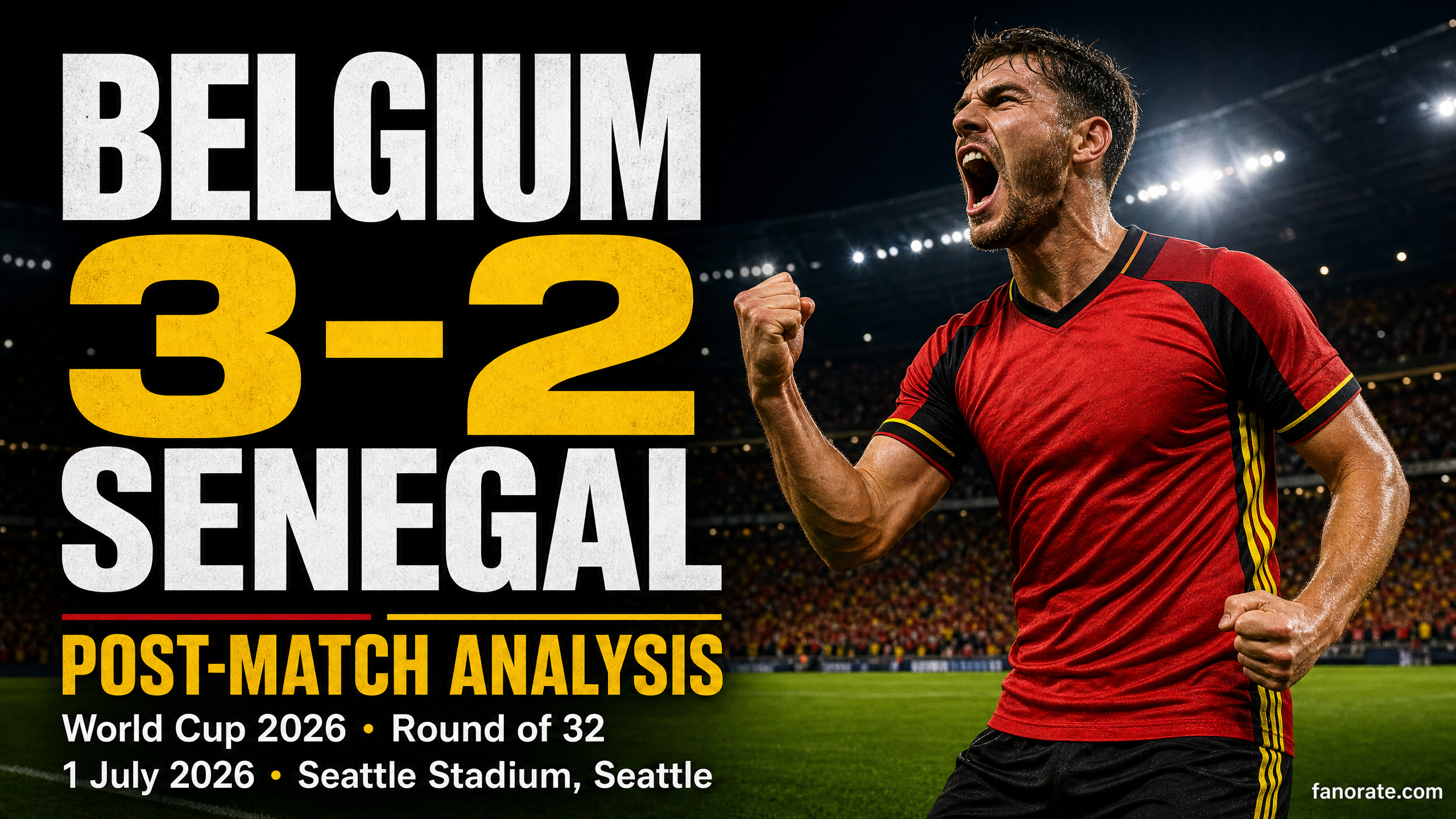
Belgium 3-2 Senegal (AET): Lukaku & Tielemans Penalty Seal Dramatic Round of 32 Thriller | FIFA World Cup 2026
Belgium survived a Senegal comeback, a frantic finish, and 120 pulsating minutes to reach the World Cup 2026 last 16. Goals from Romelu Lukaku and Youri Tielemans — including a stoppage-time penalty confirmed by VAR — sealed a 3-2 extra-time victory in a Seattle classic.
Belgium win after extra time
What happened
Under overcast Seattle skies, Belgium and Senegal delivered one of the most dramatic knockout encounters of FIFA World Cup 2026. Senegal drew first blood through a stunning early strike, extended their lead after the break, and looked poised for a stunning upset — before Belgium’s substitutes completely flipped the script. Romelu Lukaku pulled one back with four minutes to go in normal time, Youri Tielemans levelled in stoppage time, and the Belgian midfielder ultimately finished what he started by converting a VAR-awarded penalty in extra time to send the Red Devils through 3-2. It was tense, breathless, and utterly unforgettable.
How it was won and lost
Senegal’s First-Half Discipline Stifled Belgium’s Creative Core
Senegal coach Aliou Cissé set his side up in a compact mid-block, inviting Belgium into wide areas and denying Kevin De Bruyne and Youri Tielemans the central pockets they crave. Belgium’s 52% possession looked comfortable on paper but rarely translated into genuine danger, with Senegal’s defensive line, marshalled superbly by Kalidou Koulibaly and Moussa Niakhaté, sitting deep and disciplined. The Lions of Teranga were content to absorb pressure and strike on the counter — a strategy that paid immediate dividends when Mouhamadou Diarra broke the deadlock on 25 minutes, capitalising on a transition moment that exposed Belgium’s high defensive line.
Halftime Substitution Gamble Pays Off — Lukaku Changes the Dynamic
Belgian manager Domenico Tedesco threw Romelu Lukaku into the fray at halftime, replacing Charles De Ketelaere in a clear tactical escalation. But Senegal responded before the big striker could impact the match, with Ismaïla Sarr extending the lead to 2-0 on 51 minutes, converting a dangerous ball from Niakhaté. The introduction of Dodi Lukebakio and Nicolas Raskin on 56 minutes added wider attacking threat and midfield energy, and Diego Moreira’s arrival at 63 minutes injected further pace and unpredictability. Belgium’s bench depth — a hallmark of the Golden Generation era — was being weaponised in real time.
Senegal’s Tactical Disruption and Yellow Card Chaos in the Second Half
Lamine Camara entered for Senegal at 66 minutes but immediately found himself in the referee’s notebook just one minute later, a yellow card that hampered his effectiveness and disrupted Senegal’s midfield balance. Senegal made further attacking changes — Ibrahim Mbaye and Pape Matar Sarr both introduced at 73 minutes — but as legs tired and discipline frayed, Belgium began to exploit the spaces that opened up. Thomas Meunier’s introduction at 78 minutes down the right proved pivotal, his energy and delivery giving Belgium a new outlet in the crucial final phase.
Four-Minute Comeback: Lukaku and Tielemans Rewrite the Narrative
Belgium’s late siege was extraordinary. Lukaku latched onto a Thomas Meunier delivery to pull it back to 2-1 on 86 minutes — classic Lukaku, powerful and predatory. Then, just three minutes into stoppage time, Leandro Trossard found Youri Tielemans, who finished coolly to level at 2-2 and send the match into extra time. The momentum had swung completely. A rattled Senegal saw their manager Rudi Garcia pick up a yellow card on 90 minutes, reflecting the mounting pressure on the touchline.
VAR Controversy Decides Extra Time
Extra time was tight and tense, with both teams exhausted and cautious. Belgium’s breakthrough came in the second period of extra time when a VAR review at 120 minutes awarded a penalty to Belgium — the call confirmed at 120+5 for Tielemans to step up and convert. It was a dramatic, polarising conclusion, the kind that sends one nation into ecstasy and another into anguished debate. Belgium’s superior squad depth and set-piece threat — 27 successful headers to Senegal’s 15 — ultimately proved the difference across the 120 minutes.
Who decided it
Romelu Lukaku
BelgiumIntroduced at halftime, Lukaku was the catalyst for Belgium’s remarkable comeback. His goal on 86 minutes — assisted by Thomas Meunier — was a towering header that reignited Belgian belief and set up a frantic finale.
Lukaku’s physicality immediately unsettled Senegal’s backline. His aerial dominance, reflected in Belgium’s 27 successful headers, created chaos in the penalty area and forced Senegal into a deeper defensive posture that they struggled to maintain.
Youri Tielemans
BelgiumThe Aston Villa midfielder was the hero of the night with two crucial contributions: an equaliser in the third minute of stoppage time and a composed penalty in extra time that sent Belgium through. An ice-cool performance in the highest-pressure moments.
Tielemans operated as Belgium’s late-game engine, combining with Trossard in the crucial equalising move and then showing enormous mental fortitude to convert from the spot. His ability to arrive late into the penalty area — twice — was a decisive tactical weapon.
Ismaïla Sarr
SenegalThe Senegal winger’s goal on 51 minutes, assisted by Moussa Niakhaté, doubled Senegal’s lead and appeared to put the match beyond Belgium’s reach. Sarr was Senegal’s most dynamic wide outlet throughout the match.
Sarr’s ability to carry the ball and create on transition was central to Senegal’s counter-attacking threat. His movement stretched Belgium’s defensive shape and created the spaces exploited by Senegal in the first half and early second half.
Mouhamadou Diarra
SenegalThe opening goalscorer on 25 minutes set the tone for Senegal’s performance with a composed finish on the counter-attack. His replacement at 73 minutes reflected the physical demands the match placed on Senegal’s midfield players.
Diarra was a key component of Senegal’s transition play in the first half, combining defensive discipline with the ability to arrive late in attacking positions — the exact formula that caught Belgium off guard for the opener.
Thibaut Courtois
BelgiumCourtois made three saves across the 120 minutes and was commanding in the air, dealing with Senegal’s 22 crosses with authority. His presence behind a Belgian defence that was occasionally stretched prevented the deficit from growing.
Courtois’s shot-stopping kept Belgium alive in the second half when Senegal had momentum. His distribution also initiated several Belgian counter-attacks, and his composure during the Senegalese pressure phases steadied his backline.
Thomas Meunier
BelgiumIntroduced at 78 minutes, Meunier’s immediate impact down the right flank was decisive. His delivery directly led to Lukaku’s goal, and his energy injected the kind of width and crosses Belgium had lacked previously.
Meunier’s introduction shifted Belgium’s attacking axis to the right side and gave Lukaku a reliable delivery source. It was a precise tactical substitution by Tedesco that transformed Belgium’s final-third play in the crucial closing minutes.
Where it sits in history
This was a remarkable chapter in the history of Belgium and Senegal at the World Cup. Belgium’s Golden Generation — now in its twilight with players like Lukaku, De Bruyne, and Tielemans — continues to deliver in knockout football despite constant suggestions that the window has closed. Senegal, who famously reached the World Cup quarter-finals in 2002 and the Round of 16 in 2022 in Qatar, once again showed they can compete with elite European opposition. The 3-2 extra-time result echoes the fine margins that have defined knockout football at this tournament, and Senegal will feel they were agonisingly close to a historic upset. Belgium advance to the last 16 having survived one of the most dramatic matches of World Cup 2026 so far.
Inside the ground
Seattle Stadium, with its 68,740 capacity, provided a cauldron of noise for this Round of 32 thriller. The Belgian diaspora made their presence felt in full force — red, yellow, and black filling large sections of the stands — while Senegal’s passionate travelling support delivered an unforgettable soundtrack with drums, chanting, and the vibrant colour of West African football culture. The frantic energy of Belgium’s stoppage-time comeback was met with seismic noise levels, and the tense quiet during the VAR review before Tielemans’ extra-time penalty captured the breath-holding drama of knockout World Cup football perfectly. Under overcast Pacific Northwest skies, Seattle had witnessed something extraordinary.
Looking ahead
Belgium advance to the Round of 16 at FIFA World Cup 2026, where their path through the bracket will demand another high-level performance. The Red Devils will need to recover quickly — both physically and emotionally — after 120 gruelling minutes against Senegal. Key questions remain: can Kevin De Bruyne, who was substituted in the second half, return to full fitness and influence? Will Lukaku’s impact off the bench earn him a starting role? For Senegal, the journey home will be one of heartbreak and reflection — they were the better team for large spells and will look back on those final minutes with enormous regret. The Lions of Teranga exit having reminded the world of their quality, and the future of their squad, led by Sadio Mané, Ismaïla Sarr, and their young midfielders, remains exceptionally bright.
The bottom line
-
Belgium completed one of the most dramatic comebacks of World Cup 2026, scoring twice in the final four minutes of normal time to force extra time
-
Romelu Lukaku proved his knockout-stage quality once again, scoring the crucial 86th-minute goal that reignited Belgium’s hopes
-
Youri Tielemans was the match’s defining figure, scoring both the equaliser in stoppage time and the decisive extra-time penalty
-
Senegal were excellent for over an hour but were ultimately undone by Belgian squad depth and clinical finishing
-
A VAR-awarded penalty at 120+5 minutes settled the tie in the most dramatic fashion possible
-
Belgium’s 27 successful headers compared to Senegal’s 15 highlighted their aerial dominance as a key tactical weapon
-
The match featured 12 total substitutions and spanned 120 minutes, underlining the physical and tactical demands of knockout World Cup football
-
Senegal’s exit ends a strong campaign from Aliou Cissé’s side, who showed genuine capacity to trouble elite European opposition
