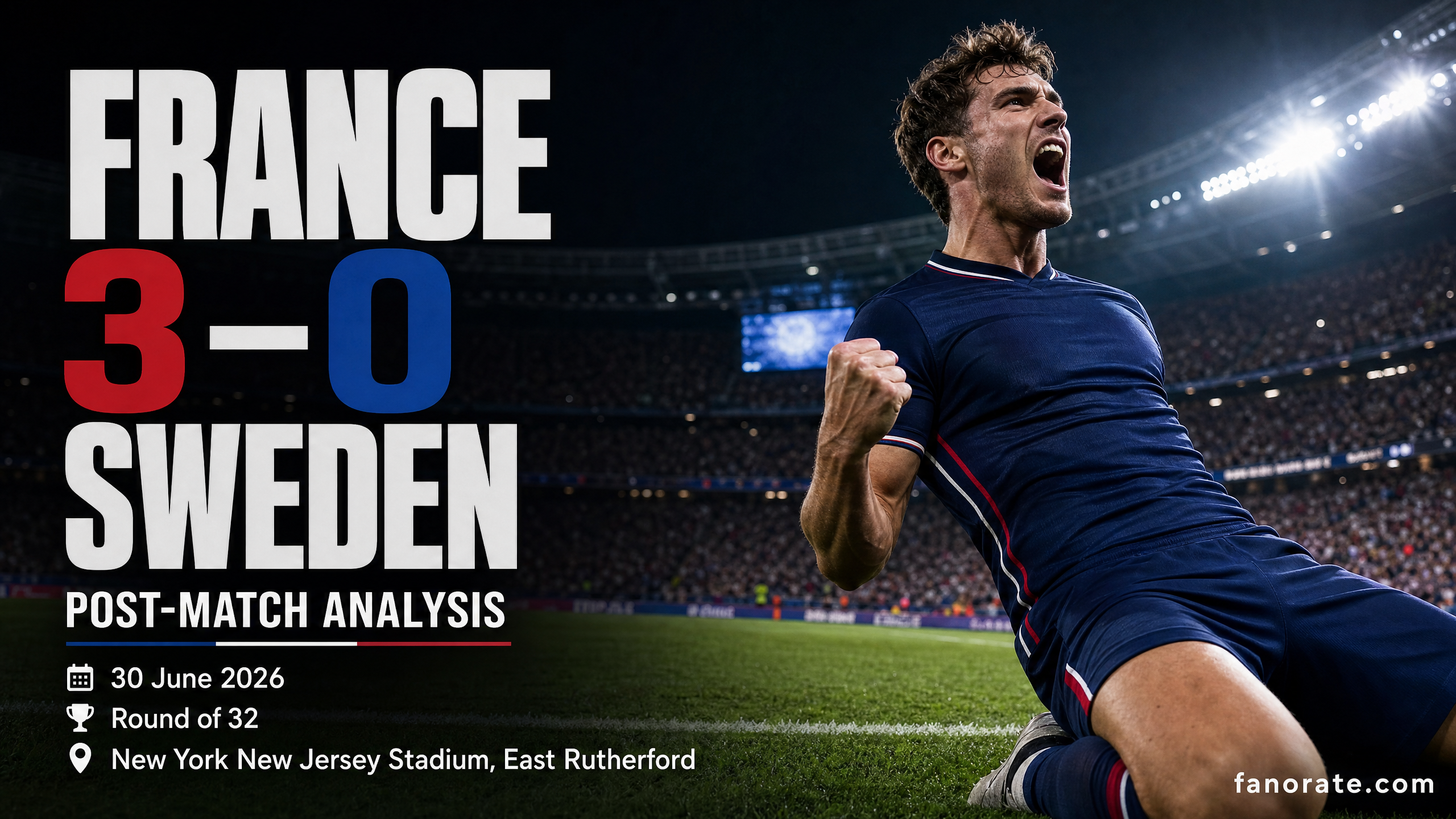
France 3-0 Sweden: Mbappé Brace Powers Les Bleus Into World Cup 2026 Round of 16
Kylian Mbappé scored twice and Bradley Barcola added a stunning third as France swept aside Sweden 3-0 at New York New Jersey Stadium, delivering a commanding performance to advance into the Round of 16 at FIFA World Cup 2026.
France advance to the Round of 16
What happened
Under the overcast skies of East Rutherford, France turned the New York New Jersey Stadium into a showcase of ruthless, attacking football. A Kylian Mbappé brace either side of a Bradley Barcola strike dismantled a Sweden side that battled hard but were simply overwhelmed by one of the tournament’s most potent attacking units. With 25 shots, 12 on target, six big chances created, and 62% possession, Didier Deschamps’ men issued a statement of genuine World Cup intent. France are through, and they look menacing.
How it was won and lost
France’s Positional Dominance Suffocates Sweden
France set up in a fluid 4-3-3 structure that consistently overloaded Sweden’s defensive lines. With 551 passes attempted and an 88% pass success rate, Les Bleus controlled the territorial and rhythmic fabric of the match from the opening whistle. Aurélien Tchouaméni and N’Golo Kanté anchored the midfield with composure, allowing the forward trio of Mbappé, Dembélé, and Olise to rotate freely and create chaos in the final third. Sweden’s 38% possession share tells the full story of their containment.
Michael Olise: The Creative Engine Behind Both Second-Half Goals
Michael Olise was the architect of France’s second-half dominance, registering assists for both Barcola’s 53rd-minute strike and Mbappé’s 74th-minute clincher. Operating from the right flank, Olise’s ability to cut inside and thread precise through-balls exploited the space behind Sweden’s high defensive line repeatedly. His contribution to France’s 20 key passes underlines how central he was to unlocking a resilient Swedish defensive structure.
Sweden’s Defensive Block Eventually Cracked Under Sustained Pressure
Sweden arrived with a clear low-block defensive plan, registering 12 interceptions and winning 40 duels. They held France to just one goal in the first half and made nine saves through goalkeeper Jacob Widell Zetterström. However, the sheer volume and quality of French attacks — 63 dangerous attacks, 16 total crosses, and the woodwork struck twice — meant the dam was always likely to break. Once Barcola extended the lead early in the second half, Sweden’s defensive shape quickly disintegrated.
VAR Drama Before the Opener Sets the Tone
The match’s first major talking point arrived at the 21st minute when Mbappé was involved in a VAR review. While the decision appeared to go against the French captain in the moment, it served as a psychological catalyst, and just before the whistle blew on the first half, Mbappé converted from a Dembélé assist to send France into the break ahead. The timing of the goal — deep into first-half stoppage time — was a psychological blow Sweden never fully recovered from.
France’s Substitution Strategy Keeps Intensity High
Deschamps made calculated changes to manage energy and maintain press intensity. The introduction of Desire Doué for Dembélé at the 75th minute and Mathis Cherki for Mbappé at the 85th demonstrated both squad depth and tournament planning. Malo Gusto replaced Jules Koundé to freshen up the right flank, while Theo Hernández came on for Lucas Digne to reinforce the left side. Five substitutions in the second half allowed France to sustain high pressing tempo without exhausting key personnel ahead of the knockout rounds.
Who decided it
Kylian Mbappé Lottin
FranceMbappé was the defining figure of the match, scoring in first-half stoppage time from a Dembélé assist and adding his second in the 74th minute via an Olise through-ball. He was also central to a VAR incident at the 21st minute. His movement between the lines, ability to accelerate in behind, and clinical finishing were on full display in front of 82,500 spectators in New Jersey.
Mbappé’s runs in behind consistently stretched Sweden’s defensive line, opening channels for Olise and Dembélé to exploit. His presence forced Sweden’s centre-backs into deep defensive positions, compressing their mid-block and creating the overloads that ultimately broke them.
Michael Olise
FranceOlise was arguably France’s most impactful performer in the second half, contributing assists for both Barcola’s 53rd-minute goal and Mbappé’s 74th-minute strike. His incisive passing, dribbling creativity, and spatial intelligence made him Sweden’s biggest problem on the right flank throughout.
Operating as the right-sided attacker in France’s 4-3-3, Olise created width, drew defenders, and delivered decisive final balls. His link-up play with Mbappé and the overlapping runs from the full-back created overloads that repeatedly broke Sweden’s defensive structure.
Bradley Barcola
FranceBarcola netted France’s second goal of the match in the 53rd minute from an Olise assist, and his movement off the ball throughout was a constant menace to Sweden’s right-sided defenders. Lively and direct, he was excellent in transition and helped France immediately press the advantage at the start of the second half.
Barcola’s goal effectively ended the match as a contest just eight minutes into the second half. His directness on the left flank complemented Mbappé’s central movement and prevented Sweden from committing numbers to any single area of the pitch.
Jacob Widell Zetterström
SwedenSweden’s goalkeeper made nine saves in a night that could have been far more emphatic for France, who struck the woodwork twice. Zetterström kept Sweden in the contest during the first half and repeatedly denied what should have been routine finishes, making him arguably his team’s best performer despite the scoreline.
Without Zetterström’s heroics, Sweden could realistically have conceded six or seven goals. His nine-save performance at least preserved some dignity against a French attack that generated 20 key passes and six big chances.
Where it sits in history
France’s comfortable 3-0 victory continues their strong tournament pedigree at the FIFA World Cup. Les Bleus, winners in 1998 and 2018, have now demonstrated that this crop of players — headlined by a Mbappé still very much in his prime — is built for deep tournament runs. For Sweden, the Round of 32 exit represents a familiar ceiling for the Scandinavian nation, who last reached the quarterfinals in 1994. Despite the emergence of talents like Alexander Isak and Lucas Bergvall, the gulf in quality against Europe’s elite remains a challenge the next generation must bridge. The venue itself added historical significance — New York New Jersey Stadium becoming the backdrop for a French masterclass on US soil ahead of the tournament’s latter stages.
Inside the ground
The 82,500-capacity New York New Jersey Stadium provided a vibrant backdrop for the match, with a strong French supporter presence generating an atmosphere more reminiscent of a European final than a Round of 32 tie. Overcast skies added a dramatic edge to the evening, and the noise each time Mbappé received the ball underlined his superstar status even on American soil. Sweden’s travelling support remained vocal throughout despite the scoreline, particularly during the first half when their team showed genuine defensive resilience.
Looking ahead
France advance to the Round of 16 at FIFA World Cup 2026 with momentum, fitness, and a fearsome attacking depth chart fully intact. The performances of Mbappé, Olise, and Barcola will have scouts and opposing coaches taking serious note. With Deschamps managing substitutions intelligently and fringe players like Cherki and Doué getting minutes, squad depth appears to be a genuine strength rather than a concern. Sweden, meanwhile, exit the tournament with their heads held reasonably high — Zetterström’s heroics and moments of defensive discipline suggest the foundation is there for a stronger campaign in 2030.
The bottom line
-
Kylian Mbappé scored twice, in first-half stoppage time and the 74th minute, to lead France’s dominant Round of 32 victory.
-
Michael Olise registered two assists, emerging as a key creative force in France’s attacking system.
-
Bradley Barcola’s 53rd-minute goal killed Sweden’s resistance at the start of the second half.
-
France dominated with 62% possession, 25 shots, 12 on target, and six big chances created.
-
Sweden goalkeeper Jacob Widell Zetterström made nine saves to prevent a heavier defeat.
-
France struck the woodwork twice, indicating the scoreline could have been far more severe.
-
Deschamps made five tactical substitutions to manage squad depth for the knockout rounds.
-
Sweden’s 38% possession share reflects how thoroughly France controlled the match from start to finish.