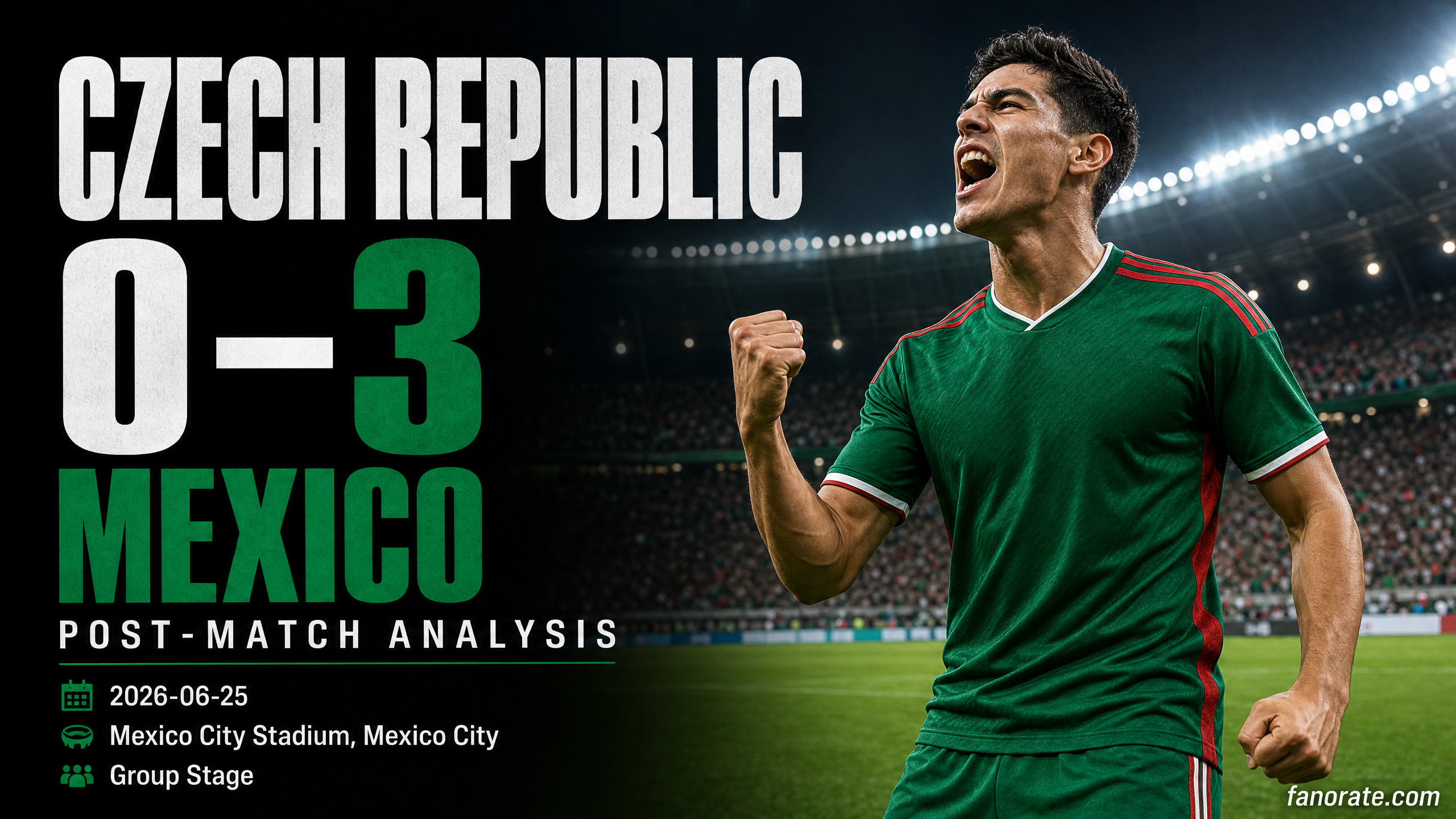
Mexico 3-0 Czech Republic: El Tri Dominate With Devastating Second Half at FIFA World Cup 2026
A goalless first half gave way to a stunning Mexican second-half explosion as El Tri dismantled Czech Republic 3-0 on home soil, with goals from Mateo Chávez García, Julián Quiñones, and late substitute Álvaro Fidalgo sealing a dominant FIFA World Cup 2026 Group Stage victory.
Mexico win 3-0 with all goals scored in the second half
What happened
Under the floodlights of a rain-soaked Mexico City Stadium — a cauldron holding over 87,000 passionate souls — Mexico delivered the kind of second-half performance that will echo through the FIFA World Cup 2026 Group Stage. Czech Republic had matched El Tri stride for stride through a cagey, goalless first 45 minutes, but the moment the second half ignited, Mexico were utterly transformed. Three goals in 39 second-half minutes, a suffocating press, and pinpoint execution in the final third sent the home crowd into rapturous celebration. For Czechia, it was a brutal lesson in the dangers of facing a host nation with the crowd behind them and the momentum suddenly shifting.
How it was won and lost
Czech Republic’s First-Half Discipline Dissolved in the Second Half
Czech Republic entered this fixture organized and compact, sitting in a structured mid-block and frustrating Mexico’s build-up play throughout the first half. With 52% possession, Vladimír Darida and Tomáš Holeš anchored a disciplined midfield, while the back line remained narrow and denied El Tri any meaningful penetration inside the box. However, the second half told a completely different story. Mexico’s increased intensity off the ball, combined with sharper movement in behind the Czech defensive line, began to expose the visitors’ lack of pace in transition. Czech Republic’s inability to convert any of their 26 crosses — managing just 5 accurate deliveries from that volume — highlighted a blunt attacking edge that ultimately left them with nothing to show for their early discipline.
Mexico’s High Press and Transition Intensity Unlocked the Game
Mexico’s second-half transformation was rooted in a significant uptick in pressing intensity and vertical intent. With 86 attacks generated and 31 classified as dangerous, El Tri flooded the final third with speed and combinations, particularly through the right flank via Jorge Sánchez. The 9 shots inside the box compared to just 2 from outside underlines Mexico’s commitment to attacking the spaces in behind rather than relying on speculative efforts. Their 86% pass accuracy and 10 key passes reflect a team that grew increasingly fluent as the match wore on, exploiting defensive fatigue and space in the Czech second half. The tactical shift paid immediate dividends with goals arriving at the 55th and 61st minute in rapid succession.
Substitution Strategy Proved Decisive for Both Sides — But Only Mexico Got It Right
The flurry of substitutions between the 63rd and 64th minute represented a defining tactical crossroads. Mexico replaced strikers and added fresh energy with Guillermo Martínez, Obed Vaargas, and later Álvaro Fidalgo, who made an immediate impact by scoring in the 90+4th minute to seal the match. For Czech Republic, bringing on Patrik Schick and Tomáš Souček — two experienced internationals — looked bold on paper, but neither could influence the game in the context of a 2-0 deficit with the Czech attack generating zero big chances across the entire match. The statistics are stark: Czech Republic created 0 big chances compared to Mexico’s 5, and the visitors’ single shot on target across 90 minutes speaks volumes about the limitation of their attacking threat.
Set-Piece Imbalance Reflected Broader Attacking Disparity
Czech Republic generated 5 corners to Mexico’s 1 and attempted 26 crosses — the highest volume in this match — yet managed only 5 accurate deliveries and created nothing from set-piece situations. By contrast, Mexico were clinical in open play, requiring minimal set-piece involvement to carve out big chances. With 11 successful headers for Czech Republic compared to Mexico’s 9, the aerial battle was competitive, but the Czechs could not convert that physical presence into goalscoring opportunities. The inability to create a single ‘big chance’ across the full 90 minutes reflects systemic issues in Czech Republic’s attacking structure that go beyond individual errors.
Who decided it
Mateo Chávez García
MexicoThe opening goalscorer on 55 minutes, Chávez García set the tone for Mexico’s second-half blitz. His goal, assisted by Luis Romo, was the catalyst that broke Czech Republic’s defensive resolve and sparked a frantic period of Mexican dominance. He remained active enough to earn a substitution in the 78th minute after an energetic contribution.
Chávez García’s movement and directness in the channel unsettled the Czech defensive structure at a pivotal moment. His goal came just ten minutes into the second half, and the psychological blow it delivered proved irreversible for the Czech side, immediately shifting the energy of the 87,000-strong crowd.
Julián Andrés Quiñones Quiñones
MexicoQuiñones struck just six minutes after Mexico’s opener to double the lead, converting an assist from Jorge Sánchez in the 61st minute. His predatory instinct inside the box and sharp movement made him a constant threat throughout the second half.
By scoring in the 61st minute, Quiñones effectively killed the contest before Czech Republic could respond to going 1-0 down. His run and finish exploited the space behind the Czech backline that Mexico had been probing since the restart, and his goal triggered Mexico’s sweeping substitution wave.
Álvaro Fidalgo Fernández
MexicoThe Spanish-born midfielder came on as a substitute in the 72nd minute and made an immediate tactical impact before capping his cameo with a goal in the 90+4th minute, assisted by Roberto Alvarado. Fidalgo’s composure and technical quality in midfield provided Mexico with a creative dimension in the closing stages.
Fidalgo’s late goal was more than a scoreline addition — it was a statement of Mexico’s depth and intent. His ability to arrive late into scoring positions from central midfield areas demonstrated a tactical fluency that Czech Republic had no answer for by that point in the match.
Luis Francisco Romo Barrón
MexicoRomo pulled the strings throughout, registering an assist for the opening goal and bringing intelligence and composure to Mexico’s midfield operation. Replaced in the 63rd minute after delivering a commanding performance in the engine room.
As Mexico’s deep-lying creative force, Romo dictated tempo and helped maintain the 86% pass accuracy that underpinned El Tri’s controlled second-half dominance. His ability to pick passes in tight spaces and release runners in behind was central to Mexico’s attacking fluency.
Matěj Kovář
Czech RepublicDespite the scoreline, Czech Republic’s goalkeeper made 2 saves and was not helped by a team that generated barely any quality in front of him. Kovář could do little to prevent any of the three goals given the defensive exposure ahead of him.
Kovář remained Czech Republic’s most reliable individual on the night, but was left horribly exposed by a team that offered him almost no protection against Mexico’s relentless second-half pressure. His performance underscored the magnitude of the defensive and attacking imbalance on the night.
Where it sits in history
Mexico’s emphatic 3-0 victory over Czech Republic carries enormous emotional weight at a FIFA World Cup taking place on home soil. El Tri have famously struggled to advance beyond the Round of 16 — a curse known to Mexican fans as the ‘Quinto Partido’ — across five consecutive World Cup editions. Playing a World Cup at home adds layers of expectation, pride, and pressure unlike any other tournament environment. A commanding Group Stage victory of this nature, particularly in front of over 87,000 fans at Mexico City Stadium, serves as a powerful statement of intent that this generation of El Tri is ready to rewrite that narrative. For Czech Republic, the defeat represents the harsh reality of the gap between European qualification pedigree and the intensity of World Cup tournament football against high-pressure opponents.
Inside the ground
Mexico City Stadium was transformed into an electric cathedral of football passion on a rain-soaked June night. The light rain only seemed to intensify the atmosphere as over 87,000 fans roared their team forward, and when Mateo Chávez García broke the deadlock on 55 minutes, the stadium erupted with a noise that reverberated across the city. Each subsequent goal was met with waves of green-clad celebrations, traditional Mexican football chants, and an outpouring of national pride. The weight of World Cup history — of five consecutive Round of 16 exits — hung in the air before kick-off, but by full time, the crowd was already dreaming of something greater. For Czech Republic’s travelling supporters, it was a difficult and largely silent evening against a wall of noise they could not compete with.
Looking ahead
Mexico’s dominant 3-0 victory puts El Tri in an excellent position heading into the remaining FIFA World Cup 2026 Group Stage fixtures. A positive goal difference combined with three points sends a clear message to other group rivals that the home nation cannot be underestimated on their own turf. Czech Republic, meanwhile, face an urgent need for a tactical and attacking reset if they are to salvage anything from their Group Stage campaign — their single shot on target across 90 minutes and zero big chances created represent serious alarm bells that manager and players must address immediately. The race for Group Stage qualification is far from over, but Mexico have laid down an emphatic marker.
The bottom line
-
Mexico scored all three goals in the second half, with none coming before the 55th minute — a devastating and concentrated burst of quality.
-
Czech Republic managed just 1 shot on target across the entire match and created zero big chances despite generating more possession and more corners than Mexico.
-
Álvaro Fidalgo came off the bench in the 72nd minute and scored in stoppage time, highlighting Mexico’s dangerous squad depth.
-
The result in front of 87,000+ fans in Mexico City carries enormous symbolic significance given Mexico’s historical World Cup struggles at the knockout stage.
-
Mexico’s 86% pass accuracy and 5 big chances created reflect a controlled and clinical performance that belied their 48% possession share.
-
Czech Republic’s high volume of crosses — 26 attempted, only 5 accurate — exposed a lack of genuine attacking quality despite organizational effort.
-
Goals from three different scorers underline Mexico’s collective attacking threat rather than reliance on any single individual.
