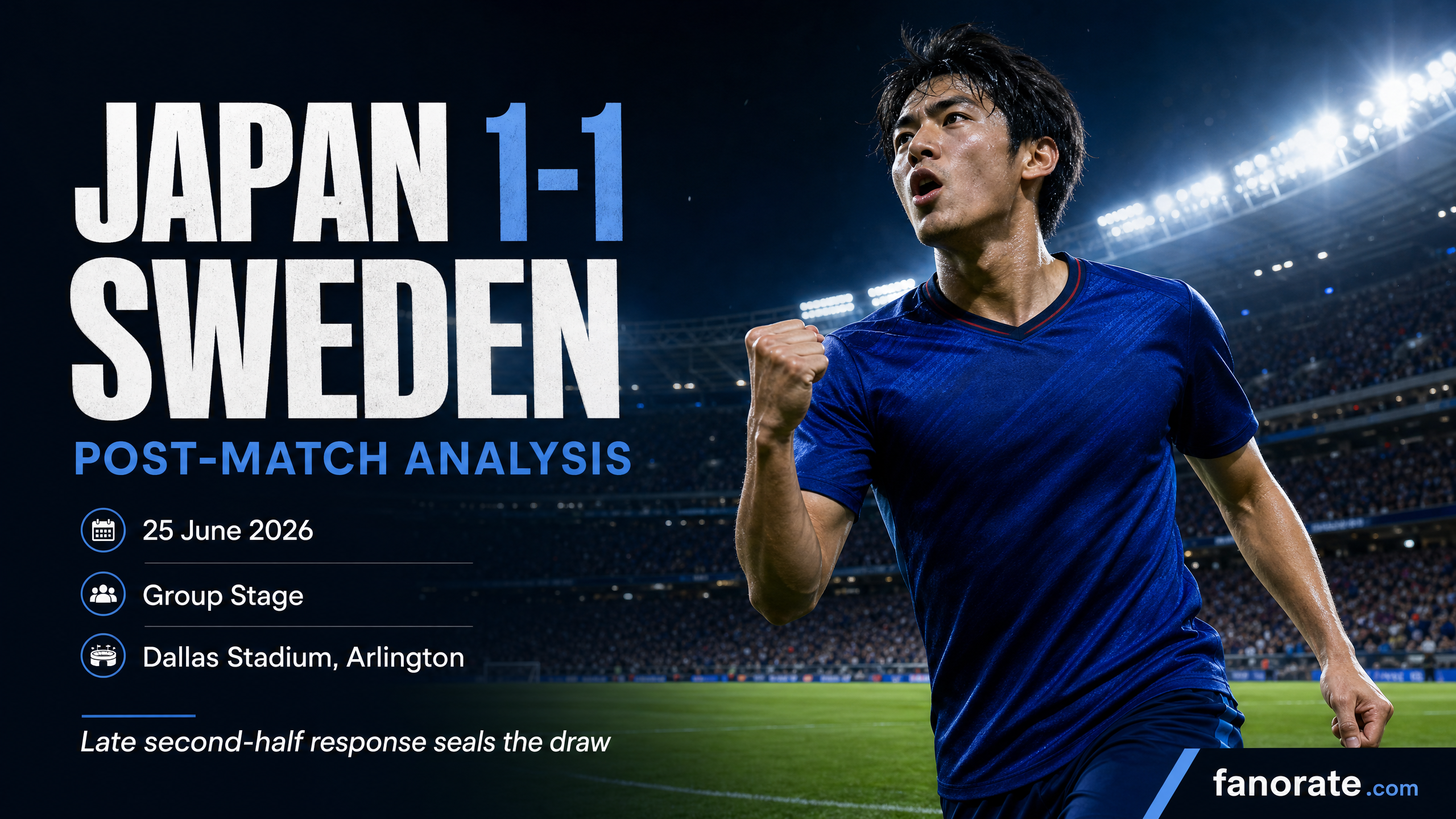
Japan vs Sweden 1-1 Draw: World Cup 2026 Group Stage Tactical Breakdown & Match Report
A second-half goal apiece from Daizen Maeda and Anthony Elanga secured a share of the spoils as Japan and Sweden played out a compelling 1-1 Group Stage stalemate at Dallas Stadium in Arlington. Neither side could find a winner, leaving both nations with crucial decisions ahead in their World Cup 2026 campaigns.
Match ended in a draw
What happened
Under the clear Texas skies at a near-capacity Dallas Stadium, Japan and Sweden played out one of the more tactically absorbing draws of the FIFA World Cup 2026 Group Stage. A goalless first half gave way to a fiercely contested second period, with Japan’s Daizen Maeda breaking the deadlock on 56 minutes before Anthony Elanga — the electric Nottingham Forest winger — restored parity for Sweden six minutes later. Both teams made sweeping changes in the final quarter, but neither could engineer a winner. The 1-1 scoreline leaves both nations in a precarious but not impossible position in the group standings, and the pressure heading into their respective next fixtures is now firmly dialled up.
How it was won and lost
Japan’s Controlled Possession Game Masks Defensive Caution
Japan dominated the ball throughout — finishing with 52% possession and an impressive 85% pass accuracy across 441 attempts — but their control was fundamentally conservative. Manager Hajime Moriyasu’s side appeared content to circulate possession and wait for openings rather than commit men forward aggressively. Their dangerous attack count (32 compared to Sweden’s 68) tells the real story: Japan kept the ball safely but rarely threatened to cut Sweden open in the final third. With only 8 total shots and 3 on target, the Blue Samurai prioritised structural integrity over offensive ambition for much of the contest.
Sweden’s Width and Crossing Threat Caused Persistent Problems
Sweden were the more direct and dynamically threatening side across large stretches of the match. Their 16 total crosses and 8 corners illustrate a clear tactical intention to exploit width and deliver into the box, where they won 7 successful headers. Viktor Gyökeres was a constant physical menace through central channels, drawing the yellow card in the 85th minute after a bruising encounter with Japan’s backline. Sweden’s 68 dangerous attacks to Japan’s 32 reflects a pressing, vertical game that created the conditions for Elanga’s equaliser — a move constructed precisely on the kind of wide overload and penetrating cross Sweden sought all evening.
First-Half Discipline Broken by Early Tactical Turbulence
The first half ended 0-0 but was far from uneventful beneath the surface. Isak Hien’s yellow card in the 32nd minute for Sweden proved consequential — forcing head coach Jon Dahl Tomasson’s hand with a 37th-minute substitution that brought Lucas Bergvall into the fray in place of the cautioned centre-back. Japan responded on 39 minutes, replacing Ko Itakura with Shogo Taniguchi, effectively a tactical mirror-image reshuffle. These early changes disrupted both teams’ intended defensive structures and arguably triggered the more open, goal-laden second half that followed.
The Substitution Wave That Reshaped the Second Half
Between the 66th and 75th minute, both managers made a collective eight substitutions that fundamentally altered the game’s complexion. Japan brought on Junya Ito and Koki Ogawa — injecting pace and directness — while Yuto Nagatomo and Tsuyoshi Watanabe added experience and defensive cover. Sweden countered with Ken Sema and Daniel Svensson, seeking renewed energy and width. The sheer volume of changes disrupted tempo and made coherent sustained pressing difficult for either side, ultimately resulting in a tense but increasingly fragmented final 15 minutes that neither team could convert into a winning goal.
Japan’s Defensive Discipline Under Pressure
Japan committed 20 fouls — significantly more than Sweden’s 11 — suggesting a team under sustained physical stress and willing to use the tactical foul to break Sweden’s attacking momentum. Their 13 tackles compared to Sweden’s 6, combined with 4 saves from goalkeeper Zion Suzuki and 5 shots blocked, painted a picture of a backline that worked hard and defended with genuine collective discipline. The one moment where the defensive structure fractured came in the 62nd minute when Elanga converted with an assist from Gyökeres, exposing Japan’s right channel with a combination that bypassed the press entirely.
Who decided it
Daizen Maeda
JapanThe Celtic forward provided Japan’s decisive moment, converting on 56 minutes from Ritsu Doan’s assist to give the Blue Samurai a first-half-to-second-half turnaround advantage. Maeda’s movement in behind Sweden’s defensive line was Japan’s most consistent attacking weapon before the substitution wave.
Maeda’s goal forced Sweden out of their defensive shape and temporarily compressed their midfield, creating space for Japan to threaten on transitions. His industry off the ball also made life difficult for Sweden’s centre-backs when building from deep.
Anthony Elanga
SwedenSweden’s wide attacker was a live wire throughout and capped a powerful individual performance with the 62nd-minute equaliser, finishing calmly from Viktor Gyökeres’ assist. His directness, dribbling threat, and ability to beat his marker in one-vs-one situations gave Japan’s right side persistent problems.
Elanga’s willingness to run directly at defenders and stretch Japan’s defensive shape horizontally was central to Sweden’s most dangerous moments. His goal came from exactly the type of wide exploitation Sweden had been targeting all game, making him the embodiment of Tomasson’s attacking blueprint.
Viktor Gyökeres
SwedenThe Sporting CP striker was a constant physical and technical threat through central channels, registering the assist for Elanga’s equaliser and earning a late yellow card for his combative style. He created space not only for himself but for Sweden’s supporting runners throughout.
Gyökeres’ ability to hold up play, bring wide players into dangerous positions, and draw multiple Japanese defenders toward him created the diagonal combinations that made Sweden’s attack genuinely difficult to contain. His assist on the equaliser was a trademark piece of link play.
Ritsu Doan
JapanThe Freiburg midfielder was Japan’s most creative force in the first half and into the second, registering the assist for Maeda’s opener before being replaced in the 66th minute. His ability to find pockets between Sweden’s lines and deliver incisive passes was Japan’s primary source of attacking creativity.
Doan’s press resistance and ability to turn in tight spaces provided Japan with the technical quality needed to convert possession into genuine attacking moments. His departure at 66 minutes was arguably a turning point in Japan’s ability to sustain forward momentum.
Zion Suzuki
JapanThe Japanese goalkeeper made 4 saves across the 90 minutes — the most of any single player in the match — and was fundamental to Japan maintaining parity as Sweden’s attacking pressure intensified. His distribution also contributed to Japan’s possession-based build-up.
Suzuki’s 4 saves — compared to Sweden keeper Jacob Widell Zetterström’s 2 — underlined the degree to which Sweden’s attacking output threatened Japan’s goal more directly in the second half. His performances kept Japan in the match during Sweden’s most dominant spell.
Where it sits in history
Japan and Sweden have met rarely on the grandest stages, making this World Cup 2026 Group Stage encounter a genuinely significant occasion for both footballing nations. Japan have made extraordinary strides as a football nation across the past two decades, cementing themselves as Asia’s dominant force and reaching consecutive knockout stages in recent World Cups. Sweden, despite the retirement of Zlatan Ibrahimović, have continued to produce world-class individual talent — evidenced by Gyökeres and Elanga — and remain a fixture at major tournaments. A draw at the World Cup between these sides was only the second time they had shared points in a competitive international fixture, adding quiet historical weight to what was, on the surface, a measured Group Stage result.
Inside the ground
Dallas Stadium in Arlington provided a spectacular backdrop for this FIFA World Cup 2026 Group Stage contest. With a capacity of 80,000 and a clear Texas night sky overhead, the atmosphere was vibrant and international in its flavour — a collage of Japanese blue and Swedish yellow that filled the stands with colour and noise. The 56th-minute Japan goal prompted an eruption of blue in the stands, while Elanga’s leveller drew a deafening Scandinavian response just six minutes later. The final whistle was met with mixed emotions — relief from Sweden, mild frustration from Japan — but the crowd acknowledged a genuinely absorbing contest worthy of the World Cup stage.
Looking ahead
Both Japan and Sweden now face pivotal moments in their FIFA World Cup 2026 Group Stage campaigns. A draw leaves neither side with the comfort of a clear lead, and the next round of fixtures will likely determine which team controls their own destiny heading into the final group day. Japan will need to sharpen their attacking edge — scoring more consistently and generating more dangerous chances — if they are to advance from the group. Sweden, meanwhile, will be encouraged by the way they absorbed Japan’s possession dominance and still found a way to equalise, but will need Gyökeres to be even more decisive in front of goal when the knockout stakes become real.
The bottom line
-
Japan dominated possession with 52% and 85% pass accuracy but generated only 3 shots on target — a productivity gap they must close
-
Sweden’s 68 dangerous attacks compared to Japan’s 32 shows Tomasson’s side were the more direct and threatening team despite less of the ball
-
Daizen Maeda broke the deadlock on 56 minutes with an assist from Ritsu Doan, giving Japan a second-half lead
-
Anthony Elanga equalised on 62 minutes with a Viktor Gyökeres assist, restoring parity in a six-minute swing that defined the match
-
Both teams made five substitutions each, with a collective eight changes arriving between the 66th and 75th minute in a tactical reshuffle that reshaped the game’s final act
-
Zion Suzuki made 4 saves for Japan — the highest individual save count in the match — underlining Sweden’s greater threat on goal
-
Viktor Gyökeres was Sweden’s physical and creative engine but will be unavailable for the next match if he picks up another yellow card
-
The 1-1 draw leaves both Japan and Sweden needing results in their next Group Stage fixtures to secure progression
