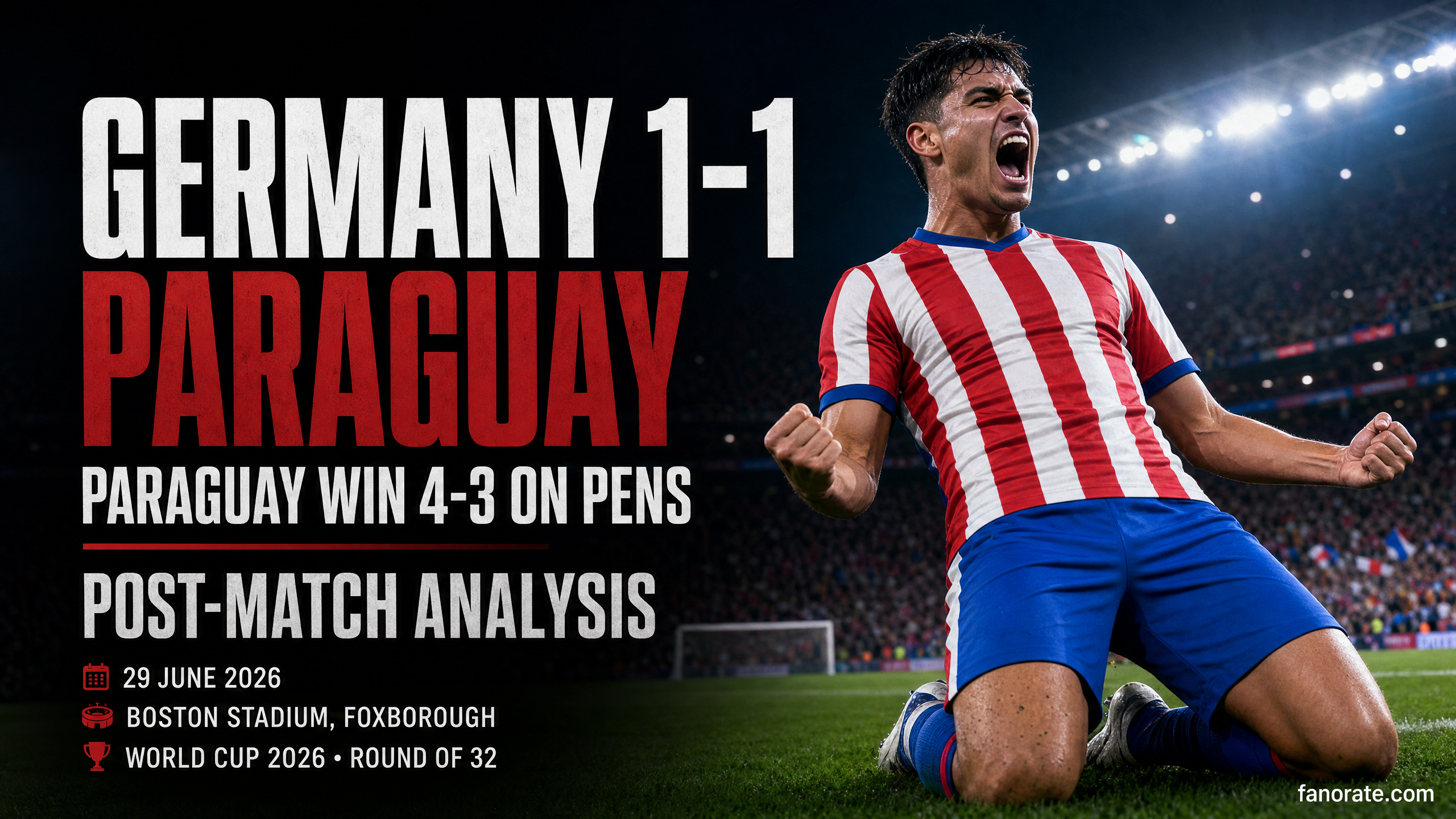
Germany vs Paraguay: World Cup 2026 Round of 32 Thriller Ends in Penalty Heartbreak for Die Mannschaft
Germany controlled 75% of the ball, fired 21 shots, and still found themselves eliminated by Paraguay on penalties at the FIFA World Cup 2026. Kai Havertz’s shootout miss proved fatal as Die Mannschaft’s tournament dream died in Foxborough.
Paraguay win 4-3 on penalties after 1-1 draw (AET)
What happened
There are World Cup exits that make sense and there are exits that defy logic. Germany’s Round of 32 elimination at the hands of Paraguay at Gillette Stadium falls firmly into the latter category. Die Mannschaft dominated from first whistle to last — 75% possession, 21 shots, 16 corners, 799 passes — and yet when the shootout lottery arrived, they blinked first. Kai Havertz, the man who had equalized on 54 minutes to haul Germany level, stepped up first and missed. Nick Woltemade and Jonathan Tah followed him into the void. Paraguay, resolute, disciplined, and ruthless from 12 yards, converted four of five to book a remarkable place in the Round of 16. Julian Nagelsmann’s side dominated every statistical category that matters in the build-up. None of it mattered under the cold arithmetic of a penalty shootout.
How it was won and lost
Paraguay’s Low Block: A Masterclass in Defensive Compactness
From the opening minutes, Paraguay head coach Gustavo Alfaro committed to a deep, disciplined defensive structure designed to deny Germany space between the lines. With just 25% possession across 120 minutes, the Paraguayans were unambiguous in their approach: sit deep, stay compact, and absorb pressure. Their defensive block rarely allowed Germany direct penetration centrally, forcing Nagelsmann’s side wide. Paraguay recorded 33 tackles and 13 interceptions, numbers that reflect an organized unit rather than mere desperation. The 8 shots blocked tells a similar story — bodies in the way, discipline maintained, shape preserved.
Germany’s Possession Dominance Without a Clinical Edge
Germany’s 799 passes with a 90% accuracy rate represented one of the most statistically dominant individual performances of the tournament, yet final-third quality proved elusive for large stretches. Die Mannschaft’s 56 total crosses — with only 10 accurate — highlighted their over-reliance on wide delivery against a physically robust Paraguayan backline that won 19 aerial duels. Germany created 10 key passes and 2 big chances but missed both. The pressing trap Paraguay set in their own half consistently recycled possession without allowing vertical progression. Germany’s failure to stretch the defensive block with runners in behind was a recurring tactical limitation.
Paraguay’s Devastating Counter-Punch Before Half-Time
Against the run of play, Paraguay struck with clinical precision just before the break. Matías Galarza Fonda’s assist released Julio César Enciso, who finished calmly to give the underdogs a 1-0 lead heading into half-time. The goal exemplified Paraguay’s transition threat — sitting deep to absorb German pressure and launching with speed and directness. With only 64 attacks compared to Germany’s 186, Paraguay demonstrated how efficiency can neutralize dominance. The timing of the goal, arriving in the 42nd minute, was psychologically significant, giving Alfaro’s side the half-time lead and a platform to defend.
Nagelsmann’s Half-Time Response and Goretzka’s Withdrawal
Germany made an immediate tactical adjustment at the break, withdrawing Leon Goretzka for Felix Nmecha, signaling a desire for greater dynamism in midfield rather than positional security. The change accelerated Germany’s forward play and within nine minutes of the restart, Kai Havertz leveled through a clinical Florian Wirtz assist. Nagelsmann subsequently withdrew Jamal Musiala at 63 minutes for Deniz Undav, seeking a more direct attacking presence, and later brought on Waldemar Anton to shore up defensive structure in extra time. The tactical reshuffling kept Germany dominant but never unlocked the decisive third-man combinations needed to break a determined Paraguayan rearguard.
Extra Time Tension and a Yellow Card Avalanche
Extra time degenerated into a physically intense, nervy affair. A VAR check on Jonathan Tah at 103 minutes added anxiety to Germany’s evening. Yellow cards flew — Gustavo Alfaro on the touchline, Julian Nagelsmann in response, Kai Havertz, Jamal Musiala, and Matías Galarza Fonda all cautioned. The hostile edge to proceedings reflected the enormous stakes. Germany continued pressing but Paraguay’s defensive resilience held firm through two periods of extra time without conceding. Both sides emerged from 120 minutes with the tie level, setting up the drama that would define the evening.
Penalty Shootout: Paraguay’s Nerve vs Germany’s Collapse
The shootout narrative was defined by Germany’s misses rather than Paraguay’s success. Havertz went first and failed, setting a nervy tone. Woltemade and Tah also missed, meaning Germany converted just 3 of their 5 kicks. Paraguay, by contrast, were composed and clinical — Mauricio Prado, Gustavo Gómez Portillo, and Matías Galarza all converted, with only Arnaldo Sanabria and Fabián Balbuena missing. A team that managed 25% possession and 7 shots had outlasted European giants in the cruelest format the game offers.
Who decided it
Julio César Enciso
ParaguayThe Brighton forward was Paraguay’s most dangerous attacking outlet, scoring the crucial 42nd-minute opener with a calm finish assisted by Galarza. He was substituted at 57 minutes, likely for tactical or fatigue reasons, but his goal proved the catalyst for one of the tournament’s great upsets.
Enciso’s ability to receive in tight spaces and turn on the ball gave Paraguay a genuine focal point in transition. His goal was not a fluke — it arrived from a well-rehearsed counter pattern that Germany failed to close down.
Kai Havertz
GermanyA tale of two moments. Havertz’s 54th-minute equalizer, converting a Florian Wirtz assist, was precisely the composed finish expected of a top-level international forward. His penalty shootout miss, however, opening the shootout, proved to be the defining and devastating moment of Germany’s World Cup.
Havertz operated as Germany’s central attacking reference point, linking play effectively and generating movement in the final third. His yellow card in extra time added to the pressure before the shootout. In a match defined by his brace of critical moments, Havertz embodies the cruel duality of tournament football.
Florian Wirtz
GermanyGermany’s most creative presence throughout, Wirtz delivered the assist for Havertz’s equalizer and consistently found pockets of space between Paraguay’s defensive lines. He was eventually withdrawn at 110 minutes for Nadiem Amiri, having driven German attacking play for the majority of a demanding 120-minute encounter.
Wirtz’s ability to receive under pressure, turn, and play forward was Germany’s primary mechanism for progression in tight spaces. Without his creativity, Germany would have struggled even more acutely to convert possession into genuine danger.
Roberto Fernández Torres
ParaguayThe Paraguayan goalkeeper was exceptional, making 6 saves across normal time and extra time to keep his side in the tie. With Germany launching 21 shots and 16 corners at his goal, Fernández Torres was under sustained bombardment and rose to the occasion repeatedly.
Without his shot-stopping contribution, Paraguay’s defensive structure would have been breached long before penalties. His composure during the shootout, watching opponents miss while his takers converted, was the final pillar of Paraguay’s historic victory.
Matías Galarza Fonda
ParaguayGalarza was Paraguay’s midfield engine — assisting the opening goal, carrying a yellow card into the shootout, and then stepping up to convert under maximum pressure. His performance encapsulated Paraguay’s spirit: aggressive, direct, and technically capable when it mattered most.
As the architect behind Enciso’s goal and a reliable defensive presence in midfield, Galarza provided the platform for Paraguay’s low block to function effectively. His work rate across 120 minutes was extraordinary given the limited possession his side held.
Joshua Kimmich
GermanyKimmich orchestrated Germany’s passing game with characteristic authority, contributing to the 799-pass tally and maintaining structural discipline throughout. He was one of Germany’s successful penalty takers, converting calmly in the shootout.
As the deep-lying pivot, Kimmich’s role in recycling possession and switching play was central to Germany’s dominance. However, his inability to unlock Paraguay’s block with incisive vertical passes highlighted the collective tactical limitation rather than any individual failing.
Where it sits in history
Germany’s penalty shootout exit in the Round of 32 represents one of the more stunning results in their World Cup history. Die Mannschaft, four-time world champions, have historically been penalty specialists — their 1990 World Cup final victory and 1982 semifinal shootout wins cemented that reputation. However, the 2026 elimination echoes the trauma of their 2018 group stage exit, suggesting structural questions remain beneath the surface of statistical dominance. For Paraguay, reaching the Round of 16 is a significant achievement. The Guaraní have historically punched above their weight on the international stage, reaching the quarterfinals in 2010, and this result — eliminating a European powerhouse on penalties — will be celebrated as one of their finest hours. It is also a broader statement about the competitive depth of CONMEBOL in the 2026 cycle.
Inside the ground
Gillette Stadium, with a capacity of 66,829, generated a cauldron atmosphere for a match that delivered every dramatic element World Cup knockout football promises. Germany’s traveling support, famously organized and vocally consistent, urged Die Mannschaft forward through 120 minutes of mounting frustration. Paraguay’s contingent, smaller in number but electric in voice, grew louder with every German shot that failed to find the net. The VAR check at 103 minutes and the cascade of yellow cards in extra time produced visible tension in the stands. By the time the penalty shootout began, the atmosphere had built to a breathless crescendo. Each Paraguayan conversion was met with delirium; each German miss with stunned silence from the blue and white sections of the stadium.
Looking ahead
Paraguay advance to the Round of 16 of the FIFA World Cup 2026, where they will face one of the tournament’s stronger sides with renewed belief and tactical clarity after this result. Their defensive structure will be tested against higher-quality opponents, but the psychological boost of eliminating Germany cannot be overstated. For Germany, the inquest begins immediately. With Nagelsmann’s project under scrutiny, questions about finishing quality, penalty preparation, and tactical flexibility in knockout football will dominate the post-tournament analysis. Die Mannschaft’s statistical dominance in Foxborough made their exit no less painful — perhaps more so. The margin of performance and the margin of the result have never been further apart.
The bottom line
-
Paraguay eliminated Germany on penalties (4-3) despite holding only 25% possession across 120 minutes
-
Julio César Enciso’s 42nd-minute opener gave Paraguay a half-time lead they almost defended entirely
-
Kai Havertz equalized on 54 minutes but then missed the first penalty of the shootout — a devastating irony
-
Germany generated 21 shots, 16 corners, and 799 passes but could not convert their overwhelming dominance
-
Roberto Fernández Torres made 6 saves to keep Paraguay level through normal and extra time
-
Joshua Kimmich and Nadiem Amiri converted for Germany but Havertz, Woltemade, and Tah all missed
-
Paraguay’s low block and disciplined transition plan was tactically executed to near-perfection
-
Gustavo Alfaro and Julian Nagelsmann both received yellow cards in a heated extra-time period
-
Germany’s World Cup exit raises serious questions about Nagelsmann’s system in knockout football
-
Paraguay’s Round of 16 place is one of the standout results of the 2026 tournament so far
