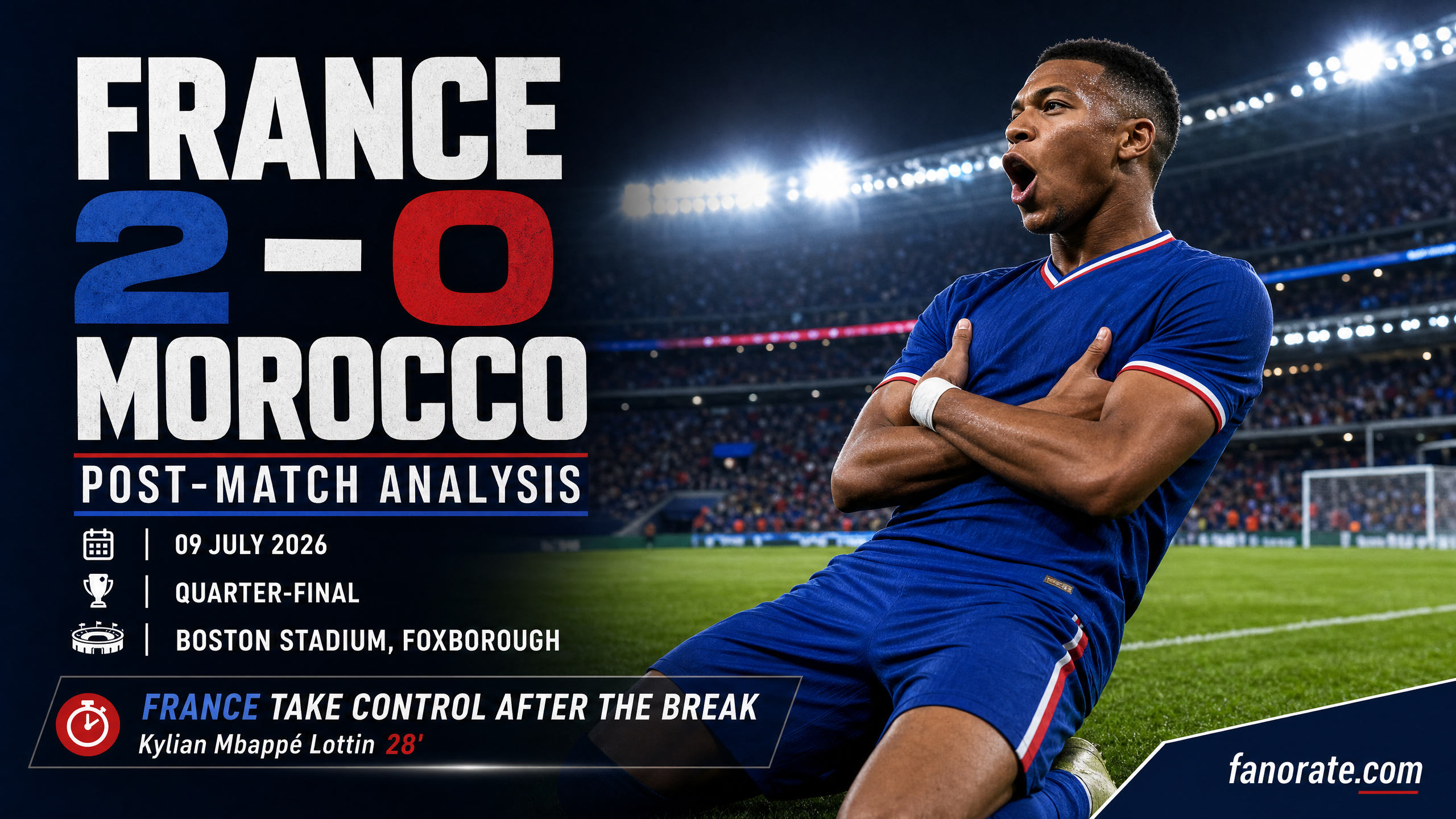
France 2-0 Morocco: Les Bleus Storm Into World Cup 2026 Semi-Finals With Clinical Second-Half Display
France weathered a first-half penalty miss from Mbappé before turning on the style after the break, with goals from Mbappé and Dembélé sealing a 2-0 quarter-final victory over Morocco at Boston Stadium.
France advance to the FIFA World Cup 2026 semi-finals
What happened
France are into the FIFA World Cup 2026 semi-finals after a composed, authoritative second-half performance dismantled a well-organized Morocco side at Boston Stadium in Foxborough. A goalless first half that included a Kylian Mbappé penalty miss belied the eventual margin of victory, but once Les Bleus found their rhythm after the break, the Atlas Lions had no answer. Mbappé opened the scoring on 60 minutes before Ousmane Dembélé doubled the advantage just six minutes later, ending Morocco’s World Cup dream in clinical fashion.
How it was won and lost
First-Half Stalemate: Morocco’s Defensive Discipline Frustrates France
Morocco arrived with a clear game plan: compress space centrally, limit France’s transition opportunities, and frustrate the world’s most dangerous attacking unit. With 52% possession in the first half, the Atlas Lions were surprisingly bold on the ball, completing 86% of their passes and using width effectively via Achraf Hakimi and Noussair Mazraoui. France’s 4-3-3 looked sharp in phases but struggled to unlock Morocco’s low defensive block. The defining moment came on 28 minutes when Mbappé stepped up from the spot only to see his penalty saved by Yassine Bounou — a moment that sent a wave of belief through the Moroccan camp and silenced the French supporters momentarily.
France’s Pressing Machine Shifts Gear After the Break
Didier Deschamps’ men returned from the interval with greater urgency and directness. France generated 113 attacks and 55 dangerous attacks across the match, but the second half saw a clear tactical shift towards quicker verticality. Rather than patiently probing, France began exploiting half-spaces more aggressively, with Désir Doué and Michael Olise providing creativity between the lines. France’s 21 total shots — 12 inside the box — reflected a side that increasingly dominated the physical and positional battles as the game progressed.
The Decisive Six-Minute Burst: Goals on 60 and 66 Minutes
The match turned emphatically in a six-minute window that Morocco simply couldn’t survive. Mbappé, refusing to let his penalty miss define his afternoon, converted on 60 minutes from a Désir Doué assist — a move built on sharp interplay and intelligent movement in behind. Just six minutes later, the roles reversed, with Mbappé threading a precise delivery to Dembélé who finished with characteristic composure. Two goals in six minutes effectively ended the contest and underscored France’s capacity to punish defensively resolute sides once even the smallest gap appears.
Morocco’s Structural Vulnerabilities Exposed in Transition
Despite their discipline, Morocco were exposed on two critical occasions by France’s explosive counter-attacking pace. With only 1 shot on target all match and 5 shots blocked, the Atlas Lions’ attacking threat never truly materialized at the level needed to threaten Brice Samba. Morocco’s 35 dangerous attacks suggest ambition, but their xG contribution was negligible. The substitutions of Amrabat and Rahimi on 62 minutes — moments after conceding — reflected a desperate tactical pivot that came too late to alter the match’s trajectory.
Defensive Solidity and Set-Piece Authority Underpin France’s Progression
France’s defensive structure was near-impeccable. Brice Samba was called upon for just 1 save across the entire match, a testament to the defensive partnership of Upamecano and Konaté, supported by the industrious Tchouaméni sitting deep. France won 41 duels to Morocco’s 36, completed 11 interceptions, and dominated aerial contests with 11 successful headers. France also hit the woodwork once, underlining their attacking dominance without over-extending defensively. The French backline’s positional discipline ensured Morocco’s 13 crosses yielded virtually nothing of consequence.
Who decided it
Kylian Mbappé Lottin
FranceThe French captain endured the lows of a missed 28th-minute penalty before emphatically responding with the opening goal on 60 minutes, assisted by Désir Doué, and then turning provider for Dembélé’s second on 66 minutes. Mbappé’s individual tournament story — resilience personified — continued in compelling fashion.
Mbappé’s movement between the lines and willingness to drop deep to receive possession created constant dilemmas for Morocco’s center-backs. His ability to recover psychologically from the penalty miss and immediately influence two goals showcased his world-class temperament. His substitution on 77 minutes was precautionary given the comfortable scoreline.
Ousmane Dembélé
FranceDembélé was France’s most consistently dangerous wide threat throughout the match, and his clinical finish on 66 minutes — drilled low from Mbappé’s precision assist — sealed Morocco’s fate. He was bright, direct, and a constant headache for Moroccan left-sided defenders.
Operating on the right flank, Dembélé’s direct dribbling stretched Morocco’s defensive shape horizontally, opening corridors for Mbappé and Thuram centrally. His 6 accurate crosses from 12 attempts and consistent pressing intensity made him one of the match’s dominant figures on both sides of the ball.
Désir Doué
FranceThe young PSG playmaker was France’s creative heartbeat in the second half, contributing the assist for Mbappé’s opener with an inventive, incisive pass that sliced through Morocco’s block. His combination play and press-resistance in tight areas were consistently impressive.
Doué operated as a fluid number ten, dropping between the lines to connect midfield and attack. His technical quality under pressure — evidenced by France’s 89% pass accuracy — and his ability to turn in tight spaces provided the creative spark that unlocked a well-organized Moroccan defensive structure.
Yassine Bounou
MoroccoMorocco’s goalkeeper was arguably their best performer, making 6 saves across the match and notably denying Mbappé from the penalty spot on 28 minutes. Without Bounou’s heroics, Morocco’s deficit could have been far heavier.
Bounou’s penalty save in the first half kept Morocco competitive and arguably preserved the team’s belief for another thirty minutes. His shot-stopping quality in a match where France generated 8 shots on target from 21 total attempts was the last line of a defense that was ultimately undone by elite finishing rather than defensive collapse.
Where it sits in history
This quarter-final rematch carried significant emotional weight. Morocco famously shocked the world at the 2022 FIFA World Cup in Qatar, becoming the first African nation to reach the semi-finals — a journey that ended at the hands of France in a 2-0 semi-final defeat. The 2026 edition offered Morocco the chance at revenge and another historic milestone, but France proved once again to be an immovable obstacle on the biggest stage. France’s passage to the semi-finals continues their record as one of the World Cup’s most reliable performers, having now reached the knockout rounds of every tournament since 2014. For Morocco, the quarter-final exit still represents a remarkable achievement for African football, and their 2022 legacy remains an inspiration across the continent.
Inside the ground
Boston Stadium in Foxborough provided a vibrant backdrop for this heavyweight quarter-final, with pockets of the 66,829-strong crowd draped in blue, white, and red alongside a sea of Moroccan green and red. The atmosphere surged when Bounou saved Mbappé’s penalty in the first half — Moroccan supporters erupting with the kind of raw passion that defined their 2022 journey. However, the mood shifted decisively in that lethal six-minute second-half spell. France’s travelling faithful, vocal and expectant throughout, reached fever pitch as Mbappé’s redemption goal hit the net, with Dembélé’s follow-up moments later sending them into near-delirium. Overcast skies with broken clouds did nothing to dampen the electricity inside one of North America’s finest football venues.
Looking ahead
France advance to the FIFA World Cup 2026 semi-finals, where Les Bleus will face one of the tournament’s remaining heavyweights. With Mbappé firing, Dembélé in form, and a defensively watertight structure, Deschamps’ side will fear no opponent. For Morocco, the tournament ends here, but their status as Africa’s standard-bearers in international football remains unchallenged. The Atlas Lions will reflect on a campaign that again demonstrated their tactical organization and collective spirit, even if the ultimate prize once more proved beyond reach.
The bottom line
-
France defeated Morocco 2-0 in the FIFA World Cup 2026 quarter-finals at Boston Stadium, Foxborough
-
Both goals came in a decisive six-minute second-half burst — Mbappé on 60′ and Dembélé on 66′
-
Mbappé missed a 28th-minute penalty but recovered brilliantly to score and assist in the same match
-
Morocco goalkeeper Yassine Bounou made 6 saves, denying what could have been a heavier scoreline
-
France dominated the shot count 21-5 and created 5 big chances against Morocco’s zero
-
Brice Samba made just 1 save, underlining France’s near-total defensive control
-
Morocco were eliminated at the quarter-final stage for the second consecutive World Cup by France
-
France advance to the semi-finals as one of the clear favourites to lift the 2026 World Cup trophy
