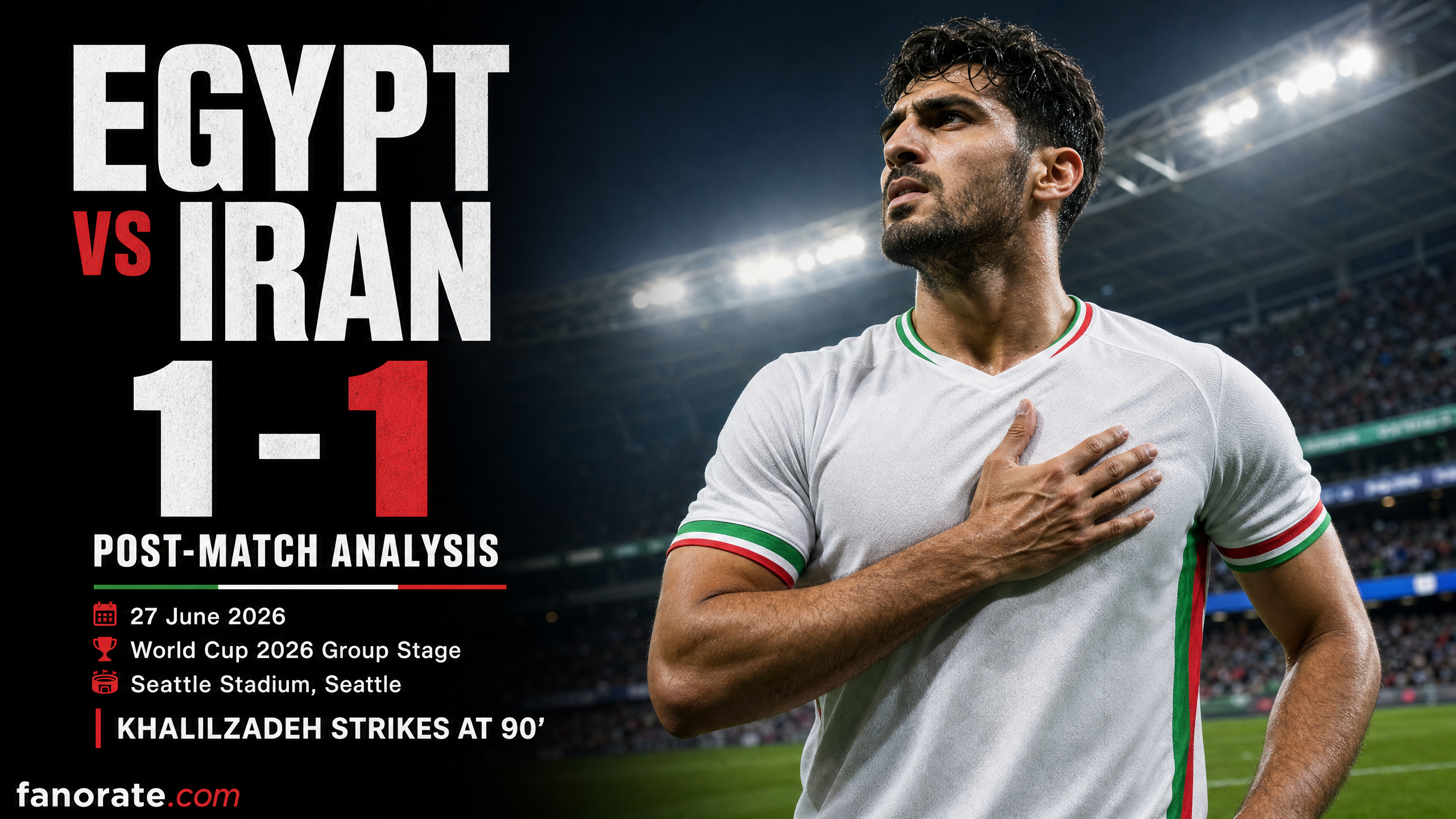
Egypt vs Iran 1-1 Draw: World Cup 2026 Group Stage Tactical Breakdown
A breathless first half featuring an early Egyptian goal, a missed Iranian penalty, and a rapid equalizer set the tone for a fiercely contested 1-1 draw between Egypt and Iran at Seattle Stadium in the FIFA World Cup 2026 Group Stage.
Draw
What happened
Under broken Pacific Northwest skies at Seattle Stadium, Egypt and Iran delivered a gripping Group Stage encounter that finished 1-1 — a result packed with early drama, disciplinary chaos, and tournament-defining implications. Mahmoud Saber fired Egypt ahead inside five minutes, only for Mehdi Taremi to squander a penalty six minutes later before Ramin Rezaeian levelled at the 14-minute mark. From that point, the match evolved into a tactical battle of attrition, with Egypt dominating possession at 62% but unable to convert their territorial advantage into a winner. Both nations now face a critical final group fixture with their World Cup fate delicately balanced.
How it was won and lost
Egypt’s Possession-Based Structure Smothers But Fails to Punish
Egypt set up in a controlled, possession-oriented system, accumulating 587 passes at an impressive 87% accuracy — nearly 200 more passes than Iran across 90 minutes. The Pharaohs consistently built from deep, using wide overloads and their 8 corners to create second-phase opportunities. However, despite 15 total shots and 47 dangerous attacks, Egypt created zero big chances according to the match data, suggesting their dominance was positional rather than penetrative. Their inability to stretch Iran’s defensive block through the final third ultimately cost them all three points.
Iran’s Low-Block Counter: Disciplined but Fragile
Iran opted for a compact defensive shape, conceding 62% of possession and sitting deep to invite Egypt onto them. With only 364 passes and a long-ball percentage sitting at 45% successful, Team Melli relied on direct transitions and the individual brilliance of Mehdi Taremi to threaten on the break. Their 38 dangerous attacks from just 100 total attacks reflects genuine efficiency in transition moments — but Taremi’s missed penalty at the 11th minute proved catastrophic to their winning ambitions. Iran hit the woodwork once, a cruel reminder of what might have been.
First-Half Chaos: Three Goals in Fourteen Minutes That Weren’t
The opening 14 minutes were breathtaking. Saber’s fifth-minute opener arrived with devastating directness, assisted by Mahmoud Ibrahim Hassan. Iran’s immediate response was a penalty — won and taken by Taremi — but the Inter Milan striker blazed his effort wide, a miss that momentarily appeared match-defining. Yet within three minutes, Rezaeian silenced the Egyptian end of Seattle Stadium with a composed equalizer, completing a remarkable nine-minute swing from 1-0 to penalty miss to 1-1. The second half, by contrast, was a chess match that neither side could crack open.
Substitution Wars: Marmoush Arrives, But Egypt Can’t Find a Winner
Egypt’s coaching staff threw on Omar Marmoush at half-time — a significant tactical injection — replacing Emam Ashour to add creative thrust in the second period. Despite generating 10 key passes across the team and attempting 20 dribbles, the Pharaohs lacked the clinical edge to breach Beiranvand. Iran’s switch of Shahriar Moghanlou for Saman Ghoddos at 67 minutes reinforced their midfield compactness. The late introduction of Alireza Jahanbakhsh in the 90th minute signalled Iran’s own push for a winner, but five yellow cards across both sides in a febrile second-half period told the story of a match where tension outweighed creative ambition.
Set-Piece Dominance Without Reward: Egypt’s Achilles Heel
Egypt earned 8 corners to Iran’s 2 and won 15 accurate crosses to Iran’s 1 — a staggering positional advantage. Yet with only 19 successful headers compared to Iran’s 29, Egypt were physically second-best in aerial duels despite controlling the ball. Iran’s defensive resilience from set-pieces, anchored by physical presence and compact organisation, denied the Pharaohs the dead-ball goal that their dominance arguably deserved. Egypt’s corner count was one of the highest in any Group Stage match at this tournament, yet the scoreline remained level — a genuine tactical frustration for their coaching staff.
Who decided it
Mahmoud Saber
EgyptThe Egyptian midfielder opened the scoring with just five minutes on the clock, capitalising on a sharp assist from Mahmoud Ibrahim Hassan to give the Pharaohs the perfect start. Saber was involved in the early tempo-setting phase but picked up a yellow card at 20 minutes and was eventually substituted at half-time for Marwan Attia — suggesting his disciplinary situation became a tactical liability.
His early goal forced Iran to chase the game immediately, contributing to the pressure that produced the penalty situation. His physical presence also drew fouls, though his yellow card limited his effectiveness in the second half.
Ramin Rezaeian
IranThe right-back turned goalscorer at the 14th minute, arriving with composure to restore parity for Iran after Taremi’s missed penalty. His equalizer fundamentally reshaped the match and ensured Iran’s low defensive block was operating from a position of security rather than desperation.
Rezaeian’s goal neutralised Egypt’s momentum at its peak. His attacking runs from deep also stretched Egypt’s defensive shape, creating the kind of second-phase chaos that suits Iran’s transition-heavy tactical model.
Mehdi Taremi
IranIran’s talisman endured a match of extreme contrasts. His missed penalty at the 11th minute — failing to capitalise on what could have been a 1-1 scoreline reversed — was the moment that defined Iran’s inability to take all three points. Taremi worked tirelessly as a focal point across 90 minutes, holding up play and creating link-up opportunities in Iran’s counter-attacking phases.
Taremi’s movement and physicality kept Egypt’s centre-backs honest throughout, and his ability to win aerial duels contributed to Iran’s remarkable 29 successful headers. The missed penalty, however, remains the defining moment that prevented Iran from potentially sealing a crucial Group Stage victory.
Omar Marmoush
EgyptIntroduced at half-time for Emam Ashour, Marmoush brought urgency and directness to Egypt’s attacking play in the second period. His energy and technical ability provided a new dimension as Egypt sought the winner, with his dribbling attempts and progressive carrying adding dynamism to a side that had become too predictable in the final third.
Marmoush’s arrival shifted Egypt’s attacking shape, creating wider overload opportunities and forcing Iran deeper. Despite not registering a goal or assist, his presence altered the game’s dynamics and reflected Egypt’s tactical intent to push for three points.
Mohamed El Shenawy
EgyptEgypt’s goalkeeper made 3 saves across the match, preserving his side’s point during Iran’s counter-attacking moments. With Iran managing 12 total shots and 4 on target, El Shenawy was called upon at crucial moments and responded with composure.
El Shenawy’s reliability behind a back line that conceded dangerous attacks allowed Egypt to commit more players forward in search of a winner. His saves ensured the draw remained intact when Iran threatened on the break.
Where it sits in history
Egypt and Iran have limited World Cup history against each other, making this Group Stage encounter a relative rarity on the global stage. For Egypt, their FIFA World Cup 2026 campaign represents a continued effort to re-establish themselves as Africa’s premier football nation after years of near-misses in qualification. The Pharaohs — led by the iconic Mohamed Salah — remain one of Africa’s most storied football nations, with their record seven Africa Cup of Nations titles reflecting a footballing culture built for tournament football. Iran, meanwhile, have become a consistent Asian qualifier, and their tactical evolution under a defensive, transition-focused approach has made them a difficult opponent for any Group Stage rival. A draw in Seattle extends a Group Stage tradition of closely contested encounters between these two nations, both of whom will now look nervously at the standings as the group reaches its decisive final matchday.
Inside the ground
Seattle Stadium — a venue that has become one of the surprise stars of the FIFA World Cup 2026 — provided a stunning backdrop for this Group Stage clash. The Egyptian support, renowned for their passionate and vocal backing, created an intense atmosphere from the opening minute, amplified when Saber’s fifth-minute goal sent their end of the 68,740-capacity stadium into raptures. Iran’s travelling support responded with equal fervour following Rezaeian’s equalizer, creating the kind of competitive atmosphere that makes the World Cup Group Stage uniquely electric. By the febrile closing stages — with yellow cards flying, a VAR check for Shoja Khalilzadeh, and five bookings in the final 15 minutes — the stadium crackled with nervous tension, befitting a match where two nations’ World Cup dreams hung in the balance under the Seattle clouds.
Looking ahead
Both Egypt and Iran enter the decisive final Group Stage matchday with their tournament ambitions firmly on the line. Egypt, with their superior possession stats and attacking intent, will need to convert dominance into goals if they are to advance — a problem this draw has cruelly underlined. The return of Omar Marmoush to the starting line-up may be a priority for their coaching staff after his half-time impact. Iran, for their part, will be encouraged by their defensive resilience and transition threat, but Taremi’s missed penalty will haunt their analysis sessions. With a draw the outcome here, both nations now require victory in their final group fixture to confidently secure progression, setting up what promises to be two unmissable World Cup climax encounters.
The bottom line
-
Egypt dominated possession with 62% and 587 passes but failed to create a single big chance, highlighting a gulf between territorial control and genuine penetration.
-
Mehdi Taremi’s missed penalty at the 11th minute proved decisive — Iran’s inability to capitalise on that moment ultimately cost them a potential winner.
-
Ramin Rezaeian’s rapid equalizer at 14 minutes reset the match and allowed Iran to regroup into their preferred defensive-transition shape.
-
A combined seven yellow cards across the match — including a late VAR incident involving Khalilzadeh — reflects the high-stakes intensity of the Group Stage encounter.
-
Iran’s remarkable 29 successful headers compared to Egypt’s 19 underlines how Team Melli negated Egypt’s set-piece and crossing threat despite numerical inferiority in possession.
-
Omar Marmoush’s half-time introduction added creative urgency for Egypt but could not break down Iran’s disciplined defensive structure.
-
Both nations remain level in the group standings, setting up a thrilling final matchday where neither side can afford to drop points.
