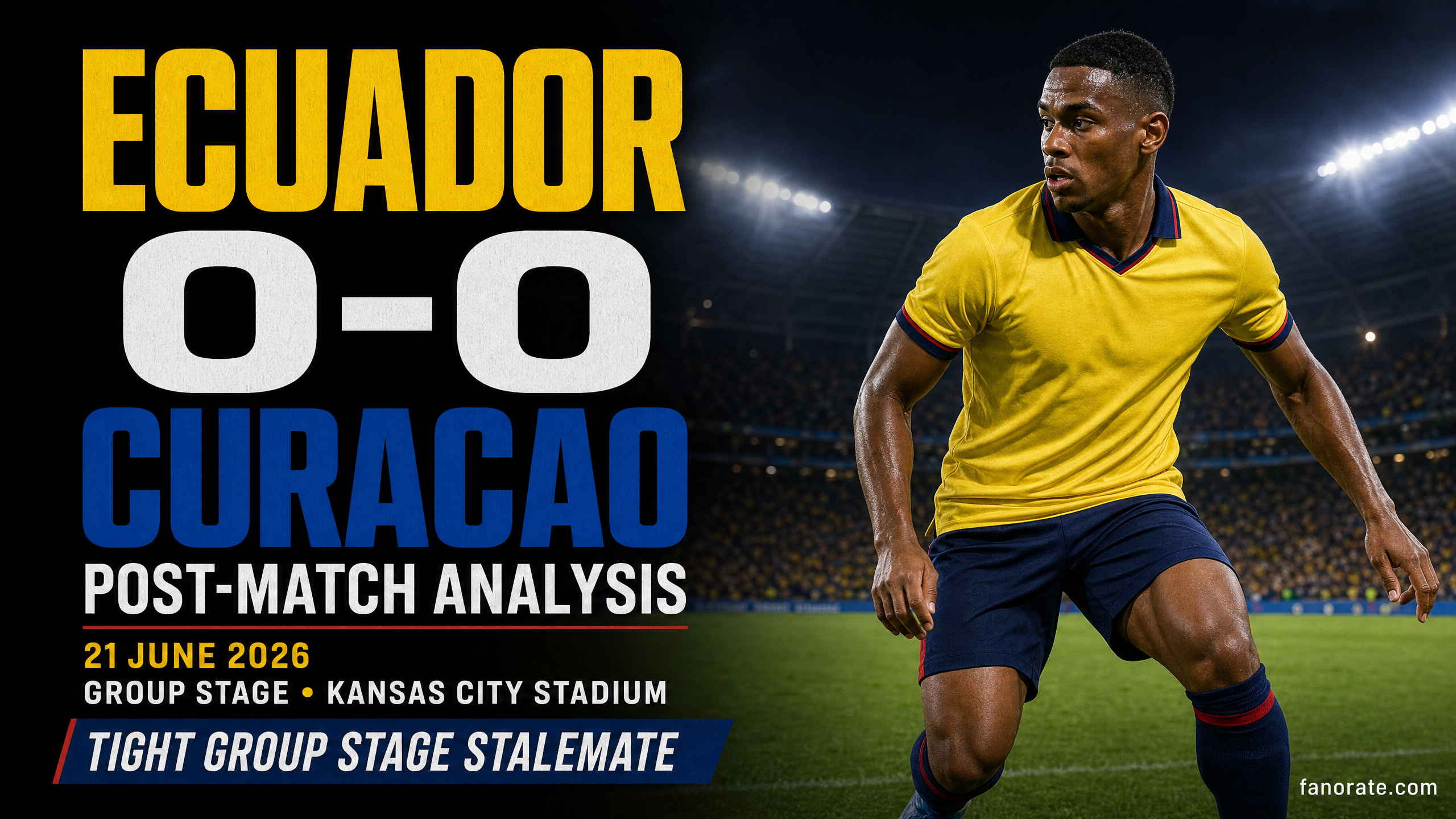
Ecuador 0-0 Curacao: La Tri Dominate but Fail to Convert in Kansas City Stalemate | FIFA World Cup 2026
Ecuador controlled the ball, the space, and nearly every statistical category — but Curacao’s disciplined defensive block and La Tri’s glaring wastefulness in front of goal combined to produce a stunning 0-0 stalemate at Kansas City Stadium that will send shockwaves through Group Stage calculations at the 2026 FIFA World Cup.
What happened
Under overcast Kansas City skies, Ecuador arrived as heavy favourites against a Curacao side making one of the most remarkable appearances in FIFA World Cup history. What followed was a masterclass in frustrated dominance. La Tri enjoyed overwhelming possession, generated a mountain of chances, and recorded an xG north of 3.22 — yet walked off the pitch without a single goal to show for it. Curacao, disciplined, organised, and resolute, held firm through wave after wave of Ecuadorian pressure to claim a point that will be celebrated across the Caribbean island as one of their greatest footballing achievements. For Ecuador head coach, the result is a damaging dropped two points that immediately complicates their Group Stage ambitions at the 2026 World Cup.
How it was won and lost
Ecuador’s Possession Stranglehold Goes Unrewarded
Ecuador were suffocating in their control of the ball, completing 577 of 641 attempted passes for an accuracy rate of approximately 90%, compared to Curacao’s 154 completions from 223 attempts. La Tri’s 62% possession share was matched by an aggressive pressing structure that regularly pinned Curacao deep into their own half. Ecuador attempted 28 dribbles and won 13 of them, showing an intent to break lines and exploit half-spaces. Despite this mechanical dominance, the final third proved elusive — a combination of clinical defending, poor decision-making in the penalty area, and a goalkeeper inspired kept the scoreline blank.
Curacao’s Low Block Defied the Statistics
Curacao set up in a compact, defensively rigid shape that prioritised denying Ecuador space in behind and limiting shots on target. Their 37% possession share was by design rather than weakness, with the island nation content to absorb pressure and hit on the counter. With only 7 shots compared to Ecuador’s 13, Curacao showed remarkable defensive discipline. Their four recorded shots on target — matching Ecuador’s numbers in that metric — suggest they were dangerous on the break when the opportunity arose, with an xG of 0.57 indicating their limited chances were reasonable in quality. The Bacuna brothers, Leandro and Juninho, were central to Curacao’s midfield resilience until both collected fouls that disrupted their rhythm.
Substitution Wave Fails to Break the Deadlock
Ecuador’s technical staff threw on fresh legs throughout the second half, with Nilson David Angulo Ramírez introduced at 71 minutes in place of left-back Pervis Estupiñán, reflecting an attempt to inject more attacking width. As the game entered its final quarter, both sides made mass changes — Curacao introduced Kenji Gorré, Roshon van Eijma, Jearl Margaritha, Gervane Kastaneer, and Godfried Roemeratoe in a flurry between the 75th and 84th minutes. Ecuador responded with Angelo Smit Preciado and Jordy Caicedo from the bench. Despite nine substitutions between the two teams across the second half, neither side could manufacture a breakthrough, with Ecuador’s xG of 3.23 standing as a damning indictment of their finishing.
Set-Piece Threat Unused by Ecuador
Ecuador recorded five corners and five other set-piece situations — a significant weapon that ultimately yielded nothing. With tall, technically gifted centre-backs in Felix Torres and William Pacho, La Tri possessed the aerial quality to threaten from dead-ball situations. The fact that none of these opportunities produced even a clear headed chance on goal will concern the coaching staff ahead of their remaining Group Stage fixtures. Curacao, by contrast, recorded zero corners, a telling indicator of just how little they engaged in offensive territory.
Who decided it
Eloy Room
CuracaoThe Curacao goalkeeper was the undisputed hero of the Kansas City stalemate. Facing an Ecuador side that generated an xG of 3.23 and attempted 13 shots, Room produced a commanding performance between the posts. His shot-stopping, positioning, and ability to command his area under sustained pressure were instrumental in securing a historic point for the Caribbean nation.
Room’s saves were not just reflexive — they were positionally intelligent. By cutting off angles and claiming crosses from Ecuador’s wide threats, he single-handedly neutralised a dominant attacking unit and handed Curacao one of the most celebrated results in their brief international footballing history.
Moisés Caicedo
EcuadorThe Brighton and Hove Albion midfielder was Ecuador’s most dynamic presence in the engine room, registering 24 ball recoveries and demonstrating his elite press-resistance and passing range. With 641 passes attempted at team level and Ecuador moving the ball with purpose, Caicedo was the conductor of La Tri’s rhythmic possession game.
Caicedo’s ability to win the ball and immediately transition Ecuador from defence to attack was their most reliable source of momentum. His workrate in covering ground both defensively and in support of forward runs ensured Curacao rarely had sustained spells of possession when he was on the pitch.
Leandro Bacuna
CuracaoThe Curacao captain and attacking midfielder was involved in nearly every significant moment in the first half, drawing a foul in the 39th minute that disrupted Ecuador’s rhythm and providing leadership when his side were under the cosh. His composure on the ball in tight spaces was essential to Curacao’s ability to relieve pressure when needed.
Bacuna’s tactical intelligence in positioning between Ecuador’s midfield lines allowed Curacao to play out of their defensive shape on occasion and gave the team a focal point when transitioning forward. His substitution later in the game was a necessary freshening of legs but momentarily destabilised Curacao’s structure.
Ray Kendry Páez Andrade
EcuadorThe young Ecuador playmaker was arguably La Tri’s most inventive attacking presence, operating with creativity and directness in the spaces behind Curacao’s defensive line. His dribbling attempts and forward passing were consistent highlights in an otherwise frustrating attacking display for Ecuador.
Páez Andrade’s ability to carry the ball forward and draw defenders created pockets of space for Ecuador’s wide forwards, but his and his teammates’ inability to apply the clinical finish meant his creative contributions ultimately went unrewarded in the statistics that matter most.
Where it sits in history
This result is seismic in the context of Curacao’s football history. The Caribbean nation — a constituent country of the Kingdom of the Netherlands with a population of just over 150,000 — has produced a remarkable generation of professional footballers playing across Europe’s top leagues, but reaching the FIFA World Cup has been the ambition that has long escaped them. To not only qualify for the 2026 tournament but to hold a South American nation to a scoreless draw in the opening Group Stage match is a watershed moment for Caribbean football. Ecuador, meanwhile, have been a fixture at recent World Cups — qualifying for 2002, 2006, 2014, and 2022 — and their inability to break down a minnow side mirrors a historical tendency to underperform against defensive opponents despite controlling matches statistically. The 2022 World Cup saw Ecuador exit in the Group Stage despite a strong opening, and another stumble here risks a premature departure from the 2026 tournament on home soil.
Inside the ground
Kansas City Stadium, with a capacity of 76,416, provided an electric backdrop for this unexpected tactical encounter. The North American World Cup atmosphere brought together a predominantly Ecuador-supporting crowd, with the yellow of La Tri overwhelming the stands — though a passionate pocket of Curacao supporters made themselves heard throughout. The overcast Kansas City skies did nothing to dampen the noise as Ecuador pressed for a breakthrough, and when the final whistle confirmed the 0-0, the disbelief among the Ecuador fans was palpable — while the scenes among the Curacao contingent bordered on jubilant chaos, their celebrations entirely justified given the magnitude of the result.
Looking ahead
Ecuador now face a critical reassessment before their next Group Stage fixture. Dropping two points against Curacao in their opening match means La Tri cannot afford further slip-ups if they are to advance to the knockout rounds at the 2026 FIFA World Cup. Head coach will need to address the glaring wastefulness in front of goal — an xG of 3.23 with zero goals scored is simply not sustainable at this level. Strikers John Zamora and Kevin Rodríguez, replaced at half-time, will face scrutiny, while Jordy Caicedo offers a more physical threat from the bench. For Curacao, this point could be the foundation of a fairytale Group Stage campaign. They will now believe they can take points off anyone, and the confidence flowing from this result in Kansas City should fuel their remaining matches with an energy and belief that no pre-tournament calculation factored in.
The bottom line
-
Ecuador dominated possession with a 62% share and 641 passes but were unable to convert an xG of 3.23 into a single goal
-
Curacao’s disciplined low-block defensive structure frustrated one of CONMEBOL’s most established World Cup nations
-
Eloy Room was man of the match with a commanding goalkeeping display against sustained Ecuadorian pressure
-
The result is arguably the greatest in Curacao’s footballing history and a landmark moment for Caribbean football
-
Ecuador’s Moisés Caicedo was their standout outfield performer but received no attacking dividend for his midfield excellence
-
Nine substitutions across both teams in the second half failed to change the game’s fundamental dynamic
-
Ecuador’s set-piece threat — five corners, five set pieces — went entirely to waste despite their aerial quality
-
The 0-0 draw immediately complicates Ecuador’s 2026 FIFA World Cup Group Stage progression calculations
