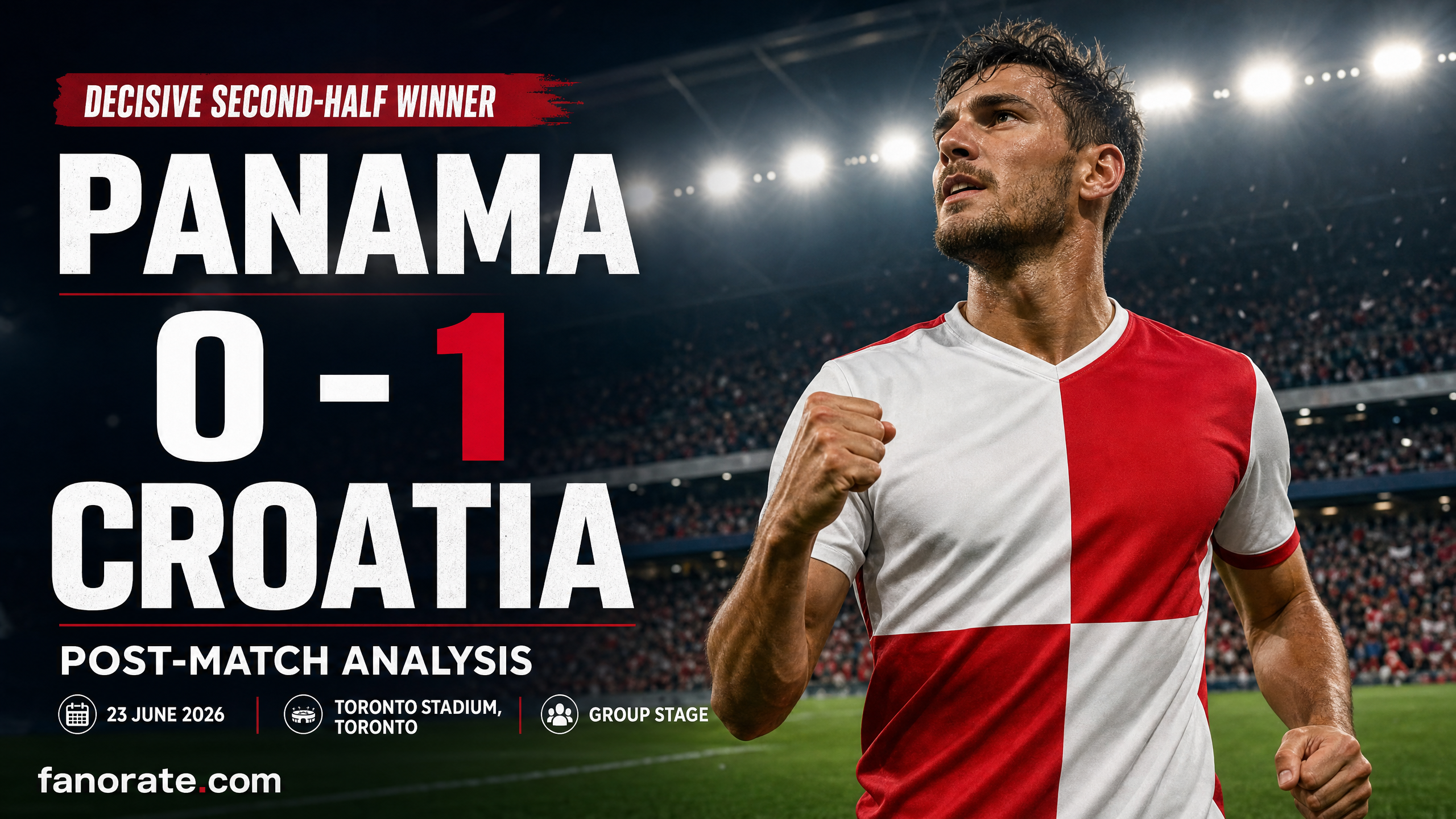
Croatia Edge Panama 1-0 in Toronto | FIFA World Cup 2026 Group Stage Recap
A second-half masterclass in pragmatic football saw Croatia grind out a 1-0 win over Panama at Toronto Stadium. Ante Budimir, introduced at half-time, headed home from a Josip Stanisic assist to hand the Vatreni three crucial Group Stage points under the overcast Toronto sky.
Croatia win
What happened
Croatia arrived in Toronto as heavy favourites against a Panama side making only their second-ever World Cup appearance, and Zlatko Dalić’s men delivered exactly the kind of measured, professional performance their experience demands. A goalless first half gave way to a decisive second-half surge, as two halftime substitutions — Ante Budimir and Andrej Kramarić replacing Petar Musa and Joško Gvardiol — instantly reshaped Croatia’s attacking energy. Budimir wasted no time justifying that selection, converting a clinical header from Josip Stanisic’s cross in the 54th minute to settle what had been a surprisingly competitive contest. Panama pressed with admirable ambition — outperforming their opponents in long balls and direct attacking attempts — but Croatia’s defensive solidity and superior ball retention ultimately told a familiar story: the Vatreni finding a way to win without ever shifting into top gear.
How it was won and lost
Croatia’s Halftime Reset Unlocks the Game
Zlatko Dalić’s double substitution at the break was tactically calculated and immediately effective. Bringing on Ante Budimir for the more mobile Petar Musa introduced a powerful aerial presence in the box, while swapping Joško Gvardiol — who may have been managing a knock — for Andrej Kramarić added a sharper creative link between midfield and attack. The goal arrived within nine minutes of the restart, confirming that Croatia’s second-half tactical reset completely changed the game’s dynamics. Josip Stanisic’s overlapping run from right back created the delivery, and Budimir’s movement off the ball separated him from his marker at the crucial moment.
Croatia’s Possession Dominance and Press Resistance
Croatia controlled the game through ball retention, completing 432 accurate passes from 514 attempts — an 84% accuracy rate — compared to Panama’s 278 from 358. The Vatreni held 58% possession across the match and demonstrated strong press resistance in midfield, with Mateo Kovačić and Luka Modrić recycling possession efficiently against Panama’s mid-block. Croatia’s higher progressive pass count (type_27265: 33 vs Panama’s 42) shows Panama did attempt to play forward more directly, but Croatia’s defensive block absorbed the pressure comfortably, conceding just six shots on target and one yellow card.
Panama’s Direct Approach and Defensive Resilience
Panama were not passive opponents. They launched 19 long balls to Croatia’s 12, attempted more dribbles, and won more aerial duels proportionally in the first half. Bárcenas Herrera and Ismael Díaz were active on the wings, creating brief moments of danger through direct runs in behind. Panama’s defensive block frustrated Croatia for long stretches of the first half, forcing the European side to probe patiently without penetrating. However, Panama’s xG of just 0.466 — compared to Croatia’s 1.0152 — reveals how little genuine threat they generated in front of goal despite their energetic pressing.
Modrić as Conductor, Not Goal Threat
Luka Modrić’s role in this match was quintessentially modern — a deep-lying playmaker orchestrating tempo rather than driving at defences. He was quietly influential throughout before being withdrawn in the 81st minute for Mario Pašalić. Modrić’s passing range and spatial intelligence kept Croatia’s structure tight and their build-up fluid, with Kovačić doing the more combative pressing work beside him. Together they formed the engine room that prevented Panama from sustaining their attacking transitions into meaningful chances.
Croatia’s Defensive Discipline Shuts the Door
Croatia’s backline — marshalled by Marin Pongracic and Josip Šutalo with Stanisic and Gvardiol (later replaced) as fullbacks — kept Panama’s attack well below their potential. Croatia conceded zero goals, recorded two blocks, and the goalkeeper Dominik Livaković was rarely troubled, with Panama’s expected goals against sitting at just 0.466. The type_1605 completion metric showed Croatia at 100% in a key defensive metric vs Panama’s 53%, indicating Croatia’s superiority in winning individual defensive duels when it mattered most.
Who decided it
Ante Budimir
CroatiaIntroduced at halftime, Budimir took just nine minutes to justify his selection with a composed headed goal from Josip Stanisic’s right-wing cross in the 54th minute. He held the ball effectively, challenged aerially, and brought a physicality to Croatia’s attack that Panama’s centre-backs struggled to contain.
His presence as a classic targetman immediately changed Croatia’s attacking shape, drawing defenders higher and creating more second-ball situations for Kovačić and Kramarić to exploit. The goal itself was a masterclass in striker movement — arriving late, losing the marker, and finishing with authority.
Mateo Kovačić
CroatiaKovačić was Croatia’s midfield heartbeat, completing passes with efficiency and winning possession in key areas throughout the 72 minutes he played before making way for Petar Sučić. His pressing triggers were sharp and his distribution kept Croatia’s structural balance intact.
Operating as the more dynamic of the two central midfielders alongside Modrić, Kovačić provided the pressing intensity Croatia needed to prevent Panama from building through the thirds. His ability to recover possession quickly was critical in neutralising Panama’s direct attacks.
Josip Stanisic
CroatiaThe right back was Croatia’s most consistently dangerous attacking outlet, providing the assist for Budimir’s winning goal with a well-timed overlapping run and precise cross. He contributed positionally throughout, maintaining Croatia’s width and balance on the right flank.
Stanisic’s willingness to arrive late into crossing positions gave Croatia an extra attacking dimension on the right side that Panama struggled to track, particularly in transition. His assist was the decisive act of the match.
Luka Modrić
CroatiaThe legendary midfielder played 81 minutes, quietly controlling tempo and orchestrating Croatia’s possession sequences with characteristic intelligence. He was withdrawn for Pašalić as Croatia managed the closing stages.
Modrić’s positional discipline and ability to retain possession under pressure prevented Panama from sustaining attacking spells. He remains the critical reference point for Croatia’s build-up geometry, even at this stage of his international career.
Luis Mejía Cajar
PanamaPanama’s goalkeeper was his team’s standout performer, facing Croatia’s 15 shots with alertness and making several saves that kept his side in the game for long stretches. He was ultimately beaten by Budimir’s precise header but had no chance of stopping it.
Mejía Cajar’s performances gave Panama a platform to compete in a match they were expected to lose heavily. His shot-stopping kept the deficit to a single goal and will be a source of national pride regardless of the result.
Where it sits in history
Croatia have now demonstrated their capacity as a tournament team capable of winning ugly — a hallmark of their modern identity since their remarkable run to the 2018 World Cup final in Russia. This Group Stage victory recalls their pragmatic approach from France 2018 and Qatar 2022, where efficient, professional wins over smaller nations set the foundation for deep tournament runs. For Panama, the challenge of competing at a second World Cup remains steep. Their debut came in 2018 in Russia, where they were eliminated without a win. Facing Croatia — a nation with a World Cup final and two bronze medals to their name — represented the sort of gulf in tournament experience that still defines CONCACAF’s challenge at the highest level. The 2026 FIFA World Cup marks a historic edition as the first to feature 48 teams across three host nations — the United States, Canada, and Mexico — and Toronto’s hosting of this match underlines Canada’s growing role in elite international football infrastructure.
Inside the ground
Toronto Stadium, with its 45,700-capacity venue under overcast skies, provided an atmospheric backdrop for what turned into a tightly contested Group Stage encounter. The Croatian diaspora — historically vocal and visually striking with their chequered red-and-white jerseys — created pockets of genuine noise, particularly when Budimir’s header hit the net. Panama supporters, buoyant with the pride of a second World Cup appearance, were determined to make themselves heard throughout, particularly during the first half when their team competed on more even terms. The damp, grey Toronto weather gave the occasion a gritty northern European feel — perhaps ironically suiting Croatia’s measured, professional performance style more than Panama’s sun-kissed Caribbean flair.
Looking ahead
Croatia move forward in Group Stage competition with three points on the board, bolstering their hopes of advancing from the group with confidence. Dalić will be pleased with the clean sheet but will demand more creative fluidity in attacking transitions as the tournament progresses — particularly if Croatia are to threaten the latter stages as they did in 2018 and 2022. Panama, now needing results to stay alive in the group, face a significant challenge. Their defensive resilience and direct play will need to translate into goals if they are to avoid a group-stage exit. Their next assignment will be critical, requiring at minimum a point to keep their World Cup 2026 campaign alive. Ante Budimir’s impact from the bench will dominate selection discussions heading into Croatia’s next fixture, with Dalić likely to consider his starting inclusion given the instant impact he delivered in Toronto.
The bottom line
-
Croatia secured a 1-0 victory over Panama in the FIFA World Cup 2026 Group Stage at Toronto Stadium
-
Ante Budimir scored the decisive goal in the 54th minute from a Josip Stanisic assist, just nine minutes after being introduced at halftime
-
Croatia dominated possession with 58%, completing 432 of 514 passes at an 84% accuracy rate
-
Croatia’s xG of 1.0152 significantly outperformed Panama’s 0.466, reflecting their superior shot quality
-
Luka Modrić played 81 minutes as the conductor of Croatia’s midfield before being replaced by Mario Pašalić
-
Panama showed competitive spirit — particularly in the first half — but lacked the finishing quality to threaten Livaković’s goal
-
Zlatko Dalić’s halftime double substitution was the tactical turning point that unlocked the match
-
Croatia kept a clean sheet, maintaining their tournament pedigree as a defensively reliable unit
-
Panama will need results in their remaining group matches to avoid an early World Cup exit
-
This result continues Croatia’s strong record of grinding out results at World Cup Group Stage level
