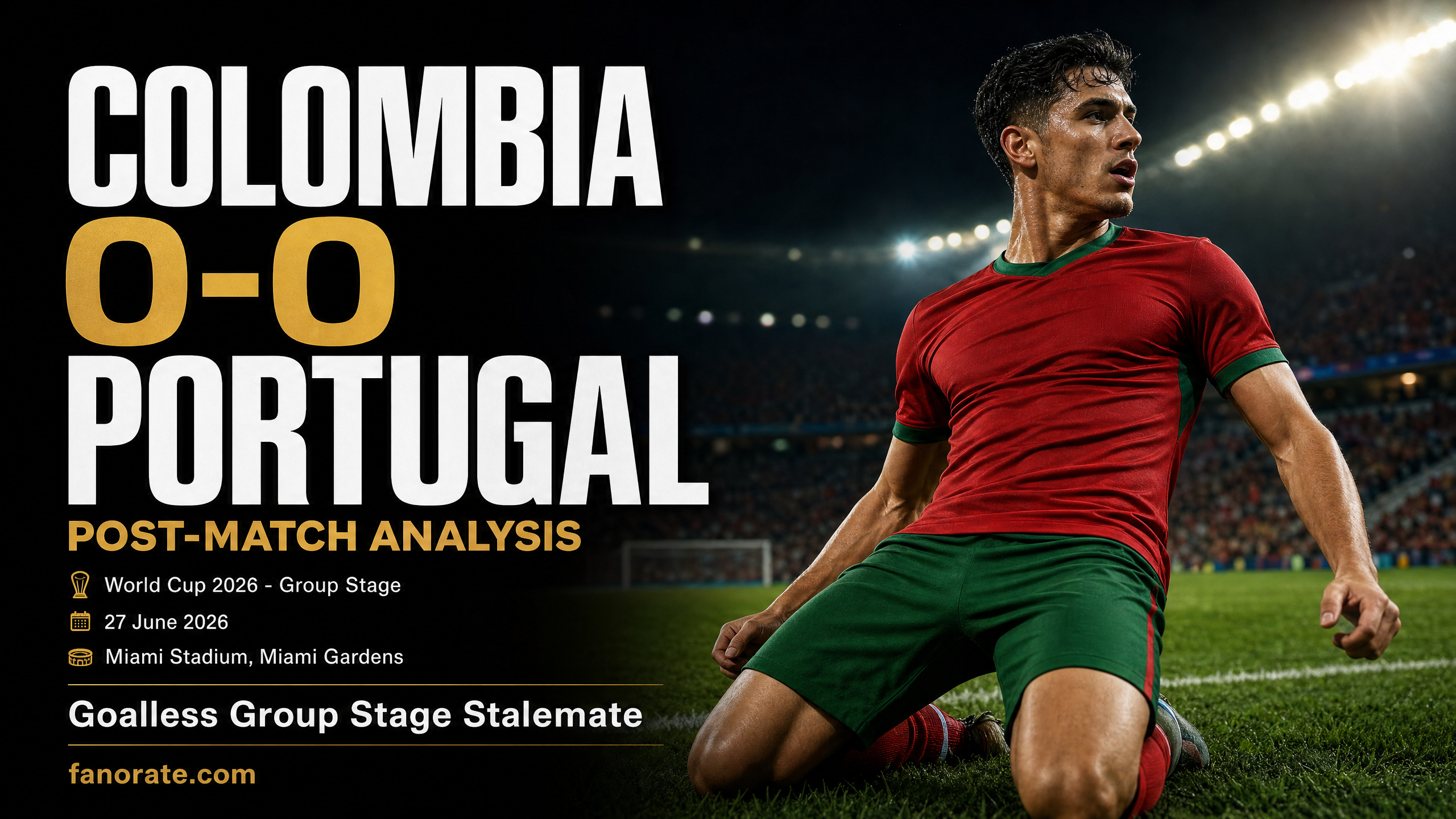
Colombia 0-0 Portugal: Tactical Stalemate in Miami as Group Stage Drama Unfolds | FIFA World Cup 2026
A hard-fought goalless draw at Miami Stadium saw Colombia dominate possession and create the better chances, while Portugal’s disciplined defensive structure frustrated Los Cafeteros throughout a tense World Cup 2026 group stage encounter.
0-0 Draw – FIFA World Cup 2026 Group Stage
What happened
Under clear Florida skies at Miami Stadium, Colombia and Portugal served up a tactically absorbing 0-0 draw in their FIFA World Cup 2026 Group Stage encounter. Colombia were the dominant force on paper — generating 24 shots, 67 dangerous attacks, and creating two big chances — yet found themselves unable to convert their superiority into goals against a resolute Portuguese side that rarely looked threatened despite managing just two shots on target. In a game that flickered with tension but never quite ignited, both teams will feel the weight of two dropped points as the race for Group Stage progression intensifies.
How it was won and lost
Colombia’s Possession-Heavy Dominance Fails to Unlock Portugal
Colombia controlled the tempo throughout, finishing the match with 55% possession, 545 passes at an 89% success rate, and a remarkable 20 key passes — more than double Portugal’s eight. Manager’s setup saw Colombia work the ball patiently through the midfield, creating overloads on the flanks while James Rodríguez pulled strings from deep. However, with 11 shots off target and two big chances missed, Colombia’s final-third execution repeatedly let them down. The volume was there; the clinical edge was not.
Portugal’s Low-Block Defensive Discipline Stifles Los Cafeteros
Portugal’s tactical brief was clear: remain compact, deny space between the lines, and frustrate Colombia’s creative players into low-percentage decisions. With just 45% possession, Roberto Martínez’s side absorbed pressure intelligently, registering 11 interceptions, 8 tackles, and blocking 7 shots. The defensive shape held firm despite Colombia’s 15 shots from inside the box — a testament to Portugal’s organized defensive unit led by Rúben Dias and the central defensive partnership.
Portugal’s Inefficiency in Attack Reveals Missed Opportunity
When Portugal did venture forward, their output was limited. Thirteen total shots, just five from inside the box, and a 91% passing accuracy that suggested possession retention rather than attacking intent. With Cristiano Ronaldo isolated and Bernardo Silva unable to find pockets between Colombia’s defensive lines, Portugal’s attacking threat rarely materialized. Six saves were required from Colombia’s David Ospina, but the quality of those efforts rarely tested him at full stretch. One big chance created and one big chance missed tells the attacking story plainly.
Halftime Adjustments Shift the Game’s Rhythm
Both sides made double substitutions at halftime — Portugal introducing Diogo Dalot for Cancelo and João Neves for Rúben Neves, while Colombia’s changes came at the hour mark with Richard Rios replacing Lerma and Luis Suárez coming on for Córdoba. The freshness in midfield altered the game’s pressing structure. Portugal briefly gained more control through Neves’ energy and Leão’s introduction at the 70th minute brought direct running and width that had previously been absent, creating intermittent danger on the break.
VAR Intrigue and Late Drama Underline the Match’s Tension
A VAR check involving Davinson Sánchez in the 92nd minute added a layer of late drama to what had been a tight but goalless affair. The incident, coming at the death, sent pulses racing around Miami Stadium. Sánchez’s yellow card for Puerta Molano in the 86th minute had already signaled Colombia’s growing nervy frustration in the closing stages. Despite sustained pressure, the scoreline remained unchanged — a result that will be analyzed carefully by both coaching staffs heading into their next fixtures.
Who decided it
James David Rodríguez Rubio
ColombiaThe talismanic Colombia playmaker was the creative heartbeat of Los Cafeteros, orchestrating attacks from deep with his trademark vision and weight of passing. He was withdrawn for Juan Fernando Quintero at the 76th minute, a sign that the staff sought fresh energy to unlock Portugal’s backline in the final quarter.
Rodríguez’s ability to receive under pressure, turn defenders, and thread passes into advanced positions kept Portugal’s defensive block occupied. His involvement in Colombia’s 20 key passes made him the primary architect of offensive build-up, though the final ball into dangerous areas eluded his teammates throughout.
Bernardo Silva
PortugalCarrying Portugal’s most creative burden throughout, Bernardo Silva worked tirelessly between the lines attempting to manufacture opportunities against a physically imposing Colombian defensive unit. His passing accuracy and intelligent movement were the brightest elements of Portugal’s otherwise conservative attacking display.
Silva’s positioning — dropping deep to collect and immediately playing forward — was designed to break Colombia’s midfield press. While he won possession back with intelligent pressing of his own and contributed to Portugal’s 401 successful passes, the link between his creativity and Portugal’s attacking line proved too fragile to produce a decisive moment.
David Ospina Ramírez
ColombiaThe veteran Colombia goalkeeper was largely untested by Portugal’s limited attacking output, recording just two saves in the match. His composure in possession aligned with Colombia’s ball-playing style from the back, and his decision-making during Portugal’s sporadic transitions added authority to a backline that rarely looked severely stretched.
Ospina’s command of his area — including sweeping up behind a high defensive line during Portugal’s second-half moments with Leão — was crucial to maintaining the clean sheet. His calm under late pressure helped Colombia’s defensive unit hold firm through the VAR-fueled stoppage time drama.
Rafael Leão
PortugalIntroduced at the 70th minute as Portugal sought a breakthrough, Leão immediately brought directness and pace that had been missing from Portugal’s forward play. His running in behind Colombia’s fullbacks created the kind of transitional threat Portugal needed, even if he couldn’t conjure a decisive final ball in the time available.
Leão’s width and explosive dribbling — Portugal’s best dribbler on the night with the squad finishing at 56% dribble success rate — opened spaces for Cristiano Ronaldo centrally. While he didn’t manufacture a clear-cut chance, his introduction visibly shifted Colombia’s defensive posture in the final 20 minutes.
Luis Fernando Díaz Marulanda
ColombiaThe Liverpool winger was Colombia’s most dangerous direct threat, combining his electric pace and direct dribbling to consistently unsettle Portugal’s right flank. Operating as the primary wide threat, Díaz’s movement stretched Portugal’s defensive shape and created the majority of Colombia’s most dangerous overload situations.
Díaz’s ability to commit defenders and drive into the penalty area created knock-on effects for Colombia’s central attackers. His contribution to Colombia’s four successful dribbles out of five attempts on that side of the field underlined his importance as a progressive carrier in Colombia’s attacking system.
Where it sits in history
Colombia and Portugal share a World Cup history defined by star power and unpredictability. Portugal, one of European football’s perennial contenders and the nation of Cristiano Ronaldo, have long sought to convert their individual brilliance into tournament success. Colombia, Copa América finalists in recent years, arrive at the 2026 World Cup on home soil in North America with genuine belief that this squad — featuring Díaz, James, and a generation of European-based talents — can go deep in the tournament. A 0-0 draw between two Group Stage sides of this caliber is not merely a point earned; it is a complex negotiation between ambition and pragmatism that both nations must now resolve in their subsequent fixtures.
Inside the ground
Miami Stadium, packed to near capacity in south Florida’s warm evening air, created a vibrant and passionate backdrop for this FIFA World Cup 2026 group encounter. The Colombian support — extraordinarily vocal throughout the 90-plus minutes — filled the stadium with their distinctive yellow, blue, and red colors, delivering the kind of wall-of-sound atmosphere that only South American footballing passion can generate. Portuguese supporters, numerous in a city with deep Latin connections, responded with their own intensity whenever Ronaldo touched the ball. The late VAR decision in stoppage time sent shockwaves through the crowd, a collective gasp that underscored just how much was at stake in every second of this tightly contested Group Stage clash.
Looking ahead
Both nations now face critical decisions as the FIFA World Cup 2026 Group Stage enters its decisive phase. A draw leaves both Colombia and Portugal in a position where nothing less than positive results in their next fixtures will be sufficient to guarantee advancement with comfort. Portugal will need their attacking stars — particularly Cristiano Ronaldo, Bruno Fernandes, and Leão — to find the cutting edge that was absent against Colombia’s organized defensive setup. Colombia, meanwhile, must convert their statistical dominance into actual goals; creating 24 shots and two big chances without scoring is a pattern that top-tier opposition in the knockout stages will exploit ruthlessly. The VAR incident involving Davinson Sánchez also bears watching as potential disciplinary implications emerge.
The bottom line
-
Colombia dominated possession with 55% and fired 24 shots but failed to convert any of their two big chances against Portugal’s disciplined backline.
-
Portugal managed just 13 shots and two on target, relying on defensive solidity rather than attacking intent to secure the goalless draw.
-
Colombia generated 67 dangerous attacks compared to Portugal’s 38, underlining Los Cafeteros’ territorial superiority throughout the match.
-
Halftime double substitutions from both sides — including João Neves and Diogo Dalot for Portugal — reflected tactical urgency from both managers.
-
Rafael Leão’s second-half introduction injected Portugal’s attack with the directness it lacked, though it arrived too late to manufacture a winner.
-
A VAR check on Davinson Sánchez deep into stoppage time provided the match’s most dramatic moment in what was otherwise a carefully controlled affair.
-
Both teams face heightened pressure in their next Group Stage fixtures, with neither side able to rely solely on defensive solidity to advance comfortably.
