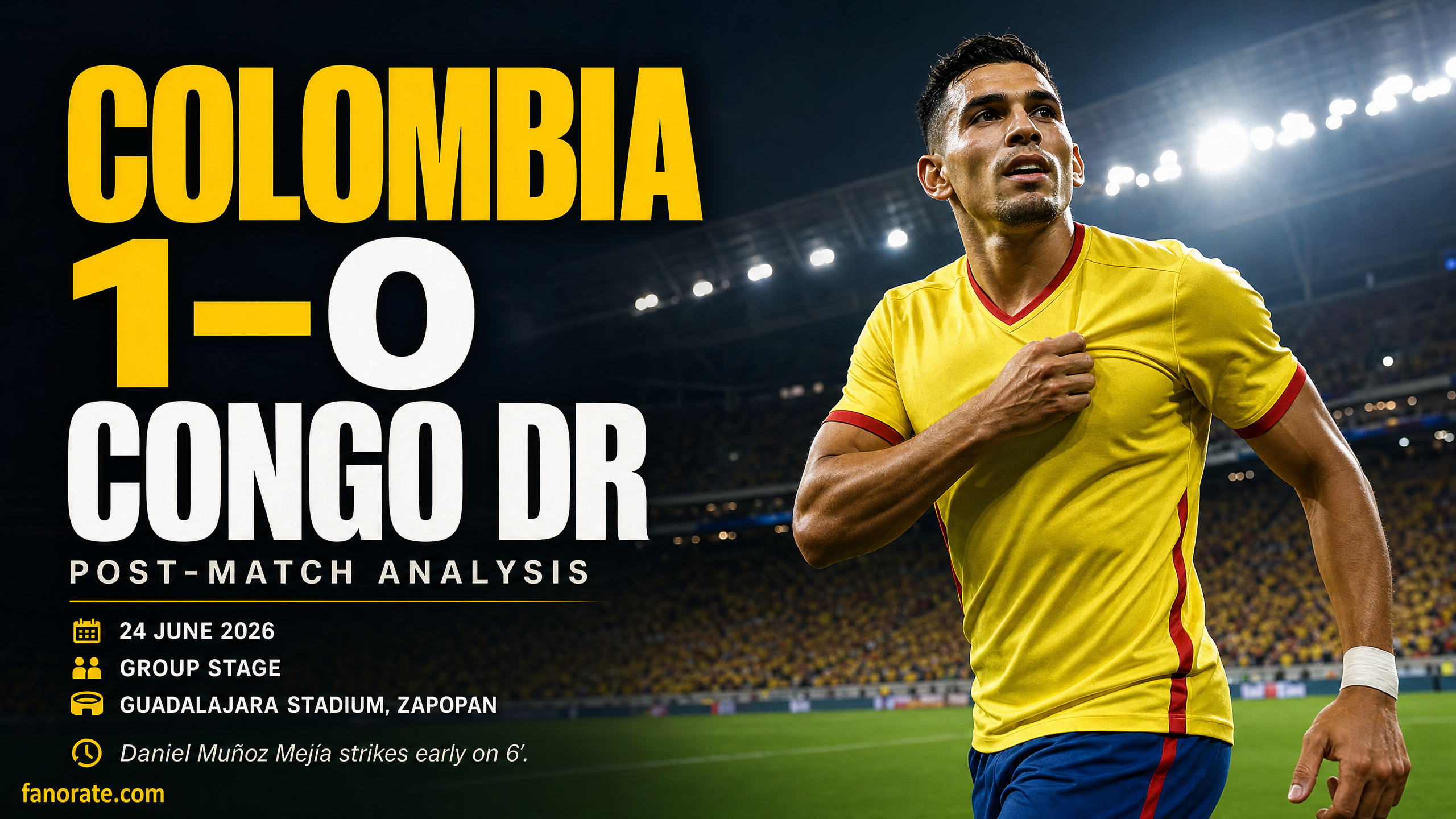
Colombia 1-0 Congo DR: Quintero’s Touch Unlocks the Leopards | FIFA World Cup 2026 Group Stage
A disciplined but laboured Colombia finally cracked a resolute Congo DR side with a 76th-minute Daniel Muñoz strike, assisted by the influential Juan Fernando Quintero shortly after coming off the bench. The 1-0 win at Guadalajara Stadium sends Los Cafeteros through with vital Group Stage points.
What happened
Under the light rain falling over Guadalajara’s 45,664-capacity stadium, Colombia secured a hard-fought 1-0 victory against Congo DR in their FIFA World Cup 2026 Group Stage encounter. It was a match that demanded patience, tactical discipline, and a moment of individual quality to separate two sides who, for long stretches, were locked in a tense tactical stalemate. The breakthrough arrived in the 76th minute when Daniel Muñoz Mejía directed a right-footed finish beyond Lionel Mpasi-Nzau, after being brilliantly found by substitute Juan Fernando Quintero — who had entered the field just 18 minutes earlier replacing the influential but fading James Rodríguez. Colombia controlled possession throughout, completing 538 passes to Congo DR’s 293, while the Leopards showed commendable defensive organisation until that decisive moment. A first-half disallowed goal for Muñoz had already foreshadowed his eventual impact on proceedings.
How it was won and lost
Colombia’s Possession Dominance Failed to Translate Early
Colombia controlled the match’s rhythm almost from the first whistle, registering 88% pass accuracy and completing 473 of 538 attempted passes. They built patiently from the back and moved through midfield lines with purpose, but their attacking third entries too often lacked the final creative spark to truly threaten the Leopards’ back five. Jorge Carrascal and the early version of James Rodríguez probed in the half-spaces but found Congo DR’s defensive shape compact and well-organised, limiting Colombia to speculative efforts in the first period. The xG data tells the story — Colombia’s attacking xG sat at 1.3194 compared to Congo DR’s 0.4509, reflecting decent volume but a quality gap in execution before the winning goal.
The Disallowed Muñoz Goal Set an Early Tone
As early as the 6th minute, Daniel Muñoz thought he had broken the deadlock, only for the goal to be cancelled — likely ruled out for offside or an infringement in the build-up. That moment injected a note of frustration into Colombia’s early dominance and seemed to tighten the game rather than open it up. Congo DR read the warning and retreated deeper, making it harder for Colombia’s width-players, particularly Luis Díaz on the left, to find dangerous pockets.
Congo DR’s Half-Time Substitution Shifted Defensive Structure
Congo DR made a bold tactical substitution at half-time, bringing on Noah Sadiki for Ngal’ayel Mukau, a move that subtly adjusted the Leopards’ midfield coverage and set a more compact mid-block for the second period. Despite not threatening on the scoreboard, Congo DR’s structure was difficult to break — they recorded 19 defensive clearances and blocked 8 shots, illustrating the collective diligence of a side that came to Guadalajara without fear.
Quintero’s Introduction Changed the Game’s Dynamic
The most decisive managerial call of the night came in the 58th minute when Colombia coach replaced James Rodríguez with Juan Fernando Quintero. The move signalled a shift in creative responsibility — where Rodríguez operates in deeper zones with his passing range, Quintero functions closer to the action, pressing higher and driving into spaces between the lines. Within 18 minutes of entering the pitch, his influence was decisive: threading the assist for Muñoz’s winning finish in the 76th minute with the kind of low, incisive delivery that only a player of his technical calibre can produce under pressure.
Right-Flank Combination Proved the Winning Formula
The eventual goal came down Colombia’s right flank, where Muñoz’s overlapping run was the key structural element. Quintero’s ability to operate in the inside-left channel drew attention centrally before releasing Muñoz in space on the right. The Colombian right-back, who also had that disallowed effort in the 6th minute, showed tremendous stamina and timing to convert his second meaningful contribution of the evening. Colombia’s right side finished the match with significantly more attacking output than their left, suggesting a deliberate tactical overload late in the second half.
Congo DR’s Late Discipline Problems Summed Up Their Frustration
As the clock wound down, Congo DR’s growing frustration materialised in Charles Pickel receiving a booking for unsporting behaviour in the 90+3rd minute, followed by a Jefferson Lerma foul in the 90+4th. The final minutes captured the emotional arc of the Leopards’ evening — organised and brave for long stretches, but ultimately undone by a single moment of quality and left with nothing to show for their efforts.
Who decided it
Daniel Muñoz Mejía
ColombiaThe Colombia right-back was the man of the match, bookending the game with two goal-related moments. His 6th-minute finish was chalked off, but he returned in the 76th minute to slot the decisive goal from a right-footed effort, assisted by Quintero. Muñoz was relentless down the right flank throughout, offering both defensive solidity and attacking thrust in equal measure.
His overlapping runs were integral to Colombia’s strategy for breaking Congo DR’s low block. By timing his forward movements to coincide with Quintero’s central drives, Muñoz created the width and depth that ultimately broke the deadlock.
Juan Fernando Quintero Paniagua
ColombiaIntroduced in the 58th minute as a direct replacement for James Rodríguez, Quintero was Colombia’s game-changer. Within 18 minutes of his arrival, he had delivered the assist for the winning goal — a precision pass that cut through Congo DR’s defensive shape and found Muñoz perfectly.
Quintero’s positioning higher up the pitch and his ability to operate between the lines gave Colombia a different attacking dimension. His decisiveness in tight spaces, combined with superior ball velocity on that 76th-minute delivery, was the tactical edge Colombia needed.
James Rodríguez Rubio
ColombiaThe iconic number 10 started and directed Colombia’s build-up play through the first 58 minutes, operating as the creative hub of midfield. While he didn’t produce the decisive moment, his passing range and ability to dictate tempo kept Colombia in control of the match’s structure throughout the first half and into the second.
Rodríguez’s deep-lying creative role allowed Colombia to dominate possession, with the midfield pairing around him offering pressing coverage while he focused on ball progression. His replacement by Quintero was a tactical evolution rather than a criticism — a coach recognising when fresh attacking energy was needed.
Luis Fernando Díaz Marulanda
ColombiaDíaz was Colombia’s most direct attacking threat down the left flank for much of the match, using his pace and dribbling to test Aaron Wan-Bissaka repeatedly. While he didn’t register a direct contribution on the scoresheet, his movement stretching Congo DR’s defensive shape was important in creating the spaces Quintero and Muñoz would ultimately exploit on the right.
His directness forced Congo DR to track back defensively and prevented them from committing bodies forward in the second half, which kept the tactical balance tilted in Colombia’s favour.
Noah Sadiki
Congo DRIntroduced at half-time, Sadiki provided Congo DR’s midfield with extra coverage and energy as the Leopards sought to hold their shape against sustained Colombian pressure. His presence improved their defensive compactness in the early stages of the second half.
The half-time substitution to bring Sadiki on temporarily steadied Congo DR’s defensive structure, suggesting the coaching staff identified a vulnerability in midfield coverage during the first period and acted quickly to address it.
Where it sits in history
Colombia’s appearance at the FIFA World Cup 2026 continues their reputation as one of South America’s most talented yet occasionally underperforming sides on the global stage. The generation featuring James Rodríguez — who famously won the Golden Boot at Brazil 2014 — has long been viewed as one with unfulfilled World Cup potential. This victory against Congo DR, while grinding and far from a statement performance, represents important progress for a squad blending experience with emerging talent. For Congo DR, this World Cup represents a landmark moment — one of Africa’s most historically significant footballing nations returning to the world stage with a squad boasting genuine Premier League and European quality in players like Aaron Wan-Bissaka, Yoane Wissa, Gaël Kakuta, and Cédric Bakambu. A narrow defeat to Colombia is not a disgrace, and the Leopards will take encouragement from the tactical resilience they showed for large portions of this match.
Inside the ground
Guadalajara’s stadium provided an evocative backdrop under the light rain — a venue with strong footballing heritage hosting a tournament charged with the electricity of a genuine continental clash. The Colombian support was loud and unwavering, carrying the kind of carnival energy that South American supporters are renowned for on the world stage. There were groans when Muñoz’s early goal was disallowed, building tension that only intensified as the minutes ticked by without a breakthrough. When the 76th-minute goal finally arrived, the Colombian end erupted — a release of collective anxiety transformed into pure joy. Congo DR supporters, though fewer in number deep in Mexican territory, remained vocal throughout, their songs and drums a reminder that the Leopards carry the pride of an entire continent’s expectations with them.
Looking ahead
Colombia will now look ahead to their next FIFA World Cup 2026 Group Stage fixture needing to build on this narrow victory. The coaching staff will want to see sharper decision-making in the final third and more clinical execution earlier in matches — relying on a single goal in the 76th minute is not a sustainable formula in a tournament where the margins narrow with each round. For Congo DR, the defeat is disappointing but not terminal. Their defensive organisation and squad quality suggest they are capable of producing a result in their next fixture, and the Leopards will need to be more adventurous going forward if they are to stay in World Cup 2026 contention. Both teams will study this performance closely before their next assignments.
The bottom line
-
Colombia claimed a vital 1-0 Group Stage victory over Congo DR at Guadalajara Stadium in the FIFA World Cup 2026.
-
Daniel Muñoz Mejía scored the decisive 76th-minute winner after having a 6th-minute goal disallowed earlier in the match.
-
Substitute Juan Fernando Quintero was the game-changer, providing the match-winning assist just 18 minutes after replacing James Rodríguez.
-
Colombia dominated possession with 538 passes and 88% accuracy compared to Congo DR’s 293 passes and 75% accuracy.
-
Colombia’s xG of 1.3194 reflected their attacking superiority, while Congo DR’s 0.4509 underlined their defensive resilience.
-
Congo DR showed admirable tactical organisation under pressure but lacked the attacking output to threaten David Ospina’s goal seriously.
-
The result carries significant Group Stage implications for both sides as FIFA World Cup 2026 progresses.
-
Charles Pickel’s late booking for unsporting behaviour highlighted Congo DR’s growing frustration in the closing stages.
