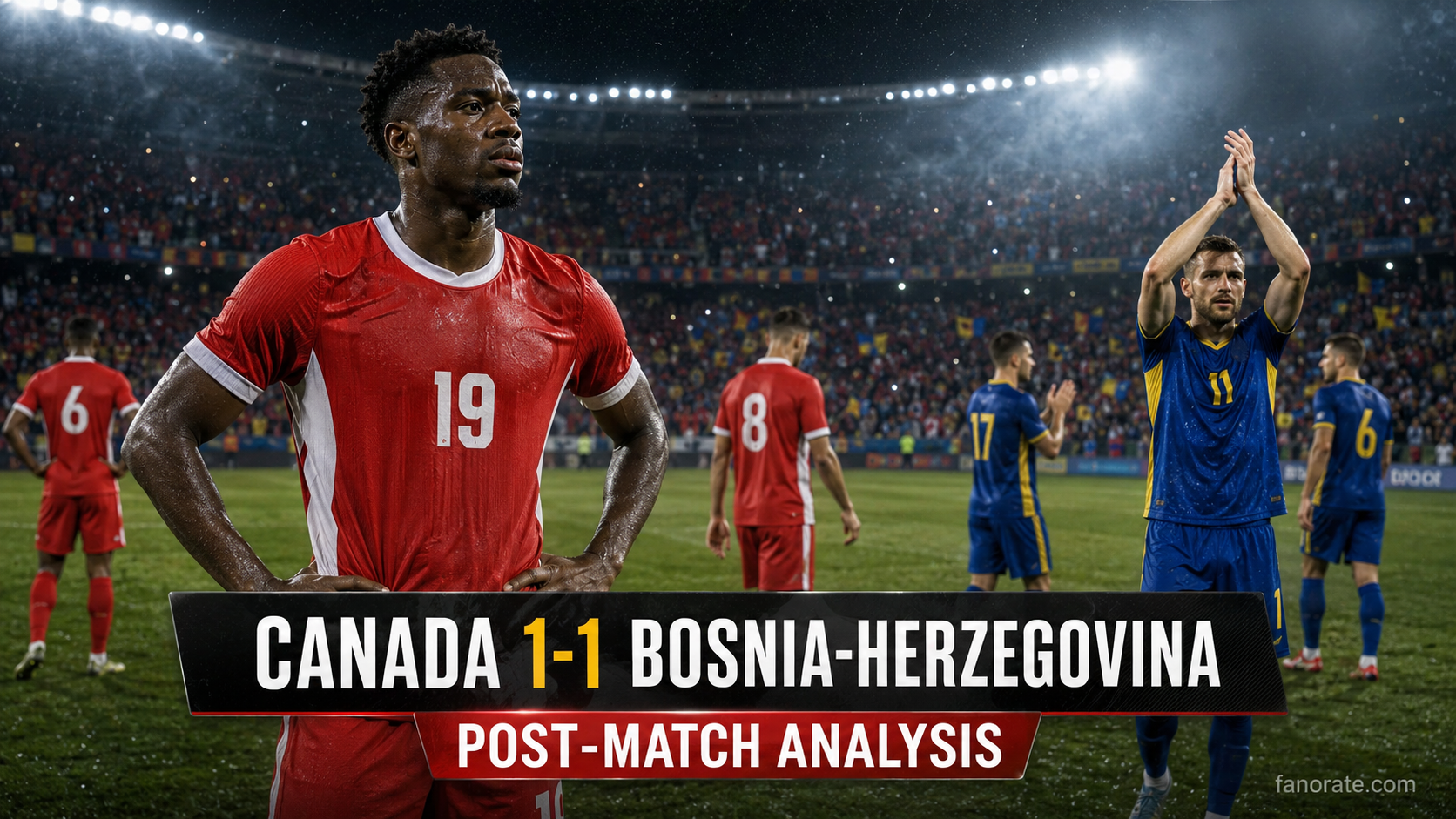
Canada 1-1 Bosnia and Herzegovina: Larin’s Late Strike Earns Hosts a Hard-Fought World Cup Draw | FIFA World Cup 2026
Cyle Larin came off the bench to rescue Canada on home soil, heading in a 78th-minute equalizer to cancel out Jovo Lukić’s early header and earn the co-hosts a 1-1 draw against Bosnia and Herzegovina in their FIFA World Cup 2026 Group Stage opener at Toronto Stadium.
What happened
In front of a passionate Toronto crowd, Canada’s FIFA World Cup 2026 campaign began with both the agony of going behind and the relief of fighting back. Bosnia and Herzegovina struck early through Jovo Lukić’s 21st-minute header, assisted by the experienced Sead Kolašinac, and the Balkans side defended that lead with disciplined structure for much of the second half. But Canada head coach refused to let the occasion slip away. A triple substitution at the hour mark injected fresh energy and direct threat, and it was the arrival of Cyle Larin that ultimately changed the game. The veteran striker latched onto a Promise Akinpelu assist in the 78th minute to fire home with his right foot and send Toronto Stadium into delirium. The point keeps Canada’s World Cup group stage campaign alive, but the hosts will know they needed more from their superior possession and territorial dominance on this historic night.
How it was won and lost
Canada’s Possession Dominance Lacked Final-Third Penetration
Canada controlled the ball with authority throughout the match, registering 417 total passes to Bosnia’s 268 and completing 74% of them compared to Bosnia’s 63%. The hosts also had a significantly higher attacking touch count and more touches in the final third. However, translating that territorial supremacy into clear chances proved elusive in the first half. Bosnia set up in a compact, defensively organized mid-block that denied Canada space between the lines, forcing the home side into wide circulation rather than progressive central penetration. Jonathan David and Liam Millar worked hard to find pockets, but Bosnia’s back four and screening midfield were disciplined in denying through-balls.
Bosnia’s Defensive Block and Clinical Set-Piece Ruthlessness
Bosnia and Herzegovina were content to sit deep and threaten on the counter and from set pieces. Their goal was a perfect execution of this plan — Kolašinac’s delivery from a dead-ball situation found Lukić making a sharp run at the back post, and the header was clinical. Bosnia’s defensive compactness was evident in their foul count and willingness to break up play, with 110 defensive actions recorded. They allowed Canada to have the ball in harmless areas while protecting the central corridors. Their pressing was selective and positional rather than high-intensity, saving energy for the counter-attack.
The Triple Substitution That Changed the Match
Canada’s most decisive moment came not in open play but in the dugout. The simultaneous introduction of Ali Ahmed for Tajon Buchanan, Promise Akinpelu for Jonathan David, and Jacob Shaffelburg for Liam Millar at the 61st minute dramatically changed Canada’s attacking shape and directness. Where the first half was built on patient possession, the second half became more vertical and physical. Akinpelu in particular showed the ability to hold up play and link in tight spaces, and it was his involvement that directly created Larin’s equalizer. The Cyle Larin substitution at the 76th minute was equally significant — within two minutes of arriving, the striker had drawn the game level.
Bosnia’s Midfield Shield and Transition Threat
Bosnia’s central midfield, built around Benjamin Tahirovic and the physical presence of their holding structure, was effective in limiting Canada’s ability to play through the press. Their midfielders consistently closed down Ismael Koné and Stephen Eustáquio quickly after winning the ball, preventing Canada from building rhythm in the second phase. When Bosnia did win possession, they looked dangerous on the transition with Ermedin Demirović leading press-breaks in behind Canada’s high defensive line. Canada’s back four, featuring Alistair Johnston and Joel Waterman, had to be alert to these moments throughout.
Set-Piece Vulnerability Exposed for Canada
Canada’s defensive weakness from set pieces was laid bare in the 21st minute. Bosnia’s delivery quality and movement off the ball was simply better than Canada’s defensive structure could handle. Kolašinac’s assist on the goal highlighted Bosnia’s ability to use their physically powerful players — including the experienced Edin Džeko drawing attention — to create space for runners like Lukić. Canada conceded the corner zone and failed to pick up the run effectively. This is an area the coaching staff will need to address ahead of their remaining group fixtures.
Who decided it
Cyle Larin
CanadaIntroduced as a second-half substitute in the 76th minute, Larin required only two minutes to make his mark. His 78th-minute right-foot finish, assisted by Promise Akinpelu, earned Canada a crucial point on home soil. His movement into the channel and physical presence immediately troubled Bosnia’s tiring defence.
Larin’s introduction added an entirely different dimension to Canada’s attack — a target striker capable of holding the ball, linking play, and finishing under pressure. His goal changed the emotional trajectory of the match and validated Canada’s bold triple substitution strategy.
Jovo Lukić
Bosnia and HerzegovinaLukić was Bosnia’s standout performer, providing the decisive moment of the first half with a well-timed header in the 21st minute, expertly assisted by Kolašinac’s delivery. He was a consistent threat from set pieces and combined defensive resilience with attacking runs throughout the match.
Lukić’s goal was the product of Bosnia’s carefully rehearsed set-piece routine. His ability to time his run and generate power on the header showed a player well-suited to Bosnia’s direct, physical style of play. He was withdrawn at the 62nd minute as part of Bosnia’s tactical reshuffle.
Sead Kolašinac
Bosnia and HerzegovinaThe experienced left-back was a constant presence on Bosnia’s left flank and provided the decisive assist for Lukić’s opener. His delivery from set pieces was a consistent weapon for Bosnia throughout the match, and his defensive positional awareness helped limit Canada’s right-sided attacking threat.
Kolašinac’s delivery quality and experience proved pivotal. His ability to put dangerous balls into threatening areas from dead-ball situations gave Bosnia a repeatable threat that Canada struggled to neutralise, particularly in the first half.
Stephen Eustáquio
CanadaCanada’s midfield engine worked tirelessly in both defensive and offensive phases. Eustáquio consistently looked to progress the ball and was one of Canada’s highest-volume passers, helping maintain the team’s 74% pass accuracy. He remained on the pitch until the dying moments when he was replaced by Jonathan Osorio in stoppage time.
Eustáquio’s ability to carry the ball through Bosnia’s mid-block and find pockets of space was central to Canada’s build-up play. His presence allowed Canada to maintain pressure and recycle possession without losing shape, even when attacking moves broke down.
Promise Akinpelu
CanadaIntroduced in the triple substitution at the 61st minute for Jonathan David, Akinpelu made an immediate impact with his directness and physical play in the second half. He provided the assist for Larin’s equaliser in the 78th minute, demonstrating excellent awareness to lay the ball into the striker’s path.
Akinpelu’s introduction changed Canada’s physical profile in attack. His ability to combine with Larin in tight spaces and drive at the Bosnia defence added a new layer of unpredictability that the visitors had not prepared for, and his assist was the key moment in Canada’s recovery.
Where it sits in history
This match carries enormous historical weight. Canada are co-hosting the FIFA World Cup 2026 alongside the United States and Mexico, marking their most significant tournament involvement since their sole previous World Cup appearance in 1986 in Mexico, where they failed to score a goal or win a match in the group stage. The 2026 edition represents not just a return to football’s greatest stage but a homecoming performance in front of their own nation. A draw in the opening group game, while not the dream start, reflects a Canadian side that has matured significantly since their historic qualification campaign for the 2022 World Cup in Qatar. Bosnia and Herzegovina, meanwhile, are making only their second-ever World Cup appearance, having reached the group stage in Brazil 2014. The Balkan nation continues to build its international football identity, and a hard-fought draw against a co-host nation in front of a vociferous home crowd represents a creditable result.
Inside the ground
Toronto Stadium was an electric cauldron of red and white as Canada’s World Cup 2026 campaign finally kicked off on home soil. The 30,991-capacity ground was filled with passionate Canadian supporters draped in the national colours, creating an atmosphere that blended World Cup grandeur with the raw emotion of a nation experiencing this tournament as a host for the first time in the modern era. When Bosnia took the lead through Lukić’s header, an eerie silence briefly fell over the stadium before the crowd rallied behind their team with renewed determination. The substitutions at the hour mark were met with roars of encouragement, and when Larin’s equalizer hit the net in the 78th minute, the stadium erupted in unbridled joy. A strong contingent of Bosnian supporters added colour and noise throughout, making this a genuine festival of football that showcased Toronto’s multicultural passion for the beautiful game.
Looking ahead
Canada will need to recover quickly and assess their tactical options ahead of their next group stage fixture. The draw means they have one point from their opening game and will need wins or positive results in their remaining matches to advance from the group. Boss will face the pressure of playing on home soil with the expectations of an entire nation behind them. The coaching staff will look to tighten up their set-piece defensive structure and find better ways to convert their dominant possession into clear-cut chances. For Bosnia and Herzegovina, a point away from home against a co-host is a decent foundation, though they will need to be more proactive in future fixtures if they are to advance from the group stage for the first time in their history.
The bottom line
-
Canada dominated possession with 417 passes and 74% accuracy but struggled to break down Bosnia’s compact defensive block in the first half.
-
Jovo Lukić’s 21st-minute header, assisted by Sead Kolašinac, gave Bosnia a deserved lead built on superior set-piece execution.
-
Canada’s triple substitution at the 61st minute proved decisive in shifting the momentum of the match.
-
Cyle Larin came off the bench to score the equalizer in the 78th minute, assisted by Promise Akinpelu.
-
Bosnia’s defensive discipline and mid-block structure frustrated Canada for long periods despite the home side’s territorial advantage.
-
Canada’s vulnerability from set pieces was exposed and represents a tactical concern heading into the rest of the tournament.
-
The 1-1 draw means Canada have one point from their opening FIFA World Cup 2026 Group Stage game on home soil.
-
Bosnia and Herzegovina hold a creditable point from a difficult away fixture against a co-hosting nation.
