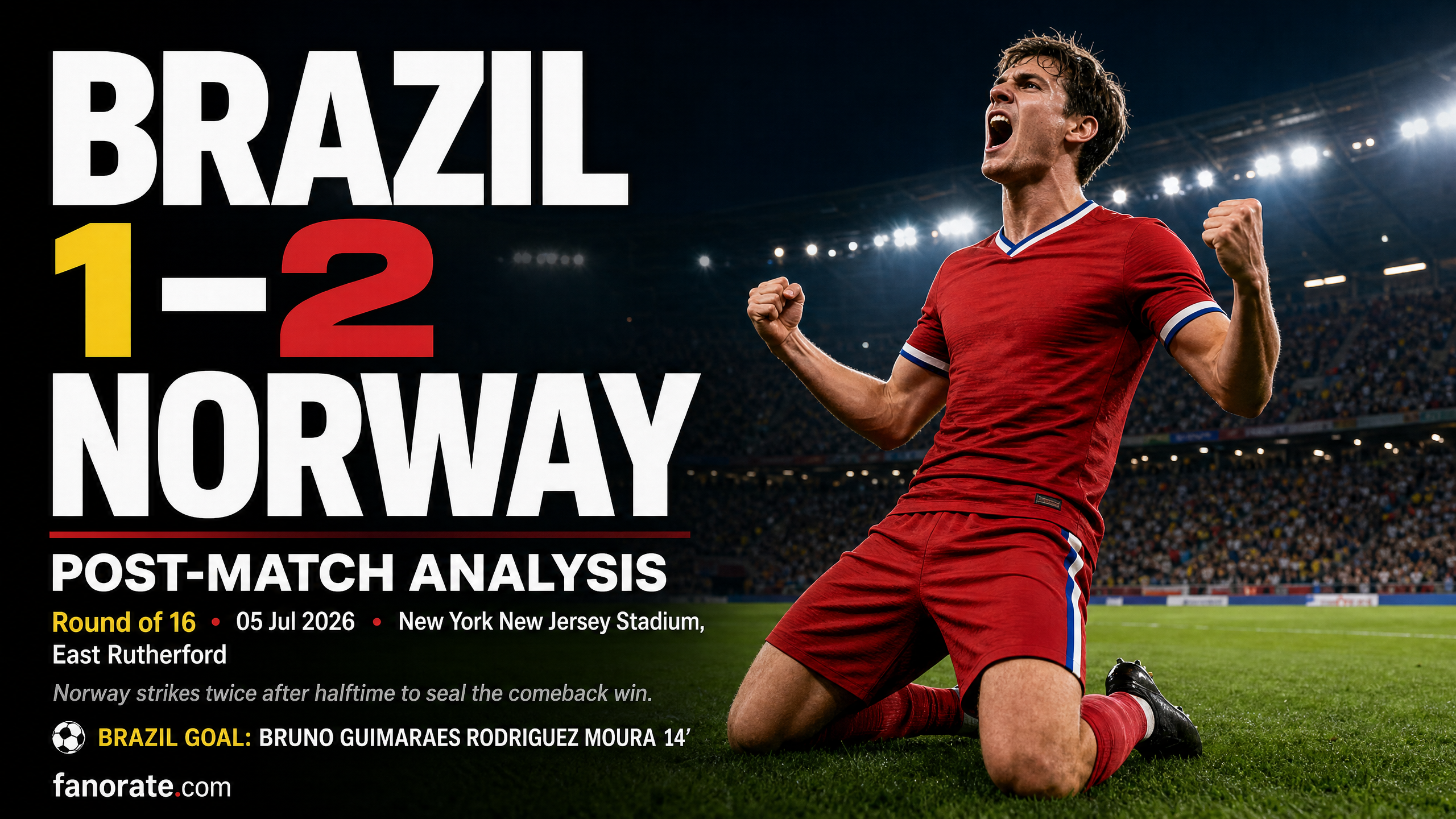
Norway Stun Brazil 2-1 in World Cup Round of 16: Håland Brace Ends Seleção Dream
Erling Håland delivered a devastating late double to send Norway into the World Cup quarter-finals, ending Brazil’s tournament with a 2-1 victory that will resonate for years. A missed Bruno Guimarães penalty in the first half proved catastrophic for the Seleção.
Norway advance to the Quarter-Finals
What happened
Under overcast skies at a packed New York New Jersey Stadium, Norway produced one of the great World Cup upsets of the modern era. Erling Håland, restrained for large stretches of a tense encounter, erupted with two goals in the final ten minutes of regulation to eliminate Brazil and send the Vikings into the quarter-finals of FIFA World Cup 2026. The Seleção, who had dominated the match in terms of shooting volume and big chances created, were ultimately undone by their own wastefulness and a moment of Nordic brilliance that will live long in the memory.
How it was won and lost
Norway’s Suffocating Possession Game Dismantles Brazil’s Structure
Norway’s 67% ball possession was not merely statistical padding — it was a deliberate and disciplined tactical blueprint that suffocated Brazil’s ability to build in their own half. With 677 passes completed at a 91% success rate, Ståle Solbakken’s side moved the ball with patience and purpose, stretching Brazil horizontally and forcing the Seleção into a deep defensive shape. The combination of Sander Berge and Patrick Berg as a double pivot provided constant recycling options, while Martin Ødegaard threaded intelligent lines between the lines. Brazil’s 23 tackles compared to Norway’s 14 illustrated just how reactive the five-time world champions were forced to become.
Brazil’s Clinical Failure: Big Chances Wasted, Penalty Missed
The statistics are damning for Brazil. The Seleção created five big chances and missed four of them — a conversion rate that would have been catastrophic in any context, let alone a World Cup knockout stage. Most symbolically, Bruno Guimarães stepped up to convert a penalty in the 14th minute — and missed. That moment, coming after a VAR review involving Matheus Cunha in the 12th minute, shifted the psychological momentum of the match irrevocably. Brazil hit the woodwork once and managed 14 total shots, but their 33% possession figure meant they were largely operating on the counter, which paradoxically played into Norway’s defensive structure.
Håland’s Movement: The Threat That Always Existed
For much of the match, Norway appeared content to control the game without forcing the issue through Håland. The Manchester City striker — marked tightly by Gabriel Magalhães and Marquinhos — was deliberately isolated for long periods. But Norway’s patient build-up was always loading the gun. When Andreas Schjelderup, a second-half substitute, provided the quality in behind on both of Håland’s goals, it became clear the strategy was calibrated: tire Brazil’s defensive line, stretch the shape in the closing stages, then exploit Håland’s finishing. Both goals came from Schjelderup assists, confirming the pre-planned nature of Norway’s late-game surge.
Brazil’s Substitution Gamble: Neymar’s Return Backfires
With Brazil chasing the game after Håland’s 80th-minute opener, manager’s decision to introduce Neymar at the 68th minute — before the decisive Norwegian goals — was meant to inject creative urgency. Instead, the legendary forward received a yellow card deep into stoppage time and then stepped up to convert a penalty in the 90+9th minute, pulling one back for Brazil. But it was too late. Neymar’s penalty, Brazil’s only goal of the match, arrived as a consolation in a moment that epitomised the Seleção’s evening: technically present, emotionally charged, but ultimately insufficient. The introduction of Endrick in the 58th minute added youthful energy, but Norway had already locked down their defensive transitions.
Norway’s Half-Time Tactical Reset Bears Fruit
Both of Norway’s substitutions at half-time — Oscar Bobb replacing Sørloth and Andreas Schjelderup coming on for Nusa — proved to be the defining moments of the match. Bobb’s directness down the right provided a new dimension of penetration, while Schjelderup’s lateral movement and passing creativity off the left completely changed Norway’s threat profile. Brazil’s defence, which had coped reasonably well in the first half, suddenly found itself unable to track the movement of players who hadn’t been on the pitch in the opening 45. Schjelderup’s two assists underline the transformative impact of Solbakken’s tactical refresh at the break.
Who decided it
Erling Håland
NorwayA performance defined not by volume but by timing. Håland was largely nullified for 79 minutes by Brazil’s physical central defensive pairing, registering limited involvement in open play. But when the moment came, he was clinical. Two goals — both assisted by Schjelderup — in the 80th and 90th minutes to seal a famous victory. His movement for both goals was textbook: intelligent runs beyond the last line, composed finishing under World Cup pressure.
Håland’s role as a constant positional threat kept Brazil’s defensive line pinned deep even when he wasn’t receiving the ball, which created the space for Ødegaard and the wide players to operate. His two late goals were the culmination of a game-long tactical plan executed to near perfection.
Andreas Schjelderup
NorwayArguably the most impactful substitute of the entire tournament so far. Coming off the bench at half-time, Schjelderup assisted both of Håland’s goals and was a constant menace with his driving runs and incisive passing from the left side. His movement pulled Brazil’s right-sided defenders out of position repeatedly in the second half.
Schjelderup’s half-time introduction fundamentally altered the geometry of Norway’s attack. His two assists were not fortunate — they were the product of intelligent positioning and quality decision-making under immense pressure. He is the assist-man of the match and arguably the match-winner without scoring a goal.
Martin Ødegaard
NorwayThe Arsenal captain was the conductor of Norway’s possession symphony. Operating in the number ten role, Ødegaard dictated tempo with 91% pass accuracy across the squad, consistently finding pockets between Brazil’s lines to progress the ball. He won his share of duels and covered exceptional ground defensively when Brazil attempted to counter.
Ødegaard’s press resistance and ability to retain possession under pressure meant Norway never lost control of the game even in periods when Brazil showed their attacking quality. His link-up play kept Norway’s dangerous attacks ticking and created the platform from which the late goals came.
Bruno Guimarães
BrazilThe Newcastle United midfielder had an evening that encapsulated Brazil’s tournament in miniature. Industrious, technically sharp, and influential in Brazil’s build-up — but haunted by a missed penalty in the 14th minute that changed the match’s trajectory. He was later substituted in the 79th minute having given everything, but the memory of that spot-kick will define his World Cup.
Despite the penalty miss, Guimarães was Brazil’s best midfielder on the night in terms of work rate and press resistance. His substitution late on reflected the urgency of the situation, but also robbed Brazil of their most reliable ball-carrier precisely when composure was needed most.
Neymar da Silva Santos Junior
BrazilIntroduced at 68 minutes in a bid to turn the tide, Neymar’s return to the World Cup stage carried enormous emotional weight. He converted a stoppage-time penalty to make it 2-1 and showed flashes of his dribbling brilliance, but a yellow card in the chaos of added time and the inability to create a genuine equaliser left his performance bittersweet at best.
Neymar’s introduction added unpredictability to Brazil’s attacking shape and his set-piece delivery provided moments of threat, but coming on 22 minutes before the decisive Norwegian goal, his impact was ultimately insufficient to alter the result. The penalty conversion may be the last moment of a storied World Cup career.
Where it sits in history
Brazil’s elimination at the Round of 16 by Norway represents a seismic shock in the history of the FIFA World Cup. The five-time world champions have not won the tournament since 2002, and this defeat continues one of football’s most agonising trophy droughts for a dominant footballing nation. Norway, meanwhile, are writing entirely new chapters in their football history. The Scandinavian nation famously beat Brazil 2-1 in a legendary 1998 World Cup group stage match in Marseille — and remarkably, have now replicated that scoreline on football’s biggest knockout stage nearly three decades later. For a country that failed to qualify for multiple tournaments across the intervening years, reaching the World Cup quarter-finals in 2026 is nothing short of a national milestone. Erling Håland’s generation has delivered what previous Norwegian teams could only dream of.
Inside the ground
New York New Jersey Stadium — the largest venue in the United States at 82,500 capacity — was alive with a multi-continental clash of cultures. The Brazilian diaspora in the New York metro area, one of the largest in North America, painted the lower tiers in yellow and green, generating an atmosphere of almost domestic intensity for the Seleção. The Norwegian contingent, smaller in number but extraordinary in voice, grew louder with every passing minute of the second half. When Håland’s first goal hit the net in the 80th minute, the Norwegian end erupted in scenes that will rank among the tournament’s most emotional. By the final whistle, those Norse horns were drowning out the stunned silence of the Brazilian faithful.
Looking ahead
Norway advance to the FIFA World Cup 2026 quarter-finals and will now face one of the tournament’s elite contenders in what promises to be the defining test of their extraordinary run. Solbakken’s side will take enormous confidence from their ability to control possession at the highest level and the devastating late-game threat of Håland with Schjelderup in support. For Brazil, the soul-searching begins immediately. A second consecutive Round of 16 exit raises fundamental questions about the Seleção’s tactical identity, their ability to perform in knockout football, and the future of an ageing squad. Whether this was the final World Cup for Neymar remains to be seen — but the curtain has fallen on another painful chapter in Brazil’s long wait to reclaim football’s ultimate prize.
The bottom line
-
Erling Håland scored twice in the final 11 minutes to eliminate Brazil and send Norway into the World Cup quarter-finals
-
Norway dominated possession with 67% and completed passes at a 91% success rate, completely controlling the match’s tempo
-
Bruno Guimarães’ missed penalty in the 14th minute was a pivotal moment that haunted Brazil throughout the night
-
Andreas Schjelderup’s half-time introduction as a substitute was the tactical masterstroke of the match, providing both assists for Håland
-
Brazil created five big chances and missed four, a conversion failure that proved fatal in a knockout tie
-
Neymar converted a stoppage-time penalty but the consolation goal came too late to change the outcome
-
Norway have now beaten Brazil 2-1 at a World Cup for the second time, mirroring their famous 1998 group stage victory
-
Brazil’s World Cup trophy drought stretches on, with no title since their fifth and last in 2002
